We owe persecuted dissidents around the world our solidarity. But we, like the Iranians, should focus first on the crimes our own government is committing.
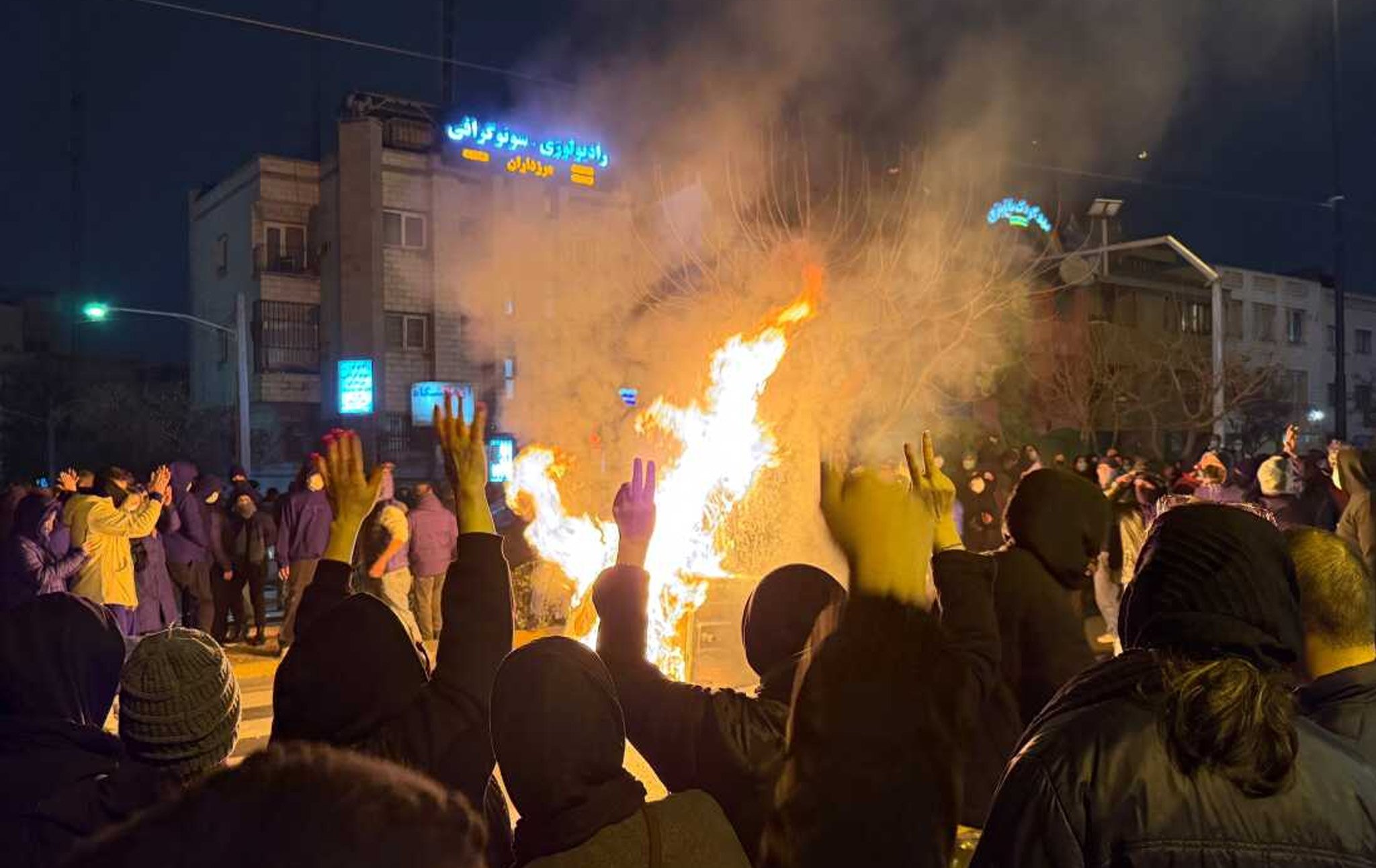
Iran is in the midst of an uprising that has resulted in thousands, perhaps tens of thousands, of people being massacred, and many more people being imprisoned, and plenty blinded or otherwise maimed. In just two days the government may have killed over 10,000 people, although reliable information is difficult to come by, with the government having imposed a virtually complete shutdown of the internet. The Islamic Republic government has responded fiercely, and it seems like the repression is having its intended effect of quelling the protests. Iran’s government has long been brutal—there were over 300 executions in just the first four months of 2024, and the country uses grotesque punishments like flogging and amputation, severely restricts free expression, practices torture, and suppresses the rights of women and LGBTQ people. But this is a new and deadly escalation.
Much is unclear about the Iranian protests. We don’t know how widely supported they are among the population, nor even what the protesters’ ultimate demands are. Some appear to desire a return of the monarchical government of the Pahlavi family. Some simply appear to be angry about the cost of living, with Iran suffering from a major economic crisis (thanks largely to crippling U.S. sanctions) and major water shortages. But the morally correct position on Iran’s protests is not difficult: people resisting authoritarian governments should be supported, and governments should respect the basic human rights of dissenters. The Iranian regime uses familiar propaganda, calling protesters “rioters” and “terrorists.” (As my colleague Alex Skopic found out while reading the Tehran Times, it is striking how similar state propaganda is in our own country to the propaganda of foreign authoritarian governments.) We should always be clear that when governments are shooting dissenters in the street merely for dissenting, we side with the victims rather than the perpetrators.
But some commentators, rather than simply expressing solidarity with Iran’s dissidents, have used the opportunity to bash pro-Palestine protesters in the United States, arguing that if they really cared about the things they say they care about (the killing of innocent people), they would be protesting the Iranian government right now. Piers Morgan, for instance, says it’s “fascinating to observe the almost total silence from loudly pro-Palestinian celebrities [and] media figures re the courageous Iranian protestors risking their lives for freedom and democracy. Suggests their hatred of Israel overrides intellectual honesty and principle.” Ian Bremmer of the Eurasia Group says that U.S. “college activists would gain a little credibility if they were demonstrating against the brutal repression in Iran.” And Gerard Baker of the Wall Street Journal has penned a whole op-ed asking “Where are the student radicals disrupting classes?” for Iran, concluding that “perhaps the reason so many protesters condemn Israel for its legitimate actions and give Iran a pass for its illegitimate ones is that, unlike Israel, Iran isn’t run by Jews.”
Now, let us set aside Baker’s claim that Israel’s actions are legitimate, which ignores the voluminous documentation put out by human rights groups that Israel has been committing a genocide in Gaza. Is there anything to this point, that moral consistency means Western activists should demonstrate for the people of Iran as well as the people of Palestine?
No. This is ridiculous, and we can see immediately how ridiculous it is by posing an analogous version of the question: “Why aren’t the Iranian activists demonstrating against Trump’s ICE raids?” After all, wouldn’t that be morally consistent of them? If they care about authoritarianism, why aren’t they launching anti-Trump demonstrations?
The answer is, of course, that Iranians are quite legitimately concerned primarily with the actions of their own government. One did not ask Soviet dissidents why they weren’t out protesting U.S. involvement in Vietnam. In the Israel-Palestine conflict, our government is involved in perpetrating the atrocities. Ian Bremmer, in speculating why the students don’t act, speculates that while one reason might be antisemitism, another might be that “Israeli actions in Gaza [are] seen as supported by/complicit with U.S. policy.” But they’re not just “seen as” that. They are supported by U.S. policy. We are the leading supplier of arms to Israel. We provide diplomatic support to Israel. We are responsible for what is being done to Palestine. It is being done with our tax dollars. (For background on just how much the U.S. has enabled Israel’s crimes, see the Israel-Palestine chapter of The Myth of American Idealism.) The same thing is true if you’re in the U.K., a less crucial but important facilitator of Israel’s oppression of Palestinians. (See Peter Oborne’s new book Complicit: Britain’s Role in the Destruction of Gaza.) If the U.S. was supporting the Iranian government and supplying it with arms, it would be important for American students to act. But since the U.S. not only does not support Iran, but regularly attacks it with cyberweapons and has been successfully trying to destroy its economy through sanctions, there is not a comparable policy shift that U.S. activists should be pushing for.
What, after all, does Baker think student activists should be demanding when they “disrupt classes” to protest the Iranian government? In the case of Israel, activists can push for an end to Western support for the genocide. The BDS movement has concrete demands (boycott, divestment, sanctions), and there is a plausible theory for how the activists’ actions could in fact shape policy. What is the theory of how a student demonstration in Boston or Chicago is going to aid the Iranian people?

In fact, we must be careful here, because the most likely involvement of the U.S. may be wholly negative. The Trump administration favors the indiscriminate use of violence, and is considering attacking Iran, While the Trump administration's rhetoric is on the side of the Iranian dissidents, one should be under no illusion that Trump actually cares about democracy and human rights. After all, his administration is happy to support authoritarian governments in Saudi Arabia and El Salvador, and after he removed the president of Venezuela, Trump swiftly waved away suggestions that he use his power to transition the country toward greater democracy, keeping most of the regime in place. Trump made it clear that his priority was securing Venezuela’s oil, and that human rights had never mattered at all. If Nicolás Maduro had been a compliant leader who gave the U.S. favorable access to his country’s natural resources and didn’t ostentatiously taunt Trump, he would likely be in power today. The problem with Iran, for Trump, is not that it is a human rights violator (he couldn’t care less), but that it is a geopolitical adversary, and so fomenting chaos in the country is perceived to be in the U.S.’s interest. The U.S. does not care about the well-being of the Iranian people. As Human Rights Watch noted in 2019 during the first Trump administration, “US officials have indicated that the pain US sanctions are causing for ordinary Iranians is intentional, part of a strategy to compel Iranian citizens to demand their autocratic government to ‘change behavior.’” That strategy of strangling Iran appears to be paying off, at the cost of tens of thousands of dead in the streets. It’s part of a brutal U.S. calculus that if it can make Iranians miserable enough they will turn against their government, which will fall in line with U.S. demands.
Governments that abuse human rights should be opposed. But there’s nothing wrong with focusing first on the human rights abuses that your own government is complicit in and over which the population of your country may exercise some level of control. American students are right to focus on American policy. We have to stop our own crimes first.