From Venezuela to Iran, the United States can always find ambitious would-be leaders willing to advocate regime change. But they don’t have their countries’ best interests in mind.
In Bernardo Bertolucci’s 1987 film The Last Emperor, there is a moment where the title character has a chance to return to power. After being banished from his palace for over a decade, Pu Yi, the child emperor of China, is offered a resurrected throne, complete with a dazzling court and an army to back him.
There’s just one catch: the army is the Japanese army, which has made no secret of its rapacious desire for Manchuria’s resources. “Don’t you see that the Japanese are using you?” asks his incredulous bride. But the throne is worth the price. “I must try to use them,” the monarch replies. For the next decade, Pu Yi presides over the destruction of his country.
Client rulers have been a feature of imperialism since Herod the Great, the biblical king of Judea who was propped up by the Roman Empire. But they don’t work quite the way you’d expect. It’s easy to see when the strings are being pulled by a foreign power, but sometimes the would-be leaders can only gain power by leveraging the support of a powerful foreign backer.
The U.S. has had more than its share of marionettes and client allies over the years. As far as I know, the Dalai Lama is no longer on the CIA’s payroll, but there are plenty of others waiting for their turn. You might remember Ahmed Chalabi, the convicted Iraqi bank embezzler who claimed to have “highly credible” intelligence of Saddam Hussein’s weapons program in the early 2000s, and was rewarded with a seat on the country’s interim governing council after the 2003 invasion. Or there was Mahmoud Jibril, the Pittsburgh university professor who became the leader of Libya’s “moderate rebels” during the NATO assault that deposed Qaddafi. Every time the war machine stops for gas, someone wants to hitch a ride.
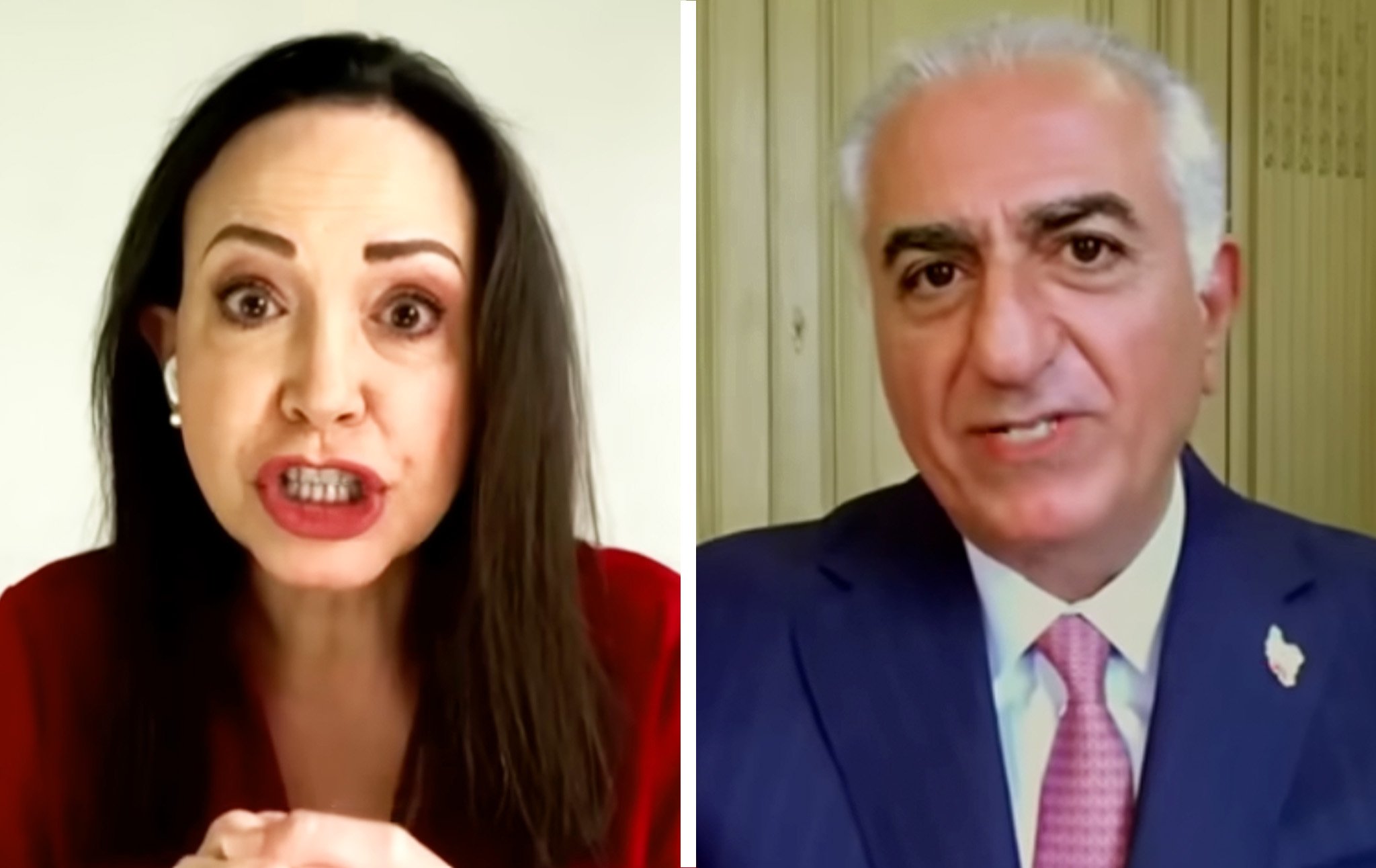
Two of them came into the spotlight this year. Unless you’re tuned in to the Iranian exile community, you might not have known about Reza Pahlavi, the prince of Persia who acts as a celebrity figurehead for the idea of regime change in Iran. Then there’s María Corina Machado, the Venezuelan dissident cheering for American aggression against Venezuela.
We’ll take Machado first, since she is more central to today’s headlines. If you read any of the breathless reports in the U.S. press, you know that she is the celebrated opposition leader who was banned from running for office by Venezuela’s supreme court during the country’s most recent elections. Her origin story is like that of a character in an Ayn Rand novel: she was born to a family of wealthy industrialists, until their mom-and-pop steel empire was senselessly seized by the illiterate masses.
Machado is also the recipient of this year’s Nobel Peace Prize, joining other democratic pacifists like Henry Kissinger, Barack Obama, and Israel’s Shimon Peres. The Prize committee gave the award specifically “for her tireless work promoting democratic rights for the people of Venezuela.”
The committee was wise to specify that she promotes democratic rights for Venezuela, because Machado has not shown the same concern outside her own country. She has also cultivated the support of El Salvador’s Nayib Bukele (whose second term is not exactly, shall we say, constitutional) and Brazil’s Jair Bolsonaro, who is currently in prison for… trying to overturn his country’s democratic elections.
Machado’s commitment to Venezuelan voters might also be less stalwart than the Nobel committee hopes. Her first introduction to presidential politics was in 2002, with an attempted coup against the overwhelmingly popular Hugo Chávez. As the military spirited the president away, the entire Washington establishment—from the State Department to the New York Times Editorial Board—shared a sigh of relief that “Venezuelan democracy is no longer threatened by a would-be dictator.”
One would imagine that kidnapping elected leaders is also a threat to democracy, but that did not occur to the editors at the Times. Nor did it occur to Machado, the “tireless fighter for voting rights.” The day after Chávez was removed, she attended the inauguration of interim president Pedro Carmona, and was one of around 400 signatories to the decree that voided the constitution and dissolved Venezuela’s legislature.
Later—after the Venezuelan people swept Chávez back to power—Machado distanced herself by claiming that she didn’t know what she was actually signing, and believed the decree was a “sign-in sheet” at the presidential palace. This might sound like a poor excuse, but signing things without understanding them is something that Washington looks for when choosing another country’s president.
Today, Machado is selling fabrications that would embarrass Ahmed Chalabi. After raising credible questions about Maduro’s most recent election, she also accused him of rigging the U.S. elections.
In any case, removing the Venezuelan government “isn’t standard interventionism,” she argued in The Wall Street Journal, under the breathtakingly Orwellian title “Overthrowing Maduro Isn’t ‘Regime Change.’” What follows is a familiar list of the benefits we can expect from a liberated Venezuela: overthrowing Maduro will stabilize the region. Venezuela will be our democratic ally. They will greet us as liberators. And if you believe that, I’ve got some yellowcake uranium to sell you.
At this point, it should be obvious that Machado is trying to invite a foreign military intervention, and she knows just how to bait the hook. “Forget about Saudi Arabia,” she told Donald Trump’s son in a podcast episode earlier this year. “We have more oil, I mean, infinite potential.” (She is presumably aware how badly the president regrets not taking Venezuela’s oil in his first term.) “And American companies are in a super strategic position to invest,” she added. She has since moved on to the bizarre claim that Maduro is the head of not one but two drug-running cartels, both smuggling fentanyl—a drug that Venezuela does not produce—into the United States, using boats that cannot possibly reach American shores. Also, the only way to stop them is with an aircraft carrier strike group.
Then there’s Reza Pahlavi, the Persian dauphin who has spent his entire adult life interviewing for a job with no openings. He was already living in the U.S. when his father, Shah Mohammad Reza Pahlavi, fled Iran during its Islamic revolution in 1979. (Lubbock, Texas, to be precise, where the young heir received training as a military pilot from the U.S. Air Force.) He formally declared himself Shah Reza II the following year, after his father’s death. Today he is just referred to as a crown prince; evidently, His Majesty has accepted a demotion.
But many Iranian émigrés wonder why “Pahlavi, the man who would be king, suddenly appears out of nowhere each time there is a crisis in Iran,” wrote Struan Stevenson, coordinator for the Campaign for Iran Change, after the country saw large-scale protests in late 2022 and early 2023. “The fact that millions protesting on the streets of Iran’s towns and cities were chanting ‘Down with the oppressor, be it the Shah or the Sheikh’, seems not to have caught his attention.”
Nowadays, the prince has to strike a delicate balance, angling for power without seeming to want it too much. Officially, he has no preference for a monarchy, but that doesn’t stop him from using royal titles in public. Earlier this year, the National Union for Democracy in Iran, a Washington-based nonprofit closely aligned with Pahlavi, published a transition plan for the “National Uprising.” The 130-page “Emergency Phase Booklet” provides a detailed outline for a three-branch provisional government—none of which actually matters, because everyone involved is chosen or approved by “the Leader of the National Uprising”—Pahlavi himself.
In public, Pahlavi has to condemn the Ayatollah’s regime without reminding people how the Ayatollah took power in the first place. Go too far down memory lane, and you end up at the 1978 Black Friday massacre—when royal security forces fired on hundreds of demonstrators—or the dungeons of the Shah’s secret police, whose interrogation methods included “whipping and beating, electric shocks, the extraction of nails and teeth, boiling water pumped into the rectum, heavy weights hung on the testicles, tying the prisoner to a metal table heated to white heat, inserting a broken bottle into the anus, and rape.”
Pahlavi has commented sparingly on the atrocities committed by his father’s security personnel, or the interrogations-by-rape conducted by the SAVAK secret police. “I have criticized where criticism is due,” he told Der Spiegel last year. (If he has, I haven’t found it.) “However, there was a disproportionate exaggeration of facts, especially by radical Islamists and Marxists.”
This language should sound familiar to anyone unlucky enough to watch Fox News. Reza Pahlavi seems to have finally found a patron in Donald Trump—who has posted about “Mak[ing] Iran Great Again” and asked “why wouldn’t there be a regime change?”—and Benjamin Netanyahu, who has urged Iranians to rise against their government and said publicly that it was time to repay the Persians for freeing the Jews from Babylon. Perhaps there’s a vacancy for the prince after all.
Even before the latest conflict, Israel rolled out the red carpet for the crown prince, and Pahlavi was welcomed in Tel Aviv by the Israeli president and prime minister. “The Crown Prince symbolizes a leadership different from that of the Ayatollah regime,” crowed an official press release, comparing Pahlavi to the biblical Queen Esther of Persia.
That visit “had several clear and strong messages,” according to the Jerusalem Center for Security and Foreign Affairs, a think tank dedicated to enhancing the country’s strength in the Middle East. One of them was “that Israel recognizes Crown Prince Reza Pahlavi as the main leader of Iranian opposition.”
Pahlavi wouldn’t be the first Shah to look for foreign help. Current Affairs readers may already be familiar with Operation Ajax, the British-American plot that overthrew prime minister Mohammad Mosaddegh and slammed the door on Iranian democracy. (The New York Times editorial board was delighted by that operation, saying it provided the less developed countries with “an object lesson in the heavy cost that must be paid by one of their number which goes berserk with fanatical nationalism.”) The bloody counterrevolution that followed became a sort of leftist parable for the consequences of imperial overreach, right up there with the CIA-backed rebels in Afghanistan.
But that gives you no idea how heavily the Pahlavi family depended on foreign patronage. Reza Khan, the crown prince’s grandfather, was handpicked by British officers. They later overthrew him when he got a little too close to his German advisors. The Pahlavis thus have the rare distinction of being a royal family where each generation was put in power by a foreign military. Today, the current crown prince seems to make going on Fox News his full-time job. If he ever does return to power, he might as well invite them to perform his coronation ceremony.
One could be excused for thinking that all of this does not quite make either of these would-be leaders a modern Pu Yi. The “outside agitator” accusation is one of the oldest clichés in politics; authoritarian governments, like authoritarian people, cannot resist blaming their problems on someone else.
But I think the “puppet” label fits a little better when you start asking for military help. In every country I know of, the first thing a new leader must do is swear to protect their subjects. It should be immediately disqualifying for an aspiring leader to invite foreign attacks on the civilians that they are pretending to lead.
That is exactly what Machado and Pahlavi have done. The sharks had not finished eating when Machado praised Trump’s airstrikes on Venezuelan boats, all in international waters and far from the coast of the United States. “Maduro started this war,” she declared, “and President Trump is ending it.” Neither Trump nor Machado furnished any evidence of criminal activity—unless you count the missile strikes on unarmed boats, or the secondary attacks on the survivors, which constitute a war crime even if the people being targeted were “narco-terrorists” the way Trump claims. Even the Houthis respect the international laws of war enough to take prisoners.
Reza Pahlavi has shown a bit more sense than Machado, but he still continued the family tradition. “This isn’t the Iranian people’s war, it’s Ali Khamenei’s war,” he told Fox News in 2024, after Israel bombed the Iranian embassy in Damascus and Iran struck it with missiles in return. He’d maintain that position even after a new wave of Israeli bombs killed over a thousand of his would-be subjects the following year, this time during an attempt to destroy nuclear facilities. One would think at least some of the blame could be saved for the United States—which had abruptly withdrawn from the deal limiting Iran’s nuclear program—or for the country that had launched the surprise attack in the first place.
The prince did not object to Israel’s attacks on Iranian hospitals and broadcasters, and he even spoke favorably about the June 23 airstrike on the notorious Evin Prison, which his father built. “These are things that, in the view of our people, are positive,” he said. “They [the people] know that this is not targeting our country, it is targeting our regime.” Apparently, “the regime” included dozens of transgender inmates at Evin, whose deaths were described by Human Rights Watch as an “apparent war crime.”

There is one more thing that Pahlavi and Machado have in common. Among the details of their transition plans, they have both pledged to sell off their country’s public assets. Pahlavi’s NGO has published several white papers on the urgency of selling the country’s state-owned enterprises.
Machado has been even more direct. “We’re going to kick [out] the government from the oil sector” she told Donald Trump Jr. “We’re going to privatize all our industry. This country, Venezuela, is going to be the brightest opportunity for investment of American companies.” In her transition plan, privatizing the oil and gas industry is listed before voting, freedom of speech, or any of the other political reforms.
And that, ultimately, gets at the heart of the empire-proxy relationship. It doesn’t matter whether the string is pulling the puppet, or if the puppet thinks it’s pulling the string. Either way, the performance is the same.