
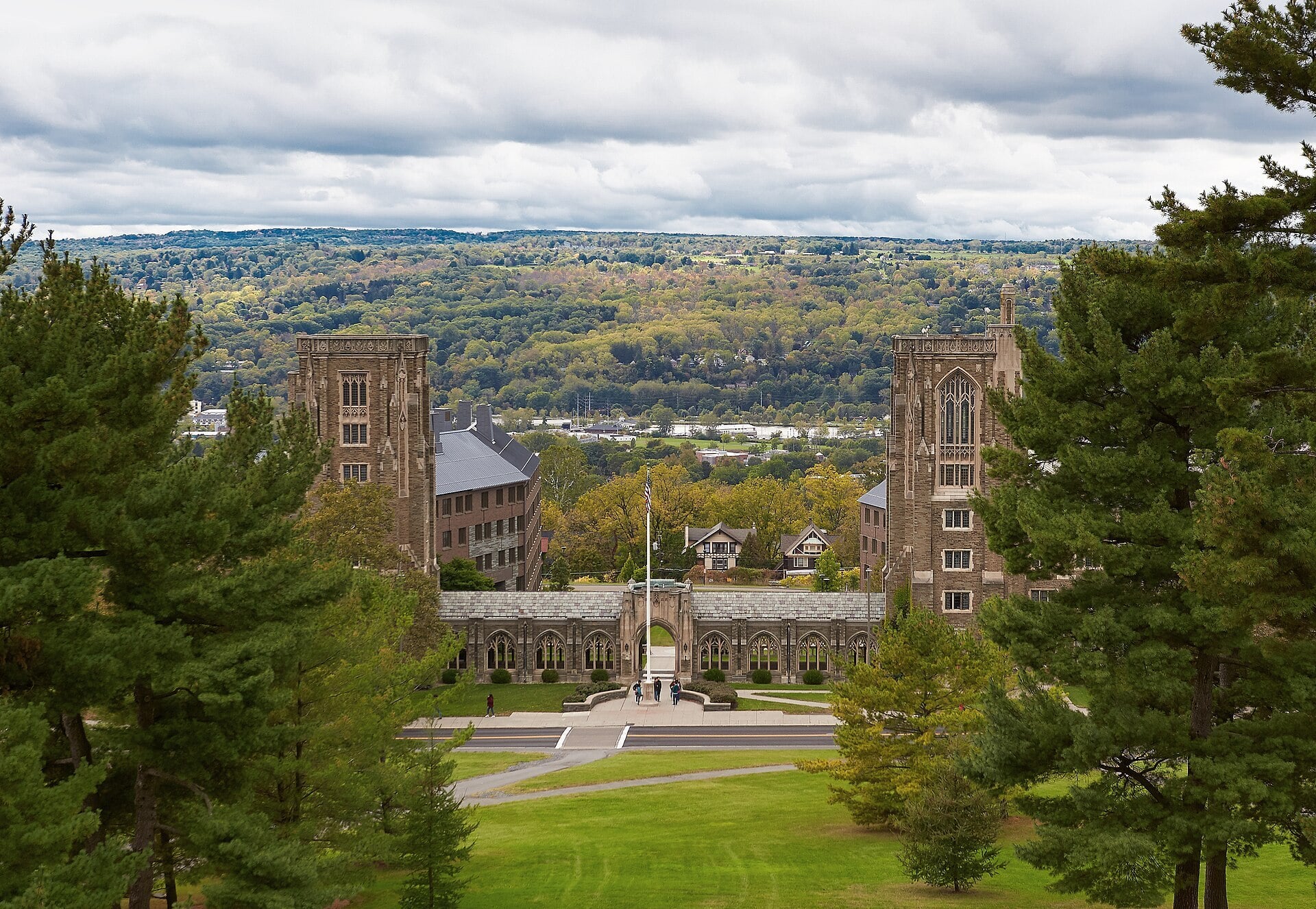
At Cornell, a district attorney dismissed an alleged rape case without ever speaking to Jane Doe—and her story is all too common.
A decade after the Stanford rape trial that saw Brock Turner sentenced to a few months in county jail, a young woman is suing Cornell University and seven fraternity members she says raped her in 2024. The most overtly vile facets of this case have sparked viral, rightful outrage: the men allegedly gang raped Jane Doe for hours after pressuring her to take debilitating drugs, then advertised “free pussy” in their fraternity group chat. Cornell responded by barring the fraternity chapter from campus, then expelling two of the students and suspending the others; Doe’s lawsuit alleges that the male students “were afforded the opportunity to mitigate their conduct by submitting essays.”
The county district attorney, Matthew Van Houten, declined to prosecute any of the men named in the suit (Johnathan Newell, Winston Lee, Gillio Lopes, Diego Sarabia, Scott Norris, and Scott Kretzschmar) in 2024. Van Houten only reopened the case on Monday following significant backlash—and, alarmingly, stated that he hadn’t brought charges because he’d previously, inexplicably interpreted her experience as “voluntary, conscious, and consensual.”
In the 2010s, campus sexual assault was a defining issue that presidential administrations sought to—at least performatively—plant a flag in. Culturally and politically, the issue has been largely abandoned over the last several years—not because it went away, but because the public simply moved on.
Yet, even when the public was paying attention, there was no wide understanding of just how deep the rot within university Title IX offices went: there are alarming, systematic ways that universities are not just protecting but effectively rewarding assailants while punishing and forcing victims out of their schools. The Cornell rape case is the product of a nationwide crisis long swept under the rug—by administrators who are all too eager to do nothing under the guise of neutrality, or the mythology that adjudicating consent is too “complicated.” There is a term for this used by sexual violence experts: orchestrated complexity.
Even in a case as undeniably straightforward as this, a young woman is still being implicitly and explicitly accused of lying and ruining seven young men’s lives—all as her own life is upended and invaded. Anti-rape activists coined the term “the second rape” to describe what victims face upon coming forward. On Tuesday, the independent journalist Michael Tracey called on his hundreds of thousands of followers to identify Doe, and at least one men’s rights influencer claims he has, directing exponentially heightened harassment and death threats. Van Houten, along with Cornell, are increasingly framing Doe’s allegations as inconsistent—because she consensually took some drugs, and consented to some sex acts, but not others.
There is, of course, nothing confusing about any of her account: consent can be withdrawn, or someone can lose the capacity to consent, at any time. Nor is there anything especially confusing about a 20-year-old woman in a fraternity house, semi-conscious after being pressured to take heavy drugs, not wanting to have sexual intercourse with at least seven different men. All while a group chat of frat boys advertised her incapacitated body as “free pussy” and inquired whether the “shop” was “still open.”
The men's own statements are increasingly conflicting and illogical—one acknowledging that parts of the alleged gang rape happened but denying a role in it, and another denying anything happened. Doe also produced contemporaneous text messages from one of the defendants apologizing for “how things went down” and for failing to "shut it down and kick people out before it got way out of hand." Taken together, these responses from the men defy logic but have faced none of the same scrutiny as the victim’s account produced under unthinkable duress. Her fatal flaw, here, is that she is a victim within a culture that requires only victims, not perpetrators, to be perfect, all in the midst of extreme trauma.

From the moment victims report, they are perceived as the actual assailant for trying to “ruin” a young man’s life, requiring a vast range of new privileges and accommodations for their rapist—who is coded as the real victim. This reversal of victim and offender, a common tactic within abusive relationships, is at the heart of our campus sexual assault crisis. In 2016, a woman named Delaney Robinson accused a UNC football player of rape, and later recounted being “treated like a suspect” by investigators, who asked what she’d been wearing, whether she “led” the man on, and about her sexual history; meanwhile, audio recording shows investigators at one point laughing along with her alleged assailant. In 2015, one survivor sued Emerson College, accusing school investigators of pressing her on her sex life after she reported being assaulted. When she became upset, she says investigators told her to “leave the room and come back” when she could “control her emotions,” because: “We can’t do an unbiased investigation if you are emotional.”
One in four female undergraduates report being victimized by sexual assault—an act perpetrated by an estimated one in 10 male college students. Universities suspend just one of every 12,400 students enrolled each year for reported sexual misconduct offenses and expel one in 22,900, USA Today reported in 2022. The organization Know Your IX found 39 percent of student survivors take a leave of absence, transfer, or drop out, as Doe did—the natural outcome of being failed and endangered by their universities, dragged through a grueling, retraumatizing reporting process. Many survivors are forced into a lifetime of student debt for a degree they didn’t receive, as well as medical debt, the cost of defamation lawsuits, legal fees, and loss of employment or opportunities.
When Title IX administrators speak about how they adjudicate these cases, a clear image of how survivors are systematically denied their futures begins to take form: male assailants don't just evade consequences, which would be cruel and harmful enough. They also reap academic and professional benefits, including being allowed to drop classes and improve their transcripts, because universities are so afraid of appearing “biased” that they overcompensate and overwhelmingly favor assailants. Sexual violence researcher Dr. Nicole Bedera published her book On the Wrong Side in 2024, featuring over a dozen case studies in how an unnamed U.S. university adjudicated reported assaults. When I spoke to her about her book in 2024, she told me that within Title IX offices:
“There was this pervasive thinking of, ‘I don’t want people to think I’m unfair to the perpetrator, so I’m going to go above and beyond to treat them better than anybody else,’ so there can be no allegations of bias.”
Should one male student punch another male student, administrators had no problem doling out disciplinary action. Everything changed when the victim was a woman—a phenomenon sociologists call “himpathy.” The only accused student that was removed from a university during Bedera’s observation was a student who threatened to harm the Title IX administrators themselves.
Crucially, if there is even the possibility that an accused student might have thought there was consent at some point in an encounter, the university won’t take action, several Title IX administrators told Bedera. This response—no action—is the conclusion in nearly all cases of reported assaults. Administrators told Bedera they saw this as the “fairest” outcome. But fair for whom? Certainly not for the victims Bedera interviewed who were ultimately forced out of school, while their assailants continue to reap generous academic “accommodations” for the rest of their enrollment.
By nature of being enrolled at university, student assailants don’t fit the socially constructed image of a rapist, administrators said in On the Wrong Side. In the cultural imagination, rapists are exclusively “dangerous” men of color befitting racist, classist stereotypes; rape is portrayed solely as a street-based crime perpetrated by total strangers in dark alleyways—a propagandistic means to justify ever-more investment in policing. (In reality, most acts of sexual violence are committed by people the victims know, in private settings.)
“It was this thinking that, ‘Someone on the campus is not the kind of person who would do this if we admitted them,’” Bedera told me. Title IX administrators she spoke to couldn’t conceive of privileged college students as violent criminals, because they didn’t fit the stereotyped imagery of—as one administrator put it—the “creeper in the bushes.”
Where does this leave us? In response to Cornell’s devastating mishandling of the case, Rep. Carolyn Maloney, a New York Democrat, on Monday said: “It’s time to change the law, allegations of rape should automatically be referred to the police.”
But if anything, the Cornell case underscores why this policy—one that student survivors have rejected for years—would be so harmful. The district attorney first declined to charge any of the male students without ever speaking to Jane Doe, and while he is now taking action, he’s also chiding Doe and her legal team for supposedly not making it clear enough that she was raped two years ago. Yet, importantly, Van Houten isn’t even basing his criticisms on conversations with her—or even reading the transcript of her conversation with campus police, during which we now know she stated: "I can say with 100% confidence I was raped.”
Rather, he is criticizing her based on officers’ summaries of her statements. To apparently not even read Doe’s words is appallingly callous—but to then accept the summaries of police officers who are notoriously unreliable at handling sexual violence cases is inexcusably irresponsible. According to CBS News, “When told Jane Doe had said she was confident she was raped, Van Houten said, 'That wasn't information that I had, first of all. Second of all, that is a legal conclusion.'"
The university, for its own part, is turning the blame for this tragedy on its critics, claiming in a recent statement that criticism of the school’s response “will make survivors feel less safe and supported, and will perpetuate the underreporting of sexual assault.”
Of course survivors rarely turn to police. Victims, as a class, are far more likely to be jailed than their assailants: just three percent of rapists will ever spend a day in jail, while about 90 percent of incarcerated women are survivors, thanks to the sexual assault to prison pipeline. About a quarter of victims who call 911 over a domestic violence incident are arrested or threatened with arrest, and 77 percent of victims who once called the police say they’re too afraid to call them again.

The Cornell case, like nearly every campus sexual assault, illustrates how a confluence of different systems encourage men to commit violence, render women vulnerable to this violence, and from there, set victim and perpetrator on vastly different trajectories—often enabling assailants to ascend the halls of power. Yet in progressive and left-leaning spaces, campus sexual assault is sometimes relegated to a “women’s issue” or, worse, an elitist issue—despite how many victims are low-income and find themselves entrapped in debt as a direct result of their assault. Rape, it should go without saying, is a material issue: sexual violence costs victims more than any other crime.
When college assailants aren’t held accountable, they could (and often do) go on to Congress, the Supreme Court, or anywhere else where powerful men make decisions about women’s lives. They might be elected two-term presidents, and wield their office to write off their alleged victims as too ugly to be rapeable. They might respond to a woman accusing their Supreme Court nominee of assault by saying “it’s a very scary time for young men.”
In reality, while campus sexual assault is by no means a new issue, it’s hardly ever been a scarier time to be a young woman, attending university with male students who are being radicalized and instructed on how to abuse women by the likes of serially accused and criminally charged rapist and human trafficker Andrew Tate, or the alleged rapist Clavicular. In the aftermath of the 2022 defamation trial between Johnny Depp and Amber Heard, which became a viral online sensation among young people, there was a spike in abusers trying to sue their victims for defamation. In at least one case, a man assaulted his victim while calling her “Amber Heard.” I can think of almost nothing more horrifying, right now, than being a young woman and trying to pursue any form of justice against your assailant in this current political and cultural moment.
As the journalist Kat Tenbarge notes, those of us following the Cornell rape case are likely in for a long, crushing journey. One of the accused students, Kretzschmar, denied the allegations while his attorney smugly said they “look forward to confronting the plaintiff in a court of law for her selfishly false claims with both the evidence and her own words.” As Tenbarge put it, this inevitably “means victim-blaming, DARVO, and smears.”
Two years after the alleged gang rape took place, we are only at the beginning of this case that is a microcosm for the epidemic of campus sexual assault and how it continually reproduces itself. This case is inseparable from a broader, horrific context: a system in which male assailants evade accountability and can become president, while survivors are punished for the rest of their lives. Jane Doe’s story is the tip of the iceberg.

%20(1).jpg?width=352&name=Parrots_by_a_nest_in_the_Green-Wood_Cemetery_gate_(61841)%20(1).jpg)