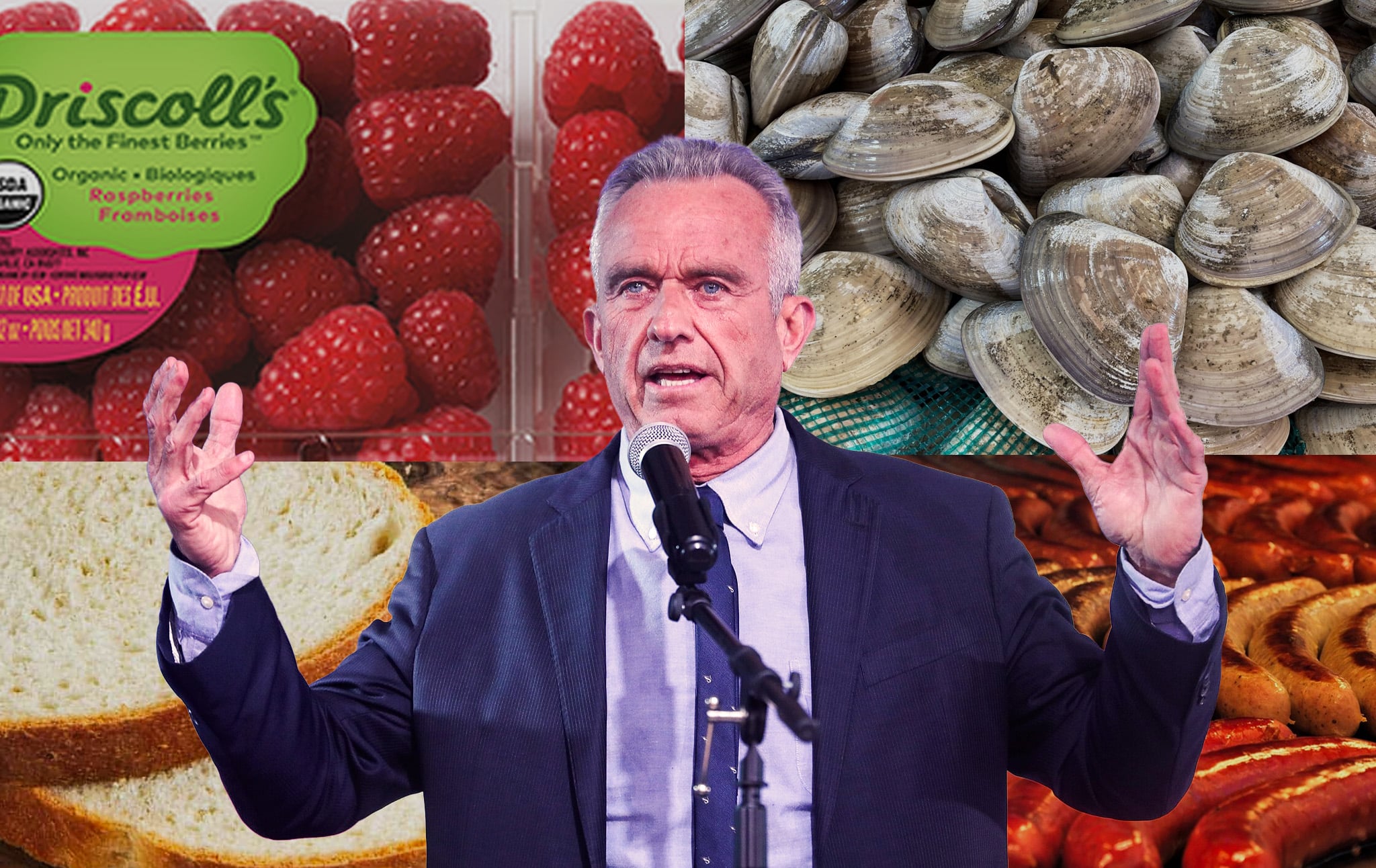
There’s plastic in the sausage, and the clams have hepatitis. A greedy power circle runs our food system, and their push for deregulation is calamitous.
I always feel better about my day when it starts with a smoothie instead of a breakfast sandwich. When it comes to peak writing mode, some whipped-up fruit and oat milk beat out a delicious-but-greasy bacon, egg, and cheese. I usually buy Driscoll’s strawberries. But I recently learned of a class-action lawsuit alleging that their berries are laced with “forever chemicals,” and that children living near Driscoll’s strawberry farms face a 38 percent higher cancer rate because of fumigants they put in the soil. One of the fumigants, Chloropicrin, was once used as a chemical weapon in World War I. I know America wants us to eat, breathe, and sleep war, but damn.
We’re living in a food dystopia developed and sustained by a ghoulish, profit-over-all power circle. The Trump administration’s lust for deregulation has led to mass FDA layoffs, and their warmongering portends more food famine worldwide. Elon Musk cozied up to Trump to attain the power to lay off the FDA employees overseeing his Neuralink venture. That defunding put our food supply in peril, leading to widespread outbreaks and recalls. Earlier this year, we couldn’t even take a bowl of salad for granted. Over 94 percent of Americans are concerned about the frequency of food recalls this year; count me in. Politicians and tech bros are trying to speed us toward a further degradation of Gil Scott Heron’s 1970 vision, where “Whitey’s on the moon,” while death is on the plate, and horror’s on the wall.

For me, pushing 40 means it’s time to eat a little better. And in America, healthier eating means being vigilant about ingredients with too many weird syllables and greens sprayed to hell with pesticides. They tell you to shop on the outer edges of the grocery store to avoid processed foods, but even the produce is compromised. But hey, at least the people making “beef” out of 3D Printers make it look edible, unlike the AI-generated atrocities that restaurants are advertising.
As Lily Sánchez wrote last April, we have to be wary of corporate food, because it’s neither healthy nor good. And neither are our current federal food safety standards. In August, former FDA Director Susan Mayne found that the FDA is on pace for 551 recalls this year, potentially the highest number since 2018. Food safety has become a hot-button midterm issue after Trump eliminated 20 percent of FDA staff and reduced their funding. CBS reports that the CDC once had 11 scientists tracking food parasites, but that number has been whittled down to three. FoodNet, a surveillance program that tracked eight microbes, is now only tracking two.
And Cyclospora, which had everybody scared to eat a salad, wasn’t one of them. The microbe comes from human feces. The risk of explosive diarrhea is the last thing anyone wants to think about at mealtime, but ruminations on infected greens dominated our summer. I thought twice about ordering lunchtime salads before I saw cheat sheets detailing which brands were getting greens from nasty-ass Taylor Farms.
That outbreak, which got over 19,883 Americans sick, exposed how bad our food safety has gotten. This week alone, I read about Ecuadorian clams infected with Hepatitis A, 2,300 pounds of frozen breakfast sausage being laced with plastic shards, more than 167,000 pounds of beef, pork, and goat meat not being properly inspected, and 1.7 million pounds of sugar contaminated with allergens. I suppose nothing restricts your diet like having nothing sterilized to eat.
The volume of recalls isn’t the whole story. It’s the number of people getting sick from them. Teresa Murray, consumer watchdog director for the U.S. Public Interest Research Group, told CBS that “One of the reasons food safety is in the news this year, and people have been rightfully concerned, is the combination of high-profile restaurant names and the absolute colossal number of illnesses[…] It's thousands of people. It makes it more real.”
When the military suffers a loss, the country devotes all sorts of resources and manpower to prevent it from happening again. But Health Secretary Robert F. Kennedy Jr. has done a terrible job of mitigating the recall crisis. Food shipments are still bypassing basic inspection, and he tells us not to fear germs because he sniffed coke off a toilet seat once. No cog of American society is untainted by Trump’s clown show, but it’s by design. Project 2025 was MAGA’s comprehensive deregulation manifesto. Trump and his lackeys are intent on removing as much federal oversight as they can, enriching themselves and their wealthy cronies while fucking everyday people over. The food safety crisis is another example of the administration succeeding at failing us. The FDA was already under-resourced, but Trump’s concentrated negligence made things infinitely worse.
Elon Musk’s Department of Government Efficiency nixed about 20 employees in the office of neurological and physical medicine devices, including those reviewing his Neuralink startup. Deregulation enables his plan to create “brain-computer interfaces” without federal pushback.
Musk is at the scene of the food safety crime, and he’s also a leading culprit in the skin-crawling violations that are AI restaurant flyers. His xAI company is worth over $250 billion. Musk, Dario Amodei of Anthropic, and Sam Altman of OpenAI are the “big 3” of artificial intelligence, speeding nose-up on a miserable race to bring on AI ubiquity.
My jaunts down New York City streets consist of inspecting window posters and sidewalk signs for the telltale signs of generative AI. The economy’s so rough that restaurant owners can’t (or won’t) pay graphic designers or photographers like they used to. Instead, they’re using AI generators to make their food look like nightmare fuel. I’ll never understand the reasoning here. If you can’t process that your poster resembles maggot burgers, how well can I trust your ability to cook? Food advertisements are supposed to trigger your appetite, not trypophobia.
While Musk is looking to turn a profit with xAI (he says they’re on pace to go into the green come 2028), Grok’s user base of entrepreneurs is seeking to save some money with no-cost AI menus (and even all-around branding). But it doesn’t bode well for restaurants to engage in inherent false advertising. When fast food looks uncanny, it reminds me of all the hormones, pesticides, and other carcinogens so much of it is rife with. I think of hearing about azodicarbonamide, a chemical that was used in both Subway bread and rubber yoga mats until 2014, and about Taco Bell mystery meat.

What does the future hold with all these greedy people over-lording our food? Do they even realize how much their warmongering is affecting the global food supply? Nitrogen fertilizer is heavily used worldwide to cultivate corn, wheat, rice, barley, sorghum, sugarcane, and forage crops. Iran’s Strait of Hormuz contains a third of the world’s nitrogen fertilizer supply. The war Trump and Hegseth are waging, totally unprovoked and with no end in sight, is keeping the Strait closed. The gas shortage also affects nitrogen fertilizer. With every day the Iran war persists, the potential for famine increases. But the 1 percent likely doesn’t care; even if the world starves, they won’t.
There are congresspeople trying to enact change. Last December, U.S. Senate Democratic Whip Dick Durbin (D-IL), and U.S. Representative Rosa DeLauro (D-CT), reintroduced the Federal Food Administration Act, a bill to consolidate federal food oversight into one agency and separate food policy from the FDA’s drug and medical device work. DeLauro declared, “We need a single food safety agency to ensure the food Americans eat is safe,” adding “Currently, food safety oversight is scattered across multiple agencies with the bulk of the responsibility falling to the Food and Drug Administration—where food safety has often been treated like a second-class citizen.” They previously introduced the bill in 2024. Even if it gets enacted, it’s worth wondering how MAGA would find a way to ruin it.
Beyond electoral politics, people can do their best to prioritize healthy food sources. As much as I can, I use a service that harvests organic produce directly from farms and delivers it to my home; think an organic Instacart. Farmers' markets sell fresh, untainted produce from the same farms. I realize that not everybody can afford these services, though. New York is doing what it can to accommodate lower-income citizens, with City Harvest trucks bringing produce to food deserts and a state Health Bucks program that gives SNAP users cashback on farmers' market purchases. And there are mutual aid gardens and farms, like The People’s Farm in Oakland, who are taking communal care into their own hands—maybe that’s the best thing for us to do, at this point. But until substantially more of us get on the same page with mutual aid organizing, there won’t be enough groups to feed millions of people in a municipality.
Solving the national food safety issue starts from on high. What does that look like? The easy answer is FDA refunding, but we’re currently dealing with a President who uses his few waking hours to deprive people of their rights. This may be a storm that only clears out with a new, non-MAGA administration and more legislators with backbone, willing to overhaul the entire system.
Andre Gee is a music, culture, and politics writer from Washington, D.C., living in Brooklyn. He currently runs the andre gee newsletter.


%20(1).jpg?width=352&name=Parrots_by_a_nest_in_the_Green-Wood_Cemetery_gate_(61841)%20(1).jpg)