A prolific columnist for New York Magazine, Barkan is literally writing the book on Mamdani. He joined us to discuss the challenges he’ll face in 2026.
Ross barkan is one of today’s most prolific political writers. He’s a columnist for New York magazine, a novelist whose works include Glass Century and the forthcoming Colossus, and the proprietor of the popular Political Currents newsletter on Substack. His nonfiction books include Fascism or Genocide, an analysis of how the Democratic Party’s refusal to distance itself from Israel cost it the 2024 election, and a work in progress on Zohran Mamdani’s unprecedented rise to power in New York City. On the day of Mamdani’s inauguration, he met with Current Affairs associate editor Alex Skopic and News Briefing writer Emily Carmichael to discuss the prospects and dangers that face the new mayor.
Alex Skopic
We’re here with Ross Barkan, someone who knows Zohran Mamdani quite well. He was, I believe, your campaign manager at one point.
Ross Barkan
Correct. I met him at the end of 2017 when I was running for State Senate in New York City, in Brooklyn, where I grew up. I was strongly contemplating pivoting from journalism to running for office.
There’d been another campaign, a city council campaign in my neighborhood, and it was backed by DSA. It was one of their very first post-2016 campaigns, where they had a real volunteer base and real energy. I watched it unfold, and I was very impressed. The campaign was for a Palestinian pastor, so it was a very rare campaign that was pro-Palestine and also not running away from a socialist label. And while he did not win, he was the runner-up against an establishment-backed candidate. The candidate’s name was Khader El-Yateem. I was impressed, and I went to the campaign manager for this campaign and asked, “Who do you recommend from your staff? Who do you think I should hire?” And they gave me two names. One of them was Zohran Mamdani. And at the time, Zohran was a 26-year-old political organizer. He had worked on a few campaigns. He was very well-regarded on the El-Yateem campaign. He was in charge of the canvassing operation and was the third in command of the campaign. He wasn’t first or second, but he was an important third. And we met and got along really well. We aligned politically. I was very impressed by him.
He hasn’t changed so much in terms of his presentation or his ability to command a room. He was always very charismatic, very well spoken, and very serious in his beliefs, and he also always had a sense of humor. And I wanted to hire him. At first, he didn’t commit right away because he was weighing other options. He also wanted to see, since he is a pragmatist, was I going to raise money, or was I a vanity campaign? He’s not interested in a vanity campaign. He didn’t want “the journalist runs for office.” So what does that mean? What is he really trying to do? And I was earnest. It wasn’t a stunt. So I needed to show him I could raise money. And I did. I hit my fundraising goal at the time, which was $50,000, by the first filing period. They have a campaign finance filing period. So I was able to show I’d raised $50,000, and at that point, it got serious. I was able to actually pay him, and he was very excited to work for me.
And I think he was very keen on the campaign because it was an underdog, insurgent campaign. It was a progressive campaign. It was one that was proudly pro-Palestine, certainly—and I was willing to campaign in mosques and court the neighborhood’s Arab community, which few politicians were willing to do. And so for all those reasons, he hopped on board, and the rest, in its own way, was history. We got to know each other quite well that summer. And as candidate and campaign manager, you spend every day together. You spend hours and hours together. We knocked on doors, stood in subway stations, and sat in the office and plotted strategy—all of the above. And I knew even then he would run for office. The question was, what office and when? But it was very clear by 2018. He was ambitious, he’s very capable, and he had all the tools. In politics, that’s most of the battle. But then you also have to be lucky, and you have to have your opportunities. And finally, he found one in 2020 to run for something. But you can ask me other stuff. That’s sort of the basics.

Skopic
Well, and now we’re nine years on from those initial moments. We’ve just come from his inauguration as mayor of New York City. He’s had this incredible rise. Even one year ago, he was polling at 1 percent in the polls. Nobody thought he had a shot. You’ve got a bit of a different perspective because you’ve known him a lot longer than almost everyone. For most of us, we’ve known Mamdani as a national figure for about a year.
Barkan
Yes, or even less, really, since he didn’t even break through until, I’d say, the spring.
Skopic
So I think what many people are wondering is, will this relatively new, untested—as far as national figures go—political figure really be able to deliver, and will he stand by what he ran on without compromise?
Barkan
Well, this is a unique moment for the left, because the left has never even been all that close to assuming executive power like this. The socialist left certainly hasn’t won any governor’s races in a while, or high-profile mayoral races. You have DSA members of state legislatures and city councils and Congress, but in those positions, one doesn’t have to compromise so much because one is ultimately not making the tough decisions. You’re voting in a body, you’re taking tough votes, but no one goes to you if a police officer is shot or the garbage isn’t getting picked up, or test scores in public schools aren’t what they should be. A mayor of any city assumes responsibility for vast amounts of policy and challenges, and now the left is getting a chance to govern.
And I think on his core campaign planks, he’s going to do his best to deliver them. I don’t doubt that. I don’t doubt he’s earnest about universal child care, free buses, and a rent freeze on rent-stabilized apartments. I think the core planks will be the core policy he fights for. Will he be able to satisfy the left all the time? And the answer just is no, just given the nature of the job and the fact that he’s had to, to some degree, moderate even how he speaks about Israel and Palestine. I don’t think his principles have changed, but he can’t quite approach the issue in the same way he used to. But he’s very intelligent and a very subtle thinker. He’s a very hard worker with a lot of energy. And as much as the right wants to caricature him as another unserious, highly educated, wealthy leftist, he, in fact, is someone who has never taken a campaign for granted. He doesn’t take policy achievements for granted, and he will be hyper-focused and disciplined.
The challenge for him is that it’s a huge city. It’s by far the biggest city in America, and there are so many variables that come with the job that no one can prepare for, whether they’re 34 or 54 or they have 20 years of executive experience or none. When you come to City Hall, you’re in charge of one of the great world cities—that has real vulnerabilities. No amount of preparation can be sufficient. So he’ll be learning on the job. But I also think mayors all learn on the job. I think he’s earnest about delivering on his policy goals. I do. I think if he has to pivot and compromise to a degree for the purposes of politics, for the electorate, he’s going to, but I don’t expect him to abandon the core planks in his campaign. That would surprise me.
Skopic
Yes, and there have been a couple of things already, even before he takes power, that parts of the left have really not been happy with. There have been things like retaining Jessica Tisch, the police commissioner, and things like not backing Chi Ossé’s challenge to Hakeem Jeffries. So do you see those things as pretty much a necessary compromise, pretty much acceptable in the circumstances, or how much does any of that worry you?
Barkan
Well, they’re different. I look at the Ossé decision as one that a lot of longtime DSA members felt good about in New York City. I think there’s this divide between the national view and maybe some of the younger members, or those who just want to see more campaigns, and they were very excited and were saying, “Well, of course, Chi Ossé should run against Hakeem Jeffries.” There are a lot of DSA members who looked at him and saw a politician who had joined DSA just a few months ago, who didn’t really have a path to victory, and were not that excited about using up resources for that type of fight. And you could argue Jeffries should be primaried, and that’s a fair argument. The way Zohran thinks, and the way a lot in the DSA think, is, what do we have the capacity to do? This year, there’s going to be a spate of leftist insurgent challengers running. There will be candidates for the state legislature and candidates for Congress. It’s very likely that Zohran is going to get involved in a bloody fight to replace Nydia Velázquez. I believe the way Zohran will approach candidates and endorsements is he’ll endorse DSA candidates. If the DSA organization backs these candidates, he will follow them and support the slate. It would surprise me if he didn’t do that, let’s put it that way. I think that would raise alarm bells if suddenly he stopped endorsing DSA candidates.
Chi Ossé is a little different, because he was not a DSA member and he was not cadre, and I think there’s an aspect to him that some saw as a bit performative. I think some of the criticisms that were lodged at Zohran were not accurate—they could have been lodged at Ossé, also, maybe not accurately. But he’s someone who has a lot of flash, and I think there is a question over substance, and he might have the substance; he might be able to run a hard race. Could he have beaten Hakeem Jeffries? Probably not. So I think that was Zohran’s decision.
Tisch is tricky. I’ve written both arguments. I’ve written arguments for and against Jessica Tisch. I’ve tried to take in the totality and understand why it makes sense and also why it could damage him, quite frankly. I think people who are upset about her are acting reasonably. She’s a conservative Democrat. She is a law and order commissioner, and she has her own power base independent of his, and so the question is, how long will they be able to stay on the same page and stay united? I don’t know. Police commissioners do come and go, so she’s not guaranteed to be there in four years or three years. But she does place him in a challenging position where he is going to have to reckon with their deep ideological disagreements and also reckon with the fact that because she’s so wealthy, she does have a certain invincibility. She’s not invincible, but having that degree of wealth in the political arena can insulate you from a lot. It’s how Bloomberg got to be mayor for 12 years, and if Jessica Tisch decides to spend her family’s fortune on politics, or a mayoral run, she’ll have the cash to do it. She can be formidable. But at the same time, I also understand why he appointed her. You need to soften your rivals and enemies to give yourself breathing room to pursue the core planks of your agenda. So his thinking was, we will keep this right-of-center police commissioner that the business community and many other elite actors want, but in turn, we will be able to keep the focus on affordability and stop the meddling from all these malicious actors or those who seek to harm him. And the feeling about Tisch is she provided a bit of cover. She was a bit of a shield for him.
Skopic
And the counterargument I’ve even seen people make is that potentially, the worst aspects of how she’s run the police so far were not necessarily her own initiative, but were things Eric Adams ordered. How much do you understand, or buy that? Or if you think, because of her family’s background, she’s pretty much—
Barkan
It’s hard to say. She doesn’t have a great incentive to agree with him, other than she’d like to remain police commissioner; that is a dream job of hers. Zohran has argued he’s the mayor and the commissioners listen to him, and that is true. Jessica Tisch has never been known not to be a loyal subordinate. Perhaps Zohran will have new marching orders, and they’ll align, and it’ll work fine. But it carries great risk, and I think that move is much riskier than not backing Chi Ossé or pushing DSA away. I think the pragmatic argument for that was very good. This one has a pragmatic argument as well. But I do think the pitfalls are much greater.
Skopic
Yes, that makes sense. I think, of the two, the Tisch thing is the one I’m more worried about as well.
Barkan
Yes, and the truth is, if she openly defies him or breaks with him politically, she could just leave. Police commissioners depart. This happened with de Blasio and Giuliani. So she could get fed up with it at some point.
Skopic
And talking about moments of crisis, there could be something like a really high-profile police shooting or a terror attack.
Barkan
Those will be the real challenges that you hope he doesn’t have to face. Where, if Jessica Tish is saying one thing about this police-involved killing or one thing about this cop who was killed, and then Zohran is just saying something entirely different, it’s going to be hard to square that. I don’t think he has an answer. I think he’s hoping that she will defer to him as mayor, which is true, but easier said than done.
But I share the left’s concern about Jessica Tisch. I think it’s reasonable to scrutinize what that department is going to do and see whether she becomes a good foot soldier for Zohran or she’s a rogue independent agent, and then that’s where he’s going to have to make a really tough decision. Does he keep her to guarantee a quasi-peace with New York’s business and real estate elites, or does he dump her and invite open warfare, which he already saw in the primary and the general? Now they’ve gone quieter in the new year.
Skopic
They haven’t actually fled the city, as it turns out.
Barkan
No, they’ve not. They’ve not fled the city. They won’t flee the city. They’re very hyperbolic, and they’re not used to not getting their way. What makes Zohran Mamdani so unique is he’s the first mayor of the modern times, certainly, who won without any support at all from finance or real estate. And that’s mostly unheard of. It’s a big deal. Even Bill de Blasio, who fought with Wall Street and was progressive for his era, had a very close relationship with real estate, and developers backed his campaign. And he was very pro-tenant, but he also wanted to build more housing, and he had political allies who were in the real estate world. Of course, Bloomberg was finance personified, and Giuliani was a conservative. And even David Dinkins, who was a longtime creature of the establishment, had long-standing relationships with finance and real estate. So that does make Zohran very unique, and he’s in a position where he’s trying to both achieve his agenda and placate, to some degree, those that could strike him down or try to strike him down. And that’s the balancing act. It’s an excusable balancing act because you want to achieve your agenda, and you don’t want massive Super PAC spending against you for your whole term. And you don’t want a completely vindictive and extremely enraged real estate and finance establishment. As much as you ran against them at the same time, you can’t cater to them too much. And so Jessica Tisch was the olive branch. It really was. Will he decide at some point that the olive branch should be rescinded? We’ll see. I don’t know.
Emily Carmichael
Why do you use the word pragmatic? You were talking about Zohran’s campaign being pragmatic. And then thinking about how there’s a pragmatic angle, is that a lens through which you’re viewing his actions?
Barkan
I think, to some degree, yes, and I think there are different parts to him. He is earnest about his ideology, and he deeply cares about the working class and about the Palestinians in Gaza. He is someone who is driven by his ideals in every way. The reality is, the position of mayor of New York City forces you to confront political realities that you just don’t have to if you’re a legislator or even if you’re a member of Congress. He’s governing eight-and-a-half million people, a city that voted for him in overwhelming numbers but also did not as well. Andrew Cuomo did get 40 percent of the vote. So he’s trying to both stay true to who he is while managing the reality of governing an ideologically diverse city.
And that’s something about New York. Is New York a progressive city? Yes. Is it also a city with a significant MAGA pocket? Yes. Trump got 30 percent of the vote here in 2024. That support has tailed off, but there’s one borough of the five [Staten Island] that is still very pro-Trump. And you’ve got a wide range of Democrats. You have very progressive and leftist Democrats who are growing in number. You’ve got older moderates. It’s a heterogeneous city. So I do think his pragmatism comes into play where he wants to be successful. He wants to manage these coalitions. And listen, on policy, he clearly walked away from at least some of his 2020 positions. He didn’t support defunding the police as a candidate for mayor. He did in the state assembly. You know, that is part of the pragmatism; that is where he saw a policy that was politically harmful and decided that there were better ways to talk about and to approach it, and that’s his department of community safety, where he’s trying to achieve some of the aims one would through defunding without a blanket cut of the department.
Look, he’s got to make a lot of tough decisions, especially around policing. There are many things the NYPD does that people of color and the activist class resent, and he, as mayor, is going to have to weigh all of these concerns: civil liberties, public safety. It’s something every mayor deals with, but he’s in the unique position of being a democratic socialist, and how does that translate into governing? We’re going to find out. That’s the exciting thing. We don’t know. We can guess. I think his antecedent is sewer socialism. He’s talked about that, the Milwaukee mayors who ran the city quite successfully for almost half a century. I think that’s the type of socialism he’s interested in. And there’s an element, too, of good government, which isn’t always thought of as a socialist value but really should be. Are you running an efficient government? Are you running one where it is delivering public goods as it promises to? Are you cutting down on waste and fraud? Legitimate waste and fraud, not just the welfare state. Are you avoiding corruption? We just came off four years of the most corrupt mayor, certainly in the modern era. He’s going to have to run a clean administration, or a reform-oriented administration, one that is based on merit and not patronage, and so that will be part of his agenda too.
Carmichael
Well, it was interesting the way that you were talking about it at the end, how governing is about efficiency.
Barkan
I think those things should matter for the left more. Honestly, I think leftists and socialists—I consider myself a leftist, certainly a socialist at heart—ignore good government. Bernie was very good as mayor of Burlington. I think that’s why Zohran is so drawn to him. It is because Bernie is one of the rare left-wing politicians in America who had to oversee a city. It was a small city, but he had to make decisions around budgets and policing and who works for the administration. And it’s not glamorous, it’s not fun, and it’s not overly interesting to people, but it matters to the working class like you need.
The old socialists understood that. You had corrupt political machines that were rife with patronage and were in many ways inefficient. And that’s something that the Milwaukee socialists were really good at, which was, we say we’re going to do something, and we’re going to do it in a timely manner. And I do think that informs him, and I do think in the left broadly that should just matter more. Yes, it’s not something you necessarily campaign on and excite crowds with, but having an administration free of corruption, having one where people of merit are working there, you’re attracting the best and the brightest. I think that’s an exciting aspect of this administration. He really can hire really good people.
I think, to a degree, he’s doing that already—a few too many de Blasio and Adams people, for my taste. But I think his calculation is that he can, as mayor, shape them and direct them. So I understand that. But yes, I think getting good people into government really does matter, and I think it’s something where a socialist congresswoman or state legislator just doesn’t have to worry about it so much. I’m very cynical. I ran for state senate myself, so I would have been a legislator, but I’m a bit cynical about legislators. I’m a bit cynical about [this idea of], let’s just have another left-wing senator. I think it’s time to get socialists into executive offices, and that’s what’s happened here with Zohran. I think that’s a great opportunity. There’s peril that comes with that too. There could be tremendous failure, and he knows that, but it is also an opportunity.

Skopic
Yes, and I think the parallel between when Bernie was mayor of Burlington is a really good one, because even in today’s speech, he said, Bernie is the person I seek to emulate most.
Barkan
He did, yes, and that was striking. Even with Ocasio-Cortez right there, he made it clear that Bernie Sanders was his North Star.
Skopic
But that also means, in today’s context, Bernie Sanders is the leader of the American left.
Barkan
Yes, he is absolutely.
Skopic
So to an extent, if Zohran really wants to step into those shoes, that also means becoming a leader on a national stage.
Barkan
Oh, yes.
Skopic
I’m wondering how that meshes with his very narrow focus on the needs of New York, or if those will be contradictory.
Barkan
I’ll say, for one, he, right now, is not focused on being a national leader of the left because he has to run New York City. I think Bill de Blasio tried, in a very ham-handed way, to force his way into the national conversation, and then it ended with him going to Iowa to knock doors for Hillary Clinton and then running a very disastrous campaign for president. Zohran can’t run for president, but I do think by being a strong socialist mayor, he will be a de facto leader of the left. He’s still so young; he’s going to have a long political afterlife. And so is there a universe where, after eight successful years, Zohran Mamdani is the celebrated former mayor of New York City, who can go around the country and campaign for candidates and build up DSA and the left? Yes.
I think national leadership and success in that realm will come through New York City. If he’s a bad or mediocre mayor of New York City, he can’t be a national leader of the left. That’s the challenge. That’s the trouble with executive posts. You can do a lot more and help a lot more people, but there’s a lot of risk. It’s higher reward, higher risk. Bernie Sanders and AOC are both tremendously talented and important people, but no one asks about the state of Vermont, what the unemployment rate is there, how much child poverty there is, or what crime is like. It’s just not Bernie Sanders’s responsibility. Ocasio-Cortez too. To a degree, we can look at her district and go, well, have outcomes improved there? But very few people seriously blame a member of Congress for long-term socio- and macroeconomic trends in their district. Members of Congress are judged on their voting records. And there are leftists mad at AOC for how she voted on defensive arms for Israel, but no one is mad at her that—and I’m speculating here. I don’t know these statistics, but I’m saying if the child poverty rate is high in her district or reading scores in the public schools in her district are not high enough—they don’t care. It’s not her job. With being mayor, they sure as hell care.
And Zohran, if he will be a national leader of the left, he must do a great job in New York City. That’s why he’s so focused. Because you can’t just say, “I’m going to be a national leader now,” and go float around. Because if he’s perceived as being inattentive to the city, if he’s perceived as not achieving his promised policy outcomes, there is no left future for him. He’s Brandon Johnson. That’s the cautionary tale. You have Michelle Wu in Boston, who is reelected overwhelmingly. And I think for him, Michelle Wu is a model. He’s talked about Michelle Wu. Brandon Johnson is kind of the alternative. And in Johnson’s defense, Chicago is a tough city to run. Zohran has advantages of being mayor of New York that Chicago does not have, so I’m sympathetic to the hand Johnson was dealt. But the reality is, if you’re perceived as a bad mayor, if you’re an unpopular mayor, there’s no national conversation about the left. His approval rating is very high right now. If he’s underwater in a year from now—and inevitably, his approval rating is going to decline. It’s usually what happens to the mayors. But if it really falls low, there’s not going to be a national role for him, and he knows that, and it’s why I think he’s so focused on not seeming feckless, being deliberate, and sort of trying to build out an administration that is filled with a lot of policy veterans. I think he’s aware of this, that he’s got to meet a certain bare minimum of governance, or it’s not going to work.
Carmichael
Were you there at the inauguration today?
Barkan
Yes, that’s why I’m so cold. I’m usually not a cold person. Yes, I was there the whole time.
Carmichael
What’s your initial reaction?
Barkan
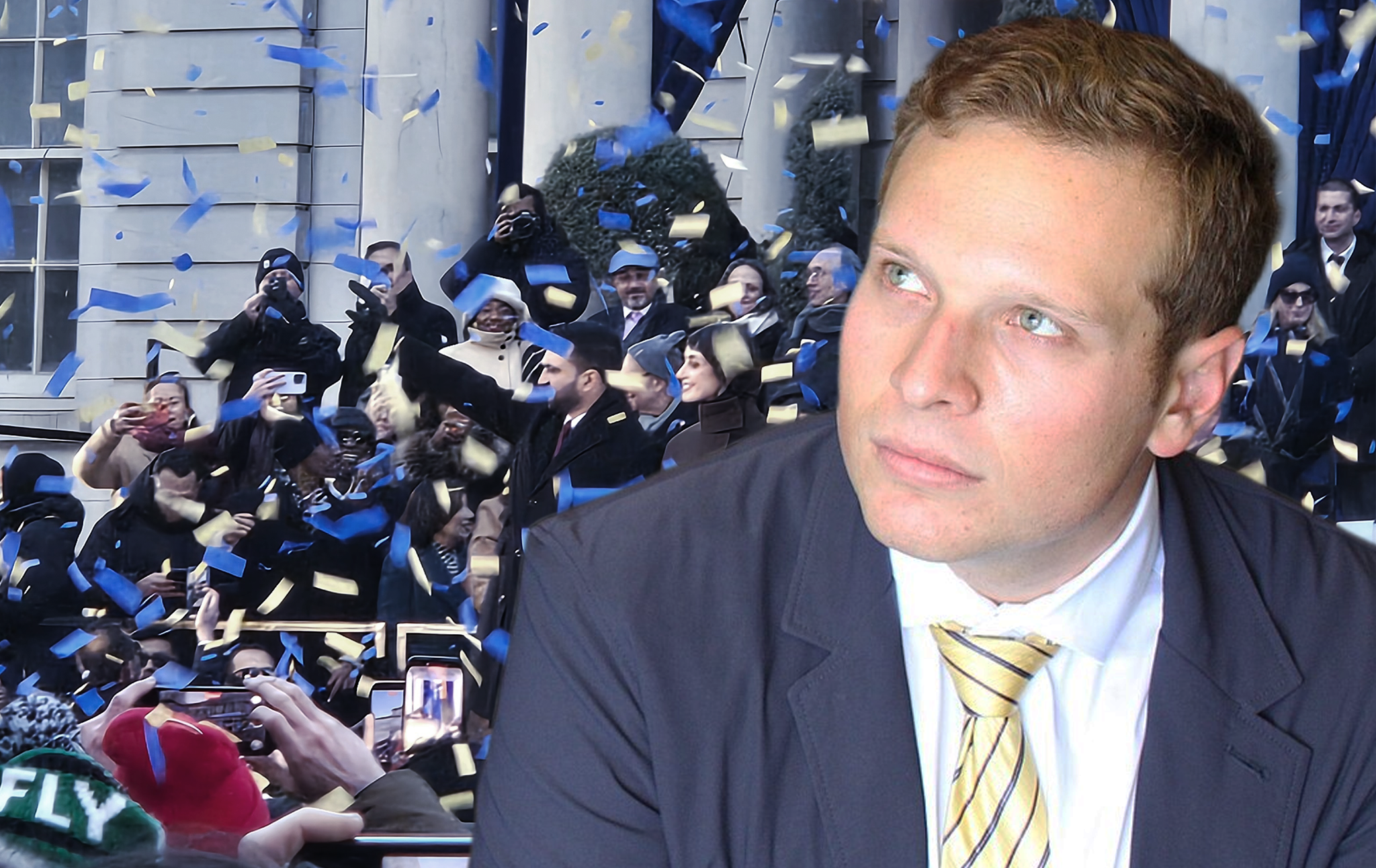
I was struck by his awareness, I’ll say, that there are elements of his base who want to know he’s going to stay true to who he is. So the fact that he said, “I’m going to be a democratic socialist,” and the fact that he talked about Palestinians in Bay Ridge—Bay Ridge is my home neighborhood. That’s where I ran for office. That’s where Zohran spent two years of his life between my campaign and the El-Yateem campaign. So the fact that Palestinians and democratic socialism were mentioned in his speech was very striking—not striking. I would have assumed he would have, but the fact that he went out of his way to do it was important.
The fact that he called Bernie Sanders his guiding light—I’m paraphrasing on that—made it clear he’s interested in Sanders’ style of governing. I think it was a very strong speech. I think what makes him such a compelling figure is he really hearkens to the New York version of populism, which is the halal cart owners and taxi drivers and maids and people really on the margins of society trying to make a go of things. He understands that very well. And he’s got a real populist touch that comes through, and it’s why he’s successful. So I thought it was the type of speech that he needed to give, and it was important for him to make real allusions to his base, and if he gave a whole speech and did not mention democratic socialism, that would have been an issue, and also not mention Palestine. So those two things really matter.
And these inaugurations have a certain script. It’s my second inauguration. I was at de Blasio’s in 2014, and this was much larger in terms of people attending. But there are some similarities too. De Blasio ran as a progressive and promised a new era and a tale of two cities, and in some ways, he did deliver. One challenge for Zohran that all mayors face is there’s so much beyond your control. He can’t just make New York cheaper all of a sudden—he can’t do it—but what he can do is alter policy in such a way as to make life more livable for working-class and middle-class people. He can do that, but he can’t solve these entrenched problems in one year, maybe not even in eight years. But it was a very hopeful inauguration. I think you felt that. And I think you felt that this was the culmination of a really large and fascinating movement.
And I think something Bernie said that was true, and that Zohran, to a degree, echoed, was that you’ve got to stay engaged. One key for Zohran as mayor is he’s got to keep his core supporters, who are very large in number, but also the type who are newer to politics and could become less interested or disillusioned. It’s important to keep them involved and make them feel like they matter in this government. That’s going to be interesting. I don’t quite know how he’ll do that. I have my ideas, but I think it’s going to be very essential for him to not make the mistake Barack Obama made. Beyond Bernie and AOC, the rise of Zohran Mamdani has a lot of parallels to Obama’s rise, down to the fact that they were men with foreign names, descended from Africa—one is Muslim, one was accused of being Muslim—and both faced really vicious racist attacks. Barack Obama arrived with a mass movement behind him, and he did not keep them engaged in any meaningful sense. They came back for his reelection, but they weren’t coming back otherwise. One advantage Zohran has is DSA, and the fact is, will he be a mayor who bolsters the DSA machinery? Will he be a mayor who fundraises for DSA, who backs DSA candidates, and who ensures that DSA remains an arm, to a degree, of his administration? This is how old-world politicians, in a good way, used to govern. I criticized political machines before, but I also think they could be very beneficial. Political machines were democratic. It was about having democratic clubs that actually brought working-class people into politics and made them feel like they belonged, gave them things, and gave them reasons to keep voting. So I think for DSA, now is the time for Zohran to ensure DSA remains strong and his many thousands of volunteers feel a part of the administration and are going to fight for his policies. He’s got to do that. That’ll be interesting to see how he does that. I don’t know.
Carmichael
That was something that really struck me throughout the inauguration, too. It kicked off with AOC saying, we need to turn to the public. What was the quote? Be outside, stay outside.
Barkan
Yes. And a lot of politicians say this, but what makes him unique—really genuinely unique—is he is the only New York City politician I’ve ever seen with a mass following. There’s never been anyone like him. Giuliani, Bloomberg, Adams, de Blasio, Dinkins, you can go back to Koch—nothing like this, where there are just tens of thousands of people who are enthralled by him. He could fill Madison Square Garden tomorrow, if he wanted. It’s a weapon. I was talking before about the pragmatism and having to work with, to a degree, the financial and real estate elites who opposed him. But he can play hardball too. That’s something I’m going to watch and see. Zohran is a very agreeable person. He’s very personable. He wants to meet with you. He wants to understand your point of view. He wants to work with you. He does not hold grudges, and he might have to start holding some grudges. We’ll see. He has leverage too. Now, others have leverage on him. The governor has leverage on him. To a degree, Hakeem Jeffries has leverage on him. He’s got leverage on them as well. Kathy Hochul is running for reelection this year. Zohran commands this base of fervent support. He’s got to wield that.
And I think if he’s smart, he’s going to learn from another guy who he’s not going to invoke in this way, but I will, because I’m not a politician: Donald Trump. Why did Donald Trump keep having rallies? Well, how is Donald Trump able to, through losing a presidential campaign, continue to be so relevant out of office? I think there’s a lesson to be learned there. Trump is the dark version of this, but there’s a light version of Trump—there’s a positive version of Trump, where you can have political rallies, you can bring people into the mix. The Trump voter throughout 2021-24 felt a part of it still. And I feel like Bernie does that with his Fighting Oligarchy tours. But Bernie, of course, will not be president. He’s not going to run for president or be president, and Zohran is now mayor. So, if I were Zohran, I would think about continuing to have rallies and continuing to have ways to keep people feeling like they’re part of this movement and not put it to bed in the way Obama did. I’m not saying Obama didn’t have rallies, but there was a real feeling that Obama won; there was this great level of excitement, and there wasn’t really any party building behind it. There wasn’t any sense of, okay, now, what do we do? And I think for Zohran, it’s going to be very important to not make that mistake.
Skopic
No, but the Trump thing is fascinating. There are a lot of similarities between them.
Barkan
Yes, anti-establishment outsiders who subverted their party establishments, and maybe will take them over. Trump took over his. Zohran has not taken over the Democratic establishment. But that could be a goal of his.
Skopic
Well, and we all just saw their first big meeting together, Trump and Zohran. Shockingly, to some.
Barkan
Yes, even to me. So people thought it would be a disaster, and I thought it would go better than people thought. Knowing him, I thought he’d do well. I didn’t expect it to be that friendly. That tableau surprised me too.
Skopic
And it seems like Zohran’s strategy there is basically the charm offensive: to find the certain points where he and Trump might overlap, and emphasize those, and emphasize where he’s willing to cooperate and not necessarily confront him directly. That seems to have worked.
Barkan
Yes, for now.
Skopic
Down the track, when there are moments of real conflict, how far can that get?

Barkan
Look, there will be limits. I think if Trump dispatches the National Guard to New York City, which I used to think was inevitable—now I’m not sure if it’s inevitable anymore. I really thought, and I wrote this last year, that it was almost a fait accompli that at some point there’s going to be a very performative but stressful National Guard presence in New York City. I’m not sure anymore, but if ICE ramps up efforts in New York City, which, to a degree, it has—if that continues at far greater numbers, yes, there are limits to charm. I do think for Zohran there are a few parts to dealing with Trump. I think he’s learned a bit from the few Democratic governors who’ve managed to both battle with Trump and work with him. One person who doesn’t really get credit for it, but I do think has done a decent job, is Kathy Hochul, the New York governor who is not pro-Trump by any means and has criticized him relentlessly, but she’s on the phone with him a lot. And, for example, with congestion pricing, she’s really held off the Trump administration from coming in and trying to kill this program, even illegally.
I think what Democrats have learned with Trump now, after a decade, is that not engaging is a bad idea. You have to engage. The no-engagement strategy is not practical in any real way. You can feel good doing it—you can feel better about yourself. “I don’t talk to fascists. I don’t mix with that.” But the reality is, when you’re responsible for a state or a city, if he’s the president, you have to talk to him, and I do think that’s something that the Democrats have started to learn. But that doesn’t mean you just roll over for him. It’s kind of this balancing act. I think, in a strange way, there’s a part of him that respects those who punch back a little because he likes a fight. He senses weakness. He’s very good at that. And honestly, with Zohran, I do think the reason they got along wasn’t that Zohran had these magic words that made Trump smile. It’s because Trump recognized another celebrity, another politician who commanded his own mass following, and someone who’s great on television and is also great in person.
I think that these factors, some shallow and some not, all worked to Zohran’s benefit, and I think there’s a part of Trump that respects how he won. Trump even said it: you were nowhere in the polls, and you rose up out of nowhere; I never heard of you. To him, that’s more interesting than Chuck Schumer’s career or Hakeem Jeffries’ career. He has real disdain for establishment Democrats. Remember, these are the people he’s known for decades and he’s dealt with. Trump was basically, for a period of his life, an establishment Democrat. As he himself said, which was true, “I cut checks for these people, and then they did what I wanted.” It was one of his very honest moments. Trump is a liar who can be, in his own way, frank. And so he gets these people. He hates these people in the same way he hates establishment Republicans too—the Mitt Romneys of the world. He has great disdain for—
Skopic
Little Marco.
Barkan
Yes, and then Little Marco, he’s brought into the fold now. And it seems like Marco Rubio, through many years of effort, has now charmed him or just kind of won his respect. But generally speaking, for all the ways Andrew Cuomo attacked Zohran as someone who could never deal with Trump, if Andrew Cuomo walked into the White House, I don’t think Trump would feel particularly warm toward Andrew Cuomo. Again, this is someone he’s known for many decades. He knew his father, and establishment Democrats are not charming or interesting to him. He likes stars. He likes celebrities. He likes people who can kind of sit in that rarefied world of being a mass celebrity. Trump always wanted to be a mass celebrity. He became one through the presidency and, to a degree, through his prior life. And I think Zohran is very charming, but I do think that a lot of that is just having charisma, being someone with a mass following who subverted the party establishment. I think all these things Trump likes. I really do.
Carmichael
Something that we’ve both been thinking about is, how do we help the readers of Current Affairs understand Zohran’s actions and whether he’s coming through? What are the green flags, versus red flags?
Barkan
Yes, I think the green flags are, is he working towards delivering on the core policy planks? Is what he’s doing in these first few months geared toward trying to freeze the rent, trying to secure funding for universal childcare, or trying to get state funding to make buses free? Is he working toward these goals? If he’s earnestly working toward these goals, I don’t think it’s fair to criticize him. If he’s truly giving his best effort to get there—because it’s going to be hard to get there. He can’t snap his fingers and make all this happen. And there are a lot of factors beyond his control—political factors, in particular. He has to work with the state legislature and the governor, for starters. So I think for anyone on the left, if you see him trying very hard, organizing in such a way, that’s good. If he were not working towards these goals, that’s bad.
I would say as a socialist, I look at who he is going to endorse in these spring primaries. Will Zohran endorse every candidate DSA also endorses? That’s a green flag if he does. If he refuses to endorse a candidate that DSA is backing, to me, that’s a red flag. That’s something AOC did, because AOC was not really cadre DSA. Now, you might remember there was a socialist candidate for state assembly in 2020 who was backed by DSA, not AOC. Do you remember who that candidate was?
Carmichael
Was it Zohran?
Barkan
Yes, it was Zohran Mamdani. And she endorsed other DSA members and not him.
So, to me, the endorsements will be very interesting. That’s why with Chi Ossé, I gave him a pass—and I argued with Briahna Joy Gray about this. And she made some good points about pressuring Hakeem Jeffries, but the reality is, he’s got an agenda he’s got to get done in New York City and in Albany, and antagonizing the future Speaker of the House, who’s also a close ally of the governor, is high-risk, and the rewards aren’t that great. And also, he influenced the DSA vote. But even if he was hands-off with the DSA vote, at best, Chi Ossé would have squeezed out a 50/50 endorsement. And also, from what I understood, the higher level of New York City DSA didn’t want to back Chi Ossé, so they might have killed it anyway. So I think, will Zohran follow the lead of DSA? Green flag, yes. Red flag, no.
I think he is being committed to his ideals in the movement when, in the spring, once DSA has its full slate of endorsers, he supports each and every one of these people. He’s done a few so far, like he’s supporting the DSA candidate for his old assembly seat. He’s doing that. He appears ready to support the DSA candidate for Nydia Velázquez’s seat, and that’s going to be a really big fight. That’s where Briahna and I disagree. I respect Briahna a lot. I’m not criticizing her. I think she’s great, but it’s where some of the national progressives don’t quite get the dynamics of [New York City] all that well, because you can’t be fighting Hakeem Jeffries and trying to fill Nydia Velázquez’s seat. That’s hard to do, especially when there’s a very strong candidate—a progressive, non-DSA candidate running already in that seat. So they’re going to have to beat the guy who’s the current Brooklyn Borough President, who is in many ways a fine candidate. He’s just not DSA. That’s a hard fight. So if Zohran is putting his muscle behind the DSA candidate there and supporting this slate for state legislature, that’s green. That’s good.
I would say policing will be very interesting, and it’s complicated for him. In some ways we don’t know yet. Tragically, what might test him is if there’s a shooting of an unarmed civilian, and Jessica Tisch feels one way—does Jessica Tisch say something publicly that he disagrees with, or does he even move to dismiss her if she is bucking his agenda? I think how he talks about criminal justice in public and what he does with the NYPD will be very fascinating. I think there are two paths right now. There’s the path that he’s calculating where Jessica Tisch is a smart bureaucrat who is going to take orders—if he’s able to accomplish that, that’s a green flag. It’s a red flag if Jessica Tisch is behaving, quite frankly, like a lot of prior police commissioners and acting as kind of a quasi-mayor—monarch of the NYPD fiefdom. It is fairly unaccountable, and if Zohran kind of leaves her be—not the best. So that dynamic, I think, is worth watching very closely.
That’s something that I understand why the left is concerned about. And there are others. I, personally, would not have promised to arrest Netanyahu. I say this as someone who is Jewish and anti-Israel. I would not describe myself as a Zionist. I’ve written very extensively about my own—I wouldn’t call it disillusionment with Israel. I never had illusions about it. I’m not one of these “What has Israel done?” [people]. I knew it was a contradiction, in many ways a moral failure, from the time I was a teenager. So none of this surprised me. That all being said, I would not have promised to arrest Netanyahu because it’s just practically incredibly difficult, and I don’t know how he can fulfill that promise with Jessica Tisch as police commissioner. I have no idea. If Netanyahu, who is a Trump-like performance artist who is also flailing around in Israel right now and will probably lose his next election, decides that he’s going to travel to New York just to travel to New York, and he dares Zohran to dispatch NYPD officers to arrest him, I genuinely don’t know how it’s going to go, and I don’t know if Jessica Tish is going to follow through. That could be a flashpoint. He says, “You must send officers to arrest this man.” She says, “As a Zionist, a proud Jew, I will not do it.” Also, that’s a red flag/green flag situation. Does he accept that she won’t do it and kind of walk away from that promise?
And he’s already walked away from certain campaign promises, though, and in every context, I confess, I’ve agreed with him. Like mayoral control of the public schools. That was one yesterday a few were upset about, and to me, it’s a green flag that he supports payroll control, to be honest with you. But there are people kind of on a certain segment of the left who are upset about it. But the Netanyahu thing is tough because Zohran is pro-Palestine, and there are elements of the pro-Palestine movement who are already very furious with him for appointing Tisch.
Skopic
Having known him and having a little insight into how he thinks, what do you think he’s thinking there? Because he really has committed himself to that position, and said it after being questioned so many times. If he doesn’t do it, he now loses credibility.
Barkan
So I know for a fact that when it comes to anything regarding Israel and Palestine, he has thought about it extensively, and he is very committed to those beliefs. He was forced, through repeated bullying and criticism, to not even disavow “globalize the intifada,” but discourage its use after giving what I thought was a very nuanced explanation of why one would use that phrase. But I think he has largely stayed true to his values on the Middle East. He really has. He’s never, even to this day, said, “Israel must be a Jewish state.” He has not said that. I’d say if you say that, you’re advocating for ethnonationalism that doesn’t recognize Palestinian rights. But I think he believes all this very earnestly, and I do think he believes that Netanyahu should be arrested, and that’s why he said it so many times.
The next time I speak with him—I actually spoke with him not long ago because I’m writing a book about him. I did not ask him about Netanyahu, but I am genuinely curious, because he is both someone who is pragmatic and someone who has these beliefs, and in this case, they’re going to be hard to reconcile. I think in most cases you can reconcile. Here this is tough, because there is just a situation where he’s not on the best legal footing, but even if he were, he needs a commissioner who’ll follow through, and maybe he believes Jessica Tisch will follow through. I don’t know. I don’t know about the private conversations they’ve had, but that’s a major question that I don’t have the answer to. I know he believes what he believes, and when it comes to the Middle East, he is very schooled. His father is a renowned scholar, and that’s what he grew up with. He could speak with great fluency and nuance about that whole region. So he believes it. How does he enforce it? What happens if Netanyahu shows up? And quite frankly, it’d be better for his administration if Netanyahu never shows up.
Skopic
But because the United Nations is in New York, it’s probably going to happen.
Barkan
That’s right, and that’s also strange legal territory, because you enjoy at the UN at least a diplomatic immunity. So I don’t know. I want to truthfully ask him more about it, because I don’t know to what degree he’s thought through the practical implications of it, which is, when can you arrest someone if they’re visiting? As a foreign official, though it’s the International Criminal Court, they don’t really have jurisdiction. It’s all very muddled. So this will be a tough question that his administration has to account for, and it’s one that I do think he has boxed himself in with, because, quite frankly, I don’t think most of his pro-Palestine support base was asking for him to declare he’d arrest Netanyahu. I don’t recall it being something that was demanded of him when he was polling at 2 percent or even at 10 percent. I think it’s something he believes earnestly. So that’s where belief and practical reality are going to just run up against each other. That’s going to be tough.
Skopic
I’m fascinated to see what happens.

Carmichael
You’re writing a book about Zohran Mamdani?
Barkan
Yes, I’m doing a book for Random House. It’s going to come out this fall. I’ve started a draft already. I have to finish it by the springtime so that we can add on a little bit afterward. So, yes, it’s going to be about the campaign, his first months as mayor, kind of his rise to power, and taking it all in.
Carmichael
If you had to give it a title now, what would it be?
Barkan
The working title is The Revolutionary. And I think it’s going to be a mix of a deeply reported look at his mayoral race and rise to fame, but also kind of an intellectual and essayistic consideration of what he means to the left and what he means to New York City. I, personally, dislike most politics books that are published today. So I want to really write kind of a version of Fascism or Genocide. A version of the book that’s deeply considered and also reported in a way. Fascism or Genocide works off reporting I’ve done, but this will be a real behind-the-scenes look at what happened. I’ve interviewed a lot of people. I’m interviewing more people, but at the same time, I want it to be a big picture, thinking deeply about all this stuff.
Skopic
It sounds like you almost think of it as your Power Broker.
Barkan
A lot shorter. It’s a lot quicker, much quicker—80,000 words, not so thorough in that way. But it’s going to be a record of what happened. It’s not a biography, but it’s authorized in the sense that I’m speaking to him for it and speaking to his people. But I don’t want it to be—I don’t like hagiography either. Like these questions about will he deliver, and what are the practical concerns, and even about his campaign, and what was good about it, and were there ways it could have been better? I’m going to try to give a fair accounting of it as much as I can as somebody who’s known him, and also there’s a bit of memoir in it, going back to my race and how I met him. So I’m working it in a small amount. It’s not a memoir, it’s not a biography, but a little chapter on kind of my personal experiences with him. So I see it as a melding of it all.
Skopic
But when you get a little closer to publication, let us know.
Barkan
I will. I absolutely will.
Transcript edited by Patrick Farnsworth.