
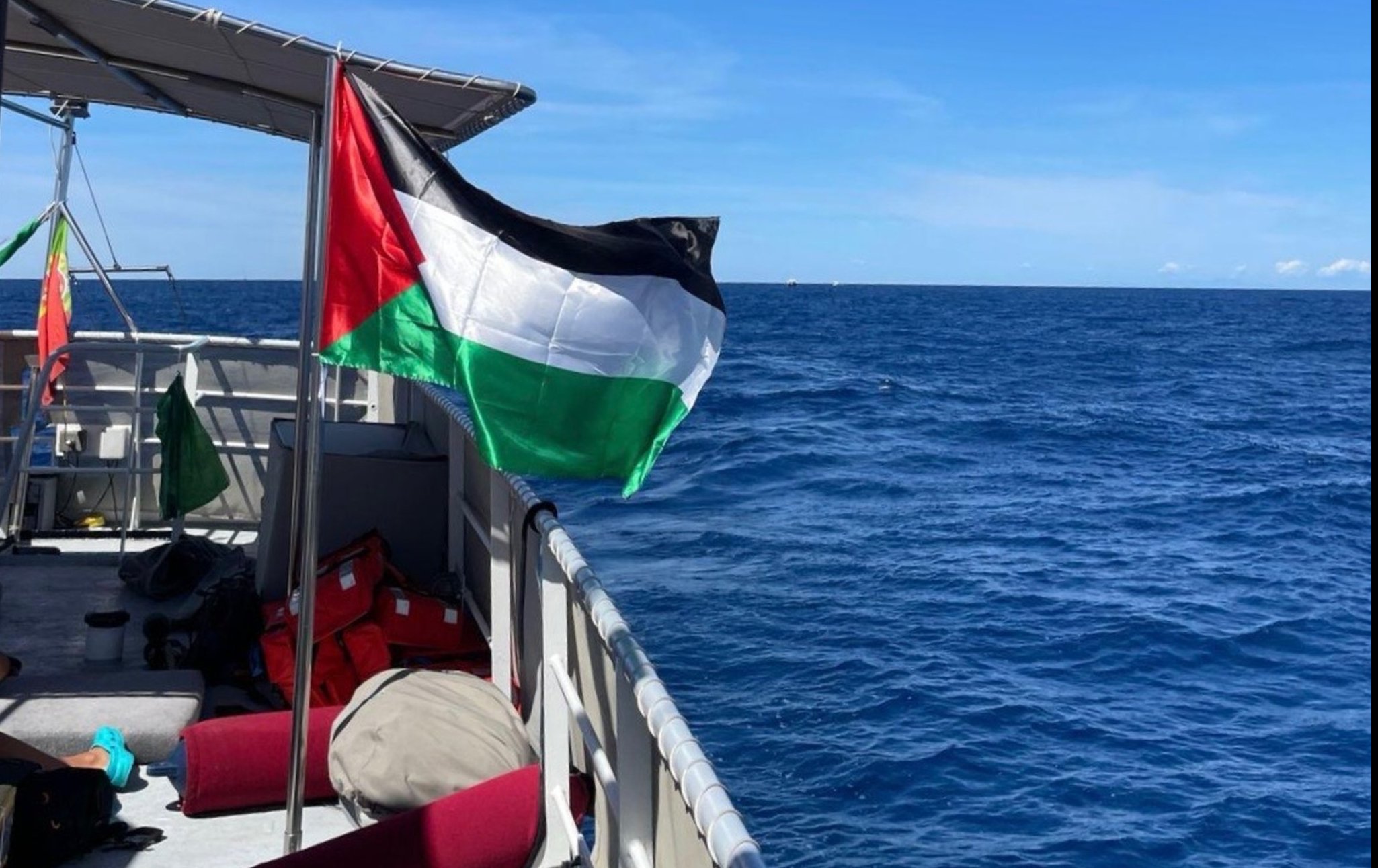
Like hundreds of other activists aboard the Global Sumud Flotilla, I was abducted by the IDF and held in Ketziot prison. There, I saw firsthand that Israel’s “strength” is more fragile than it seems.
“You know we’re the good guys, right?” Their faces were masked, but I could tell they were smiling. They mean “we’re the good guys and Hamas are the bad guys,” I thought. Later, though, with my hands cable-tied and my knees pressed to the tarmac, it occurred to me that they might have meant the police. They might have meant “you think the IDF are bad? Just wait until we hand you over to Israeli cops…” But that was later. For now, we were prey to Shayetet 13 (S’13), the elite Israeli naval commando unit.
In a world of ubiquitous screens, even the mundane must frequently feel cinematic. And here I was—on a sailing boat in the Mediterranean Sea, hands raised, staring at a dozen uniformed members of a genocidal army carrying guns the size of adult marsupials, listening to them utter phrases straight out of a Marvel Comics movie.
We were 70 nautical miles from the shores of Gaza. We had sailed from Barcelona and gotten this close. You could feasibly sail the Atlantic in the time it had taken us—so hampered by technical and logistical setbacks was our flotilla, so hampered by Israeli drones. We set off on August 31 with an estimated arrival date of September 12, but now it was October 1. More than 50 boats had taken to the water over the course of the entire journey, from dinky sailing boats to small ships.

As it happens, I don’t manage physical discomfort very well. I often feel irritable in my own skin, have been known to twitch, and get quickly agitated without adequate space to roam. I would make a terrible battery hen. Not the ideal candidate for a long mission at sea. Then again, none of us was. Apart from the captains and crew, we were all landlubbers. Moby Dick is in my top five novels of all time, but that helped nothing. We all accumulated a trillion dollars’ worth of sleep debt over the month of September, and we all washed so little that the sea salt near-mummified us. The standard refrain was “it’s nothing compared to the people of Gaza”—and the standard refrain was, of course, emphatically true. But the unavoidable reality is that a group of largely-urbanized people, unaccustomed to the raw power of the elements over extended periods of time, are going to face a painful adjustment. And, in a way, that was the point: why is this being left to a bunch of pampered amateurs? Where are the governments? Where are the international organizations?
We all missed loved ones, we all missed privacy, we all missed freedom. The impression I get is that most people on the flotilla believed (and still believe) that their boat constituted the “best” community, made up of the “best” people. I am no exception, and I don’t begrudge anyone else’s metric system—I think it says transcendent things about humanity that we can seemingly love each other in random and infinite permutations. I will sidestep boat chauvinism and simply say that my boatmates quickly became dear friends, among them Greta Thunberg, and Current Affairs contributors David Adler and Tommy Marcus.
The mission could have fallen apart in Tunisia. It would be convenient to say that this was solely because of Israel’s drone attacks on two of our vessels at the port of Sidi Bou Said, on September 9 and 10. Convenient, but not entirely true. I think it’s obvious to anyone who took part in the Global Sumud Flotilla to Gaza that organizers—particularly the central steering committee—bit off considerably more than they could chew. Prior to departure, we had it explained to us at a training session in Barcelona that the GSF operated a very rigid top-down structure. Fine by me, as long as it’s effective. Pretty quickly, however, it became apparent that it was not entirely effective. Ego, control freakery, and paranoia at the very top prevented the delegation of tasks and responsibilities to ordinary participants, even when it was clear that bottlenecks and capacity issues were jeopardizing the mission. An iron law became palpable: the longer the boats were stalled because of logistical problems, the more fractured the atmosphere became.
The mission survived because of love and hate: participants’ love for Palestine and for the people of Gaza, from whom we were receiving luminous messages of anticipation, and hate for the PR win an abortive mission would gift to Israel. Quite aside from all the drone bombings, Israel’s rhetorical strategy from the beginning had been to try and conflate the flotilla with Hamas in the public imagination. We knew this was possibly a precursor to violence, but we weren’t going to be deterred. Israel always lies, bullies, and cajoles, and almost always gets its way. Not this time.
Despite the sea’s stubborn invariability, invisible markers came and went, reassuring of progress. Now we’re passing south of Syracuse, now Crete. Now north of Alexandria, Cairo… until finally, just over the horizon, the site of the worst genocide of the 21st century. The mere knowledge of its proximity acted like a magnetic field, bending and distorting my sense of things. Gaza—always heard in the abstract, always a synonym for torture—had once been something much simpler to millions of souls: home. We were going to bring them food, medicine, and baby formula. But the IDF had other ideas, and it had them in international waters (an offense to both maritime and humanitarian law). Moments before they illegally boarded our boat, we threw our phones into the water, lest Israel glean intel from them.
The “good guys” were an elite naval unit, but they were vomiting over the side of the boat from seasickness all the way to Ashdod, an Israeli port to the north of Gaza. Perhaps more embarrassingly, they couldn’t consistently maintain their balance amid our boat’s (modest) to-ing and fro-ing, which didn’t do much for the fear they were trying to instill. It’s fun to have cheap laughs at the IDF’s expense, but there is a deeper point here. Throughout my entire experience in Israeli detention, I saw countless cracks beneath the surface. For every ostensible manifestation of strength and vitality, there was a corollary sign of weakness, stupidity, decline, or all three.
For the next 18 hours we were kept below deck, herded into stuffy little cabin rooms and guarded by masked soldiers. Finally, we arrived at Ashdod, where we were yanked onto land by police officers keen to prove to each other that they could be bigger sonsofbitches than their IDF counterparts. I was led by the scruff of my neck to an open courtyard in front of the port authority building, where 300 or so of my flotilla comrades were kneeling in silence, heads bowed. The eerie silence, the evening dark (disorientating because we hadn’t seen daylight in more than 24 hours), the bleakness of the port authority buildings, the menacing prowl of the police officers—I hadn’t drunk a drop of alcohol in a month (flotilla policy), but now I felt sober.
But it wouldn’t be long before those cracks, those little auguries of decline, showed themselves again. After about an hour of kneeling in silence, I heard faint footsteps approaching, followed by the rustling of trousers, followed by the sight, in the corner of my eye, of a small cluster of legs passing next to me. Dare I look up? I dared. It was Itamar Ben-Gvir—the far-right Ziofascist politician and member of Netanyahu’s coalition government—surrounded by young, male groupies, here to humiliate us on camera. But they failed. Almost immediately and spontaneously, several hundred of us started chanting “free Palestine!” and addressing him as a war criminal and genocidaire. I was close enough to see his smile melt into a frown, his frown melt into shock, and finally, shock into rage. I was close enough to see what happens when trophy kills refuse to submit.

Palestinians, of course, don’t have the same latitude to rebel as we did, and any triumphalism must be immediately tempered with that observation. My family’s great fear was that Israel would discover that I am, myself, half-Palestinian. After all, all they’d need to do is type my name into Google and they’d hit the motherlode: how my grandfather was shot in the head during the Nakba, how my uncle was “disappeared” by Mossad, how my brother was locked up and tortured from the age of 12.
But I suppose the thing about racists is that they are, actually, very obtuse. I have a European-sounding name and a British passport, and that’s all there is to it. Once I’d been relieved from the kneeling position and brought inside the port authority for processing, I had to explain to customs officers why it was that I’d been to Israel twice before. The real answer is that my dad lives in occupied Palestine, and because Israel made a point of destroying all the airports in Palestine, I had to travel via Ben Gurion Airport in Tel Aviv. But I couldn’t say that. So instead, I said I’d visited as a tourist. Twice as a tourist and once as a flotilla activist. “I just want peace,” I said, in an attempt to stifle the puzzlement breaking out across their faces. Amazingly, it worked. No more questions asked. No names Googled.
What is evil’s primary noun? Hannah Arendt tells us it’s banality. In his book on the Mitford sisters, David Pryce-Jones says frivolity. I saw an abundance of both—with good lashings of idiocy and dead-eyed antipathy—everywhere I turned. Several hours and many incompetent layers of security later, I was stripped of all my belongings, my hands were cable-tied so tightly that my fingers started to turn all the colors of the rainbow, and I was bundled onto an armored prison bus pumped full of freezing cold air. Two hours later, we arrived at Ketziot prison—a nasty little thicket of barbed wire, breezeblocks, and corrugated iron that the Israelis saw fit to plant in the middle of the Negev Desert. As it happens, my Palestinian half-brother was once imprisoned and tortured in Ketziot, a fact I only realized later.
I was there for two days, but it felt like two years. Some of our flotilla comrades were kept for as long as seven days. No inmate was provided with clean water, critical medicine was mockingly disposed of, women had their hijabs torn off their heads by male guards, and the “food” (dried bread with rotten vegetables) was crawling with insects. The guards woke us up every fifteen minutes or so by bashing on the doors to our cells and switching the lights on and off. People were pushed, kicked, punched, and spat on. When I told the British Consular General of these abuses, he pursed his lips and said we could “have a debrief” when I returned to the U.K. (whenever that would be). The fish rots from the head, after all, and right now the head of the British state is Prime Minister Keir Starmer, a self-avowed Zionist and bounty hunter of Palestine activist groups.
Nonetheless, as the hours wore on in Ketziot, something changed. The power dynamic shifted. At first, we were cowed—frightened little mice who did what we were told. Quickly, though, we started answering back, singing defiantly in the guards’ faces, calling them baby killers and fascists, and refusing to comply with their absurd demands. Muslims in our row of cells sang the call to prayer, and non-believers joined in. By the evening of the first day, the bastards were at a loss to control us. There was that pervasive fear again, lurking behind an edifice that grows more unstable the closer you get to it.
Again, Palestinians can’t shift the power dynamic against their jailers so easily. But probing and exposing the fragility of the colonial psyche is something of immense value, because in that fragility lies the lineaments of a more liberated future.
My more liberated future didn’t take long to arrive. With our captors still apparently none-the-wiser that half my family is Palestinian, I was summoned in the first wave of deportees and batched onto a chartered Turkish Airlines flight to Istanbul, along with 140 others from the flotilla. Amid the jubilant atmosphere at 30,000 feet, I asked myself what we’d achieved. We didn’t reach Gaza, true. We didn’t bring the aid. And we didn’t bring anyone back to life. But I’m told that—because we kept the IDF busy that night on October 1—Palestinians in Gaza were able to catch and eat fish from their own waters for the first time in months.

Then there’s the so-called “big politics” stuff: after Israel attacked our flotilla with drones, the Italian and Spanish working classes threatened to close down their economies with massive labor strikes unless their governments protected us. Accordingly, Italian and Spanish naval vessels were deployed to the Mediterranean and, lo and behold, Israeli aggression ceased. That would be (by my reckoning) the first time NATO countries have used their militaries to deter Israeli violence—particularly significant in the context of a state that is forever pushing the geopolitical envelope. One has to wonder what might have been achieved had other governments been willing to put their heads above the parapet and uphold international law.
Ah, but it’s the hope that gets me—the endless messages of hope we received from the people of Gaza. It was false hope, this time, but it won’t be forever. As our plane doubled back over the southern Negev Desert, the vast desiccated landscape beneath seemed to stretch on and on. I thought about ancient and colonial history, about how we’d retraced Homer’s Odyssey across the Mediterranean, about Nelson’s path to Egypt for the Battle of the Nile, about T.E. Lawrence fomenting Arab rebellion against the Ottomans in those very sands. What did it all mean now, this history, two years into a genocide? 77 years into an occupation? Then, the person sitting next to me said: “spectacular when you see it like that, isn’t it. Shows that there’s still so much land to fight for.”
Indeed. And fight we will.