The geopolitical analyst and author of “Gaza Apocalypse” talks Iran, Lebanon, Palestine, and the deadly chaos coming out of the White House.
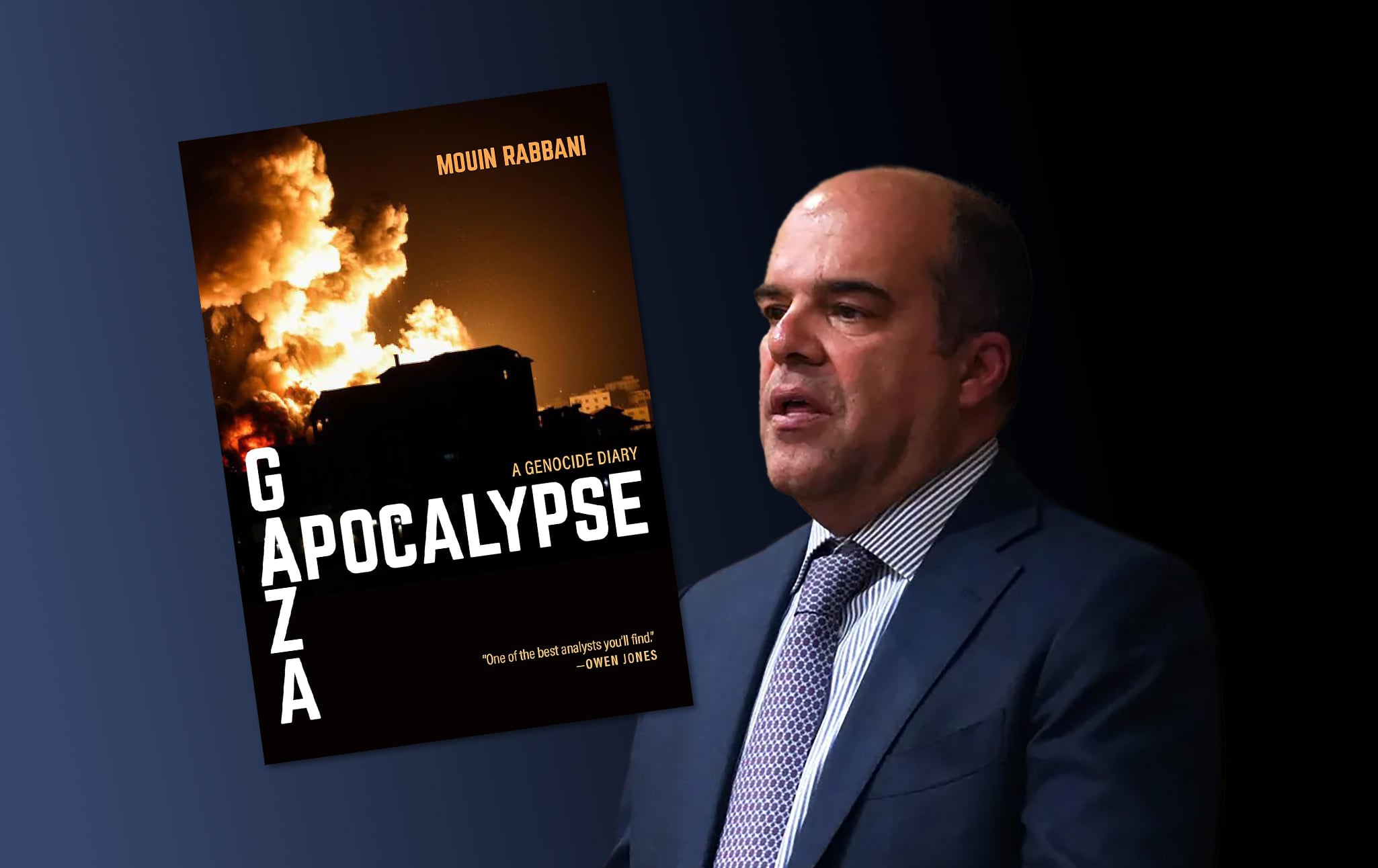
Mouin Rabbani is one of the foremost analysts of the Middle East working today. He’s a senior fellow at the Middle East Council on Global Affairs, an editor at the journal Jadaliyya, and the author of the forthcoming book Gaza Apocalypse: A Genocide Diary. You might also remember him as Norman Finkelstein’s debate partner in their epic four-hour exchange with Israeli historian Benny Morris and Steven “Destiny” Bonnell, or as the prolific social-media critic of what he calls the “Hasbara Symphony Orchestra.” He joined Current Affairs editor-in-chief Nathan J. Robinson to unravel the chaos coming out of the Trump White House, the joint U.S.-Israeli wars on Iran and Lebanon,
Nathan J. Robinson
I have mentioned before to you that you are the person I turn to when I need sanity and calm.
Mouin Rabbani
You’ve come to the wrong place.
Robinson
Well, I just want to begin with perhaps the inverse of sanity and calm by reading to you from the Truth Social feed of the President of the United States:
“I just had excellent conversations with the president of Lebanon and the prime minister of Israel. They’ve agreed that in order to achieve PEACE”—in all caps—“between their Countries”—capital C—“they will formally begin a 10-day CEASEFIRE”—all caps. “The two countries met for the first time in 34 years in Washington, DC, with our great Secretary of State”—once again, capitalized—“Marco Rubio. I’ve directed Vice President JD Vance, Secretary of State Rubio, together with the Chairman of the Joint Chiefs of Staff, Dan ‘Raizin’ Caine, to work with Israel and Lebanon to achieve a lasting peace. It has been my honor to solve nine wars across the world, and this will be my 10th. So let’s get it done. President Donald J. Trump.”
Your reaction to this, Mouin Rabbani?
Rabbani
Well, you also recall that he explained that no one had ever stopped a war before. The problem with your question, Nathan, is that one can’t apply rational analysis to anything the way you would to any other government or country, or even previous U.S. governments. With the current leadership in the White House, they have absolutely no idea what they’re doing. They have absolutely no idea what their own objectives are. And somehow it’s left to us to figure out not only what they’re doing but also where they’re going, in a context in which they routinely contradict themselves and go in every conceivable direction. So that’s made the work of people like you and me extraordinarily difficult.
But having said that, if we take this specific issue of Lebanon, let’s look at the background. As you will recall, when Pakistan announced that a ceasefire had been achieved between the United States and Iran, the prime minister or the president of Pakistan, I can’t recall which, in his statement about that ceasefire, explicitly stated that it would apply to all theaters and explicitly mentioned Lebanon in that context. The Israelis then said Lebanon was left outside it, that they would not respect any ceasefire with Lebanon, and the following day, they launched an aerial massacre in multiple neighborhoods of the Lebanese capital, Beirut, the most intensive bombing of that city since Israel’s 1982 invasion. And then you had the initial round of talks between the United States and Iran in Islamabad, which the U.S. broke off after 21 hours and departed for reasons that remain unclear[...]
But that’s the general background to this. Now, of course, what remains unclear is how Israel is going to define “ceasefire.”
Robinson
The most crucial question with Israel.
Rabbani
Yes. Does the ceasefire mean you stop shooting? Or is Israel going to transform this into an Israeli ceasefire, where only the other side is committed to stopping shooting? And more importantly, the Israelis see renewed hostilities in Lebanon as their best bet for reigniting the war with Iran, which I think is by now clear the U.S. is seeking an exit from.

Robinson
I want to ask you about the Israel-U.S. relationship in all of this, because I think there is a dispute, even among critics of the Trump administration and of U.S. foreign policy generally, over the degree to which Israel determines U.S. policy versus the U.S. being able to control Israel. I’ll quote something that you posted recently. You said, “Israel is a gangster state because the United States runs the crime syndicate. Without Washington, Israel is nothing.”
Somebody in the comments replied, “You got that backwards.” And indeed, there are a lot of people who say Israel pushed the United States into this war. That this is Israel’s war. The U.S. was dragged in through the influence of Netanyahu. I’d like to hear your perspective on the degree to which Israel controls or influences U.S. policy, versus is under the thumb of its benefactor.
Rabbani
Well, I think I’ve answered that question in the first part of our discussion. A ceasefire with Lebanon [was] absolutely not in Israel’s interest, and in fact, now also presents a political danger to the Israeli prime minister, who is heading into elections. But the phone call came from Washington: there’s going to be a ceasefire, and Israel has no choice but to do as it’s told. Because if there’s one thing that we didn’t already know, although we should have known it, but that we learned very clearly since late 2023, it’s how extraordinarily dependent Israel is on the United States militarily, politically, diplomatically, and so on. And now we actually have U.S. forces stationed in Israel to defend it from Iranian missiles and so on. Having said that, there are different levels of proxy relationships, and Israel, of course, has, over the decades, managed to build up a very powerful and influential lobby within Washington and the United States generally.
Look at the repression of campus protests. If you look at the U.S. media, we journalists have more freedom to criticize the American government than we do to criticize or scrutinize the Israeli government. And in the particular case of the war with Iran, as many people have noted, this is something Israel has been agitating for for decades, at least since the turn of the century, and it has failed to persuade the U.S. to either launch or support such a war with Democratic as well as Republican administrations. But in Trump, they found their mark. We’re talking about someone who is extraordinarily vacuous, ignorant, knows nothing about diplomacy, knows nothing about the Middle East, and knows nothing about strategy or warfare, and they were able to successfully present him with a fantastical war plan that he would achieve a decisive victory within 72 to 96 hours. And because the U.S. government is composed exclusively of yes men and yes women—you probably saw the reporting in the New York Times that when Netanyahu made his presentation arguing for this war in the White House on February 11, every Cabinet member, except for Pete Hegseth, said this was a farcical idea, but they ended up signing off on it anyway. And so the broader point I’m trying to make is tails don’t wag dogs, dogs wag tails, and that’s certainly true in the case of the U.S.-Israeli relationship. Nevertheless, Israel does have more influence in Washington than perhaps any other U.S. proxy or ally.
Robinson
You mentioned there the degree to which it’s kind of shocking that in the United States, our ability to criticize Israel is less than our ability to criticize the United States government. I couldn’t help but think back to my own firing from the Guardian as a political columnist, which occurred over a tweet about Israel. Even though I’ve criticized the U.S. government over and over for a very long time.
Rabbani
There you go.
Robinson
Another quote from you, which I think may sound provocative at first, but I think you’re probably right, is this:
Whatever one thinks of Zionism during its formative years, it is today, indisputably, a totalitarian movement. Anyone of any background who steps out of line anywhere on the planet is immediately defamed, delegitimized, and demonized. In unison, an army of flunkies will go after you, your work, your family, even your citizenship. Campaigns are launched to get you silenced, fired, imprisoned, and deported. Whether you’re an individual. institution, or even a country, everyone is expected to boycott and sanction you if you express even the slightest criticism or dissent, but if you call for Israel to be boycotted and held accountable for its actions, these suddenly become the most illegitimate tactics ever conceived.
Could you expand a little bit on what you mean by a totalitarian movement there?
Rabbani
Well, what I’m speaking about here is a movement that tolerates absolutely no questions, scrutiny, criticism, or condemnation, and if you step out of line, they will do everything within their power to ensure that there are consequences. We’re talking about elementary school teachers who are being fired. We are talking about a full-scale assault on academia. We are talking about laws that are being passed left and right to make criticism of Israel a hate crime. Look at all the criticism there has been of the U.S. with respect to the war against Iran compared to criticism of Israel with respect to the Gaza genocide. There has been much greater tolerance of criticism and condemnation of the U.S. by the U.S. government than there has been of Israel by the U.S. government. And here I’m referring both to the Biden administration and to the Trump administration.
For God’s sake, we have a case of a student at Tufts University who was kidnapped by plainclothes agents, put into an unmarked car, and sent to a prison camp in Louisiana because she had written an opinion piece in a student newspaper no one has ever heard of. That’s the extent to which this is going now. People are constantly being nominated for deportation, even for denaturalization. Look at the current mayor of New York, Zohran Mamdani. Ultimately, the indictment against him was not that he was a democratic socialist or that he was a Muslim, although that played a big part, but that he was critical of Israel. And we’re talking about a municipal election in a U.S. city. Now you have, of course, this new law in France that apparently has been defeated in the National Assembly, but it literally sought to make criticism of Israel, any criticism of Israel, a criminal offense punishable by imprisonment. I can’t think of any similar case outside a totalitarian political system in contemporary history, and it’s all being done, mind you, not on behalf of the governments of these individual states to immunize themselves from criticism, but it’s being done on behalf of a foreign state.
Robinson
It’s extraordinary. We had in New Orleans a couple of months ago the Combating Antisemitism Conference of Mayors, where they brought mayors from all around the country, and they were trying to get them to adopt the International Holocaust Remembrance Association (IHRA) definition of antisemitism, which is a specially crafted definition of antisemitism. But instead of the usual definition of antisemitism, which is anti-Jewish bigotry, it expands that definition to include calling Israel racist or comparing Israeli actions to the actions of the Nazi regime in Germany. And they’ve been trying to get as many entities as possible to codify in local statutes, in universities, corporate bylaws—everywhere—this special definition of antisemitism.
Rabbani
I think it’s noteworthy that the person who actually formulated that definition—his name escapes me for the moment—even said this was not intended as a definition of antisemitism, and he has disavowed it. But nevertheless, it’s now being codified into law, left and right, and people are paying consequences. Look at, for example, this comparison of Israel to Nazi Germany. Go read an Israeli newspaper. Israelis are denouncing each other as Nazis from sunrise until sundown. You now have this debate in Israel about whether ultra-Orthodox religious Jews should be conscripted into the Israeli military or not, and without getting into the details, this is being denounced as a Gestapo initiative that can only be done by a Nazi state seeking to destroy Judaism and all the rest of it. Is anyone going to go to prison for that? Or is it only people who criticize Israeli conduct or an Israeli policy and Israeli genocide vis-à-vis the Palestinians and elsewhere in the region?
Robinson
We’ve been discussing the climate of extreme repression and the levels of hostility. We’ve covered a lot of other aspects of this, from the Israeli troll farms on social media to Canary Mission trying to expose, shame, and doxx anyone deemed an antisemite. But I actually want to ask you about how the climate has seemingly changed somewhat for the better. One of the striking things about the last few years is that it hasn’t worked. We’ve seen a massive shift in public opinion, and it kind of shocked me when I saw mainstream candidates for Democratic Party office, like Graham Platner and Abdul El-Sayed in Michigan, using their rejection of AIPAC as a badge of honor. Now, previously, fealty to AIPAC was kind of a prerequisite for any success in Democratic Party politics. Now people are seeing it as a scarlet letter. Even Cory Booker, one of the most pro-Israel Democrats in the Senate, recently—he did it in a very cowardly way—said he’s no longer going to take donations from single-issue groups because AIPAC was an albatross around his neck. So could you comment on that extraordinary issue?
Rabbani
You’re exactly right. And what we’re talking about here is not a change or a shift, but I’m convinced a definitive, irreversible transformation. Israel has lost the public square in a way that it will never be able to reclaim it, and that, in turn, I think, also helps explain the intensification of this totalitarian campaign to stamp out any discussion, any debate, any criticism, any scrutiny, any condemnation, because they’ve lost the public debate. So if you’ve lost a public debate, what’s your next best option? Well, to make sure there isn’t any debate. And what I find so interesting about these politicians is, as you noted, it wasn’t so long ago that if you wanted to have a political career in the United States, whether as a senator or a municipal dog catcher, you first needed to ensure that you weren’t opposed by AIPAC, and ideally, you would be supported by AIPAC. It’s now gotten to the point where people are publicly disavowing AIPAC. And as I’ve noted elsewhere, what interests me so much about this phenomenon is not so much the principled politicians who are rejecting AIPAC and its money for the right reasons. I think the much more significant ones are the opportunists who would like nothing better than to take money from AIPAC but realize it could end up destroying their political career. That’s extraordinarily significant.
Robinson
We have seen it translate into policy a little bit because we’ve seen more and more Democrats in Congress sign on to efforts to stop arms transfers to Israel. But I think there’s still kind of a gap between where the politicians are and where the base is on this.

Rabbani
And particularly the leadership of the parties, and the Democratic Party in particular. You have Chuck Schumer, who openly says that he considers it his sacred duty to be Israel’s guardian in the U.S. Congress. And things aren’t going to change overnight. Political change often lags—always lags—behind changes in public opinion, and particularly when you’re dealing with a plutocracy, that change is going to come more slowly. But look, for example, at the recent mayoral election in New York. Zohran Mamdani’s opponents tried to make this the Tel Aviv primary, and they succeeded in doing so, but they also ended up losing for precisely that reason. So there are, I think, very significant and very encouraging signs. But of course, these things aren’t going to happen by themselves. We all still have a lot of work to do. We all still have a lot of extraordinarily hard and difficult work to do. We are probably going to lose more often than we succeed, at least in the short term, but at the end of the day, I think we are dealing with an irreversible trend, unless we allow it to take us down.
Robinson
That’s certainly a positive development, because I know that a lot of people, as they see just the relentlessness of the horror, as they saw the Gaza genocide unfold, and now they’ve seen all of these atrocities against Iranian civilians and everything going on in Lebanon, it does feel like it must have felt during the Vietnam War, where it drags on and on and on, but slowly, something is happening that maybe we can see a little light in the future.
Rabbani
Yes, and as I pointed out recently, I think it’s important to recognize that change comes incrementally, and it can come incrementally for a very long time before it begins to happen exponentially. And given both how recent many of these changes are and the extraordinary commitment, shall we say, of the forces arrayed against us, it’s not going to be easy, and it’s not going to be rapid. But if you look at the situation in the Middle East, yes, the price that has been paid has been extraordinary: a genocide in Gaza, what people are increasingly characterizing as a genocide in Lebanon, death and destruction throughout Iran, and massive destruction elsewhere in the region, particularly in the Arab states on the Persian Gulf, and now a global economic crisis and all the rest of it. But at the same time, I think, as a number of analysts have pointed out, this is also, in many respects, Washington’s Suez moment, where precisely at a time when it launched a war to confirm and consolidate its status as a leading global power, it came up against the limits of its capacities and capabilities. Future historians, I believe, will look back on this moment as the one that marked the turning point of the definitive beginning of U.S. imperial decline. Similarly, if you look at Israel, for Israel, the war against Iran was supposed to be the final act, the act that would confirm and consolidate its status as the unchallenged regional hegemon. Nevertheless, we now appear to see Israel coming up very clearly against the limits of its capacity to project unchallenged power throughout the Middle East.
Robinson
That gets me to a question I wanted to ask you about the gap between the Trump administration’s presentation of what has occurred over the last month or so and what has actually occurred. You have said that we are in the “death throes of a failed war.” Of course, the Trump administration, every day, comes out as every party in every war does and says, “We’re winning. We’re doing great. We’re achieving all of our objectives. It’s going to be a little while longer.”
Rabbani
Dizzy with success.
Robinson
Could you explain what the administration’s propaganda-world version of this war is and how we should actually understand what has just happened?
Rabbani
Well, this was, of course, a joint U.S.-Israeli war, but if we take the U.S. and look at the statements that were made at the outset by the U.S. and the demands that were made of Iran—again, with the caveat that it’s very difficult to apply any rational analytical framework to Washington these days—the U.S. was lauding the prospect of regime change. It called on the Iranian people to rise up and overthrow their leadership. It demanded the total surrender of the Iranian leadership. It demanded the complete dismantling of Iran’s nuclear program. In other words, Iran was also required to surrender the peaceful elements of its nuclear program, including those conducted as part of its internationally recognized rights under the Nuclear Non-Proliferation Program. It was supposed to surrender its ballistic missile program, and anything that it refused to forfeit would be destroyed[...]
Of course, there have been important tactical successes, but none of them resulted in the strategic transformations that had been anticipated by Washington. And if I could just backtrack a bit to this February meeting at the White House, despite their skepticism, the Americans and the Israelis were so convinced that the plan would be successful, that Iran would be paralyzed, that Iran would be incapable of significant retaliation, and most of all, that Iran would be either unable or unwilling to establish its control over the Strait of Hormuz in the Persian Gulf, that there was no contingency planning for any of these scenarios. There was no plan B. And so now, if you look at the statements coming out of Washington and the agenda of these upcoming negotiations with the Iranians, sure, they’re still talking about dismantling its nuclear program and so on, but it is primarily focused on navigation of the Strait of Hormuz. In other words, the U.S., as a result of its failures, has been forced to divert its attention to seeking to address the consequences of its war rather than the objectives it established for this war at the outset. And that, I think, is a big deal.
Robinson
I think I realized that everything had gone south at the moment when I saw a headline: “Opening the strait has become the crucial issue of the war.” And I suppose they try to get us to forget that was not an issue before the war and that amounts to now waging war in order to, as you say, undo the catastrophe that resulted from the war.
Rabbani
Yes, and if I could just make one more point, Iran has never had this kind of control over the Strait of Hormuz. In fact, the situation as it existed for many years is that the entire world has had free passage through the Strait of Hormuz, except to an extent Iran, because of all the sanctions against it. And now the situation has been completely overturned. And I suspect Iran now has concluded that it has something that is more significant, more powerful, and more valuable than even a nuclear weapons arsenal, which is something it may end up developing anyway if these negotiations don’t result in an agreement.
Robinson
You say we can’t really attribute rationality to Washington these days. But it struck me when I saw Trump’s sort of infamous tweet: “Open the strait, you fuckers, or I’ll destroy your whole civilization.” It struck me, obviously, first, as a sort of unprecedented level of threats of genocide, but it also just smacked of desperation.
Rabbani
Well, that’s certainly one interpretation to give it, and that is how I originally saw it. But now I’ve come to view it differently, because, as you remember, it was only several hours later, on the cusp of the deadline for this civilizational termination, that the Pakistanis came out with their statement that a ceasefire had been agreed upon between the U.S. and Iran. And although I have no definitive evidence for my understanding of what happened—I suspect it’ll be confirmed in a few years or decades—the Americans reached out to the Pakistanis. They realized that their war was not going to succeed. They realized that to succeed, they would have to commit enormous additional resources to this war, including a significant ground operation. And even then, there were questions about whether the U.S. had those resources and whether, even if it did and committed them, it would eventually succeed. Be that as it may, it seems clear that the Americans reached out to the Pakistanis. The Pakistanis apparently reached out to the Chinese, who informed the Iranians that we’re going to veto this UN Security Council resolution, and in exchange, we expect you to accept this ceasefire resolution. The Saudis were obviously involved as well, given Pakistan’s mutual defense treaty with Saudi Arabia. And so Trump, when he woke up that morning, already knew there was going to be a ceasefire announcement that evening. And again, in order to cover for this and to ensure that no one would believe that this was an act of U.S. weakness, a sign of U.S. failure, he made this genocidal threat, and then a few hours later, he was able to say, “Well, it’s precisely because of my threat that the Iranians accepted this Pakistani ceasefire,” even though I’m absolutely certain it had already been agreed at least the night before.
Robinson
Just to conclude here, I think there is a danger when we have these discussions of getting into questions of strategy. Is Iran negotiating from a position of strength? Does the U.S. have rational goals? Talking about these things almost as if...
Rabbani
It’s not a board game.
Robinson
Yes, as if we are sort of neutral analysts looking at a game of Risk. But I want to conclude by asking you about the moral aspects of this war, because one of the most striking things to me about it has been just the level of depravity. The war opened with a massacre of schoolchildren that dwarfed every school shooting in the United States.
Rabbani
It’s the American way.
Robinson
The language is certainly—there used to be this sort of gap between how Richard Nixon would talk in public and how he’d talk in private. And now the “bomb the crap out of them” thing is very public. But you see things like the Wall Street Journal running an op-ed, I think yesterday, saying threats to destroy civil infrastructure aren’t war crimes. I am overwhelmed by just how obvious it is that the United States is the aggressor in this. Could you discuss some of the moral aspects of this?
Rabbani
Yes, I would make several points in this respect. The first, of course, is that this is indisputably an unprovoked war of aggression. And if you go back to the Nuremberg trials after World War Two, the crime of aggression was in many ways a supreme crime that Nazi criminals were tried for and executed for. The second observation I would make is that it’s now very clear, as you and I and many others have been saying all along, that what happens in Gaza is not going to stay in Gaza, particularly given that this war was supposed to be kind of the final act of Israel’s campaign in response to the October ’23 attacks from the Gaza Strip and establish its hegemony over the region. Many of the things we’re seeing in Iran were normalized in the Gaza Strip during the past two years. And it’s not just normalizing threats and destruction of civilian infrastructure and school children, all the rest of it. Sure, if you go back a few hundred or maybe a few thousand years, you will find instances of a messenger being sent from one emperor to the other, getting his head lopped off and put in a box, and being sent back to the person. But the idea that it’s not only legitimate but desirable to murder, to assassinate negotiators and diplomats because they won’t surrender—well, we’re seeing that now being openly discussed in the U.S. and Israeli press, as if this is not only a legitimate and desirable military tactic, but it’s something that actually should be done and needs to be done if the war will be resolved on favorable terms. So yes, it’s not just that morality has been tossed out of the window. We are seeing a war against the very concept of values itself. And again, this is very much an outgrowth of what was done in the Gaza Strip, what was allowed to be done in the Gaza Strip, what was tolerated in the Gaza Strip, and what people were punished for criticizing in the Gaza Strip.

Robinson
Yes, you mentioned the U.S. press discussing killing negotiators. In fact, there’s a Washington Post column by one of their conservative columnists, I think Marc Thiessen. He said it explicitly and laid out a plan for Trump: you’ve got to tell them to agree to our terms, or we’ll kill all of your negotiators.
Rabbani
Perfectly normal.
Robinson
Quite openly, as if this is a rational thing to do. A year or two ago, Israel boasted publicly by posting audio of a Mossad agent or someone calling one of Iran’s officials and threatening to murder his whole family. And they posted this online to say, “Look how hardcore we are.” I thought it was extraordinary that we are in a world where that is not something you’re covering up.
Rabbani
Yes, this is from the 12-Day War in June of last year, where at the outset, Israeli intelligence called all these senior Iranian leaders and said, “You either defect and publicly denounce the Iranian government, or we will kill you and your entire family.” And what’s notable, I think, about these incidents is that this came immediately after all the targets of these phone calls were aware that Israel had just launched an extraordinarily successful elimination of multiple military commanders, civilian scientists, and others, and nevertheless, not a single one responded to these threats.
Robinson
Well, we always appreciate your sound, calm, thoughtful, and, as I say, sane analysis.
Rabbani
Thank you very much, Nathan.
Transcript edited by Patrick Farnsworth.