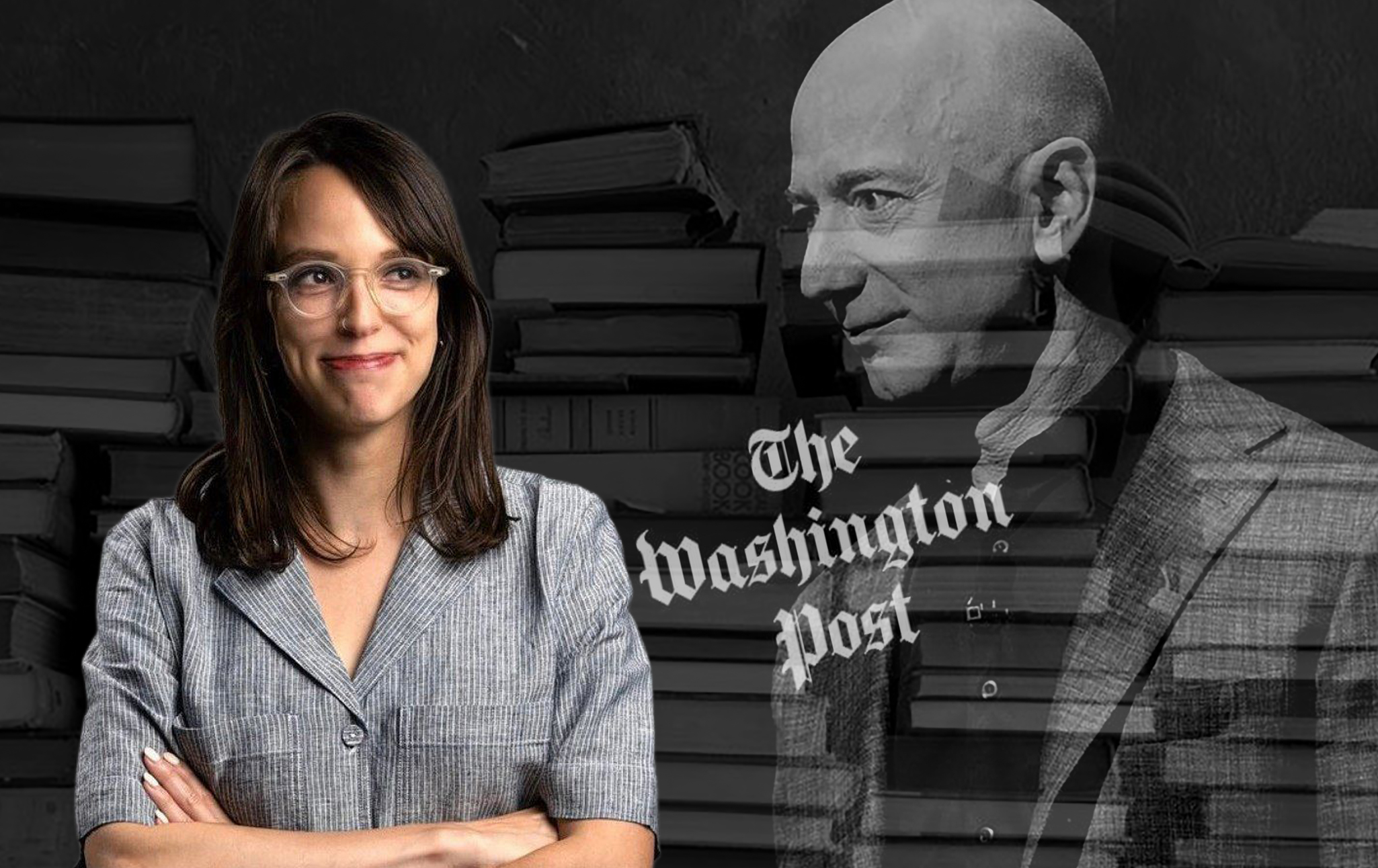
Becca Rothfeld reflects on her layoff from The Washington Post, and what's at stake in a world without readers.
When The Washington Post gutted its book section in February 2026—laying off critics and shuttering one of the last spaces of its kind in a major newspaper—Becca Rothfeld was among those pushed out. Her abrupt layoff was part of a push by owner Jeff Bezos to slash the paper's staff by 30 percent, as he continues to scrap stories that don't sufficiently bend to the will of the ultra-wealthy.
Now a staff writer at the New Yorker, Rothfeld joined Current Affairs to dissect the decision and what it says about the whims of billionaire media ownership. She discusses the collapse of book culture in mainstream journalism, the purpose of criticism itself, and why meaningful human thought still matters.
Nathan J. Robinson
What happened at the Washington Post? Massive layoffs; a third of the staff, a huge portion of the staff.
Becca Rothfeld
I think people are now speculating closer to a half. Don't quote me on that, but I think that's the most recent estimate.
Robinson
It's a lot of newspaper staff to be let go all at once. I take it Jeff Bezos woke up one day and decided that he wanted to kill the newspaper, and because he's the owner, that's his right. What exactly happened here?
Rothfeld
I think that's a great question, and I think that nobody really knows, myself included. I think that his behavior is so difficult to parse that the best explanation is just that he's not thinking about the Washington Post very much. His initial complaint a couple of years ago, when I was starting at the Washington Post, which wasn't that long ago—three years ago, or something like that; a little bit less than three years ago—was that the paper was not profitable, and so he was pumping in all this money to make it profitable. It had been profitable under the first Trump administration. We had benefited from what people call the "Trump bump," from a bump in subscriptions from Trump.
Then I think that the subscriptions had fallen off because people were tired of reading the news when Biden was reelected, so he was trying to make it profitable again. Then he himself forced the paper to do a series of things that made it significantly less profitable by driving away hundreds of thousands of subscribers. He prevented the opinion section from publishing an endorsement of Kamala Harris, which the editorial board had decided to do. He forced them to not publish it, and then he fired the editor of the opinion section—or he didn't fire them, but he amicably pushed out the principled editor of the opinion section and decided that the opinion section was only going to publish opinions in praise of personal liberties and free markets. So the combination of these decisions lost The Washington Post at least several hundred thousand subscribers.
And so then it's unclear why this happened. They didn't really give a great explanation. I think that nominally, this was for economic reasons. People have speculated that he wanted to curry favor with Trump. I think the combination of his actions basically adds up to this guy doesn't care about the Washington Post. It's a rounding error for him. So one day he wakes up and he feels like doing one thing, and he does it, and the next day he wakes up and he feels like doing something else, and he does that.
Robinson
This is the hazard of billionaire ownership.
Rothfeld
There is.
Robinson
Their fickle whims determine people's livelihoods. If one day he decides that profitability and money-making are the end-all-be-all, then that's what the institution will pursue. But if the next day, he decides that actually he'd like to go ideological or that he has someone to please, that's what happens.
You had colleagues there; did they ever interact with him? Did he ever swoop down into the newsroom? Or was he just this sort of floating, vague presence elsewhere? How did it work when you were there?
Rothfeld
I never interacted with him. I never spoke to anyone who had interacted with him. I think that I—not just I, the whole book section was relatively low in the Washington Post pecking order, which I think was more of a blessing than it was a curse. Nobody really paid attention to us. A lot of my book reviews were not opinion pieces, but I write from a particular perspective. My perspective is certainly on the left, and nobody ever disciplined me for that or even mentioned it.
So I think that the higher-ups in the forms of corporate management were mostly concerned with politics reporters and Pentagon reporters, pretty much totally unconcerned with the arts. So I, to this day, have no idea if Jeff Bezos even knew that we had a book section. I guess now he knows. He discovered that for the purposes of gutting it.
Robinson
So the order to make all opinions consistent with the values of personal liberties and free markets did not actually come down onto your desk.
Rothfeld
No. The way that the paper was structured, and I think the way that most newspapers are structured, is there's the opinion section and there's the newsroom, and they're really rigidly demarcated, and often arts coverage, including criticism, falls on the newsroom side. So all the critics, like the music and art critics, were all subject to the same constraints that the rest of the newsroom was. So we couldn't express political opinions, except insofar as doing so is necessary to our work. We couldn't be at political protests and all this kind of thing because we were journalists, bureaucratically speaking.
Robinson
Well, it gets us to the question that is at the core of your recent article in The New Yorker, which is called "The Death of Book World," where you write about the end of the Washington Post books section. That question being, what is the purpose of having a book section? Because the termination of this piece of the Washington Post provides us an opportunity to reflect on why we have these things, what value they contribute, and what you're trying to do with them. Why does a newspaper review books at all? Some newspapers don't. In fact, The Washington Post was almost lucky to have a book section in 2024 since so many city papers have cut their book reviews over the years.
So let me start by just asking you, as you think about post the end of this, why do newspaper book review sections in particular matter? Why have them? What do we lose when we gut this?
Rothfeld
Yes, great question. So I think that the way that I would answer this question is different from the way that I would answer a question that's just about the value of book reviewing and criticism in general. Obviously, I have views about that, and I think that book reviewing and criticism in general are valuable. However, as I wrote in the piece, I think that there's something particularly and uniquely valuable about a newspaper book section. And you're right. There are very few left. The Wall Street Journal has one. The Boston Globe has books coverage, but not a huge book section, I believe. And then the Times Book Review is really the only one that is still a standalone section, like a magazine that comes on Sundays that you take out of the newspaper. That used to be common, and now it's just The Times. I think that what those kinds of book review sections do is they allow a general interest reader an entree into the world of literature and ideas.
So, as I say in the piece, I love literary magazines. I write for them, and I subscribe to tons. I subscribe to the London Review of Books. I subscribe to the TLS. I enjoy reading and writing for these places, but those are really publications for people who already know that they care about literature. They subscribe to a book review because they want to read book reviews. But the point of a general interest newspaper is that it can expose you to things that you didn't know that you were interested in already, and you can become interested in them. So somebody who thinks that they're only interested in politics, or someone who thinks that they're only interested in art reviews or restaurant reviews or news about the local DC area—which they can also no longer find in the Washington Post, which no longer has a Metro section—might just stumble upon a book review, and that is a way for people to discover that they care about books and ideas.
And I think that that is a valuable function in an increasingly siloed society in which algorithms and kind of special niche interests push people to only interact with things that they already know that they like.
Robinson
Now, Becca, when you were doing the book review section of The Washington Post, presumably you heard from readers. In fact, I know this because in your piece, you say that you heard from readers, up to and including Ralph Nader.
Rothfeld
Ralph Nader emailed us a lot. A lot. He was my most frequent correspondent, I would say.
Robinson
That was the least surprising detail in your entire piece: that you heard constantly from Ralph Nader. This is a man who has an entire book of his unanswered letters to the president. Someday the Rothfeld-Nader correspondence will be in hardcover.
Rothfeld
This being him writing, "Review this book," and me being like, "Thanks Ralph, no."
Robinson
Well, let me ask you about the readership, though, because you're talking about your ideal function for this kind of section of the paper. What kinds of readers do you get? What kinds of reader interactions does this stimulate? Do you feel like it actually achieves this purpose based on what you hear from people?
Rothfeld
I definitely did. I did not figure out how to look up the numbers because I thought that that would be a crazy-making enterprise. But obviously the numbers and the metrics were available to people on the back end, and the book section was accruing subscribers and readers. Our readership was increasing. I do make the point in the piece that you shouldn't decide what to publish solely based on what's already read. But it's just the case that our readership was increasing.
But I did hear from a really wide public. It was a wider public than I'd ever had before. I had been freelancing for many years for smaller intellectual literary magazines, and there are things that you can do in that context that I value and that you can't do in a major general interest newspaper. Nonetheless, you get a much wider public; you get a ton of people who seem like they don't generally read book reviews. And in fact, there are people who would email me all the time saying, "I didn't read book reviews until I started reading your book reviews," or "I started reading Book World, and I have loyalty to one of the staff critics at Book World."
There were three people there who were really regular, two staff critics, and then Michael Dirda, who was kind of in and out, but he wrote a lot. And there were a lot of people who said that we were the ones who got them into book reviewing. They were lawyers, doctors, or they did something really unrelated.
Robinson
I'm also a critic—sometimes I do book coverage, but mostly I'm just criticizing things that people are doing. One of the things I find is that oftentimes you put a piece out into the world, and you're like, did this matter? Did this make a difference? Did anyone even care? And then you get some email from someone where you're like, I have managed to stimulate thought through what I'm doing.
I just got an email today because I'd written this piece about the Iran war, and I had a sort of casual sentence in it that said, "We're all complicit." And I got an email from a philosopher who had written this entire long blog post, where my piece had inspired him to write about the nature of complicity. What does it mean to be complicit? And he took issue with me saying we're all complicit. He said there are degrees of complicity. And then he explained, forcing us to think, what does it mean to be complicit in something that your government is doing? And I was so gratified, and that was just this morning, by going like, I have pushed forward discussion on something really important, which is, what does it mean to be complicit in an atrocity? And I assume you had those kinds of things too, where reactions make you think, "Oh, I have caused thought."

Rothfeld
Yes. I definitely had a ton of that. I had people emailing me to say that they would buy and read Flaubert's letters or these obscure works in translation that I kind of insisted on writing about periodically. Or Guy Davenport, the sort of obscure mid-century critic who was incredible. But then I also would write moderately frequent reviews of bigger political books, and sometimes political operatives would email me. I reviewed extremely negatively a book by Biden's press secretary, as you may recall, and this review went pretty viral. And I got Democratic strategists emailing me saying, "This is great; I'm going to share this with other Democratic strategists." So maybe I'm indirectly responsible for Newsom finally saying that what's happening in Israel is apartheid adjacent.
Robinson
You mentioned there the eclecticism of your particular range of subjects. I think if people go into your archive at The Washington Post, one of the things that is very striking—and there are a couple of things that make you stand out from other critics—is that you're not just reviewing the top 10 bestsellers each week. You have a really odd range. In fact, I don't even know the logic that goes into your choices. So tell us a little bit more about how you thought about—because any book critic has a giant pile every week—what is valuable to actually cover?
Rothfeld
Yes, I think it was a mix of books. So on the one hand, there are books that sort of everyone is covering that you need to have coverage of. You don't necessarily need your staff critic to be the one who's covering it, but there are some books that are sufficiently big, like Salman Rushdie's memoir, that you probably want your staff critic to weigh in on. (I didn't like that book.) Then I thought of it as important to try to be covering books from independent, smaller presses, from leftist presses. I tried to cover stuff from Verso when it was about a topic that's interesting to me and books in translation.
I also tried to sort of elevate—I guess this is a mixed metaphor, but I tried to maybe refine the reader's palettes by exposing them to sort of more literary things. I thought very carefully about when to review a book that I kind of expected would be terrible, like Jordan Peterson's book, which I reviewed, or Biden's press secretary's book, or Josh Hawley's book. And my criterion for that was, is this book going to be bad in kind of an interesting and politically and socially and culturally significant way? Does its badness tell us something about the society that we live in, or is it just bad? And if the answer was "it's just bad," then I would choose not to review it.
And then I think the other question was writing about a range of topics. If I had just written about a bunch of books about cosmetics, which is an area of interest of mine, I would switch and try to write about a different topic the next week. So it was a range of topics, a range of registers, high and low, and whether I felt that I would have something to say about the book and the topic. And they really let me kind of do what I wanted. It was great. I was not expecting to have as much leeway as I did to write about weird philosophy books and stuff.
Robinson
Yes, the fact that they gave you leeway is very clear when you look through the list of books that you reviewed. You said something interesting there, which is, is this book bad in a way that tells us something about the world? I mentioned that the range of books, from Flaubert's letters to Steven Pinker's book to Karine Jean-Pierre, is something that sets you apart from other critics.
But I would also say that one thing that I've always thought sets you apart from other critics, Becca Rothfeld, is that you are willing to criticize. And one of my frustrations, certainly, with the New York Times Book Review is the absence of negative reviews. I don't know if it is true that negative reviews have disappeared, but I certainly get the sense that a lot more book reviews are sort of hesitant to bring the knives out. You're never hesitant to bring the knives out.
Rothfeld
I love bringing the knives out. I'm a bloodthirsty critic.
Robinson
I wonder if people might be afraid if they hear that you've been assigned to review their book, but obviously you think it has value. So tell us a little bit more about what you think the value of writing about something that you think is bad is.
Rothfeld
I think that there are maybe two categories of bad books, and criticizing them is valuable for different reasons. In the former category are books that you might expect to be good. You go in thinking, "This could be a good book," and then the book is bad, and then you criticize the book. So you're not correcting, or maybe you are correcting a general misconception. Maybe you think that the book has been reviewed too positively by others, but I think in that instance, it's a matter of just holding the writer and holding literary culture aesthetically and intellectually accountable. I think that's pretty basic.
Then the other category consists of books that you expect to be bad. I would have been shocked if Jordan Peterson's book had been good. I'd like to think that I'm an open-minded enough critic that I would be honest about it if I had found it to be good. I had every reason to believe that that book would be bad. And I think also, in interesting reviews, you're not just writing about an individual book so much as you're writing about a person's overall corpus and the overall development of their thought. And at a certain point, it's like, okay, even if the next Jordan Peterson book is amazing, if we're writing about his overall corpus, there's only so nice we can be because he's already written some pretty crappy things.
So in that case, then I think that you ask these questions about, is this instructively bad? Is it representatively bad? Is it interestingly bad? Because what you don't want to be doing is just picking some book from a small press written by somebody that nobody has heard of and just bashing it. That seems like a total waste of time. It's needlessly cruel. There's no reason to do that. So I think that if you're reviewing a book negatively, it's either because you had at least moderately high expectations for it that the book has frustrated or because the book promises to be interestingly bad.
Robinson
And I tend to think about it because I write a lot of negative book coverage. I've dived into Jordan Peterson's vast body of work and also Stephen Pinker, who you wrote about as well. And what I tend to think of myself as doing is I almost give these writers credit in that I think they seem persuasive to a lot of people, and I think that I see something that people might not see, and that my job as a critic is to show why something that looks like it's well constructed and well argued, if you poke at it in the right way, starts to fall apart. I actually, again, pay tribute to how compelling someone like Jordan Peterson or Steven Pinker, or even perhaps Karine Jean-Pierre, could be.
Rothfeld
Yes. I guess I never really thought about this until now: the question of whether you're writing for the people who read the thing and whether you're trying to convince them to no longer like the thing, or whether you're just writing for people who don't but wonder why the thing is appealing. And I think a lot of times my answer—in fact, almost all the time, at least in the case of Josh Hawley and Jordan Peterson—to why the thing is popular is really not that the thing itself is compelling, but that it's fulfilling some widespread social need that other mechanisms are not satisfying.
Like in the case of Jordan Peterson, my piece, in some ways, doubled as a critique of contemporary humanistic education and its inaccessibility. Jordan Peterson is an easily accessible person who's claiming to offer people a humanistic education, and I think that that is one of the big explanations for his success. I'm not actually sure that it's any of the particular arguments that he makes or what he says. It's how he positions himself. But certainly sometimes it's the kinds of things that people say that make them appealing to people, and so it's worth debunking it. Even if you don't think that it's particularly likely that the audience who reads the person is going to read your piece, it's useful to have a record for the culture.
Robinson
And that's the other point about book reviews that I think people who don't write book reviews might not realize: so often the book is just a means for discussing the subject of the book. The book is a convenient way of entering into an argument about something that actually matters. No individual book matters that much, but a book that is about something that is hugely consequential gives us an opportunity to discuss that hugely consequential thing by having the book start our discussion on it.
Rothfeld
Yes, totally. I think some books are valuable in and of themselves, like Flaubert's letters. That's really good shit. You should totally read that. I do try, when I'm writing about some important author, to give readers a sense of their general corpus. I read all of Flaubert's books for that piece. I had read them, but I reread them.
But that's a book that's worth focusing on, but I think for something like Jordan Peterson, what you're really trying to understand is the social phenomenon of Jordan Peterson, because the book is kind of beneath intellectual notice.
Robinson
I want to discuss your recent Substack piece on AI. And I was trying to think, how do I transition between these two things? And I realized that one of the things that you say in your book review piece in The New Yorker, and one of the things that you say in your, I'd say, extremely anti-AI piece, is that, in both cases, in the book review one, you talk about how you're trying to see people not as consumers but as readers and thinkers; you talk about making an intellectual public rather than just taking people as they are. And in the AI piece, too, you're talking about forcing people to think.
In fact, I think that in both cases, there seems to be a common premise, Becca Rothfeld—you could correct me—that people have an obligation to be intelligent and to think, and you are trying to force them to be intelligent and to think.
Rothfeld
Yes, I think that the role of a public intellectual, which I think a book critic should aspire to be, shouldn't just think of themselves as evaluating books like "yay or nay" or "buy or not buy," but to try to hold people to intellectual account in a way that doesn't condescend to them. That assumes that people are capable of meeting you where you are; that assumes that people are capable of challenging themselves. And so I think that in that role, one is frustrated by all of these cultural mechanisms that seem designed to degrade people intellectually and morally, which is proof of both things like Jordan Peterson and things like AI, although AI, I think, is even worse than Jordan Peterson.
Robinson
Wow. Well, let me get into one of your phrases here, which, if people thought that was a strong statement, quoting from your latest post, which is called "You Don't Have to Use AI," you say,
"I would honestly prefer for a sentient AI to kill every last human being on the planet in some hideously gruesome way than for even one more of us to become the kind of amoral, thoughtless person-shaped vacancy that AI threatens to turn us all into."
Becca, what is a person-shaped vacancy? What is that?
Rothfeld
Well, maybe that's a strong phrase. Maybe that contradicts, to some extent, my sense that a public intellectual has to have perhaps misguided hope in the public and their ability to redeem themselves. The post is about an interview that Ezra Klein did with an executive at Anthropic, and he's the person that I'm kind of accusing of being a person-shaped vacancy because he has outsourced so much, not just of his menial reasoning and menial cognitive load to AI, but so much of his moral imagination to AI. At some point in the interview with Ezra Klein, he says something along the lines of, "When I'm having a conflict in the workplace, the way that I induce myself to empathize with my colleagues is by asking Claude to prompt me to empathize with my colleagues," and that seems to me like a degradation. If everybody were to cede that much of their moral agency to AI, I would be like, okay, this is worse than mass death.
I was texting with a friend before this who was kind of like, "Why do you think AI is so much more evil than Exxon or Google?" I'm like, "Well, it's not that the companies are so much more evil. It's that if everybody used AI in this way, it would render human life meaningless." So even if Exxon is responsible for mass casualties of some kind, this is even worse, because even if people survive, their lives would not be worth living.
Robinson
I want to probe a little bit why it is that you think this drives us towards a life that is not worth living. Your book that we talked about last time you were on the program was, in many ways, about the things that do make life worth living, and about maximalism and joy and desire and all the kinds of things that you're making a case for what we should be fulfilled by and what we should aspire to.
So in order for people to be more persuaded by what you say here about AI, I think they have to understand a little better what you mean by a meaningful life.
Rothfeld
I guess I'll cover slightly different ground in my answer than I did in my book. And we can return to my book. There's a philosopher named C. Thi Nguyen who I love, and I really recommend his work. I reviewed his book for The Washington Post. It might have been the last book or the second-to-last book that I reviewed for them, but he also has a really good academic book about games, and he has really good writing about aesthetics.
But I think that he is the person who has articulated best why I think life with the aid of AI is often not worth living, although that's not what he took himself to be doing. He has written about, or he has drawn a distinction between, two kinds of activities: activities that are outcome oriented and activities that are process oriented. This is not exactly his terminology. I forget exactly what his terminology is. He's interested in games.
So one of the questions he's asking is, why do we play a game if we could achieve the goal of the game much more easily by not playing? If you're running a marathon, you could reach the end point of the marathon significantly more quickly by taking the subway or taking a car. Why are you running 26 miles or whatever the end goal of the game is? And his conclusion is that there are some activities that are valuable because of the process that we undergo in the pursuit of a goal, but they're not actually valuable in virtue of the goal. And I think that many human activities are like this. Not all, which is why I don't think that it makes sense to rule out the use of AI for more outcome-oriented activities, like maybe in the sciences. If you just want to discover a cure for some disease, fine, use AI.
But I think that many humanistic processes and aesthetic processes, like the process of evaluating a work of art, you don't just want to be correct about a work of art. You want to undergo the process of coming to the correct judgment about a work of art by engaging with a work of art, maybe engaging with criticism about the work of art; otherwise, there would be no point. And so my implicit claim in this post, and maybe to some degree explicit, is that many things in life are like this. I also think that there are virtues in encountering obstacles and frictions and being bored, but that is a slightly different rationale.
Robinson
You say you "luxuriate in inefficiencies," I believe.
Rothfeld
Yes. Well, I think that a lot of people who promote using AI do so on the grounds that it optimizes things. And I don't necessarily think that's a virtue. Many enjoyable parts of life exist in the least optimized parts.
Robinson
Yes. We run satirical fake ads at Current Affairs. We don't have real ads. We had an ad that was for the luxury automated personal existence assistant, and it was a robot that basically was the logical conclusion of AI. It would do your job applications and all of your jobs. It would cook your food. It would have sex with your spouse for you, and you get to be suspended in a tube for the rest of your life, unconscious.
Rothfeld
Yes, that seems like the end goal of a lot of it. There was some article, I believe in New York Magazine, about how demoralizing it is to be on the job market right now. About how people are sending out AI-generated applications and getting AI-generated rejections, so there's just this entire economy of AIs communicating with people.
Robinson
And in academia it's the same thing. Professors use it to create the syllabus, and students use it to write the papers.
Rothfeld
Yes, although I would have somewhat higher hopes for people in academia, I guess increasingly I despair of that too. But yes. I think that there are some very limited cases in which it makes sense to use it. But I actually think that people allowing themselves to think, "Oh, I'm just using it for mindless things," and the way that that creeps in and encroaches on meaningful areas of life is alarming, so people should be careful about using it even for stupid shit.
Robinson
Yes, and even if people are not quite as radically—you say, "I hope you are ashamed of yourself and your dwindling humanity. I think it should be legally required for people to say when and if they've used AI in the process of writing something so I can avoid it at all costs." You say that "it would be instant divorce if your partner used AI in the way that that man used Claude..."
Rothfeld
I feel like most people feel that way. That's really crazy to me. If you're having an argument with your spouse, and your spouse is like, "Hold on, let me just ask AI what to say to you." That's crazy!
Robinson
Oh god, recently, there was a story of one of these people whose kids died of AI psychosis-induced suicide. He used ChatGPT to write his eulogy for his son.
Rothfeld
What are you doing? You see, that's the kind of thing where I think you can easily go from "I'm just having ChatGPT make my schedule" to having ChatGPT do slightly larger things for you. And also, do you enjoy living your life or not? Making your own schedule is part of living your life.
Robinson
This thing, this horrible technology—even though I've used it for these kind of mindless things, I find it horrible. There's part of me that is like, this should be destroyed. I hate this.
Rothfeld
I agree.
Robinson
Even when it does things that I find useful, I'm like, this should be burned. You say we should not set aside that question of what is permissible to let this thing do without losing our humanity? That is a vital question.
Rothfeld
And I think lots of people are just not even thinking about it. I say in the post I used it for two things, one of which is I have a lot of autoimmune diseases and am on a lot of medicine, so when I want to take a new medicine, I've used it to check if there are drug interactions, and then I had thyroid cancer, and I had to go on this weird diet for my treatment, and so I used it to make recipes for me. And I think when I did that, I was thinking, this is not actual creative work, so it's fine.
And I'm not saying that nobody should ever use it for things of that nature. I'm just saying that people should think carefully about the costs of using it more and more, because at a certain point you are outsourcing every inconvenience in your life, and at that point, I think your life is degraded.
Robinson
I tried ChatGPT's deep research function a couple of times. It produces a 10-page document that, for all the stuff about hallucination, is actually remarkably well researched. And then I realized precisely the thing that you're saying that writers know, which is that the process of producing your research document is what makes you think and what makes you understand the subject. Having someone go out and produce a big memo with all this great research looks nice, and then you realize that you didn't go through this very important part of the thinking process, and now you're stupid and your writing is worse.
Rothfeld
I think it's on both sides. It's both beneficial for people who are doing intellectual labor to go through the process to do the intellectual labor, and for a certain kind of product, people care how it was made. Like the process by which it was made is inextricable from its value as a product. You want to read a novel because you want to see a person trying to do something. And I would rather read an unsuccessful novel written by a person than a more successful novel written by an AI because of what the point of reading a novel is.
There are other things where if AI shot out a thyroid cancer medication when I had thyroid cancer, which I don't anymore, fine, I would have taken that. I don't really care about the process by which that's made except insofar as I care about the quality of life for laborers and such.
Robinson
I'd rather hear bad wedding vows, bad eulogies. Those are the extreme examples.
Rothfeld
Totally.
Robinson
The whole point is, what is coming from this person? There's an article just in the Wall Street Journal today—I read your piece, and then I saw in the Wall Street Journal, "Can AI save local news?"
"Reporters are using artificial intelligence tools to scan community meetings for topics that make top news."
It talked about all these local papers that are in dire financial situations. And it says they're starting all these newsletters written by AI. They're seeing massive boosts in paid subscriptions, and they say this could be a savior. Promises a way to monitor town meetings. They quote a city reporter,
"An Axios reporter said she used to attend three-hour city budget meetings. Now she feeds the budget into Anthropic's Claude to highlight notable line items for the newsletter. "I don't have to scramble constantly with the daily grind," she said."
And I guess your point is the grind is the point. That's life. That's the thing we do.
Rothfeld
Yes. I guess I have to think about this more. And I imagine at some point I'll fine-tune what I was saying, because, of course, there are some things that are not the point. And at various points in history, people would have been like, "Washing your clothes by hand was the point." And obviously it's not. But I think at least some large portion of what people are outsourcing to AI definitely is the point, even if a small amount is not.
Robinson
And one of the striking things here was that, as I mentioned, they said some of these local newspapers had digital subscriptions that went up by 32% with these AI-written newsletters. And it's a game changer, building up a sustainable local news business.
Rothfeld
Do people know that it's written by AI? This is one of the big concerns I have. This goes beyond what I wrote about in my Substack, but I actually do think that it probably won't become a legal requirement, because it does not seem like the government that we have is sympathetic to my concerns about AI. But I think that if you produce something with AI at any stage, you should have to say that AI went into its production, because I think that I would guess that some of the people subscribing to those newsletters are doing so, believing that they were written by a person.
Also, I prefer it if it were written by a person. It might just be that there's no local news, so they're reconciling themselves to what there is.
Robinson
Well, one of the tragedies here is that it seems like a lot of the adoption is being driven by the fact that in this horrible, hypercompetitive capitalist system maximizing efficiencies, and there's no way to escape the pressure to maximize efficiency. So if the local papers were sustainable, they wouldn't have to turn to this thing to survive. Or if the job market wasn't so brutal, people wouldn't feel compelled to use ChatGPT to try and optimize the number of job applications that they submit and the likelihood of getting a response.
Rothfeld
Yes, I think also a lot of this stuff is just being pushed on people, not even just in the indirect way that the logic of optimization is pushing it on them. In the very concrete sense that when you Google something, AI results are at the top, and I didn't ask for that. I would remove it if I could, but it's there. I've been posting about this sort of dramatically on Instagram, and lots of people have been sending me messages saying, "I hate AI. I don't want to use it. It's actually making me less efficient. It's worse for the AI to do my job, because I have to wait for it to do it, and then I have to check it. It would be more efficient for me to just do it, but my boss makes me use AI."
It gives me some hope to think that possibly some amount of AI usage is just being driven by people being forced to use AI.
Robinson
Well, I find Google keeps trying to tell me what email it wants me to send to someone.
Rothfeld
Yes! And it summarizes the email. I didn't ask for this. I don't want you to summarize my email!
Robinson
I don't want a summary. I don't want a suggestion. I want you to send the email that I write.
Rothfeld
How novel. I actually want to read my correspondence with the people that I'm writing to because I enjoy having human acquaintances!
Robinson
On the other hand, I will give you one use case: my father recently got trapped in a belt that was a weird kind of belt that only went tighter and tighter.
Rothfeld
Oh no!
Robinson
He was panicking. And he was struggling because the belt was just getting tighter and tighter and tighter. It was a very weird type of belt. And I took a picture of the belt, uploaded it, and the AI told me what kind of belt it was and how to get out of it.
Rothfeld
How? How did he get out of it?

Robinson
It's called a ratchet belt. They have a little button. It said, "Look on the underside of the belt."
Rothfeld
It's like an emergency release valve.
Robinson
It's like an emergency release. If you ever get a ratchet belt by accident—I've never seen a ratchet belt before. It doesn't have holes.
Rothfeld
That's crazy.
Robinson
Becca, as we conclude, your opinions often surprise me, and that's why you're interesting, and that's why you're worth reading. I have to say I was a little surprised recently, because I recently wrote an article about looksmaxxing and this weird guy, Clavicular, who takes all these potions to make himself look the best. I consider you an enemy of the logic of optimization, maximization, and efficiency, and this looksmaxxing phenomenon seems to embody that. And yet, I have seen you online, and apparently you have a forthcoming piece in which you give at least a moderate defense of the looksmaxxing community, and I wondered if you could explain that seeming discrepancy.
Rothfeld
I'm obviously critical of the looksmaxxers in many ways. They're the latest evolution of incels. They're obviously quite racist and sexist, and as I argue in this forthcoming article, I think that their understanding of what it means to be a beautiful person is mistaken. But there are maybe three ways in which I would offer a very qualified defense.
The first is that I think beauty is the product of labor. I think there's a persistent myth that beauty is a natural or genetic endowment, and I think that beauty is, in fact, a commodity. So, as I explained in the article, I think that what Western culture writ large has often succeeded in doing is creating a kind of commodity fetish, whereby we don't think about the labor that goes into beauty. We think that someone is just born beautiful in virtue of their good genetics. We don't understand that wealth and labor of various kinds contribute to someone's beautification. But the looksmaxxers are quite honest about this. They're very open that natural—well, they say that natural beauty is bad. I think it's a short step from saying that there is no such thing as natural beauty. Every body is a social artifact that's constructed in conjunction with society, in the context of certain opportunities and certain disadvantages. And so I appreciate that about them.
The other thing that I appreciate about them is I do think that human beauty is a good. I think it's good to be beautiful. I'm not especially beautiful, but I think it's great that people are. I just think that what it is to be a beautiful person is not to take this pseudo-scientific relationship to the ratios of your face or whatever. I think that it's about self-stylization in an interesting way. So for me, the paragon of a beautiful person is a really interesting drag queen, someone who's really thoughtfully and artfully constructed a kind of persona. And there are lots of glamorous examples of people like this. And I think that's a value. There might be things that are more valuable. It might be better to be sort of morally good than aesthetically good, but it's good to be aesthetically good. And you are a person who wears interesting clothing. You understand this is a good. And it makes life beautiful; that's good.
And then finally, I don't believe in maxxing and optimization, but I am a maximalist, and I kind of believe in just excess of all forms. And so the intensity of the looksmaxxer's insanity is kind of intriguing to me, even though the form that it takes is not good.
Robinson
Yes. You praise the people who go to extremes. I see that. In my article, I actually concluded—we had just had Mardi Gras, where people spent six months making these incredible costumes. And I was like, Mardi Gras is the real looksmaxxing.
Rothfeld
That's exactly what I think. I've never been to Mardi Gras, and I should go. Maybe I should come through.
Robinson
Oh my god. It's everything that you believe that things should be in one place.
Rothfeld
I really should.
Robinson
But yes, I think we have to be careful, because one of the things that you and I hate is the kind of graying of the world. We don't like the shaving off of edges and the excessive making of everything optimized and efficient.
Rothfeld
Beauty is the ultimate inefficiency, in a way. It makes sense. I think that there's a way of prioritizing beauty, or at least valuing beauty, even if you don't in your personal life, without being a maxxer. I almost think there's something a little bit puritanical—many of the critiques of looksmaxxers are totally reasonable. These people are sexist, racist freaks, and that's completely reasonable.
Robinson
Fair enough.
Rothfeld
But there's also, in some of the critiques, that kind of puritanical edge, where it's like, it's vanity. There's something superficial about caring about being beautiful. And it's like, you should only devote yourself to moral pursuits. Come on. No, you can luxuriate in personal beauty. You could use a skin cream. You can wear a cute outfit. That's good.
Robinson
Yes. And you're allowed to care what other people think about you. I've seen the criticism.
Rothfeld
In fact, you should! You should care what other people think about you. That's a basic tenet of sociality.
Robinson
Yes. I think we might have discussed before ornament in architecture, the rule that you can't have ornament because it's pointless. And it's like, it's not pointless, it's beautiful! It's lovely! This makes us happy.
Rothfeld
Pointlessness is the point! There should be things in society and in life that don't have some kind of efficiency or economic value-producing function. That's good.
Another problem with the looksmaxxers—I didn't point this out in my piece, but I could, and maybe should have—is that they value beauty as a means to an end. They have this whole warped incel ideology where they think that the point of becoming beautiful is to increase your sexual market value, your SMV, which, in turn, makes you attractive to women. But they're not really interested in seducing women.
Robinson
They don't like sex.
Rothfeld
Yes, they don't like sex. They're maybe gay, which is fine, obviously. But they maybe don't actually care about attracting women, which is the nominal point of this. But they're doing this as a means to the end of amassing what they think is cultural, sexual, and economic capital. And I think that's the wrong approach to beauty. Beauty is an end in itself.
Robinson
Yes. Clavicular said sex with him is one minute long because that's all you need.
Rothfeld
But he also doesn't want to have sex with people. He's like, I just need to know that I can have sex with people. I don't care about doing it.
Robinson
The point was I need to get back to work, and you're like, but for what? The sex is the point!
Rothfeld
They're a mess. In many ways, they're a mess.
Robinson
But we love a mess! Oh, and that's also tied to the last piece you wrote, which I want to wrap up here. But you recently wrote about abundance liberalism, and that too had a sort of lack of a vision of what life is for, because you said they're all about building. "Oh, we need to build. Oh, we need to get things done." But it's like, build for what?
Rothfeld
Yes, build what? Well, you said that you were going to ask me to read a line from my favorite [book reviewer]—this is related to it because I'm very interested in the relationship between politics and aesthetics. Maybe that's the intersection of a lot of these things. That was what I worked on when I was getting a PhD, which I did not complete. And, yes, so I faulted the abundance liberals for their kind of lackluster aesthetics.
Robinson
So finally, because we were talking about book reviews and the value of book reviews, I asked you if you could do a little show and tell for us here. As I read you, I think to myself, well, what's Becca's idea of a great book review? Who does she like to read? And so I asked you if you could perhaps tell us one of your favorite book reviews by one of your favorite writers and maybe read us a quote.
Rothfeld
Totally. So, there's a lot. I don't know that I have a rank order, so I don't know if this is number one, but I'm rereading this book, The Liberal Imagination by Lionel Trilling, right now. I think it's an amazing book. It's the best book about liberal aesthetics that I'm aware of. I love a lot of essays in it, but I think that the essay in it that is most easily excerptable is the introductory essay, and that's where he makes a lot of these remarks about the relationship between politics and aesthetics. I will maybe read two brief parts. All right, so he's saying that we need to have a wide sense of the word politics.
"It is the wide sense of the word that is nowadays forced upon us, for clearly, it is no longer possible to think of politics except as the politics of culture, the organization of human life towards some end or other, toward the modification of sentiments, which is to say the quality of human life. The word liberal is a word primarily of political import, but its political meaning defines itself by the quality of life it envisages by the sentiments it desires to affirm. This will begin to explain why a writer of literary criticism involves himself with political considerations. These are not political essays. These are essays and literary criticism, but they assume the inevitable, intimate, if not always obvious, connection between literature and politics."
And then the last paragraph is famous, justly so, because it's a banger.
"The job of criticism would seem to be, then, to recall liberalism to its first essential imagination of variousness and possibility, which implies the awareness of complexity and difficulty. To the carrying out of the job of criticizing the liberal imagination, literature has a unique relevance, not merely because so much of modern literature has explicitly directed itself upon politics, but more importantly, because literature is the human activity that takes the fullest and most precise account of variousness, possibility, complexity, and difficulty."
Great stuff.
Robinson
And there you have it. And I think every time we speak to Becca Rothfeld here on this program, we get a better sense of what it means to be a person, what we ought to do with our lives, and how we ought to think. And is Lionel Trilling the one who had the phrase "the moral obligation to be intelligent"?
Rothfeld
Yes, from the other collection of his essays. He also has the indelible line where he says that "conservatives don't think; they just make irritable mental gestures that resemble ideas," which is like the best line ever.
Robinson
It is. But I hesitate to endorse that because I feel like that's kind of what I do.
Rothfeld
I mean... yes, we all do that, but they do it more.
Robinson
I've made a few irritable mental gestures that resemble ideas, but I feel like you are someone who embodies putting into practice the moral obligation to be intelligent and who encourages it in others, who believes that we can't surrender thought and we need to keep reviewing books. Because a world without book reviews is as impoverished as a world in which everyone outsources the central parts of their lives to a robot that pretends to think. Thank you. Becca Rothfeld for coming on our program.
Rothfeld
Thank you so much for having me.
Transcript edited by Patrick Farnsworth.