
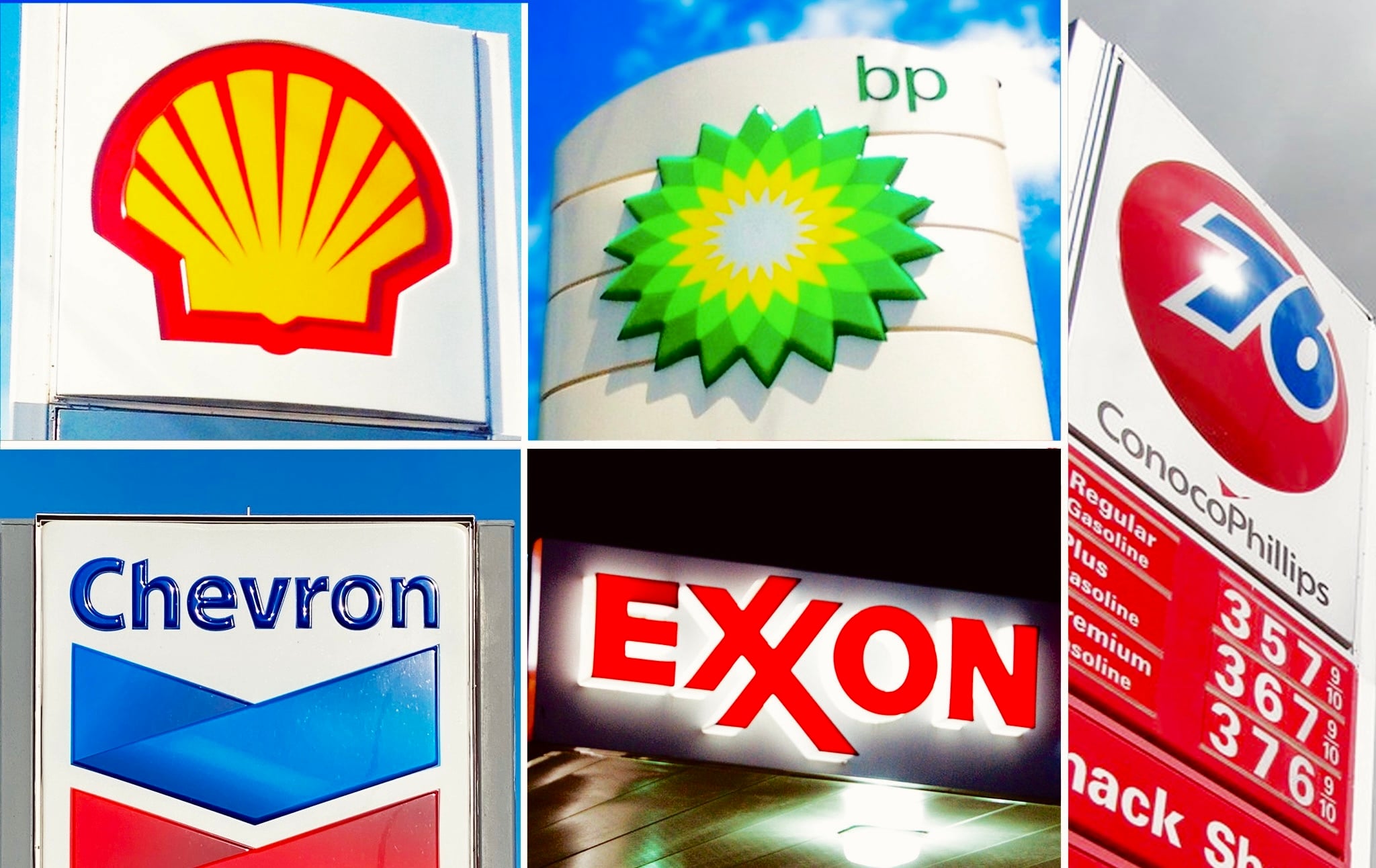
We have no choice but to take on the fossil fuel industry. Those who won't acknowledge this are peddling fake solutions to climate change.
In 2023, the Intergovernmental Panel on Climate Change reported that the world already had too much coal, oil, and “natural gas” to halt global heating at 2° Celsius. The report also said that over 2° Celsius, the risk of global “food insecurity” becomes “very high,” and we face a high risk of “limited adaptation” to “heat-related morbidity and mortality.” (Food shortages and fatal heat waves are, of course, only two of the impacts of climate change, all of which interact with and compound each other.) Yet in the past three years the world’s banks, governments, and private fossil-energy companies have poured an estimated $2 trillion into expanding coal, oil, and “natural gas” supply. Global newspaper coverage of climate change, never great to begin with, has fallen by half. The voices of the status quo will sneer that this is happening because “people don’t care about climate change,” but polling consistently shows that, even if climate is no longer the second-most salient issue in American politics (as it was in 2020), 66 percent of Americans are worried about the climate future. Swing voters reject Republican climate denial, moreover, and a supermajority supports the U.S. economy transitioning from fossil fuels to 100 percent clean energy by 2050.
Fossil fuels are expanding—and our media and politics are characterized by “climate hushing”—not because people don’t care about climate change, but because business interests and global elites want it that way. And by “business interests and global elites” I mean stakeholders both on the authoritarian right and the center-left. Some of the loudest and best-positioned voices in U.S. center-left politics are literally arguing that Democrats should pass policy that expands fossil fuels and never say the words “climate change.”
Perhaps the most underappreciated truth about climate politics is that, even if the liberals call for clean-energy development, both the authoritarian right and the center-left reject the phaseout of fossil fuels. And if the election of Donald Trump did anything, it gave these allies in climate and energy policy the license to protect the fossil-fuel status quo with impunity.
It may seem implausible to argue that liberals who are working hard to enable capital investments in clean energy could be the allies of the petroauthoritarian right. But they are exactly that if they support expanding fossil fuels—or even if they advocate for an “all of the above” energy approach, which means expanding both clean energy and fossil fuels like “natural gas” (which, let’s be real, should accurately be called “methane gas”). We could blanket the entire planet in solar panels, and power every last data center with nuclear power, but if we continued to use coal, oil, and gas, the temperature would continue to climb with no end in sight. Dismissing that physics as irrelevant, even if you purport to agree that “climate change is real,” is obviously a form of disavowal that borders on denial.
What allies the authoritarian right and the center-left is their commitment to protecting capital above all. Decarbonizing will likely create millions of new jobs in the U.S. and establish new industries and services worldwide. Economic studies show that phasing out fossil fuels and creating a net-zero economy inside ecological boundaries will lead to better economic outcomes than doing nothing. Climate impacts are already contributing to inflation, costing U.S. households between $400 and $900 per year, on average. And continued climate change will likely curtail economic growth. By one estimate it could make growth roughly 23 percent smaller than it would have been otherwise; by another it could worst-case contract the global economy 50 percent over the next 40-50 years. And these economic effects are already starting to occur. The costs of this summer’s heat waves and fires in Europe are projected actually to zero out the continent’s entire projected growth for 2026. But none of that poses much of a current financial threat to members of the global capital faction, which is to say ruling-class asset holders and rentiers, who can afford the current costs of climate change while watching their stock portfolios grow to record highs from the AI boom / bubble. However, asset holders and rentiers do face an economic threat from the phaseout of fossil fuels, and for the fossil fuel industry itself, that threat is existential.
To phase out fossil fuels, we need not only to stop investing in more fossil-fuel production, but also to wind down the production we already have, while building out global-scale clean energy, so that our world economy can be electrified to run on entirely decarbonized grids. This undoing of the fossil-energy system will devalue both the fixed and liquid capital in that system, creating what is known as “stranded assets.” Such stranding begins with not only oil wells, methane-fracking sites, and coal mines, but also their associated extractive infrastructure: offshore drilling platforms; all the world’s storage tanks and refineries; millions of miles of pipeline; storage facilities that contain coal and “liquid natural gas”; as well as the long-haul trucks and cargo ships that move fossil fuels around on land and sea. This will be challenging: together these machines and structures encompass the largest network of infrastructure ever built by humanity, reflecting tens of trillions of dollars.

If we strand these assets, much of the capital circulating through the financial system via investment and credit would also evaporate. The price of shares in fossil-fuel companies, and all the companies involved in the production and distribution of fossil fuels, depends on investor expectations of return—which is to say, on the expectations that claimed fossil-fuel “reserves” will be extracted, refined, and sold in the coming decades. If governments began to work together to phase out fossil fuels, those expectations would no longer pertain—shocking the energy sector, a pillar of the stock market, and likely threatening the value of most 401-K plans that have not yet divested from oil and gas majors. (Asset managers and index and pension funds hold massive shareholder positions in those majors. As of October 2025 Vanguard, for example, had $3.3 billion invested in coal.) And as in the stock market, so in the credit market. Worldwide, banks have invested nearly $8.7 trillion in fossil-fuel development since the Paris Agreement was signed. If the fossil-fuel economy came to an end, these banks might never see their loans repaid, catalyzing a financial cataclysm that that former investment banker and now Canadian Prime Minister Mark Carney—before he repealed Canada’s carbon tax and started approving pipelines—characterized bloodlessly as the “transition risk” of a “climate Minsky moment” that could “destabilize markets” and “spark a pro-cyclical crystallisation of losses.”
It is important to ask who is at risk from the transition. Who faces these “losses”? According to one of the most comprehensive studies of asset stranding to date, halting global heating would concentrate fossil-capital devaluation in the Organization for Economic Co-operation and Development, and, within the United States, the pain would be further concentrated among the very rich. In the U.S., 82 percent of the devaluation would hit the wealthiest 10 percent of households, and that loss, hardly affecting our wealth distribution, would amount to only 0.4 percent of the wealthiest households’ net worth. This is all the more true today, since the wealth of the top 1 percent surged to a combined $52 trillion in 2025, and the top 0.1 percent—about 260,000 people—have, in the past two years alone, accumulated more than 8,000 times as much money per household as the roughly 169 million people living in the economic bottom half of the country.
We need to apply a class analysis to the problem of stranded assets. Using such a lens, we see that the vast majority of Americans would be better off if we phased out fossil fuels and halted global heating. This is especially true if we also account for recent studies highlighting the risk that continued climate change is a much bigger threat to the economy than asset-stranding itself. I will just point again to the study by the U.K. Institute and Faculty of Actuaries which warned that, worst-case, the global economy could contract by half in 40 to 50 years on our current emissions trajectory. I will note too that their projection of course leaves out all the misery and death that isn’t measured by GDP.
We already have the technological and behavioral solutions we need to live affluent, modern lives without coal, oil, and gas. The core problem is that the phaseout of fossil fuels would catalyze a serious financial and lifestyle shock to the richest among us. But as a trade-off it would also raise people’s real incomes, making the vast majority of us better off. In a decarbonized and electrified net-zero economy—quite aside from avoided costs of worse heat waves, droughts, floods, storms, diseases, and so on—we would be paying much less for electricity, heating, and transportation, currently a huge chunk of people’s monthly bills. Healthcare costs would decline too, simply due to the public-health benefits of reducing air pollution. (We should think of high health-insurance prices as a sort of fossil-fuel subsidy.) And yes, fossil-fuel phaseout would help to mitigate global income inequality (no more private jets and white boats, for one thing).
All that said, it’s important to acknowledge that it’s low-key absurd to argue for fossil-fuel phaseout only by pointing to economic co-benefits. That hardly captures the trade-offs here. Because here’s the thing: if we’re going to halt global heating—at any temperature—we will need to phase out fossil fuels. And if we don’t halt global heating, much of the world will become uninhabitable.
Right now we’re on track to heat up around to 3° Celsius in the lifetime of kids currently in 1st grade. Let’s just think about that temperature a bit. At 3° Celsius, according to that 2023 report of the Intergovernmental Panel on Climate Change, for around three months of the year, the entire East Coast of the United States—from Maine to the Midwest and the Great Plains—and half of California would be exposed to “hyperthermic conditions that pose a risk of mortality.” Southern California, the Southwest, the Deep South, and Florida would be this fatally hot nearly half the year. And that’s just the heat.
The climate change engendered by 3° Celsius will likely remake the face of the world (for example, it’s already making the mountaintops bare by melting the world’s glaciers, which incidentally have provided drinking water to 2 billion people). 3 million years ago, during the Pliocene era, the planet was also about 3° Celsius hotter than it was in 1850. The Earth’s oceans were so much higher that the eastern coastline of what would become North America ended roughly one hundred miles west of where it is now. The Arctic (frozen during the human era before climate change) was covered in lush woods of pine and birch. Giant camels lived there. And it seems likely that, if fossil fuels heat the planet 3° by 2100, Earth’s current configuration will break down and be rearranged into something much closer to that Pliocene system, radically destabilizing human society in ways that are hard to imagine. But even that projection relies on a false sense of security, because the rate at which fossil capitalism is adding CO2 to the sky outstrips even the Paleocene–Eocene Thermal Maximum, the event with the highest release rate over the past 66 million years. And even that point doesn’t quite capture why we need to phase out fossil fuels. For the lifetime of a little kid born in 2019, 3° Celsius, or 2100, or whatever, is not an automatic end point to global heating. I will just say it again: the planet will continue to heat up, and the climate will continue to transform into something ever more inimical to human life, until we stop using coal, oil, and methane gas, at whatever temperature that occurs.
We all grow up in a culture that normalizes the environmental harms of fossil capitalism—fumes from car tailpipes, plastic containers in the trash can, the occasional news story about the extinction of a species we’ve never heard of, a hole in the ozone layer, and so on, all normal. Insofar as you think about the world using capitalist ideology, you’ll believe that we can use some combination of government regulation and technological innovation to address those so-called “environmental externalities” in a way that sustains corporate profits and allows the fossil-fuel economy (now the fossil-fuel/AI economy) to keep cranking. But the tricky bit about climate change is that it’s not simply an environmental externality. It’s not like the discrete cost imposed on one place, or one species, or one group of people (like turtles or coral reefs or “frontline communities” or “the poor,” human beings sacrificed on the altar of the fossil-fuel system). Climate change is not local. It’s planetary. It threatens the entire world, in our children’s lifetimes. That is why it is worth phasing out fossil fuels and remaking everything, even if it makes the rich less rich. Because the world is going to be remade in unimaginable ways if we don’t.
To be sure, this statement is contested. Fossil-fuel interests on the authoritarian right and “all of the above” energy advocates on the center left will insist that what I just said is “alarmism” or “catastrophism”—or they will scoff that we can just “adapt” to the so-called “impacts” of climate change. Well, these people are trying to fool us. I mean, it’s so blatant: dollars to donuts they’re either fossil-fuel executives or funded by fossil-fuel executives. You think they have the interests of the poor in mind? Anyway, it’s not “alarmism” to be alarmed by what I’ve already said—or by the fact that, for another example, multiple scientific studies now warn that a major tipping point—the collapse of a major ocean current, which could change the weather enough to “end life as we know it” in Europe—is at significant risk to be tipped as soon as the next decades. That is, if the world continues to use fossil fuels. Of course fossil-capital interests downplay (or simply ignore!) the harms of climate change, and attack the credibility of people who talk about the danger, because they are trying to fool us. And they are trying to fool us because, for them, it is a bridge too far to agree to stop destroying the world and consequently make the rich less rich. No—we can’t make the rich less rich! That would be “degrowth,” a fate worse than climate change itself.
Right now we have only a nascent class politics, which could build to something close to changing this situation. What we have is the rising awareness in this country that our current system is profoundly unfair and hanging most Americans out to dry. People overwhelmingly feel that it’s harder than it was for their parents to go to a good college, find and keep a good job, buy a home, achieve financial security, and raise a family. Majorities see billionaires as a threat to democracy. And this sense of decline and authoritarian creep under capitalism is leading to a rising embrace of socialism. Just two weeks ago, Gallup found that 45 percent of Independents have a favorable opinion of socialism, more than the 32 percent that have a favorable view of big business. 65 percent of Democrats view socialism favorably, while only 35 percent have a favorable view of capitalism. This emergent structure of feeling could be the ground for an era-defining shift.
We have a great deal of public support on climate change, too. According to researchers at the University of Chicago, expanding fossil fuel production is supported by only a minority of Americans, 42 percent (not coincidentally roughly the number of Americans who consistently vote Republican). Expanding U.S. natural gas exports is supported by even fewer Americans, only 37 percent. And a mere 19 percent support auctioning off public lands for oil and gas drilling. Furthermore, although they first want their elected officials to fix the problems that are harming them today, roughly half of registered voters say that climate change is either “extremely important” or “very important” to their vote. That share will only increase, the research suggests, as extreme weather increases. Of course, the disproportionate representation of red states in the U.S. Senate and the structure of the Electoral College together mean that popular majorities cannot drive our national politics, but one extensive 2025 survey found that even battleground voters who self-describe as “moderate” or “lean conservative,” and who earn under $75,000 annually, dislike Republican climate denial. Only 3 percent of these battleground voters “disagree” with eliminating fossil fuels. There is ample ground here on which to build solidarity and a groundswell of pressure from below.

Building this solidarity is the work of the climate movement. That movement is not just one thing, though; it’s a loose agglomeration of grassroots mobilizations, student and youth groups, nonprofits, foundations and donors, policy wonks and lobbyists, service-sector unions, and (at least in some conjunctures) clean-energy interests. And to be sure, right now that movement is fractured and needs to be rebuilt. Before Trump’s 2024 election, the coalition that coalesced around the Green New Deal had already started to crack over the passage of the IRA. At that point, people of color’s climate-justice concerns were sacrificed in the horse-trading of the law’s negotiations with Joe Manchin, then Senator from West Virginia. The triumphalism of the IRA’s biggest advocates, who overpromised about the law’s durability and emissions reductions, helped to reduce the political urgency that had driven climate activism since the Intergovernmental Panel on Climate Change’s 2018 Special Report on 1.5° C. After Elon Musk bought Twitter a few months later, waves of climate denial and disinformation started to flood the website, and—refusing to provide content for a Nazi sympathizer—many prominent climate voices left the platform, which had once been used to organize and drive media attention to climate change. Then many young climate activists, especially in Europe, started focusing their work on trying to stop the genocide in Gaza.
Then, of course, Trump won the 2024 election. Once he took office, while launching dozens of authoritarian attacks on civil society, his administration froze $20 billion that Congress had allocated to NGOs for climate work, suppressed and defunded American climate scientists, and tried to destroy the institutions where science was practiced, calling them “sources of climate alarmism.” The regime has also done everything possible to suppress U.S. clean-energy production and expand fossil fuels. A partial list: they weakened emissions rules for power plants; fast-tracked permits for pipelines; expanded federal and offshore drilling access; ordered the Justice Department to take action to “stop the enforcement” of state regulations of greenhouse-gas emissions; approved massive new liquefied natural gas (LNG) export capacity; threatened foreign nations with tariffs to coerce them into buying that gas; and invaded not one but two sovereign nations to open up their fossil-fuel reserves to American oil and gas companies. The Republicans in Washington have been aided by right-wing courts, one of which awarded the fossil-fuel company Energy Transfer a $345 million judgement against Greenpeace for its participation in the 2016 protests against the Dakota Access Pipeline — a judgement which, if it stands, would not only destroy the storied environmental group, but also “establish dangerous new legal precedents that could hold any participant at protests responsible for the actions of others at those protests,” as Greenpeace puts it.
As a climate activist, I can say that watching all this go down has been, shall we say, very difficult. Many of my comrades are exhausted and even despairing. But we are still here, and we are still determined. And now two important shifts in American politics are generating new excitement in the movement. First, the Trump regime has become historically unpopular, which opens up an opportunity to connect Trump’s fossil-energy policies to high prices, as well as the people’s economic precarity and their perception that the U.S. economy is rigged against them. Second, there is a growing cross-partisan backlash against the technofascists, fossil capital’s great climate-ignoring allies alongside the liberal Abundists. We are seeing supermajority opposition to the construction of data centers. We are seeing people spontaneously fight back to try to save their communities. This supermajority opposition to AI and this new openness to activism, combined with roiling dissatisfaction with the current economy, provides a new and potentially fruitful sphere for organizing.
So here are three things you can do, from quickest to most time-consuming. Quickest is this: call your elected officials—your House Representative, two Senators, Governor, Mayor, and State Assemblymember—and tell them you care about climate change and that you want them to pass policy to build clean energy and phase out fossil fuels. These calls are logged, and they matter more than people think. Call every few weeks or so. Get your friends to do this too! Second, and medium effort: join your local chapter of the Democratic Socialists of America (if you have such a chapter and you haven’t already joined) and go to a few meetings. Make some new friends. Be the person who works to keep climate change front and center on the DSA agenda. And, third, the biggest commitment on this list: get involved with the local fights over the deployment of data centers (anti) and clean energy (pro). Fossil-fuel advocates in community meetings are all too often astroturfed and well prepared. Your counter voice in meetings and on local Facebook group pages is needed! If you get really into it, you can even do deep canvassing training, organize your neighbors, and win some victories of your own.
Finally—to end on a more personal note—always remember that it’s okay, it’s totally normal, if thinking about climate change might make you feel bad sometimes. It can be scary to consider what’s happening to the planet, alienating to think about the political situation, and just simply overwhelming to face the forces of history. It definitely takes courage and moral fortitude to do this work. I try just to focus on what I can control, and not to worry about my impact, simply trying to do the best I can because, I don’t know, I want to be the kind of person who protects life rather than property. And you know what about that? It’s not just me. There are many more of us out there than they want you to think. And together we can turn this ship around.