The media’s sleaziest propagandists are mad about the recent aid mission to Cuba, smearing activists who brought supplies. They’re trying to distract from the real story: the inhuman denial of fuel by the U.S.
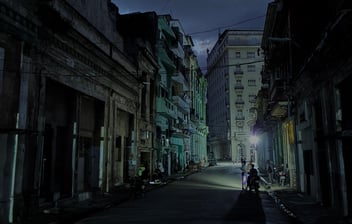
The two of us just returned this week to New Orleans from Havana, Cuba. We had traveled there alongside hundreds of volunteers from around the world on the Nuestra América aid mission, delivering tons of desperately-needed supplies to a country suffering under a U.S. blockade of fuel (in addition to the preexisting U.S. trade embargo). Current Affairs went along to report on the convoy and to document firsthand the effects of the blockade on ordinary Cubans. A longer report will be appearing in the next print edition of our magazine, but what we saw was harrowing. The whole country plunged into a blackout while we were there, because the fuel shortage brought down the national electrical grid. The entire city of Havana was in almost total darkness, with only a handful of solar or generator lamps shining out.
We have both seen things that will be permanently burned into our minds. People moving around in the shadows like ghosts. Mounds of foul-smelling trash in the street, with sanitation workers in the few running trucks overwhelmed by the task of collecting it—and worse, old men picking through the heaps, looking for anything they can use or sell. Live fish dying slowly in tanks filled with stagnant green water. Shopkeepers losing all of their refrigerated and frozen food. Taxi drivers calling out desperately for a fare, because tourism to the island has shrunk to a trickle. Restaurants having to close in the middle of a busy dinner service after losing power mid-meal. The look of worry on medical workers’ faces, as they contemplate rationing their remaining antibiotics or painkillers.
Our government is systematically torturing the Cuban people. It is doing so purposefully in order to extract concessions from the Cuban government. (Not human rights concessions, mind you, but favorable investment terms.) For a rich country to punish a poor country like this is morally grotesque. The issue is not difficult to grasp.
The Nuestra América convoy, organized by multiple groups including the Progressive International, CODEPINK, and Global Health Partners, is a noble effort to both relieve some of Cubans’ pain and draw attention to the basic obscenity of the U.S. fuel blockade. The people we met on the convoy were sincere, principled humanitarians who acted because they were angered by the unnecessary suffering the U.S. government is inflicting on Cubans.
Some U.S. media coverage has been fair in representing the Nuestra América mission. ABC News ran a straightforward story documenting that “solar panels, food and medicine to treat cancer are among the products donated to the island, which has been brought to a near standstill since Trump imposed an energy embargo in January, exacerbating a five-year economic crisis.” The Associated Press, too, has done solid factual reporting on the part of the mission traveling by sea: “A ship bringing humanitarian aid to Cuba arrived in Havana on Tuesday loaded with solar panels, bicycles, food and medicine as the island's economic and energy crises deepen.”
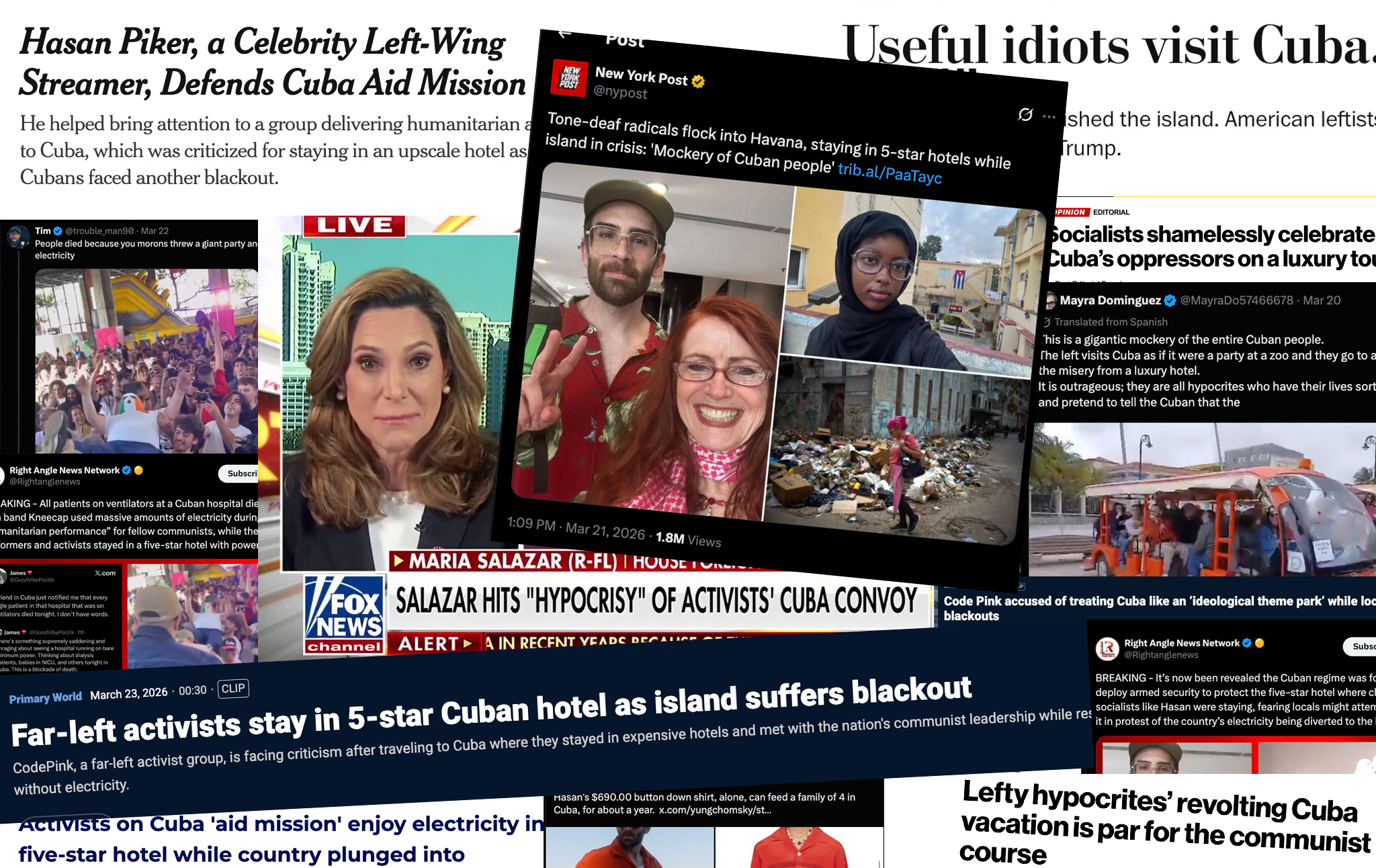
But on social media and in the right-wing press (as well as supposedly respectable liberal papers), the story of the convoy’s work was totally distorted. In the sporadic periods when we had internet access in Cuba, we realized that conservative media had spun the aid mission into a vanity trip, ignoring the issue of the fuel embargo and its effects. Much of this criticism can be waved away as noise, since the mission’s purpose of delivering medical supplies and solar panels is difficult to criticize. (Besides, a hit piece in the New York Post is basically a badge of honor.) But it is worth correcting some of the more blatant lies, which distract from the horror the U.S. is inflicting on Cuba. Examining the right-wing distortions also offers a useful study in how propaganda works.
The detractors’ narrative goes like this: “tone-deaf radicals” were “flocking into Havana,” staying in 5-star hotels while Cuba is in crisis. There, they “spent more time broadcasting their exploits to millions of followers than doing anything that might actually help the average Cuban,” as James Kirchick of the Free Press puts it. According to the editorial board of the Bezos-owned Washington Post, the Nuestra América volunteers were “useful idiots” who don’t understand that “the best way to help the Cuban people, of course, would be to free them from a dictatorship that has failed to meet their needs for more than half a century.” For the Daily Wire’s Ben Shapiro, the group were “morons” and “moral derelicts” engaged in “poverty tourism.” Popular Twitch streamer Hasan Piker has gotten the brunt of the attacks, criticized in the Daily Mail for wearing an expensive designer shirt and Cartier glasses during the trip. (If only he’d spend his disposable income on, say, traveling to a blockaded country to deliver aid.) The Irish rap group Kneecap, too, has come under fire for performing onstage in Havana, with one Florida representative even claiming the band threw a special concert and used so much electricity they “caused a power outage at a nearby hospital,” thereby killing patients whose ventilators were shut off. Overall, the New York Post declares, the trip was a “revolting Cuban vacation” put on by “lefty hypocrites.”

A large chunk of this negative coverage just consists of cheap insults (“idiots,” “morons,” “derelicts.”) In his article, Kirchick even stoops to 1950s-style misogyny, calling the female volunteers working with CODEPINK “shrieking harpies.” These kinds of slurs tell us nothing about the actual questions at issue, which are (1) whether the convoy participants are right about U.S. policy and (2) whether their mission was valuable. If the convoy participants are right about the policy, and their mission was valuable, then that’s what matters, regardless of whether it involved “shrieking,” which it didn’t.
Another angle is sly insinuation, as the writers use phrases like “ostensibly to help a population” (Free Press) or “under the guise of handing out 20 tons of humanitarian aid” (New York Post) to imply that aid wasn’t actually delivered, or wasn’t the primary purpose of the mission. They don’t actually come out and say it, of course, because they know the claim is contradicted by the facts. This is the worst kind of weaselly sophistry.
Other points made in these articles are just irrelevant. “The reality is that the U.S. has not hurt Cuba nearly as much as the communist dictatorship has,” says the Washington Post. No evidence for this claim is forthcoming; it’s just asserted, even though it’s highly contestable, since the U.S. has had a deliberate policy of economically strangling Cuba since the 1960s. Even Birsin Filip of the vehemently anti-communist Mises Institute admits this, writing:
The American government has always acted as an aggressor towards Cuba and its citizens since the Revolution prevailed in 1959, employing a wide variety of tactics in an effort to destabilize and destroy its socialist regime. During that time, no American president was receptive to the idea that Cubans are merely seeking a peaceful co-existence, free of any hostility, with the US. Consequently, Cuban companies in every sector of the economy have been forced to endure a crippling economic blockade, which prevents them from accessing raw materials and importing parts from the US.
But more importantly: the point is irrelevant to assessing whether the current U.S. oil embargo is justified. For the sake of argument, let’s set aside the facts. Let’s assume that the Cuban government was 100 percent responsible for the state of the Cuban economy before the January 29 fuel blockade, and that the longstanding prior U.S. embargo had zero negative impact on the country. It would still be true that the Trump administration’s fuel embargo was a criminal act, because turning off the power of a poor country is cruel regardless of how the country’s poverty was caused. Nothing can justify inflicting the suffering we saw in Havana.
Because an argument about the fuel blockade is so difficult for proponents to win (it’s clearly inhumane), and delivering humanitarian aid is unambiguously helpful, it’s not surprising that the right-wing press has tried to change the subject and focus on the hotel that Hasan Piker stayed in, or Kneecap’s performance. But even on these side issues, the right-wing attacks were totally misinformed about what actually happened.
For instance, a Twitter account called “Right Angle News” racked up 1.3 million views on a post claiming that it had “now been revealed the Cuban regime was forced to deploy armed security to protect the five-star hotel where champagne socialists like Hasan were staying, fearing locals might attempt to storm it in protest of the country’s electricity being diverted to the hotel.” The only proof of this was a blurry picture of a security guard at the hotel. There is no other evidence, because this is simply a piece of fake news, manufactured from whole cloth.
Much was made of the fact that delegation participants stayed at a “five-star hotel” in Cuba, but here, too, facts were missing. The delegations didn’t have many options. The U.S. government places severe restrictions on where Americans can stay in Cuba, requiring them to use privatized hotels rather than public ones, in an effort to empower private corporations and starve the state. In Havana alone, there are over 90 locations listed on the State Department’s “Cuba Prohibited Accommodations List,” and if you violate the ban, the penalties are heavy: “up to 10 years in prison,” “$250,000 in individual fines,” or both. To be clear, this is an insane and outrageous law to have on the books, but it is currently the law. The other alternative would be to stay in “casas particulares,” essentially Airbnb style “guest houses” owned by a single Cuban family. But this isn’t a practical possibility when you have hundreds of volunteers: trying to coordinate group activities would be impossible, since not all of the homes would have working internet or phone service, and all those people traveling back and forth to different houses would require far more energy than one centralized site.
There aren’t many hotels in Havana that are legal to stay at and can also accommodate delegations of hundreds of people. CODEPINK (with which both Piker and Current Affairs traveled) chose the Iberostar Marques de la Torre, which is owned by a Spanish company. (Not, as the New York Post claimed, the “Gran Hotel Bristol, a luxury lodging operated by the Cuban government.” That is simply false, and should be retracted, especially since people online are using it to claim Piker violated U.S. law and calling for his arrest.) It met both the legal and logistical restrictions, and is also centrally located, so the delegation could walk instead of having to travel around in buses using fuel. (You can’t win, though, because critics online still attacked the delegation for taking buses from the airport.) Even the “five star” designation is a little misleading. As any travel forum can tell you, a hotel rated “five stars” by the Cuban government is not necessarily what Americans would think of when they imagine a “five star hotel.” The Iberostar is certainly much more comfortable than the accommodations of most Cubans, and the delegation booked it only because there were no practical alternatives, but it’s a fairly normal hotel, which means the criticism of Piker is essentially that he “stayed in a hotel.”
Similarly, much was made of the fact that the hotels were able to keep their power on while the rest of the country was plunged into a blackout. But here again, this is the deliberate result of U.S. policy. The U.S. has not blocked all fuel to Cuba. Private hotels are allowed to import fuel to run their generators, as part of a policy that Marco Rubio says is “entirely designed” to put the private sector in a “privileged position.” As Reuters reports, 1.27 million gallons of fuel have gone to private businesses in Cuba as part of a “Trump administration plan to give private business a leg up over state-run enterprise.” It has to be understood that the U.S. policy is meant to starve the Cuban public sector (including hospitals, schools, and garbage pickup) while ensuring that foreign-owned corporations suffer as little harm as possible. Cuban president Miguel Díaz-Canel has actually contributed to the confusion on this point by stating that no fuel has entered Cuba, when he should have noted that the Trump administration is deliberately crafting exemptions, which are calculated to create the very situation (lit-up private hotels amidst a blacked-out city) that right-wing news claimed was an example of leftist hypocrisy. Every analysis of Cuba should constantly keep in mind that the purpose of U.S. policy is, and has been since 1959, to force the government to adopt a capitalist model that will be profitable for American corporations (not to free political prisoners and strengthen electoral democracy, which the U.S. does not care about). U.S. rules are carefully crafted to push Cuba in the direction of privatization, and it is the U.S. that has produced the grotesque inequality between the conditions of private hotels and the rest of the island.
The same “Right Angle News” account repeated the false claim that “all patients on ventilators at a Cuban hospital died after the Irish band Kneecap used massive amounts of electricity during a ‘humanitarian performance’ for fellow communists.” In fact, the hospital in question—the Hospital Clínico Quirúrgico “Hermanos Ameijeiras”—has confirmed on its official Facebook page that “There was no deceased in our Institution associated with mechanical assisted ventilation failures” at that time. In other words, no patients on ventilators died. Nor, for that matter, was it Kneecap’s event “for fellow communists.” The concert was a longstanding Cuban music festival, with mostly Cuban performers, where Kneecap performed a roughly eight-minute set. It would have gone forward with or without them, and it’s pretty perverse to attack Kneecap for giving a little music and excitement to people who are going through a terrible time.
Criticism of the concert-goers was part of a general tendency to characterize convoy participants as somehow sucking resources from Cuba in its time of need, eating food and using electricity needed by the people. This particular criticism is not just wrong, but also deeply harmful, because one major takeaway of our time in Cuba is that Cubans urgently want more Americans to come and visit the island and spend money there. Because Cuba isn’t allowed to export much, tourism has become one of the key sectors of its economy, and the drying up of the tourist trade is destroying so many people’s livelihoods. They do not think of visitors as parasitic. They want the hotels, restaurants, nightclubs, and taxicabs to be full. Right now, people are staying away, and if they think that by doing so they’re helping Cubans, they are wrong.
Other critics chose to focus on the price of Hasan Piker’s shirts. Now, one can make the argument that it’s distasteful to wear expensive clothes in a poor country. Yet again: the vastly more important story here is the U.S. strangling the Cuban economy, and the effort made by convoy to bring needed supplies. It does not make a difference to these things whether Piker wore an expensive shirt. But even if we are to make the claim that it’s distasteful, or immoral, to wear pricy clothes in the vicinity of poor people, what does that say about the rich of the United States? We have severe homelessness in the U.S. (worse than in Cuba). Aren’t the ostentatious displays of wealth by the U.S. rich just as immoral? If a shirt is bad, what about a president who owns his own sprawling golf resorts?
This kind of irrelevant criticism might be expected of the right-wing press. But even the liberal New York Times started talking about Piker’s perceived hypocrisy rather than the blockade. An article entitled “Hasan Piker, a Celebrity Left-Wing Streamer, Defends Cuba Aid Mission,” which somehow required the contributions of no less than three reporters, buries the lede, which is that “There has been relatively little public response from Democrats to the humanitarian crisis and monthslong U.S. blockade on Cuba.” That should be the headline.
There are no real arguments here. There are only distractions. The political right desperately wants to divert attention away from the lethal consequences of U.S. foreign policy, and the matter of culpability for the crime of collective punishment the U.S. is committing. They want us to talk about Hasan Piker’s shirt, or whether communism produces economic efficiency, because these narratives get us away from the issue of our own government’s policy and its effects.
The effort to characterize the convoy participants as “champagne socialists” also ignores what they were actually doing in Cuba, namely bringing aid. At the Nation, journalist David Montgomery—who was also on the ground in Havana—reports that “the cargo hold of Code Pink’s charter bore 6,300 pounds of medical supplies worth $433,000, shipped by Global Health Partners.” And that’s just one of the several delegations that composed the Nuestra América mission as a whole. In addition, Montgomery reports that “an Italian delegation delivered about five tons of medical supplies to a surgical hospital,” while the San Francisco nonprofit Global Exchange contributed “$20,000 worth of specialized cancer drugs.” CODEPINK itself has released a fact sheet with more statistics: “Around 1100 lbs of medical supplies from Brazil, coordinated by the Brazilian Front of Solidarity with Cuba,” “Menstrual health kits for approximately 1,300 women, organized by a solidarity coalition in Mexico,” and so on. Altogether, it adds up to “500 people from more than 30 countries bringing an estimated 20 tons of aid.”
One of us was there at the Salvador Allende hospital when a Puerto Rican delegation brought their donation in: a row of huge suitcases, each of them holding 154 pounds of medical supplies, totalling “1,848 pounds in all, including medication for high blood pressure and diabetes, antibiotics, ointments for rashes and burns, vitamins, pain medicine, and more.” To be clear, this is a small amount compared to what Cuba, a nation of over 9.7 million people, needs. But it wasn’t small to the healthcare workers we met there. You could see in their faces that they’d been struggling, and that this came as a relief. It was the same with individual Cubans. “In Havana today I saw an old woman with a painful injury burst into tears of joy when she got a bottle of Advil,” writes comedian Kate Willett, who organized our media delegation. The same kind of thing was happening all over the city.
Individual members of the convoy had their own aid projects, too. We spent time with Gerard Dalbon, a member of New York City’s DSA chapter who was single-mindedly focused on solar panels and batteries. With the help of crowdfunding donors, he had personally bought around $2,000 worth of the devices and stuffed them all into two suitcases. In CODEPINK’s group chats, he was worried about getting through airport security, since his bags full of wires and electrical thingamajigs did look somewhat suspicious. Over the next few days, he donated some of them to LGBTQ organizations (“to power their fridge”), the Callejon de Hamel public cultural center (which showcases Yoruba and Santeria traditions), the Afro-Cuban community in Guanabacoa, a local mosque, and a Palestinian doctor who lives and works in Cuba.
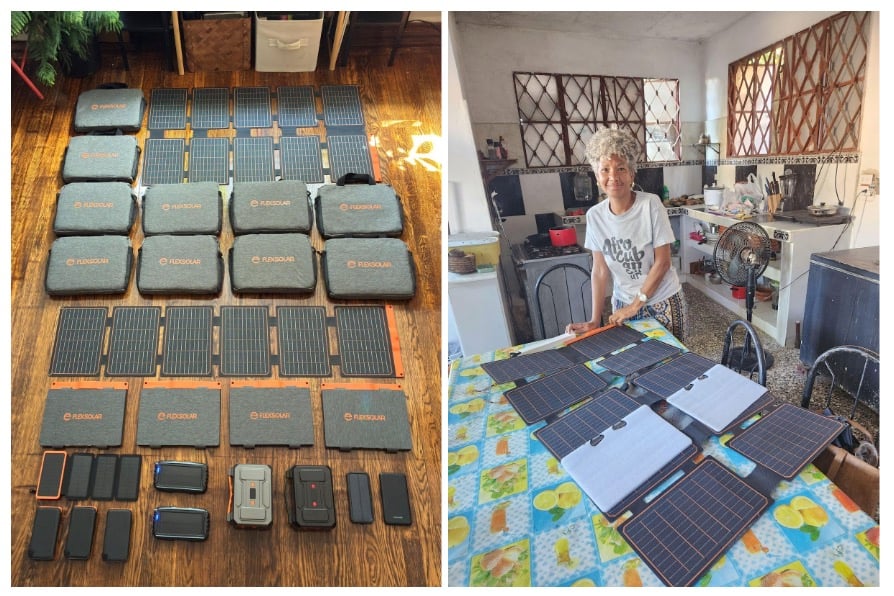
Photos: Gerard Dalbon
And then there’s James Ray, another volunteer we met along the way, who’s working on masks. As it turns out, simple medical masks are one of the best things you can bring to Cuba, because they’re small, cheap, lightweight, and can directly save lives. James has been talking to medical students in Havana, and together they’ve done the math: to equip the city’s largest hospital for a year, it would take about 40,000 masks. At the time of writing, he reports that he’s already secured the funding for 5,000 of them, and is working with “mask bloc” charities to get the full 40,000 to the island in the near future.
Those are just two volunteers from among hundreds, who we happened to talk to. Virtually everybody had their own projects. These are the extraordinary people that professional liars at the New York Post and the Free Press, who have never left their desks and risked anything for a cause they believe in, are attempting to slander and belittle.
The good news is, the propagandists are losing. A new YouGov poll, released on March 16, shows that 46 percent of people in the U.S. disapprove of the Trump administration’s oil blockade on Cuba, while only 28 percent support it—and that was before the Nuestra América mission and the journalists aboard showed the world what U.S. sanctions are really doing to the Cuban people. That mirrors the results we’ve been seeing in polls about Gaza, where more Americans now sympathize with Palestinians than Israelis, and about the war on Iran, which the majority opposes. Aggression and imperialism are losing across the board. And so, like any cornered animal, their supporters in the media are lashing out. But the lies and distractions don’t hold up to scrutiny, because the facts are so stark and obvious on their face. It doesn’t matter how you spin it: the fuel blockade is an indefensible crime, and we should all be glad that people are going to Cuba and doing their best to oppose it. The time when you could write a newspaper column and convince people that the activists, and not the U.S. government, are the problem, is over.