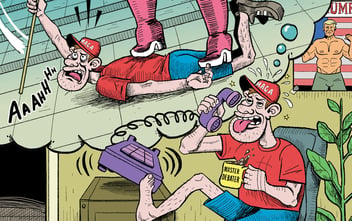
Our politicians refuse to provide basic services, but they’ll let us buy guns through the mail and violently shit our pants. These are the problems you get in a failed state.
Suddenly, the word enshittification has become literal. Before this month, Americans already had more than enough problems to worry about, from food and fuel costs to a heinous and seemingly never-ending war with Iran. But now, we’ve got a Biblical plague of diarrhea to contend with too. It’s not the first of its kind, but it’s hitting the national bowels especially hard, aided by the dismantling of regulations and public health networks across the country in the 2020s. Meanwhile, our politicians are too busy with their own reckless profit-making schemes to field much of a response. So as the shit-storm spreads across the map, it’s revealing some critical fault lines in the American state itself.
“Plague of diarrhea,” of course, is dramatic language. The Centers for Disease Control (CDC) refer to our latest crisis with more scientific terms, calling it a “multistate outbreak of cyclosporiasis.” In other words, more and more people are getting infected by tiny parasites of the Cyclospora genus. They’re single-celled organisms, not much to look at under a microscope—just little red circles. But they have a knack for getting into fruits and vegetables through contaminated irrigation water, and they’re durable little rascals, resistant to bleach and other chemical cleansers. Once a human ingests them, they wreak havoc on the digestive system. The most common symptoms are “watery diarrhea with frequent and sometimes explosive bowel movements,” along with painful stomach cramps; not life-threatening, but still pretty miserable to deal with.
The first cyclosporiasis outbreaks appeared in the Midwest in late June, but now the CDC reports that the illness has spread to at least 34 different states, with around 7,000 individual cases so far. Michigan has been the hardest hit, with around 3,700 diarrhea-stricken individuals there alone. It’s gotten so bad that Dr. Abdul El-Sayed had to put on his “public health director” hat and make an ad about cyclosporiasis as part of his ongoing senate campaign. On the CDC’s map, there are thousands more cases as far south as Texas and as far west as Colorado; in Ohio, they’re dealing with a bad case of the Cleveland Browns.
Like many public menaces, though, the diarrhea parasite got a big helping hand when the Trump administration started smashing the federal government to steal the copper wiring in the walls. As CNN recently reported, the CDC’s ability to respond to the outbreaks “has been undermined by massive budget and staffing cuts under President Donald Trump,” with around 25 percent of the agency’s workforce laid off in 2025. Predictably, this has made it harder for the remaining scientists to identify and track the parasites quickly enough to make a difference. Last year, Trump’s government also slashed the workforces of the U.S. Department of Agriculture and the Food and Drug Administration, leading to fewer health inspections at farms and processing plants. And recent reporting in Wired shows that Taylor Farms, the produce company whose lettuce has been most directly linked to the cyclosporiasis outbreak, spent more than $2 million on political lobbying in 2025, nearly all of it to Trump-aligned super PACs and other “anti-regulation” conservative groups. Clearly, they got the deregulation they paid for, and now everyone’s toilets are paying the price.
But let’s be fair here: it’s not just the Republican Party to blame. Back in 2024, the Biden administration also did its share of slashing and burning to the public health infrastructure. As CBS reported at the time, Biden’s government “quietly made significant cuts to planned testing for germs across America’s food supply,” running “54,000 fewer lab tests” in 2024 compared to previous years and cutting listeria detection by half—only for a high-profile listeria outbreak to immediately happen at a Boar’s Head deli meat plant. So the Democrats have also played their role in creating what Current Affairs contributor Bryce Greene calls “the bipartisan pro-diarrhea lobby.”
The cyclosporiasis story is a climate story, too. Like a lot of pathogens, this parasite does better in warm weather. Experts like microbiologist Don Schaefer, who was interviewed recently by the New York Times, have speculated that “higher temperatures could extend its season,” along with creating heavy rainfall and flooding that allows poop-infused wastewater to spread around more easily. If you’re a microscopic organism hoping to sneak into some lower intestines, you couldn’t ask for a better set of circumstances.

Don’t worry, though, citizen! When in doubt, you can always shoot the diarrhea bug with a gun. Your government won’t check to see if there’s fecal matter in your salad, but it will help you get some cold, hard steel into your hands. Through the mail, specifically.
It’s difficult to picture Donald Trump firing a gun, but like most Republicans he’s enamored with them, whether he’s fondling a Glock at a store in South Carolina or fantasizing about shooting someone on Fifth Avenue. In his second term, he’s been getting rid of gun regulations left and right, even legalizing “forced reset triggers” that allow semiautomatic rifles to fire rapidly like machine guns. But the most dramatic change might be the administration’s proposal to scrap U.S. Postal Service rules against shipping guns through the mail, together with the requirement to conduct an in-person background check when someone buys a gun. If those two changes go through—and despite congressional Democrats’ objections, there isn’t much they can do to prevent it—it will be perfectly legal to buy a gun online and have it shipped directly to your mailbox, without ever interacting with a dealer.
This is deranged, and it doesn’t take a Second Amendment lawyer to see why. The prohibition on sending guns through the mail has been in place since 1927, and it’s a critical safeguard: under the current system, you can buy a gun through a catalog or a website, but you’ll need to have it shipped to a store with a Federal Firearms License (FFL) and pick it up in person. The clerk at the counter can then check if you are the person you claim to be, or if you’re visibly drunk, or muttering “I’ll show them” under your breath, and refuse the sale if something seems sketchy. In fact, an added background check requirement was put in place in 1968 after Lee Harvey Oswald was able to order his Mannlicher-Carcano rifle through the mail, which turned out to have somewhat negative consequences. Under the new system, you could easily be a kid using your parent’s ID on the internet, or have serious mental issues that would be visible in-person, and still get a weapon with ease.
You can picture it now: you wake up on a Saturday morning, stumble into your slippers, and check the mailbox. Inside, you’ve got the electric bill, a couple of catalogs, maybe a postcard from your Aunt Agatha’s trip to Vegas. If you have exceptionally good taste, you’ve got the new print issue of Current Affairs. Oh, and also a Taurus Judge revolver with a 13-inch extended barrel, just sitting there in a cardboard box. Or possibly an AR-15 with a 100-round drum magazine, or the infamously cheap Hi-Point C9 pistol, available for just $129.99. Any of the above can be purchased on a “shoot now, pay later” installment plan at GrabAGun.com, the self-proclaimed “Amazon of guns,” and they offer 24-hour shipping. Although even this might be a best-case scenario, since the U.S. also has a growing problem with “porch pirates” who steal mail from people’s doorsteps, so if you were able to order a gun to your home, there’s no telling where it might end up.
Given their track record, you might start to suspect there’s an element of financial gain involved here for the Trump inner circle, and you’d be right. As Salon reports, the executive board of GrabAGun includes none other than Donald Trump Jr., who owns at least 300,000 shares of the company’s “PEW” stock and even rang the bell at the New York Stock Exchange when it went public last year. So any decision the federal government makes about gun policy results in a direct financial benefit for Trump Jr., especially when it concerns the exact business model of the company he works with. The conflict of interest couldn’t be more blatant: when regular Americans’ lives are threatened by an increase in gun violence, the Trumps make money.

These two cases—shooting and shitting, with explosive force from both ends—might not seem to have much in common, apart from their basic absurdity and horror. But when you think about it, they both illuminate the same structural problems. What we’re looking at is the degradation of state capacity. In his 2003 book State Failure and State Weakness in a Time of Terror, the influential political scientist Robert I. Rotberg provided a useful rubric for spotting the hallmarks of a failed state, and it’s disturbing how many of them sound familiar from today’s news. “When a state has failed or is in the process of failing, the effective educational and health systems are privatized (with a resulting hodgepodge of shady schools and questionable medical clinics[…])” Rotberg writes, “or the public facilities become increasingly decrepit and neglected.” Failed states “can no longer deliver positive political goods to their inhabitants,” chief among them a reasonable guarantee of safety and public health. Those are the most basic measures of what a state is for.
Well, the United States may not have failed yet, but it’s definitely starting to emit worrying creaking sounds. Ever since the end of the New Deal era, successive administrations—whether conservative Republicans or liberal Democrats—have made an ideological decision to reject state capacity as a concept, and sell off more and more to the private sector. Medicare is increasingly administered through for-profit “Advantage” plans, airports are outsourcing their security from the TSA to private firms, charter schools are displacing public ones, and there are even active policy discussions about privatizing the U.S. Postal Service. Recall what Pete Buttigieg said when there was a shortage of baby formula in 2022: “This is a capitalist country. The government does not make baby formula, nor should it.” Year by year, politicians like that have abandoned the notion that the government can or should provide basic services. So now, under Trump, we’ve wound up at the logical conclusion of deregulatory, small-government thought: the state doesn’t check for parasites in the lettuce or object to you sending a .357 magnum through the mail, either.
In the 1930s, President Herbert Hoover had the famous slogan about “a chicken in every pot and a car in every garage.” Today, we’ve got diarrhea in every pot and firearms on every doorstep, or soon will. Every state has flaws and failings, but these are problems you’d expect to find in the post-Soviet “stan” countries in the 1990s, not the wealthiest nation in the world’s history. The United States is in bad shape, precisely because we’ve elevated free markets and business interests and dismantled the state. There is still time to reverse course; as we’ve seen in Zohran Mamdani’s New York City, there’s no reason the government can’t be used for its proper purpose, to make people’s lives better and oppose the companies and oligarchs who want to prey upon them. But until we learn that lesson and implement it on a national scale, the United States’ soundtrack may be a lot of groaning and flushing, punctuated by gunshots.