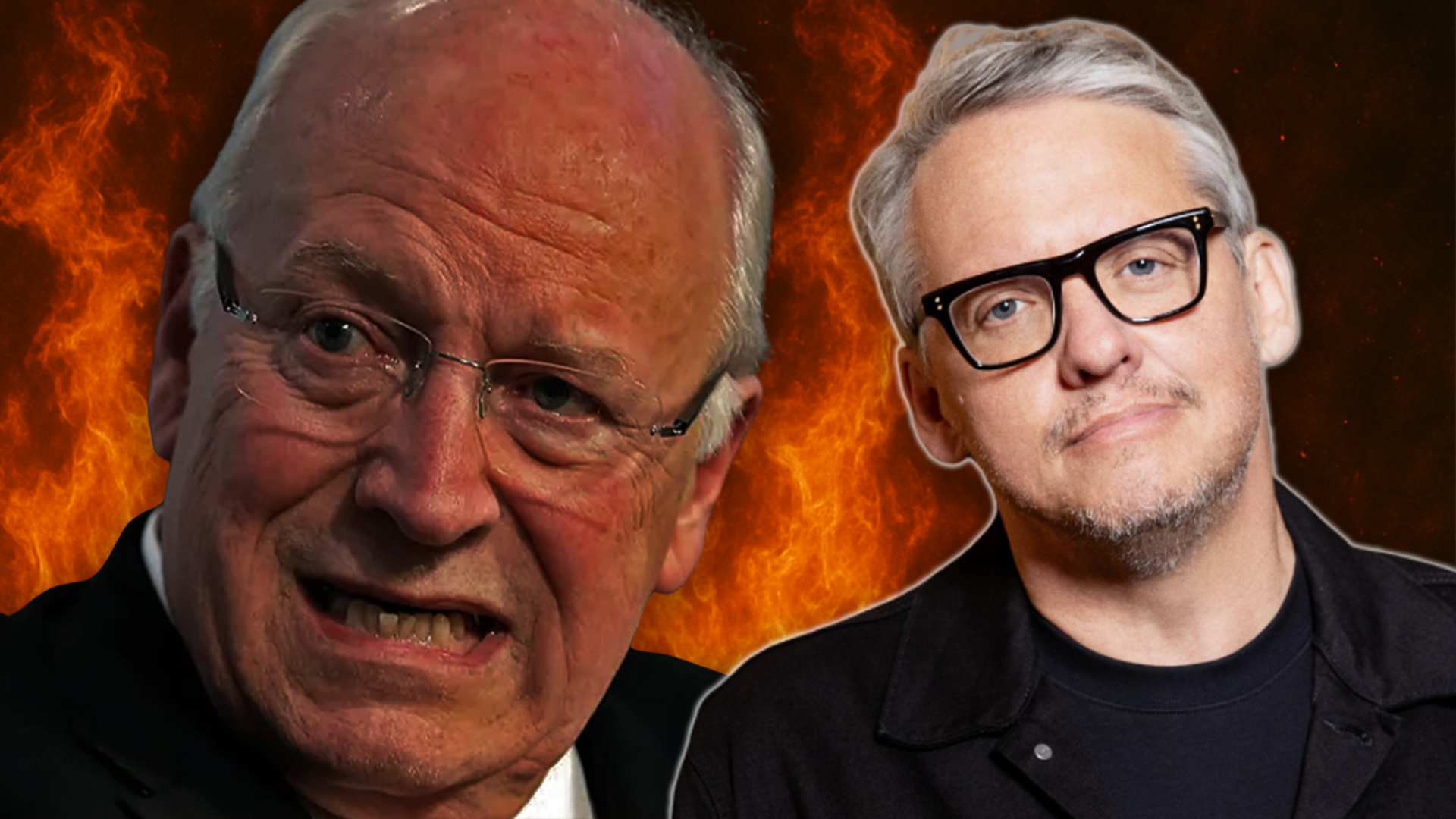
Dearly beloved, we are gathered here today to mark the passing of a professional liar, war criminal, and mass murderer. Dick Cheney is dead. As you read this, his co-conspirator George W. Bush may be reading his eulogy in Washington National Cathedral. Yet the politics Cheney represented live on—and the media are busy trying to whitewash his record, depicting him as an honorable American statesman. Today, on the day of Cheney’s funeral, we’re joined by Adam McKay, the director of 2018’s Vice, who sets the record straight.
Nathan J. Robinson
There was no one I’d rather talk to about the life of Dick Cheney after his death, and I was hoping you could give us a bit of a refreshing perspective. I just want to start here by reading you a little bit of the mainstream media coverage of Dick Cheney’s death. The New York Times’s headline: “Dick Cheney, Powerful Vice President and Washington Insider, Dies at 84.”
A former Defense Secretary and Congressman, he[...] was an architect of policies in an era of war and economic change[...] A consummate Washington insider, he was an architect and executive of President Bush’s major initiatives: deploying military power abroad to advance the cause of democracy, championing free markets and deregulation at home, and strengthening the powers of [the] presidency.
The Atlantic went with “Dick Cheney didn’t care what you thought. The former vice president’s indifference to approval made him a boogeyman for both the left and right.” And the Wall Street Journal ran an obituary by a guest contributor:
Dick Cheney was the most consequential vice president in American history. He was also one of our most successful defense secretaries[...] In the wake of 9/11, when many feared and no one knew what might befall us, he helped harden the country and prevent attacks. In an era that cherishes rags-to-success tales of talent and grit, Cheney’s humble and rocky start goes surprisingly unremarked.
So on and so forth. And you’ll be interested to know that op-ed was by a man named I. Lewis “Scooter” Libby.
Adam McKay
Oh, my God.

Robinson
He was called in to pay tribute to him. Anyway, what is your first reaction to the framing there?
McKay
I wish I could say it was surprising, but it was in no way surprising. Once I saw Kamala Harris touting her endorsement from Dick Cheney, at that point, we had totally been flung off the merry-go-round. Nothing surprises me. And the effort that’s been put forth over the last 20 years to rehab George W. Bush from centrist Democrats and liberals—I don’t know if there’s anything more horrifying and shocking than that. So I have to say, though, the one in the Atlantic surprised me a little bit. They really went out of their way to strip his entire life of consequence. It’s like writing an obituary about someone like the Night Stalker, Richard Ramirez, and only talking about his weight and how many calories he ate each day. Yes, technically, Dick Cheney was consequential.
Robinson
Yes, it’s not exactly false. So if you describe the Night Stalker as controversial, it’s like, well, yes, I guess that’s a way of putting it. I guess it’s true Dick Cheney didn’t care what you thought. He had a famous interview where he was asked, what do you think about the fact that two-thirds of Americans now oppose the Iraq War? Doesn’t that bother you? And he said, no. I don’t see why you should care about the public opinion polls.
McKay
Exactly. He said, “So?”
Robinson
Yes, exactly. So? And?
McKay
We had Christian Bale recreate that moment in the movie. Yes, it is sort of like describing Richard Ramirez as a controversial Los Angeles neighborhood activist.
Robinson
And obviously he was a consummate insider. He was the “architect of policies in an era of war and economic change.” And “Scooter” Libby says his grandfather had worked as a railroad cook and a schoolteacher, and all of that’s true. It just leaves aside, I don’t know, all the people he killed?
McKay
Yes, the people he killed and one of the most monstrous torture programs you’re ever going to encounter. But one of the downplayed things about Dick Cheney too is, probably as much as any dozen individuals, he was responsible for killing action on climate. There’s a whole story about Christine Todd Whitman in the White House, and she was head of the EPA. She’s a Republican, but people forget that George W. Bush and a lot of Republicans back then were actually for action on climate. And this was before it became fully politicized, because it’s pretty simple grade school science. No one was actively pushing denial back then. And so Bush was going to go for the carbon credits. They were going to do some kind of bill. I’m sure it wouldn’t have been enough, but it was going to be something.
Cheney caught wind of it, and he called Jim Inhofe, the senator from Oklahoma. And he said, hey, you should be aware this is coming down the pike, because he knew Inhofe was completely owned by oil companies. Then a letter showed up on Bush’s desk from a collection of Senate Republicans saying, if you go forward with this climate action, we will block your agenda. And here’s the crazy part. Christine Todd Whitman, before the letter showed up on the President’s desk, had caught Cheney printing out the letter on the White House printer. So Cheney wrote it and sent it over to Inhofe, and Inhofe and a collection of other senators sent it to Bush. And then, of course, Cheney strolls into the Oval Office, plays the role of trusted veteran advisor, and tells them to back off. And that was it. We interviewed Christine Todd Whitman, and to this day, she is pissed.
Robinson
Well, that story there illustrates something that I took to be one of the points you wanted to bring out in the film, which is that Cheney was, as the obituaries say, one of the most consequential vice presidents in history. But he was also someone who wanted to keep a little bit out of the public eye, who wanted to wield power without having his hands show up in everything he did. He declined a lot of interviews. You point out that it’s still not definitively proven his role in the infamous Valerie Plame affair, but we pretty well can surmise that he had one. And I take one of the points in doing a Dick Cheney movie is to expose the fact that this guy had an awful lot of power but made sure that many people actually didn’t know just how much.
McKay
It’s pretty remarkable. The first half of Dick Cheney’s story really isn’t even his story. He was a right-hand man. He was in service of power. He wasn’t powerful. He was in service of his wife’s intelligence and ambition. Lynne Cheney came up during that time in the ’50s in Casper, Wyoming, where women weren’t wielding power. But she was a really intelligent, forceful woman. Yes, she held pretty archaic beliefs and was very right-wing and mostly obsessed with power. So he really served her. He did not want to go to Yale. That was never an ambition he had. She was the one who swung it. When he flunked out, she came to him and said, I’m going to leave you unless you get your act together, and she really drove him.
And then the next person that he really served was Donald Rumsfeld. He went to DC. Originally, he was working for a Rockefeller-style Republican congressman who was actually a pretty good guy. His name eludes me right now, and Cheney realized that working for this guy was not the fast track towards power and ladder-climbing, so he switched over to Rumsfeld, who Nixon once said would slit his own mother’s throat to get ahead. So Rumsfeld was just a craven creature with a certain degree of charm. He was a former Navy pilot and college wrestler. I believe he went to Princeton. And so really, Cheney served Rumsfeld, and it wasn’t until Cheney started working with Halliburton—a little bit in the Gerald Ford White House, but really, Halliburton was his payday. That’s when he started to kind of have his own kind of gravitational pull, and his [political] career was over. He was no longer in DC. He was making a ton of money with Halliburton, and then, lo and behold, George W. Bush kind of wanted to piss off his dad because his dad didn’t like Cheney and hated Rumsfeld.
Bush called Cheney, and Cheney pretty quickly read that Bush was unbelievably green, easy to manipulate, and underqualified, and it was the perfect Cheney situation because he was a guy who, like you said, didn’t live in the spotlight. He realized that the vice presidency lives in this gray zone because you get the tie-breaking vote in the Senate. So is it part of the legislative branch? But you work with the president, so is it part of the executive branch? And throughout his career, he always sought out those gray areas. And then the ultimate discovery [about] Cheney was a quote that Lynne Cheney said. She said, my husband is a fly fisherman. That is all you need to know about him. He really lives in the details. If you’re a fly fisherman, you’re really looking at every little babbling bit of water, the sunlight, the depth of the river. It’s a very detail-oriented process, and he really never missed a tiny trick. And so I always say that, really, the story of Dick Cheney began when he entered the George W. Bush White House. That was really it. And then at that point, the question became, well, what are his beliefs? And really, his beliefs are an amalgam of all the powerful forces he served. It was oil. It was taking control, taking out enemies, and a strong executive branch—a strong presidency. But it’s amazing. When we made the movie, there were no definitive books on Cheney. There was one called Angler that was pretty good, but it was really specifically Cheney’s story in relation to Alberto Gonzales and the power struggle about the constitutionality of a bunch of things they were doing. Cheney’s biography is utterly useless. The entire book reads like an alibi.
Robinson
Well, usually vice presidents aren’t interesting or consequential enough to write biographies about. But Cheney really is the exception here. You said his story begins when he enters the Bush White House. Turn the interview off or stop reading if you don’t want a spoiler here: you have in the movie a kind of false ending where you show that Cheney could have gone off into the sunset and lived out his career as a businessman. But instead, history took a turn because of this remarkable contingency of George W. Bush picking him. I take one of the implicit arguments of the film, and the reasons for making it, to be that Cheney ends up having a foundational role in setting the stage for what we’re in now. You mentioned climate change, and you mentioned expanding the powers of the executive. I think you would agree with the statement that you can’t really tell the story of Trump and the modern Republicans without going back to Cheney.
McKay
I really believe that the lack of accountability on numerous layers was really, in some ways, the end of America as we knew it. Because the list of things that needed to be brought to justice and examined—you talk about the news media, the torture program, SCOTUS, even our entertainment culture around the invasion of Iraq. I think a big thing that younger people don’t understand is how obvious it was at the time that the justifications for invading Iraq were bogus. It was really obvious, and really, at the end of the day, there was no accountability. Cheney and Bush created ICE. They created the Department of Homeland Security. They were the ones to start using Guantánamo Bay as an extrajudicial prison outside the purview of national law. The list is so long. You look at what’s been happening in Gaza with the way they do extreme renditions of Palestinian doctors and journalists, and then you see the footage of how they’re detained in those Israeli prisons; it looks almost exactly like Abu Ghraib. And so when Barack Obama came in, and of course, had people like David Axelrod in his ear and Rahm Emanuel saying, “you don’t want to spend the political capital to prosecute what happened”—to me, that was the end. And then Obama not really overturning any of those DOJ statements that were written by people like John Yoo, aka the torture lawyer. When that accountability didn’t happen, we were in real trouble.
Robinson
Yes. Because, of course, Obama continued to claim the presidential prerogative and right to assassinate anyone around the world on the president’s say-so, without public evidence, without any kind of trial or conviction, and now we’re seeing what that means. And Trump’s taking it to a new extreme with these strikes on boats in the Caribbean. But these outrages, all of Trump’s lawlessness—his brazen disregard for the laws of war, for domestic criminal laws—I take it you’re arguing are possible in part because the Bush administration already demonstrated that there would be no accountability for brazenly violating the law.
McKay
That was it. And then you couple the 2007-2008 banking and housing collapse with the utter lack of accountability after that. And at that point, I remember saying about three or four months into Obama, we’re in the stagecoach thinking we’re going to Dodge, but we’ve just looked out the window and the stagecoach driver was shot dead 20 minutes ago, and we’re just wandering across a field. It was really a horrifying, slow-motion disaster of a realization. And then you mix in the news media, the New York Times laundering Judith Miller’s bogus intelligence that she was laundering for the Cheney neocons and never really having accountability over that. NBC fired Phil Donahue for daring to question the reasons why we were going to invade this fairly large, established, sovereign nation.
The news media’s failure on that was just epic, and there was zero accountability, zero questioning. And that was the moment when I realized this country is no longer a country that is working towards the idea of a collective good. It’s really just a couple of million career tracks that are zigzagging and crossing each other. When we made the movie, I couldn’t believe that no one was talking about what we had just been through. And I even had a moment, because there was another script that crossed my path, which we later produced, and it was called The Menu. Great script, entertaining. It’s got a satirical bite to it. I had read that, and I was like, boy, this movie’s really going to work. This will be fun. And meanwhile, I was staring down the barrel of having to make a big movie about an uncharismatic vice president war criminal. I knew it was going to be a slog. I knew it was going to be hard. And even people around me were like, “Are you sure you want to do this?” And I was like, “Yes, we’ve got to do it.” And sure enough, it turned out to be the single hardest project I have ever worked on.
Robinson
Your major political movies—The Big Short, Don’t Look Up, and Vice—all seem to be taking things that seem like they’d be box office poison, like the vice presidency of Dick Cheney, or a climate movie, or explaining the complex economics of the financial crisis, and trying to find a way. Because in each of those cases, there’s serious criminality that has gone unremarked upon or been forgotten, and the people who did very consequential things that affect us all and shape the world we now have to live in have all kind of gotten away with it.
McKay
It’s funny, the operating premise of the movies I’ve done in the last 10 years and the stuff we’ve produced, like Q: Into the Storm and a bunch of the other things—Succession was another one that, when we were pitching it, and even when it first came out, people were like, “This is boring. Why do we want to see awful people?” HBO did it. God bless them. But people weren’t doing cartwheels to do that show. And the operating premise, and this applies to our company Hyperobject Industries, is that the really interesting, consequential stories are not being told. There are outlets like yourself, people like Ryan Grim and Jeremy Scahill with Drop Site News—
Robinson
The Lever is doing great stuff.
McKay
Yes, and Ken Klippenstein.
Robinson
We just had him on. Ken’s awesome.
McKay
There are pieces I read from these writers and these outlets that are just incredible and dramatic beyond even a movie. There are so many ideas that could be turned into incredible movies. And, for the most part, these stories aren’t being told. And what I’ve learned from those 10 years of making what I call “the collapse trilogy” is people are hungry for these types of stories. Some of the most incredible stories I’ve heard are about audience reactions in movie theaters with Vice playing. One person told me they were in a theater, and some people in front of them were grumbling through the whole movie, but in the end, we give Cheney a moment. It was kind of Christian Bale’s idea to say his justification for what he did. And my thinking was, you know what? Let’s let him say this, because if you’ve gone this far into the movie and you still believe his justification, who cares anyway? And so he gives this little monologue to the camera, and this person told me that about five people in front of him in the theater stood up and applauded.
Robinson
Oh, dear.
McKay
And my sister was in a theater, and there was some woman who kept walking out of the theater and saying, “Screw this bull crap,” and then would walk back in.
Robinson
They keep coming back for more.
McKay
She couldn’t bring herself to leave. And finally she ended up sitting down and watching the end of the movie. So the stories you get from these types of movies are just really—Don’t Look Up, the reactions to that...
Robinson
I did a whole essay about their reactions to Don’t Look Up because it was so fascinating. All the critics reacted to it and totally misinterpreted all the points in it. And Vice was very divisive with the critics too, which I found funny. It won a ton of awards, and it was nominated for Best Picture. But it was said it was one of the worst-reviewed films ever to be nominated for Best Picture, which I think is a funny accolade to have.
McKay
Crazy. Also, I think it’s factually not true.
Robinson
It was well reviewed, and people responded to it well. And when you take these kinds of risks with these subjects, as you say, people find it’s a form of catharsis. You’re dredging up this stuff that everyone knows to be true, hasn’t been talked about, but is important, and you want to see it talked about.
McKay
One of the great reactions to Vice was from the great James Brooks, and he said to me he loved it. And he said, Cheney almost got away with it—got him at the last second. Another great reaction I heard was, Christian Bale had a friend who worked for CNN and was at some McLean, Virginia, or Washington, DC party, and Dick Cheney was there. And the friend went up to Cheney and said, “I’m friends with Christian Bale.” And Cheney just leered at him and said, “Will you tell that guy he’s a dick?” The CNN guy laughed because he thought he was making a joke off the name Dick. He looked at Cheney and realized, no.
Robinson
No, he didn’t make jokes.
McKay
He was not making a joke. The really big thing with Vice, when I knew that there was a movie there and a tragic story there, was we kept learning how Dick Cheney was a great father. That he cooked the meals. He loved his daughters. He loved his wife. He loved his family. We have it in the movie, obviously, when the one daughter comes out of the closet—that’s a true story. He immediately accepted it and gave her a hug. The endless quest for power that he and his wife shared led to the one daughter condemning the other—her lifestyle as a gay woman with children. We found out that the two daughters at the time of the release of the movie still weren’t talking, that Mary Cheney wanted nothing to do with Liz Cheney, and that that family, the center of Dick Cheney’s entire life, was fractured because of this blind quest for power. Liz was taking flak. She was trying to run for Senate, and her opponent was giving her a hard time because she has a gay sister who’s married—I don’t know if she was legally married, but she had a wife and they had kids—and the opponent was just pounding her on it. I knew there was no way Liz Cheney would do that on her own without at least consulting her parents. And I’ve had this confirmed by several people that, yes, this was a family that planned together and always talked. So on some level, the parents had to give some approval for that, and it blew the family apart. And that, for him, was the greatest pain. And I also wondered, did he ever see the connection? Probably not. So when Cheney saw that friend of Bale’s and said, “You tell him he’s a dick,” I was like, “We got him.”
Robinson
Yes. Well, I’m not terribly surprised that he was not pleased. Especially since Christian Bale, I believe, thanked Satan for inspiring the performance.
McKay
Yes, at the Golden Globes.
Robinson
Incredible.
McKay
Banality of evil, but in Cheney’s case, not that banal. Pretty overtly frightening and evil.
Robinson
Well, to conclude here, we started at the outset with me reading some of the excerpts from the obituaries. Bill Clinton also said, “Throughout his long career in public service, Dick Cheney was guided by a deep belief that he was doing what was right for America.” Which is another example where I don’t doubt that Cheney had that belief, but so did many of history’s worst monsters.
So I want to conclude here by asking you to summarize what you think this man’s legacy ought to be. You were describing and talking about his family, in many ways a classic tragedy of a man whose ego and ambition not only killed a great number of people—500,000 to a million Iraqis in the Iraq War—instituted the torture regime, and set the precedent for the authoritarianism of Trump, and who, in many ways, brings suffering on those he ostensibly cares about. So how would you wrap up the legacy of this man that you spent so much time researching, thinking about, and trying to get in the mind of to portray him realistically?
McKay
It depends. Am I writing an obituary for a major news outlet, or am I just speaking freely as myself? Because the New York Times obituary was so egregious and really dishonest in that it didn’t even really go into these major consequences. By many calculations, a million people died in Iraq, not to mention—it’s downplayed—the amount of U.S. soldiers who lost limbs and suffered catastrophic brain injuries. They had gotten very good at medical treatments so soldiers wouldn’t die, because they knew those death counts would hurt them. But to this day, there are a ton of Iraq War veterans who are still suffering those consequences. And most people know the suicide rates among those veterans are sky high. And then you get into undoing climate action, the tax breaks they gave. When the second round of tax breaks came during the Iraq War, that was like a shotgun blast to the solvency of the United States. So many programs for the people were cut to pay for those tax breaks. The list is so long. And I think to do an accurate obituary of Dick Cheney, you would have to acknowledge the decline of the United States, and the outlets we are discussing, like the New York Times, the Wall Street Journal, the Atlantic, and on and on, exist almost solely to deny that decline.
Robinson
As you were talking there about the consequences for the soldiers in Iraq, I think a fitting way to end this conversation would be with a letter famously written by Tomas Young, who was an Iraq War veteran who was paralyzed and then eventually died of his wounds. And he wrote a letter to Bush and Cheney, and I just want to read a little excerpt from it, because I think as we read these things about what a statesman he was and how consequential he was and his hardscrabble upbringing and blah, blah, blah, Tomas said:
I write this letter on behalf of husbands and wives who have lost spouses, on behalf of children who have lost a parent, on behalf of the fathers and mothers who have lost sons and daughters and on behalf of those who care for the many thousands of my fellow veterans who have brain injuries[…] I write this letter on behalf of the some 1 million Iraqi dead and on behalf of the countless Iraqi wounded. I write this letter on behalf of us all—the human detritus your war has left behind, those who will spend their lives in unending pain and grief.
I write my last letter to you, Mr. Bush, Mr. Cheney, not because I think you grasp the terrible human and moral consequences of your lies, manipulation, and thirst for wealth and power. I write this letter because I want to make clear that I, along with millions of my fellow citizens and fellow veterans, hundreds more millions in Iraq and the Middle East know fully who you are and what you have done. You may evade justice, but in our eyes, you are each guilty of egregious war crimes, of plunder, and finally, of murder, including thousands of young Americans, my fellow veterans, whose future you stole.
You sent us to fight and die in Iraq after you, Mr. Cheney, dodged the draft in Vietnam, and you, Mr. Bush, went AWOL from your National Guard unit. Your cowardice and selfishness were established decades ago. You sent hundreds of thousands of young men and women to be sacrificed in a senseless war with no more thought than it takes to put out the garbage[...]
My day of reckoning is upon me. Yours will come. I hope you will be put on trial, but mostly I hope for your sakes, that you will find the moral courage to face what you’ve done to me and to many others who deserved to live. I hope that before your time on Earth ends, as mine is now ending, you’ll find the strength of character to stand before the American public and the world, and in particular the Iraqi people, and beg for forgiveness.
And as we now know, Dick Cheney did not do that in the last time that he had on Earth.
McKay
That’s Dick Cheney’s obituary. That’s it. That’s perfect.
Robinson
Yes. He’s a character. He’s fascinating as a dramatic subject. But I think one of the things I like about your work is that it never strays far from the human consequences of this stuff, the fact that we’re talking about real people’s lives. This guy is just truly a heinous, heinous person.

McKay
Yes. I’m not a believer in the great man theory of history. I think most of the time history is the result of institutions, forces, and warped incentives, especially in the modern age. But this was a case where there was a really vulnerable moment where our politics had become so heavily skewed by marketing and persuasive advertising and celebritizing politicians that this wildly underqualified guy, George W. Bush, snuck through the wire and was able to become president of, at that time especially, the most powerful country in the world. The fact, the happenstance, that George W. Bush was angry at his father and wanted to prove to him he could do it, and that two of the guys that his father really hated were Rumsfeld and Cheney—what are the odds of all those things lining up? But it really shows a vulnerability that one guy was able to have that kind of influence. Don’t get me wrong, Rumsfeld was a major part of it as well. Richard Perle and the neocons were a part of it. Clearly, the defense contractors had a huge sway. The oil companies had wanted those nationalized oil fields in Iraq for a long time. So there were other forces at play, but there was really no one better equipped to work the system to bring about those outcomes than Dick Cheney.
Robinson
Well, Adam McKay, we truly appreciate, given all the projects we know you have on the go, you taking the time to come and talk to us after Cheney’s death. You made, in many ways, the most honest presentation of his life story, and you’ve studied it as closely as anyone has. I really wanted to get your fresh and propaganda-free take. So thanks for joining us.
McKay
Always an absolute pleasure, sir. And as always, I live in a permanent state of jealousy that you get to live in New Orleans.
Robinson
Well, you have to come by some time. Come for Mardi Gras.
McKay
I really believe it’s the greatest city in the world. Barcelona is pretty great. Berlin is downplayed, although I don’t know what it’s like now; they’ve gone a bit crazy. But I’ve never been to a place like New Orleans. So enjoy it. I hope my jealousy brings a new level of gratitude to you as you walk around the streets of New Orleans.
Robinson
I will think about how lucky we are.
Transcript edited by Patrick Farnsworth.