
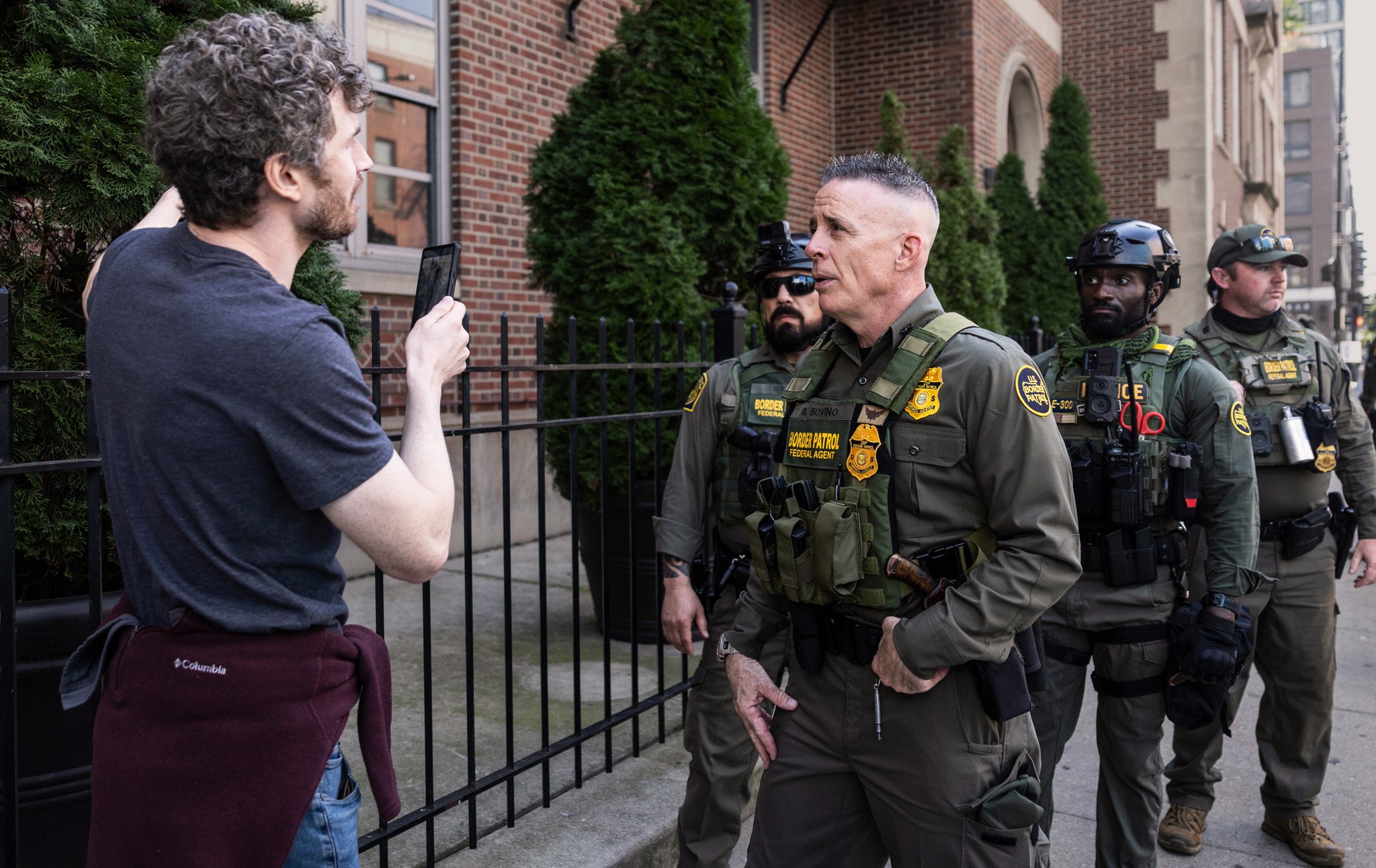
The agency wants to control the flow of information, flooding the internet with pro-deportation propaganda and suppressing any evidence of their crimes. No wonder they hate being filmed.
Don’t let the Department of Homeland Security fool you. On the whole, protesters in Minneapolis and across the country are not violent. It’s ICE agents themselves who cause the chaos and death we’re seeing on American streets, and it’s the presence of a protester’s phone, not a weapon, that can be the spark in the powder keg.
ICE agents react to phones with an aggression that is totally out of proportion, variably ripping phones from bystanders’ hands, tackling them to the ground, and tear-gassing them, then lying, claiming protesters are the ones who instigated the attack. The most famous example of this deceit is the execution of Veterans Affairs nurse Alex Pretti on January 24. In the footage of the killing, Pretti has one hand raised, the other filming ICE with his phone, shortly before he’s thrown to the ground and shot. Afterward, Stephen Miller claimed he was a “domestic terrorist [who] tried to assassinate federal law enforcement.” Yet a witness statement submitted in a lawsuit filed by the ACLU reads: “I have read the statement from DHS about what happened and it is wrong. The man did not approach the agents with a gun. He approached them with a camera.”
While each confrontation with ICE has its own complexities, and filming is only one of them, ICE is acting as if a phone is as good as a gun, and they’re attempting to police them as if they carried bullets. The agency’s heavily-armed agents—who, let’s remember, are usually wearing masks—are now claiming, without basis, that it’s illegal to record them and detaining people who film them.
Well, is it? Is a phone a gun? Of course not. The only way a phone can kill you is if you text and drive. To the Trump administration, though, phones are an existential threat. Much of the administration’s power flows through our phones. Today, Americans prefer to see the world through their screen, looking at their phones about every five minutes, all the while giving these devices massive amounts of their trackable personal data. The Trump administration happily takes advantage of this fact. They use our phones to surveil us and, at the same time, digitally manufacture a MAGA La La Land, a world where Trump’s policies are sensible, prices are lower, immigrants—not the accumulation of wealth among the one percent—are the reason people feel so economically strained, and ICE isn’t killing people. Yet, as more and more videos filmed by courageous citizens standing up to ICE come out of Minneapolis and directly contradict their narrative, the Trump administration is learning that Americans will believe a good guy with a phone over a bad guy with a gun, even if that bad guy is a federal agent. If Trump keeps losing his grip on our phones, he may lose his grip on American voters.

The MAGA right became aware of phones’ power long before the electorate, who have accepted phones into their life without much pushback. That’s why ICE’s public affairs office has been run like an overfunded influencer account. The Washington Post reported that ICE’s PR team is sending camera operators to ICE arrests. Their orders: get footage that makes immigrants look like criminals and action-movie-esque shots of immigrants being verbally degraded or hunted like fowl. You might remember the video of the raid of a Chicago apartment building that played bombastic superhero music over the whir of Black Hawk helicopters and shots of men being zip-tied in the night and thrown into vans. (Funnily enough, the video omits the children who they also zip-tied and separated from their families.) These photos and clips are then posted on social media, sometimes as often as every 30 minutes, where ICE tracks their engagement obsessively, sharing social metrics with senior officials.
“If the truth of the operation does not match the narrative of [arresting] the ‘worst of the worst,’ it’s going to be killed,” the Washington Post quotes an ICE official saying. Here, truth does not mean what we think it means; it can’t, for DHS knows that they are arresting people without criminal records, arresting citizens. They know as well as you do that criminals aren’t the ones attending the grade schools they ambush, nor the bakeries. No, truth, in this context, means online perception, calibrated through our phones. Truth, to DHS, means lie.
In Minneapolis, ICE’s PR tactics have kept pace with their surge. Not only are they sending their own PR teams, but they’ve recruited right-wing influencers and conservative journalists, like Fox News and even Dr. Phil, to ride along with ICE squads and capture DHS-approved video of arrests and protests. The right-wing influencers are filming protests on their own, getting opportunistic angles of demonstrations, then mischaracterizing the situation in a way that confirms DHS’s narrative of Minneapolis as violent and out of control. A right-wing influencer fist-bumped an ICE officer, and another, January 6 insurrectionist Jake Lang, riled up a crowd so that ICE might try to subdue them with tear gas, reports Ryan Broderick at Garbage Day. “I’ve seen up close how intertwined the twin engines of the Trump regime are. Brutal state violence and hysterical right-wing internet content work together in lockstep[...] Which is why ICE agents have a phone in one hand and a gun in the other,” Broderick wrote. But you know where you won’t find a camera rolling? In ICE’s detention centers, where, at least in Florida, Amnesty International has confirmed the practice of torture.
We are in the midst of a content war inseparable from the bloody war on the streets. One of its frontiers is images, and another, more obscure, and potentially more powerful, battle line is personal information. The government wants to control what you see on your phone while tracking every revealing click, tap, and movement you make with it. In New Orleans, ICE has monitored local discussion on the internet to identify “threats to agents” and the locations immigrants are likely to be found, as well as “public ‘sentiment,’” according to the Associated Press.
Just this month, 404 Media reported that newly purchased software lets ICE use commercial data to surveil all the phones in an entire neighborhood at once, tracking “the movements of those devices and their owners over time, and follow[ing] them from their places of work to home or other locations.” Palantir, owned by the vocally anti-democracy Trump ally Peter Thiel, has built an app called—and you can’t make this up—ELITE that ICE uses to decide where to raid, also a scoop by 404 Media. ELITE, short for “Enhanced Leads Identification & Targeting for Enforcement,” seems to work like Google Maps, but instead of storefronts and parks, it shows people, each with a “dossier” and a current address, alongside a “confidence score” on how likely it is that the address is correct. Eventually, ICE supervisors will be able to select and approve people to arrest in the app, as if deporting people was like playing a video game or ordering noodles on Uber Eats. Trump has paid Palantir hundreds of millions of dollars to help him combine Americans’ personal information from across government agencies with the hopes of creating a unified database. The President has been tightlipped about the project, but with ICE, its purpose is being revealed: Trump is probably building a database that allows for mass surveillance and mass deportation, with the push of a few buttons.
In the same way that prison companies profit every time ICE detains a person and that person is moved between facilities, tech companies are making tremendous money by enabling Trump’s darkest fantasies of population control. The result is what Maria Ressa, a 2021 Nobel Peace laureate and a renowned journalist who fought for press freedom in the Philippines, calls an “Information Armageddon.” In a panel hosted by the Bulletin of Concerned Scientists, she described it as “the crisis beneath all crises, driven by extractive and predatory technology that spreads lies faster than facts and profits from our division.” She continued: “The men who control the platforms that shape what millions believe have merged with the men who control government and militaries.”
The situation is dire, and only getting more so with the popularization of AI. The White House is pushing out AI-generated “slopaganda,” ridiculous content that ranges from hagiographic images of Trump as the pope or a ripped (as if, Donnie!) Jedi, to trite depictions of the world Trump wants to create by force, like a Studio Ghilbi-style image of an angry ICE agent arresting a crying woman of color. To square off against all of the reporting coming out of Minneapolis, the White House has begun altering real pictures, too. A photo they posted of the arrest of Nekima Levy Armstrong, a protester who interrupted church services in St. Paul, Minnesota, had changed her serious, calm expression into one of hysterical tears (sidenote: why do they want women to cry so badly?). When asked about the obvious edit, a White House spokesperson told the Guardian, “the memes will continue.”

There is still a massive chink in Trump’s tech armor—and that’s the fact that phones are a weapon we can wield, too. As much as they like to surveil us, we can surveil the Trump administration right back. Enough pictures of what’s happening in the real world, where the guns are actually shot and people actually get hurt, can puncture the fabricated digital reality of MAGA. That’s exactly what is happening in Minnesota, where the real videos of Alex Pretti’s and Renee Good’s deaths, taken by normal people who understood their power as witnesses, as well as thousands more videos of ICE’s brutality, have helped turn the tide of public opinion against ICE’s surge. Hell, even 19 percent of Republicans are starting to say “Abolish ICE.”
The real world has breached the perimeter of MAGA La La Land. Now that people are catching on to what has been happening in the United States, we cannot let them forget. There is nothing more American than keeping your eye on Uncle Sam, and telling everyone you know about his tricks. Keep your cameras on.
Emily Carmichael is the associate editor of the Lever. Previously, she wrote the News Briefing for Current Affairs. Follow her on Twitter here and read more of her work here.
Top photo: Chicago Tribune via Associated Press


.png?width=352&name=Screenshot%202026-09-04%20at%204.00.52%20PM%20(1).png)
%20(1).jpg?width=352&name=miasma-1%20(1)%20(1).jpg)