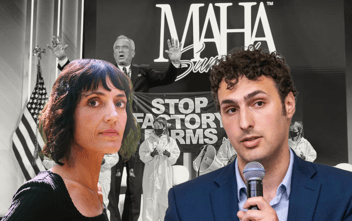
Joshua Cohen, writer of the Ettingermentum Substack, discusses the fallacy of centrism, why Democrats ignore the polls, and America's new era of punditocracy.
Joshua Cohen is a political theorist and writer of the Ettingermentum Substack: an exceedingly thorough and insightful resource for anyone hoping to understand what the hell is going on in American politics these days. Cohen sat down with Current Affairs to discuss the recent government shutdown, what Democrats actually pay attention to, and what the future looks like for a party controlled by pundits.
Nathan J. Robinson
When I want to understand what is actually happening in Washington, I turn frequently to your Substack. I want to start with the events of the last week or so. We had a major series of elections in which Democrats triumphed, including Zohan Mamdani in New York City, and then we had the end of the government shutdown. You published a take recently, and I just want to read the tweet that you wrote to accompany it, where you said, “By folding on the shutdown, the Democratic Party revealed themselves to be even worse than just cowardly and inept; they've shown that they are completely controlled by unelected centrist pundits.”
And you wrote an overview of the punditocracy. Could you tell us what your interpretation of the events surrounding the end of the shutdown is?
Joshua Cohen
So this was something that I spent the entire shutdown really thinking about, because it was really bizarre in a number of ways. I think that we are kind of accustomed at this point—I like to think, just internally, we are well past 10 years of Trump. It has been over a decade since he first launched his presidential campaign. So none of this stuff that we're going through is really as new or unprecedented as it's made out to be a lot of the time, and we have a sense of a lot of the patterns and tendencies that the actors who have stayed on for this whole time fall into.
And one thing that's this very common stereotype that we're all very used to is that Democrats—this is true election after election—chose to focus more on this kind of very lofty, moralistic, and kind of old-fashioned rhetoric about democracy and integrity and internationalism, as opposed to much of what voters said that they cared about.
What I noticed about the shutdown is that the motivation for it was obviously Trump's style of governance; in this truthful sense, he's acting authoritarian and wildly corrupt. He's destroying all the norms, good and bad, targeting political opponents, and has created this ideological war footing across the entire federal government. And we would assume that the party creating a shutdown over this would react with some very moralistic rhetoric about how this is an autocracy and authoritarianism, and just all the stuff that we're used to hearing from Democrats.
But what was really notable to me about it was that they did kind of swerve and focused almost monomaniacally on what I think, in the abstract, those of us on the left would usually recommend: focusing on material issues and healthcare, the cost of insurance premiums and subsidies, and contrasting that with his tax cuts. And it was an idea that I don't think was particularly bad in theory, but it felt very strangely timed.
It was making me wonder what the whole basis for it was, and it kind of clicked for me two or so weeks ago. It feels like it's ancient history now, but when the WelcomePAC released that Deciding to Win report, they had that one graphic that was this list of all of these policies ranked from how popular and persuasive they are to voters, and it was presented as this new thing.
But what really stuck out to me is that if you look at the specific issues that were ranked the highest on the list—like Medicaid drug price negotiations or expanding Medicaid for vision and denta—you get a list of all the stuff that the Kamala Harris campaign ran on, to the extent it had a substantive policy platform, and it really kind of clicked in my head. It's not just that these people are being greatly influenced by pundits, but it's that they're following pundits and what they're saying practically line and verse.And it brought me back to remembering that three weeks before the shutdown, Ezra Klein published an article titled “Stop Acting Like This Is Normal” that explicitly called for Democrats to do a shutdown, and this was published very shortly in advance of them actually doing it. There is reporting that he was greatly influential.

It made me realize, because there are all the usual takes that you can give about how they're just cowards, they always fold. Trump White House officials reportedly were kind of just gloating about how they're all pussies; they're all weaklings. And that is true. But what I really noticed from this, and what I thought was kind of profound, is if you read just the works of two different pundits—David Shore and Ezra Klein—you get a pretty clear advanced roadmap for exactly what they did prior to and during the shutdown. You have this idea that they had to walk kind of zombie-like into doing the shutdown because Ezra Klein said that this was an important moment where doing so is important.
I think that we've really kind of entered a different era, where we were at a point where the Democratic Party establishment was just very confident in themselves in ways that they should not have been for a long time, in a way that caused a lot of damage. Like running Biden in the first place, running Biden for reelection, the Bidenomics push—all the ways in which they campaigned where they were just telling the voters what they needed to care about.
They swerved from that to this crazy defensive crouch that is just as equally ineffective. It was a relatively politically successful shutdown. Republicans were blamed for it more than Democrats were, but there's not much evidence that they really succeeded in increasing the salience of healthcare as an issue, which was the whole intention of why they did this.
Trump's approval rating did go down at the end, but a lot of that, I think, was due to mistakes made on the White House's own end. Which, granted, is kind of a decent justification to maybe do something like this, where, if you create enough misery or chaos in the country, Trump will manage to create some awful contrast with it by building some $250 million ballroom and tearing down a third of the White House.
But I think that they really made fools of themselves, and that they really have, in a meaningful sense, given the Trump administration their buy-in for continuing the project as it is. They were so terrified and were not committed to the ultimate end game here, which was always going to be forcing the Republicans to either commit to institutional reforms, like removing the filibuster—stuff that Republicans didn't want to do and could benefit Democrats in the long term—or actually coming to the table and making some compromises. They just showed their hands and that they were not really committed to this. And in that circumstance, they just should have never done it at all.
But it shows the power of the pundits here, people like Ezra Klein just saying this and causing it to happen.
Robinson
Well, if it had been done by a party that was committed to it, it sounds like there are elements of this that make sense. You have a clear demand. The demand is related to things that actually affect people's lives. So it's not stupid.
Cohen
I didn't hate it. It wasn't something I looked at and was like, This is fucking moronic. There was an idea there.
Robinson
And then, of course, it exposes the Trump administration's real priorities. It gets them in the position of going to the Supreme Court to convince them to allow them to starve the poor, which is horrible.
Cohen
That broke through. I don't want to reference Nate Silver too much. For some reason, for a lot of these stats, people love using Google Trends to track this stuff, which I'm not sure is really like the best way of doing stuff.
So this isn't perfect, but he did find that over the course of the shutdown, searches for Obamacare never really went up relative to where they had been before, but searches for SNAP did go up by a lot after we started cutting the benefits. So that was something that really did catch people's attention. And we saw at the very tail end of the shutdown, Trump's approval started measurably going down. I'm not sure if it's still the case, but it reached an all-time low right before the election the next week. I think it might be at an all-time low right now. It's -13. Previously, the worst points had been after “liberation day” and during the Iran bombings, where it reached around -10, so it did bring him into uncharted territory.
So in a purely political perspective, they were winning this, but the end game to this. And this is something that even Ezra Klein said in his article, although he demurred on it as he often does—he never really came to a solid conclusion—that this was always going to be about the filibuster. This was always going to be about, if you're going to run this mob-style governance that's going to explicitly target us as enemies of the state, it doesn't make any sense to have this system where you require our buy-in of seven votes because you didn't get a supermajority. You only have 53 seats. You don't have 60. You didn't win the election to that extent.
There is still a level of representation from voters that are not on board with this project. If you're going to be governing in that way, you should change the rules to comport with it. Otherwise, we're going to use the tools available to us to stop this from going on. By the party's own official narrative—not to talk too much about it, but I think that this is important—Chuck Schumer didn't vote for the deal. He says that he opposed it. That's obviously just him covering his ass. It's really difficult to believe that, unless he's the most inept person to ever hold a leadership position, which is admittedly possible, he didn't have some level of sign-off on this huge section of his caucus—his own whip voted for the compromise.
The party at large was never committed to actually really going to the mat and having an extended shutdown that could have possibly ended with the filibuster being eliminated. They were not committed to that in that way. So they had lost from the very beginning. Basically, they never had the cards to actually get this to a critical stage, and it was always going to end like this. So the question is, why did they do it in the first place? And I think the answer, and what I get to in my piece, is that they've just completely lost any confidence.
To a certain extent, that's a good thing, because we've seen what happens when they get really confident of themselves. We saw the Biden years. But there's another end to that, where it can be equally as destructive, where there's no kind of long-term planning. We see that they can kind of snatch defeat from the jaws of victory here, where they were given this really strong contrast and kind of did stumble into this issue that was stronger than what they could have done, but they just did it really without thinking. It's remarkably unorganized, and it's not fitting of the moment, obviously.
Robinson
Some would argue, and I assume you would agree, that there is a desperate need for a replacement of the party leadership here.
Cohen
Oh, yes.
Robinson
Because not having any real strategy, any clear goals—that's an issue separate from the issue of left versus center, because no matter where you are, you want a party that has some kind of unity and sense of what it's doing.
I think there is a general or growing understanding that Chuck Schumer, at the very least, is a failure at the basic task of leading a party that has a coherent strategy in opposing the president, which leads to a question that you've also written about: is there any other leadership waiting in the wings? And you evaluated the possibilities, and I didn't quite get a sense from your piece whether you think those possibilities are plausible, but you did evaluate how the party might change its congressional leadership.
Cohen
Well, I think it's a bit more plausible than it was when I wrote the piece. That was kind of just a Hail Mary, to the extent that I have any influence with people who have any power. If this really is a punditocracy, I'll try to get my own level of influence in—I'm not expecting anything. But people did start calling for it a couple of weeks later. So who knows?
What I kind of really want to stress with this is that it's very unusual for a political party to be in this kind of situation after a loss where there was no leadership shake-up whatsoever. Historically speaking, that was just something that happened by default every single time, and it usually happened during an outgoing president's final couple of years.
After Bush's administration kind of went down in flames and Democrats won in 2006, Republicans completely redid their leadership makeup in the House and Senate. So by the time Obama was president, there were two new congressional leaders. Jo Bonner and Mitch McConnell were two people who hadn't actually governed under Bush and had some degree of credibility as change agents. Under Trump's first term, Democrats stripped it from Harry Reid and gave it to Chuck Schumer, who was technically a new kind of face on paper. And they did keep Pelosi, which was historically unusual and kind of a foreshadowing of this. She was unpopular, but even in her case, she had governed with Obama, who was a popular, outgoing president and not an unpopular one, so she had a little more wiggle room and wasn't as much of a clear liability.
This is just something that parties just always did. When you lose, you will change things. Republicans got rid of Newt Gingrich in 1998 even after they won the House, because they didn't win it by what they thought was enough. They'd historically been very ruthless about this, especially when those involved had governed under a presidency that is seen to have failed.

So by keeping Schumer and Hakeem Jeffries, Democrats have these two very literal connections to the Biden era, and with Schumer, you have somebody who was his governing partner, who passed all of his pieces of legislation, and was there the entire way through. Jeffries was never Speaker under Biden, but he was one of the leading Democrats during those years.
What's kind of frustrating about this, and what has always kind of motivated me from the very beginning, is that you can be the most ideologically minded person that you want, but at a certain level, a lot of what Democrats do and screw up on are just questions of basic competency and just running an organization effectively. As far as who can replace them, there's this weird kind of fallacy where it's made out you need to find this perfect replacement to get rid of these guys or swap them around.
You don't need to find some amazing leader. You just need to find somebody new who can come in as credible leadership.
Robinson
They just need better.
Cohen
Or new. They don't even necessarily need to be new. They just need to have some credibility.
Robinson
You point out that you have, in the article that you did, some of the favorability ratings of politicians. It's a really quite striking chart because Chuck Schumer is just so unbelievably unpopular.
Cohen
He's in a different realm of everything.
Robinson
To keep this person in this position at a -33 approval... I don't quite know how it works in the Senate, because Bernie Sanders is technically an Independent. I don't know whether he can lead the party.
Cohen
Yes, he currently has a leadership position. They created a bunch of titles after 2017, and he's the Secretary of Messaging or something. I don't remember.
Robinson
But just from a purely self-interested perspective, you have someone who is the most popular politician in the country, and you have someone who is one of the least popular.
Cohen
The least, according to the chart.
Robinson
What are you doing? Why is this person in power?
Cohen
Yes, some would call it popularism, I guess. But I did give some names. I mentioned Chris Murphy—I kind of ruled him out because he's so clearly in the midst of a midlife crisis.
I don't want a Democratic Senate leader who listens to "Red Scare." That's not the kind of world I want to live in. We can do better than that.
Robinson
He listens to the "Red Scare" [podcast], which is very strange.
Cohen
Yes, he does. He separated from his wife and started listening to "Red Scare" to understand populism.
Robinson
And reading Curtis Yarvin, apparently.
Cohen
Yes. And so he's figured everything out. He goes on late-night shows and restates the thesis of Bowling Alone. So he's basically like a genius, and we all have to listen to him every day. He's like the smartest person ever. But he's too smart, he's too precious, for politics.
He discovered what everybody was saying in 2017. Pretty soon, I think he's going to discover "Cum Town," and he's going to become really annoying about that. So I don't want somebody who thinks that Nick Mullen is his friend in that position.
Robinson
Although we might see him on the Adam Friedland Show soon?
Cohen
Probably, I don't know. He got Lina Khan.
Robinson
The unexpected guests on that show...
Cohen
Yes, it's awesome. But, yes, I mentioned Chris Van Hollen.
Robinson
He's an interesting guy. He's been doing fascinating stuff recently. He was very good on Palestine. Good on immigration. Went to El Salvador to meet with Kilmar Ábrego García.
Cohen
And I think that was astute, because that was a case where I talked about the party lacking any confidence and listening to pundits. If you listen to the pundits during that case, there was that WelcomePAC presentation where—before the polling shifted—I think Matt Yglesias specifically singled out his visit as an example of the party listening to groups who are giving them bad incentives.
Robinson
Oh, the groups! The groups! It's always the groups' fault.
Cohen
If you've noticed, they've kind of gone back on “the groups” a little bit. After a year of “the left is completely cancerous and ruining everything,” and “Warren staffers are going to be remembered as the cause of the end of humanity,” now it's all, why can't we just get along? We need to have a big tent where Zorhan Mamdani can make out with Josh Shapiro, and everything is lovely. So that's gone away, but at the time it was a big deal.
And what I thought was really profound here is that he did this thing that very well could have not worked out. There was kind of a risk of, if you're looking at the question of issue salience, immigration being Trump's strongest issue at the time—it still is now, although it's negative, so it's not as much of an asset—there's this idea that if you kind of focus on this case, it'll just make people focus more on immigration instead of the other stuff going on. Ad that'll make people feel warmer to Trump relative to some alternative where everybody's focusing on egg prices.
But what happens is that by focusing on the specifics of the case and changing the question of what immigration enforcement really means from “securing the border” to these abuses and examples of completely over-the-top extra-legal enforcement of laws that don't even really exist, it changed people's perception of how Trump was doing immigration, as a result of Van Hollen's visit.
Trump's approval on immigration went into the negatives for the first time, and then it went back up again because Schumer and Jeffries put a lid on future visits, and it left the news cycle. And then after Gavin Newsom does the confrontation with Trump over the LA protests, it goes down again. I don't think it's reached positive once again. So this shows this kind of more risk-tolerant way of dealing with politics. In a way, it's a lot smarter than the usual way of Democrats tolerating risk, which previously has involved nominating people like Hillary Clinton and Joe Biden with some of the worst favorability ratings in presidential politics.
Robinson
Yes, I liked what you did when you talked about immigration, where you kind of split it into the two parts. There's the border, and then there's the internal enforcement.
Kamala Harris was kind of running to the right on immigration because there was this narrative that was widely believed, which is that Democrats had gone too far left on immigration. You actually challenged that and said, Actually, if you look at the polling, Americans have become much warmer towards immigration, so it actually made political sense to move left on immigration.
Cohen
Yes, it's a little more complicated. I published this article nearly two years ago at this point, during the Texas showdown when Democrats were really starting to fully surrender on the issue in January of last year.
There was a lot of talk about how opinions on immigration had become more restrictive than they had ever been at any point. And what I kind of noted back then was that those attitudes had become so restrictive in the aftermath of Democrats really surrendering on providing an alternative vision on the issue, just kind of giving in to the right-wing narratives. It was obviously a really hard issue for them. I think there was some kind of movement away from the very, very liberal attitudes of 2019, which I will say were opinions that people actually held.
Robinson
Well, yes, that's what I refer to. If you look at the polls in 2019, America had shifted on immigration, and I think for the first time Americans wanted more immigrants than fewer immigrants. It was remarkable.
Cohen
Yes, it was. This kind of gets into a larger axe I have to grind about how people talk about wokeness. It's just accepted, taken for granted on all sides of the political spectrum, that it was this elite-driven conspiracy that was forced on unsuspecting liberals using the credentials of these groups that were captured by the same elites.
And this is funny, because there's a very good article in 2019 by Matt Yglesias about how attitudes actually shifted. The attitudinal shifts towards the left on issues like policing, race, and immigration that had happened prior to Trump—the big shift actually happened during the first Obama era—precede the politicians who very inelegantly adopted it.
I think the story with immigration under Trump's first term that many people miss is that Trump did his very kind of brutal policies, but they didn't actually succeed in bringing border crossings down. Crossings reached all-time highs at the time in 2019 during his administration. So there was this sense back then that he was just being totally vindictive and cruel and not even getting results.
So the irony is, and it's a totally reverse situation now, that in 2019 and 2020 Trump's worst issues were “cultural” ones, while the economy was his strongest. Now, the cultural issues are where he's relatively stronger, and the economy is where he's worst. And I think if we want to get to the elections that happened last week, there's a lot to say about how shifting coalitions go against the ways people presumed.
Robinson
I wanted to get to something that runs through a lot of your work, and it's something I've recently written about in Current Affairs in response to this big New York Times editorial that was about how Democrats needed to move to the center.
Cohen
This pissed me off. It had me scowling as I was reading it.
Robinson
Yes, especially as a data guy.
Cohen
Not even as a data guy, just somebody who had this weird fixation on these kinds of Democrats a couple of years ago. Just narrowing them down to centrist is so reductive. They had Tammy Baldwin as a centrist. She voted to imprison Dick Cheney and supports Medicare for All.
It's way more complicated than they make it out to be. I'm just still annoyed about that. They aren't real fans. They don't really care about these shitty Blue Dogs like I do. They don't know about Rep. Marie Gluesenkamp Perez like I do. I was in the trenches for those races. Nobody cared, and now they're all acting like they can talk about what they were. They were not there. You don't know about Joe Kent. You don't know about all this shit that was going on in all those weird-ass races. You guys are fake as hell. I hate them so much.
Robinson
But one theme that runs through your work is, I'd say, showing that left ideas and left politics are more pragmatic than often times they are seen to be. A lot of us on the left—obviously, we at Current Affairs were writing in 2016 that Bernie needed to be the candidate against Trump because he was a better candidate.
I actually never saw the polling that you saw that showed Bernie 10 points ahead of Clinton against Trump.
Cohen
It's so bad. It's terrible. It's like the most depressing thing. So this is one of the facts about politics nobody ever really talks about, but is foundational to how I understand the past 10 years: up to 2016, if you looked at personal favorability ratings of candidates, it was extraordinarily rare for the American people to actually personally dislike politicians running for president.
Even in races where you had politicians lose by 20 points and lose in 49 states, those politicians were always personally liked. Walter Mondale had a positive personal approval favorability rating. George McGovern did. And I think between 1960 and 2016, every single election, including countless blowout races, every single candidate besides Barry Goldwater in 1964 has had a positive personal favorability rating.
Since 2016, every single major party candidate besides Joe Biden in 2020—and even then it was marginal for him—has had a negative personal favorability rating. Both Hillary Clinton and Donald Trump were the two least-liked presidential candidates ever in the history of American politics in their election. Trump has been unpopular in all three of his races. Kamala Harris had net negative favorabilities by the end of her race.
So the superpower with Bernie Sanders, and I would say that his left-wing views play a large role in this, is he was seen as authentic and credible and spoke to the issues that people cared about because of his ideology. I guess it's true that you could probably slide in any popular Democrat in 2016, but Bernie undoubtedly had a particular edge because of what he believed in. He was personally well-liked, and just that fact alone—the fact that he wasn't as disliked as Hillary Clinton, and that it wasn't as bizarre a race to the bottom as that race ended up being—would have made it very easy for him to just walk into the White House that year. Not even based on anything super ideological but just the fact that he was seen as this experienced, incredible politician who wasn't a reprehensible, corrupt piece of shit.

And I think there is a degree to which people overlearn the lessons of that. I'm not a huge anti-wokeness person, but I do think it's undeniable, at least to some extent, that if you do like Zohran Mamdani and what his campaign did, as I do, just looking at them, there was a certain way that leftist campaigns did run a couple of years ago. The Biden years were not very good electorally for them, and there has been a rhetorical shift in prioritization that has happened with people like Zohran Mamdani and his campaign compared to how left-wing campaigns in the past ran. And it really shows—he had some advantages in his race, but he was able to do substantially better than left-wing candidates had done in many different communities just by shifting from one element of policies that we like to a different kind of set of policies that we like.
There are a lot of lessons to be learned from that. Like you said—I obviously have my own beliefs. I'm left-wing personally; I believe in the things that I do, but I do, at a certain level, get the idea that defeating Republicans is this very important thing, and that is kind of the logic that I often go off. And if centrists could hold up their end of the bargain, I obviously wouldn't like them and would still criticize them, but I would probably be willing to call a spade a spade and say, okay, these people are defeating Republicans. They're serving at least some purpose.
I give Abigail Spanberger and Mikie Sherrill that level of credit after they won. But what frustrates me to no end are the people who have the shitty policies and the shitty connections but can't even hold up their end of the bargain. And there are so many kinds of Democrats who are like that. The excuse has always been made that Republicans are just really profoundly powerful in X or Y area, but the real fundamental throughline for everything that I've written is that Republicans are not nearly as put together as it's been made out to be. I think last week's results were very vindicating in that regard. It took a while, but things ultimately came into place.
Robinson
The Democratic Party really hurts itself by running people that people just don't like, like Hillary Clinton, or someone who, in the Joe Biden case, Americans all just thought shouldn't be running. The opinion even among Democrats was overwhelming that he shouldn't be running.
Everyone thought this, and yet they insisted on running him anyway. And you think, well, separate from ideology, just the very fact that most people don't want this person in office and don't think this person is competent to hold office, really, that should be the end of it. Don't run him.
Cohen
Yes, that was the thing that always got me. And when I pointed out who I thought would be a better replacement for him, it wasn't necessarily the person who is the most left-wing, and it made me feel like I was going crazy. There are these people who hold the shittiest centrist views you can imagine, who are arguably even worse than Biden on some issues.
But if we're just trying to get the ball over the goal line here, they're an obvious better replacement. And I guess in that sense, it might be a bit better that we have this party that has just totally lost confidence in itself in the way that we saw over the past month, but it's just always in one extreme or the other. There's no really just clear or cool thinking here. It feels like there's a massive opportunity for a correction. Politics is serious stuff. There's a lot of stuff on the line here, and you just have the people in charge goofing off. It feels like it's very past the point of being optimized—very far from being optimized, not to think about it too abstractly.
Robinson
Every time I read one of these things about how centrism is the way to win, my overwhelming reaction is, do you understand that Bernie Sanders is the most popular politician you can run?
Even that Deciding to Win report, an absurdly centrist document, said the Bernie 2016 campaign should be one of the models for what we should do. And I'm thinking, well, at the time, you were all telling me that was crazy radical leftism that wouldn't stand a chance.
Cohen
And I will say, in that sense, there has been a shift away from what centrism really is at this point. I think that just from a knowing-your-enemy perspective, we do have this understanding that there is this complete throughline between the centrist who existed in 2016 and the centrist, the moderates, who exist now. And I don't think that's exactly true, because you had these people in 2016 who were profoundly ideological and were really pushing this idea that just running a more moderate candidate who's more centrist on every issue would always win, and those are the people who have always been around. They're the easiest people to make fun of and lampoon, like the Rahm Emanuels who have just been pushing the same argument for years.
But there has been a shift in the sense that the modern center, the people who are really pushing these ideas, are of a different kind of stock. And they're largely pundits, not campaign people. These aren't James Carville or Rahm Emanuel, who actually did run elections in the '90s and get off that cloud. These are people who mostly comment in elections. There are a couple of exceptions, but it's largely the case that it's mostly commentators.
And these commentators are people who largely consider themselves former progressives, former members of the left. Ezra Klein was a big booster of Elizabeth Warren in 2020. He wasn't like some Biden person from day one. Matt Yglesias self-identifies as a former member of the left. He went to the center left, and he had this annoying bit in 2020 where he was this pragmatic Bernie supporter. He wrote the case for Bernie on Vox, which is just like, come on. I assume he was sincere in it, but it was just this dumb kind of trollish thing.
So these are people who are not necessarily born and bred centrists. They're willing to kind of point towards Bernie 2016 as a model, and they have a disingenuous way of framing it, where, instead of what he actually did—really changing how we talked about politics by putting issues like income inequality and corruption on the table in a way that other Democrats had not done in a very long time—their explanation for it is that he was right-wing on guns when he ran in the '90s, or he went the Lou Dobbs show in 2006 and talked about how immigration was lowering native wages 10 years before that. These are all positions he reversed in the actual election where he was popular and won these working class voters. It's a bit trickier for us to argue against. It's important that we address these people in terms of what they're saying.
Because if you do look at what the shutdown was about, they did focus on a material issue. They focused on healthcare premiums. It wasn't just the kind of masturbatory stuff we're used to—the Shore-ite kind of arguments. I think a bit of it is covering your ass, but there is some truth to it.
Shore's firm is Blue Rose Research, which is another really epic Marxist reference because he's actually this really crazy and interesting guy who has this interesting ideological perspective, where he's a socialist, but he's actually really pragmatic, so you need to think he's the coolest guy ever. His firm had a leading role in a billion-dollar PAC that mostly did ads, and during the election, they talked a lot about how the really hoity-toity rhetoric was not persuasive to people. They spent a lot of money on ads that were largely focused on material issues that supposedly did test well and largely related to what you would imagine was a Sanders-esque focus on corruption. I think their strongest sole policy, the one that was kind of abandoned, was price controls.
Robinson
Yes, right. Well, they had to back off that after Tony West had a word.
Cohen
Yes, exactly. But that was something that they did push and did run ads on. So if you listen to what these people are saying, it's a bit more sophisticated and seemingly open to the left than what Sanders had been running before.
The problem that I would say is that, as I said, they had a billion-dollar PAC where they ran these ads, and the campaign they were running these ads for did not win. You can say it might have helped them on the margins. I think that's debatable. The whole argument is that Harris did a lot better in swing states in terms of how many votes she lost in the country at large. But that was because the swing states, except for Arizona, where she didn't do well at all, were largely whiter and not super Latino. They were Georgia, North Carolina, which are Black and southern white voters, and a lot of suburbanites who were swinging towards Democrats. There's not a lot of elasticity there. And Michigan, Wisconsin, and Pennsylvania, which were older and whiter, were the demographics across the board where Kamala Harris lost the least support.
She also lost very little support in Washington, which was demographically similar to a lot of these states. That wasn't because of the ads that she ran. It was because of the way the demographics were that year. The counterpoints to them are, one, you literally already did this. You've been very influential with the Biden administration for years. You have seemingly gotten to do a lot of stuff surrounding immigration that was your holy grail during the peak woke era. That didn't change things; that didn't fix things.
Even if your approach might be helpful on the margins, I would be willing to believe so, because I can kind of agree with the idea that focusing on economic issues is probably a better idea than doing rallies with Liz Cheney, if that's the debate we're having.
But the actual problem here seems to be a bit larger than messaging. And I get a little suspicious when it's always reduced to messaging, because it feels like it distracts from getting back to what we kind of opened on talking about: the fact that we have a party leader with a -35 approval rating who says the sole purpose of his project is keeping the left pro-Israel. Why are we talking about this marginal shit when there's so much obvious stuff that needs to be faced if we're trying to be pragmatic?
Robinson
And we don't have time here to dive into everything, but I'm glad you brought up Israel.
Cohen
That is where all of this pragmatism and claims of following the polls really seem to die.
Robinson
Well, yes. You cite the remarkable collapse of Democratic support for Israel to the point where, by July of this year, only 8 percent of Democrats were approving of Israel's military action in Gaza.
So there's a huge disjunction between the party and public opinion here. So once again, it's not even politically pragmatic.
Cohen
No, it's not. It's the opposite. For as much as I say the campaign did follow a lot of the Shor-ist advice—I think in many ways they surrendered to immigration. What grinds my gears, though, is because foreign policy is really the place where a lot of my leftist views are, I think, the most salient lesson of the 2024 campaign was that the party did this crusade on these foreign policy issues that they imagined to be super important, that voters didn't agree with or care about.
They obsess over Ukraine and over being pro-Israel, and they look completely out of touch in the same way that they might have on immigration, but they never get that level of criticism that “the groups” get, the people who push the party to unpopular or low-priority places on social issues.
Robinson
Yes, certainly.
Cohen
That's considered to be fine. And not only is it considered to be fine, the implication, the kind of unstated thing, is that these foreign policy goals are what we're all working to support by kind of throwing off all the “dead weight” about social issues and creating this project that is revolved around incubating this unpopular foreign policy center. That, I think, is where the core ideological difference is.
Because I think there are two tweets from David Shore from a couple of years ago that I think are absolutely critical to understanding this. And even though it may seem on paper that these guys are name-dropping Bernie's 2016 campaign and they like Zohran and how he ran on his issues—is there really stuff to disagree with them on this? Where's the problem? There are these two points that I think really get to the core of what the difference is here. One is that he said, and this is one of the most bizarre things I've ever read, that he would rather live in a world with catastrophic climate change—I don't remember the exact degree of Celsius warming that he would accept; it was very high, though—than a world where China was a global hegemon.
And the second was when he wrote this lengthy thread, where he justified the fact that Biden's stance on Ukraine will meaningfully cause huge price shocks that will help Republicans and will give them a better chance of winning the Senate. But this is fine, because it's important.
Robinson
Popularism until I prefer something else.
Cohen
It always happens to revolve around these high-level issues.
Robinson
But not protecting trans rights.
Cohen
Or immigration or police brutality.
Robinson
Well, I'm afraid we're out of time here. But there are so many insights in your Substack. You go into great depth on this stuff, and we really appreciate the work you do.
Cohen
Yeah, thank you. Thank you for having me on.
Transcript edited by Patrick Farnsworth.