The elusive author of paranoid, absurdist novels looks more and more prescient these days.
The theremin is not powered by physical contact. It is a strange instrument that makes uncanny sounds and only exists because of Soviet-sponsored government research. It may be the most Thomas Pynchonian creation that he didn’t himself imagine, and its minor presence in his 2025 novel Shadow Ticket is a useful symbol for the famously private author’s steadfast fascination with the invisible networks that power contemporary life.
Like the antennas of the theremin, which function as proximity sensors, Pynchon perceives truths about America floating in the currents of our culture. In his work, he amplifies these points and makes them audible, frequently using conspiracy theories to highlight dynamics of power, control, and hidden agendas that cut across politics and society. The Trump era is a thorough vindication of two of his strongest and most stark observations: that America is destined to suffer under the weight of its latent fascist tendencies, and the inherent absurdity of its contradictory ideals.
As has been breathlessly discussed since the announcement of two new pieces of media, 2025 was the year of Pynchon. Not only did we get his first novel in 12 years, but we also saw the release of Paul Thomas Anderson’s One Battle After Another, a film inspired by Pynchon’s 1990 novel Vineland. Set in 1984, the novel saw Pynchon reckoning with the profound, premeditated wounding of countercultural beliefs that took place in between Nixon and Reagan, paving the way for authoritarianism to swoop in and undermine civil liberties at every level. Unlike Anderson’s 2014 Inherent Vice, which was a fairly faithful adaptation of Pynchon’s 2009 postmodern noir, OBAA takes the threads of Vineland and spins its own contemporized version that’s much heavier on white supremacy, transporting the action to sometime between the late 2010s and a distant future, perhaps a decade or two out from ours.
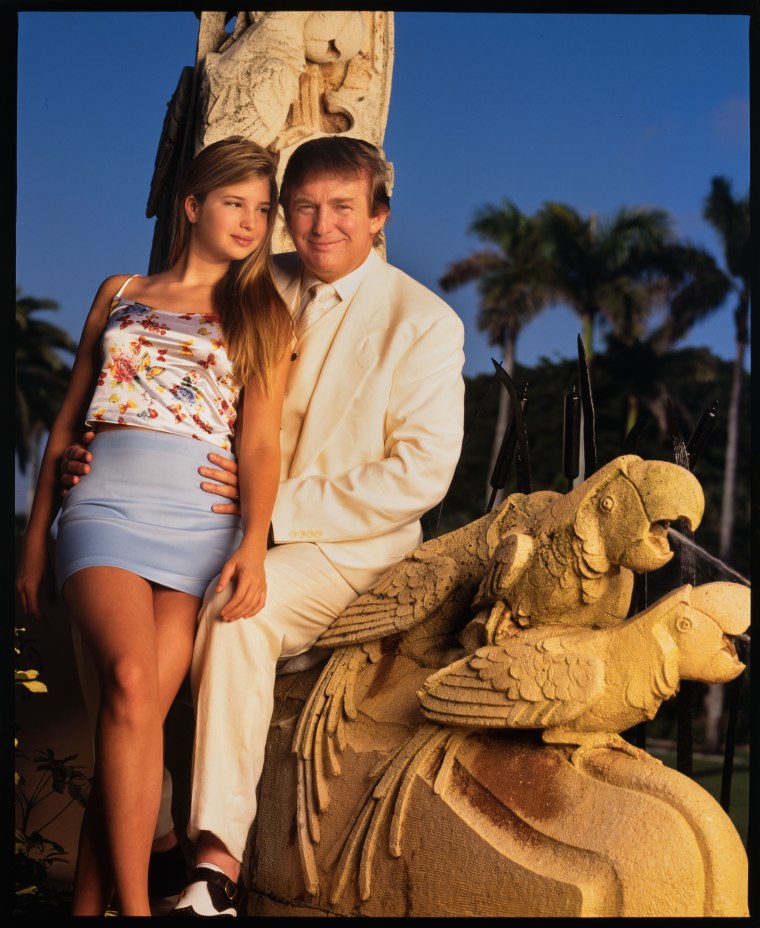
Shadow Ticket, on the other hand, is a political novel of a preterite flavor, rewinding all the way back to 1932 and tracing an oblique yet certain line from the emerging spread of fascism in Italy and the coming of Nazi Germany to Trump’s current America—a nation that has perhaps never been more paranoid and susceptible to the conspiratorial mania that’s become Pynchon’s hallmark. So many things happen in Pynchon novels, though the plot is hardly ever the point. Still, the action of Shadow Ticket is as such: former strikebreaker turned private detective (and semi-professional dancer) Hicks McTaggart is sent on a mission to locate Daphne Airmont, daughter of dairy mogul/crime boss Bruno Airmont, AKA the “Al Capone of Cheese.” Bruno himself skipped town some years prior in the manner of many a multi-millionaire with fortunes of ill-begotten means. The Airmonts are clearly references to Trump, and it’s not even subtle. Bruno is described as “not an evil genius but an evil moron, dangerous not for his intellect, what there may be of it, but for the power that his ill-deserved wealth allows him to exert, which his admirers pretend is will, though it never amounts to more than the stubbornness of a child.” Later on, McTaggart comes across “snapshots of Daphne, early adolescence, posing ambiguously on Bruno’s lap, each with the same self-pleased expression on their kisser,” which could be a verbatim description of a widely circulated photo of Trump with a 14-year-old Ivanka, taken in Mar-a-Lago in 1996.
Daphne has seemingly absconded with her lover, the jazz clarinetist Hop Wingdale, and McTaggart is pegged as the man for the job due to a previous encounter of theirs in which he saved her from illicit psychiatric experimentation. McTaggart is reluctant to take on the job every step of the way, but his role in the story has already been determined by a perverse pairing of hidden forces—not only federal agents likely at the beck and call of financial tycoons, but also the concept of being responsible for a life after interfering in it, attributed in the novel to an Ojibwe belief. The reader spends time with the detective in his home of Milwaukee, Wisconsin, during which his romance with a mafioso’s paramour results in a botched attempt on his life and finds him begrudgingly fleeing to New York.
It is at this point where the action shifts overseas, through no choice of McTaggart’s own; he awakes from a drugged state to find himself aboard a ship that drops him off in Belgrade, Serbia. He’s strong-armed into the titular “shadow ticket,” or secret assignment, by a coked-out Interpol agent with his own agenda, who insists that McTaggart keep an eye out for one of Bruno’s right-hand men while ostensibly searching for Daphne. These twin tasks send him traversing through Hungary, Transylvania, and eventually Croatia, all the while having encounters with an eclectic batch of characters. But everywhere he goes, one theme is constantly humming in the background: the imminent rise of fascism, and the clandestine maneuvers of its supporters, from the German-American nationalists Hicks meets in the Midwest of the ’30s to the seething political repression he finds in Central Europe.
If that sounds like a lot, that’s because “a lot” is Thomas Ruggles Pynchon Jr.’s specialty. The now 88-year-old has been riffing on conspiracies, police states, and related topics since he began writing in the late 1950s. Born into a middle-class family in Long Island in 1937, Pynchon would begin experimenting with the hallmarks of his future career as early as high school, where he published short stories like “The Voice of the Hamster” in his school newspaper. From there he proceeded to Cornell University to pursue a degree in engineering physics, but decided to enlist in the U.S. Navy after two years. He received electrician training and spent time on the warship USS Hank during the Suez Crisis, when a coalition of Britain, France, and Israel briefly invaded Egypt. By 1957, he was back at Cornell with a new degree in mind: a Bachelor of Arts in English. But his first job was not in academia or culture. Instead, he spent two years in Seattle, working as a technical writer for aerospace manufacturer Boeing. There he gained an intimate knowledge of the military-industrial complex, one that would imbue his work with a deep, dark suspicion and dread, trained on the weapons industry.
Thus began the writing career of one of America’s greatest living novelists. His debut V. came in 1963, followed by the countercultural, conspiratorial fever dream of 1966’s The Crying of Lot 49, and his most famous in 1973: Gravity’s Rainbow, which won the 1974 U.S. National Book Award for Fiction (in a shared win with A Crown of Feathers and Other Stories by Isaac Bashevis Singer). Gravity’s Rainbow was selected by the Pulitzer Prize fiction jury for consideration, only to infamously offend the Pulitzer Advisory Board with its “turgid” and “obscene” content. (Not only do the erections of the central protagonist, U.S. Army Lt. Tyrone Slothrop, seem to correlate with rocket strikes, but yet another character has a scene of sadomasochistic coprophagy. In other words, sexual shit-eating.) They didn’t award a Pulitzer for fiction at all that year. Pynchon didn’t accept or acknowledge the National Book Award win, either; the comedian “Professor” Irwin Corey accepted on his behalf and was interrupted by a streaker, a meta collision of high and low art that is, in many ways, Pynchon’s bread and butter.
Like the second half of Shadow Ticket, Gravity’s Rainbow is set mainly in Europe, but the action is scooted forward in time, to the end of WWII. The novel concerns the creation of the V-2 rocket by the German military, the world's first long-range guided ballistic missile and first man-made object to cross the edge of space. With over 400 characters, a multitude of narrative threads, and a seemingly inexhaustible ability to incorporate aspects of science, philosophy, mathematics, art, pop culture, sexuality, psychology, history, religion, and politics, the novel is a feat, ambitious and immersive and worthy of cultural enshrinement. That might be why it came as a bit of a shock (and perhaps disappointment) to readers when it took Pynchon 17 years to release something new––the aforementioned Vineland, composed of a mere 385 pages to Gravity’s 760. (We should mention that in between came 1984’s Slow Learner, a collection of his early short stories with an autobiographical introduction.)
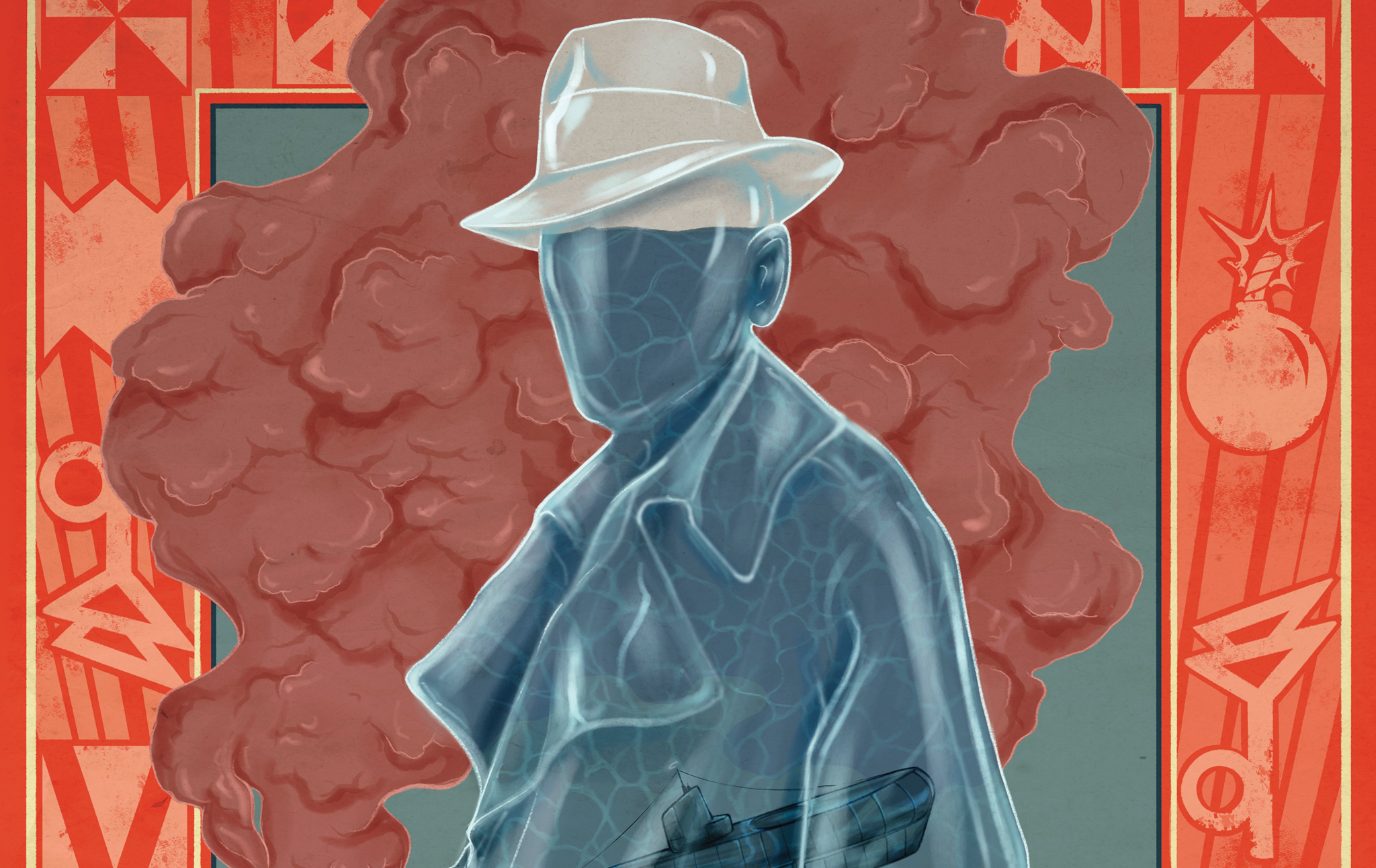
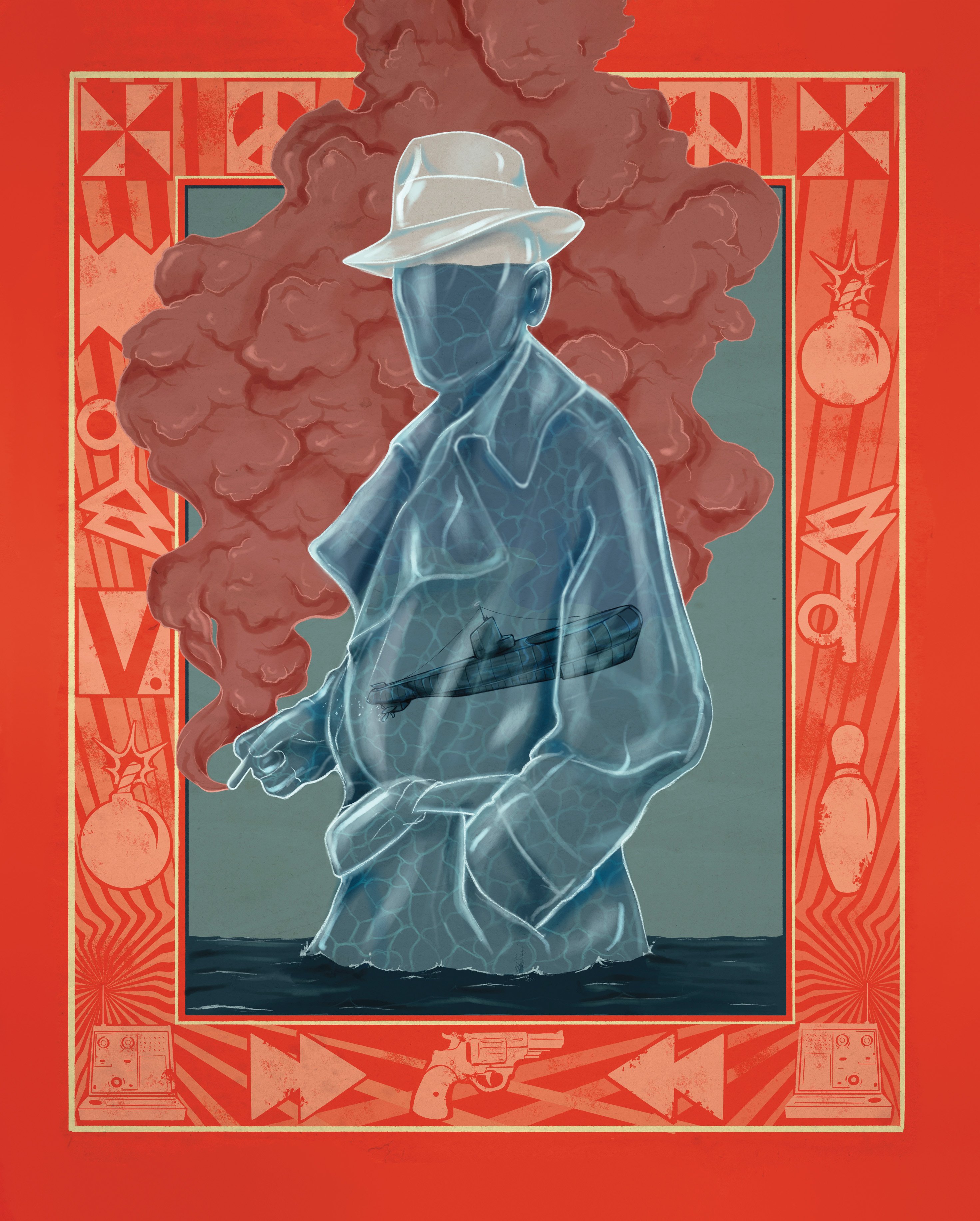 Illustration by John Biggs
Pynchon’s bibliography went on to include 1997’s Mason & Dixon, a fictionalized retelling of the lives of the historical surveyors of the Mason–Dixon line—a 773-page tome that was heralded as a return to form. In 2006 he published Against the Day, a 1,085-page exploration of the rise of global capitalism at the turn of the century that’s easily his most discursive novel to date. Then came the first two of his now three detective stories: the ’70s LA noir of 2009’s Inherent Vice and his first truly contemporary work, 2013’s Bleeding Edge, centered on the September 11 attacks and the birth of the Internet. All of which brings us to Shadow Ticket, what might end up being the final installation of this late-period trio, though no one would be terribly surprised if Pynchon had another novel (or two, or three) in various stages of completion. (Reports of another novel have in fact already circulated, though it is unlikely that anything will be confirmed anytime soon.)
If working at Boeing allowed Pynchon to peer deeply into the corporate-state nexus of the military-industrial complex, and to see the ever-increasing role that technology would play in determining the shape of life to come, it was likely his friendship with folksinger and novelist Richard Fariña that was a bridge to the counterculture. The two met at Cornell and followed the same trajectory, switching from engineering to English. A strong anti-war voice who sang protest songs and was openly pro-Cuba, Fariña died far too young at the age of 29 in a motorcycle accident. (The critic Charles Hollander has suggested, though never really elaborated on or proved, that the accident was suspicious and could have been a COINTELPRO operation.) Pynchon dedicated Gravity’s Rainbow to Fariña. It’s a bit reductive, but not necessarily incorrect, to suggest that the two most important influences on Pynchon’s works are Boeing and Richard Fariña––a multinational corporation valued at hundreds of billions of dollars, and one poor dead folksinger, dual images of America at its worst and best.
Though he spends a lot of time in other places in his novels, all of which are rendered impeccably, Pynchon returns to America as a concept to unpack and explore again and again. His postmodernist approach to reframing current events through historical analogues allows for a deeper understanding of the circumstances that led us here. While Anderson spent two decades thinking about the film that would eventually become One Battle After Another, it’s significant that its release brought Pynchon’s Vineland back into the cultural conversation in 2025, a time when his anticipation of the resurgence of the police state is chilling in its resonance.
Vineland takes place in 1984, California and follows Zoyd Wheeler (renamed Bob Ferguson in One Battle After Another) and his daughter Prairie (Willa in the film) as they live a somewhat underground life, hiding from a thuggish federal agent (Brock Vond in the novel, Stephen Lockjaw in the film) who may or may not actually be Prairie’s real father. The novel goes back and forth in time from the ’60s to the ’80s, the culture of hippies and rebellion clashing with the coming War on Drugs and Nixon’s proto-fascism. Prairie’s mother, Frenesi Gates, is a member of a revolutionary film collective, whose purpose is to document the erosion of civil liberties as committed by the state and those in power.
The fulcrum of the story is Frenesi’s unfortunate attraction to Brock Vond, who ends up using her as a double agent during the ’60s, then spirits her into a witness protection program and away from her family. She’s the missing figure at the center when the action returns to the ’80s, every major character relating to her and searching for her in their own way. The ’80s sections written in her POV, during which she is living under witness protection with her current partner and reliant on government checks, are some of the most prescient with regard to technofascism. Pynchon illustrates the cool ease with which the government can suddenly deny people basic resources through nothing more than a keystroke on a computer:
...it would all be done with keys on alphanumeric keyboards that stood for weightless, invisible chains of electronic presence or absence. If patterns of ones and zeros were ‘like’ patterns of human lives and deaths, if everything about an individual could be represented in a computer record by a long string of ones and zeros, then what kind of creature would be represented by a long string of lives and deaths? It would have to be up one level at least—an angel, a minor god, something in a UFO.
Perhaps the darkest of would-be gods, the technocrat.
At the time of its release, Vineland struck some readers as less ambitious than Pynchon’s earlier efforts, though in retrospect it seems clear that it’s nearly as complex as his more intellectually grandiose works. Salman Rushdie described it as “a major political novel about what America has been doing to itself, to its children, all these many years.” Part of what America has done to itself is untold amounts of unwitting or unconscious psychic damage to the millions of people who must work jobs they are ideologically opposed to in order to make a decent wage. But it’s not just the Frenesis of the world, informants who are forced to do the bidding of the government, painfully described in Vineland as “the destined losers whose only redemption would have to come through their usefulness to the State law-enforcement apparatus, which was calling itself ‘America,’ although somebody must have known better.” A line can also be drawn to Shadow Ticket’s McTaggart, who once beat striking workers on the picket line, but suddenly has second thoughts after an experience in which his weapon mysteriously disappears just as he’s about to use it. Afterwards, he becomes disinterested in violence and finds even the money is no longer a draw. Pain is a warning, psychic and otherwise.
Another potent illustration of finding one’s conscience in Shadow Ticket centers around an unsurrendered Austro-Hungarian U-13 submarine that should have been destroyed under the terms of the Versailles Treaty, but wasn’t. Its Skipper couldn’t bear to return it, having developed a “psychical connectedness” to the machine. He disobeys orders and, after a bender in Budapest, decides to embark on a “new career of nonbelligerence” instead. To explain his change of heart, Pynchon invokes the real historical event of the sinking of the passenger liner Persia by U-boat commander (and war criminal) Max Valentiner, who killed hundreds of civilians without warning and reason, in direct violation of international law. (Writing this in early December, it’s hard not to think of the civilian deaths from U.S. attacks on alleged narco-trafficking boats in the Caribbean and Pacific. You want to say the War on Drugs is back, but it was never put to an end.) The Skipper decides instead to run a kind of surreptitious search and rescue operation, and by the time McTaggart meets him toward the end of the novel, he’s been hired to relocate none other than Bruno Airmont to a place “where he can neither commit nor incur further harm.” The submarine is a ghostly presence, seemingly able to traverse space and time, and the suggestion is that Airmont has been taken to a parallel reality—one in which the Business Plot of 1933, a fascist conspiracy to overthrow Franklin D. Roosevelt, may have actually occurred as intended. In reality, the historical consensus is that some sort of plan was probably contemplated or maybe even discussed but didn’t get much further, in part because the plotters approached the wrong man to lead it: Major General Smedley D. Butler of the U.S. Marine Corps, who found his own conscience after decades of violently perpetuating American imperialism. Having become increasingly disillusioned with American foreign policy, he blew the whistle on the coup, which would have been spearheaded by wealthy businessmen of the Bruno Airmont and Donald Trump persuasion. Parallel realities are a warning, too.

Early in Shadow Ticket, McTaggart expresses concern about a “newer type of federal” agent, noting that “nobody knows yet exactly how bad they can be.” He’s ostensibly referring to the coming reign of J. Edgar Hoover and his many abuses, but it’s hard not to read the line as an indictment of our current era. Following this musing, the conversation he has with Assistant Special Agent in Charge T. P. O’Grizbee spells out the warning even more directly, in another instance of McTaggart being strong-armed into an assignment he doesn’t want:
“Your country calls.”
“Line’s busy.”
“I’m afraid it isn’t optional,” explains T. P. O’Grizbee. “Like it says on the subpoena we haven’t served you yet, laying aside all and singular your business and excuses. A federal rap, not to be shrugged off. Potential wrongdoers might keep in mind as yet little-known lockups such as Alcatraz Island, always looming out there, fogbound and sinister, and the unwelcome fates which might transpire therewithin. The Drys can seem like the violent ward at Winnebago sometimes, but this is the next wave of Feds you’re talking to. We haven’t even begun to show how dangerous we can be, and the funny thing? Is, is we could be running the country any day now and you’ll all have to swear loyalty to us because by then we’ll be in the next war fighting for our lives, and maybe that’ll be all you’ve got.”
The failure of the American people to understand and really grapple with the consequences of electing leaders who enact policies that go directly against their own interests, along with the consolidation of wealth and power, have led to a state apparatus even worse than whatever McTaggart may have been contemplating. The outcome seems foretold in a country that has slid toward, then away, and definitively pushed back toward authoritarianism from the days of McCarthyism on down, consolidating power in the hands of a few at the top while the rest of us are forced to give away our personal data if we want to participate in modern society at all.
One Battle After Another is a political story that does tackle contemporary expressions of fascism—the film collective of the novel is transformed into a militant leftist group called the French 75, who retaliate against the government by targeting detention centers, banks, and the power grid—but Anderson is ultimately more interested in exploring the family dynamics of the characters than the systems which entrench them. This is most clearly seen in the ways that the Frenesi of the novel is a fairly different presence than her analogue in the film, Perfidia Beverly Hills. Frenesi is a symbol for the American desire for authority, and can also be read as an indictment of a media landscape dominated by copaganda; she herself is a filmmaker with a strong erotic pull to men in uniform, depicted with both absurdity as she masturbates to an episode of CHiPs and genuine intensity during her sexual encounters with Brock Vond. By contrast, Perfidia behaves more like a realistic, flawed human who makes choices that seem to go against her own will as an indictment of the system she’s forced to maneuver in, rather than her own ethical failings. The film complicates her in the character’s favor, which allows the audience to feel moved when her voice returns to the story at the very end, through a letter she leaves behind, and strengthens her daughter’s convictions in her own political awakening. In the novel, Frenesi kind of… disappears by the end of the story. Her eventual reunion with Prairie is anti-climatic, and though Vond is ultimately thwarted (as Lockjaw is in the film, as well), the final image is a much more stark depiction of Prairie hoping he might come back for her.
Pynchon’s clear doubts about whether America can overcome its attraction to fascism are bearing unwanted fruit in 2025. The doubts have been proven right. Pynchon’s view of the American right is plainly and perversely stated in Shadow Ticket when one character says to another, of youth described as “Hitlerboys” in a changing Hamburg, “I want to believe they’re only being obnoxious but I think it’s worse than that.” The response is curt: “It’s worse.”
The Great Depression of the ‘30s in Shadow Ticket and the post-Reagan “economic ax blades” of Vineland are converging in the political realities of the mid-2020s. Once again, we’re facing the prospect of major political and economic upheaval. Only our coming depression is fomented not by the collapse of industrial production, but technofascist surveillance-sponsored production, the looming bursting of the AI bubble, and the continued consolidation of everything under the sun into one global plutocratic dynasty. Toward the end of Shadow Ticket, Pynchon describes the wind as “a theremin of uneasiness, sliding around a narrow band of notes, in which it’s said you may come to hear repeated melodies, themes and variations, which is when you know you’re going bughouse, with only a very short period of grace to try and escape before it no longer matters.”
He’s literalizing the eeriness in the air, but he also leaves room for grace, short though that window may be. America has wandered these bughouse halls before, but we’re approaching the point where it no longer matters. Will we be able to escape?