
This New Wave of Anti-Trans Legislation Threatens Us All
Kansas passed a law attempting to erase transgender people from public life. But Democratic leadership seems unwilling to pick up the fight.
I was born and raised in Kansas. This is not something that I bring up often, because it’s a bit of a bummer. When I do tell people this, it usually elicits a reaction along the lines of “oh, I’m sorry”; a blank stare in disbelief that people do, in fact, live in Kansas; or a story about how they have some random second cousin that moved there and that, no, they are not planning to go visit.
In a lot of ways, Kansas is misunderstood. The majority of people do not live on farms (although there are a lot of farms), but in urban counties, mostly around Kansas City (which is actually mostly in Missouri) and Wichita. The state has not voted Democrat for president since Lyndon B. Johnson in 1964, but currently has a fairly popular Democratic governor, Laura Kelly. To go back further, Kansas has a proud abolitionist history and famously entered the Union as a free state. Around the turn of the century, Kansas even became a bit of a hub for socialist politics. The rural town of Girard, Kansas was home to the socialist newspaper Appeal to Reason, which had half a million subscribers at its peak, making it the most widely circulated socialist publication in American history.
Today, the Kansas legislature is largely captured by far-right Republicans, who maintain a stronghold across the vast rural parts of the state. Despite this, Kansans often vote fairly progressive on the issues, such as voting with a 19-point lead to become the first state to protect the right to abortion following the Supreme Court’s Dobbs decision. It turns out controlling your neighbors’ bodies is a fairly unpopular practice in The Free State.
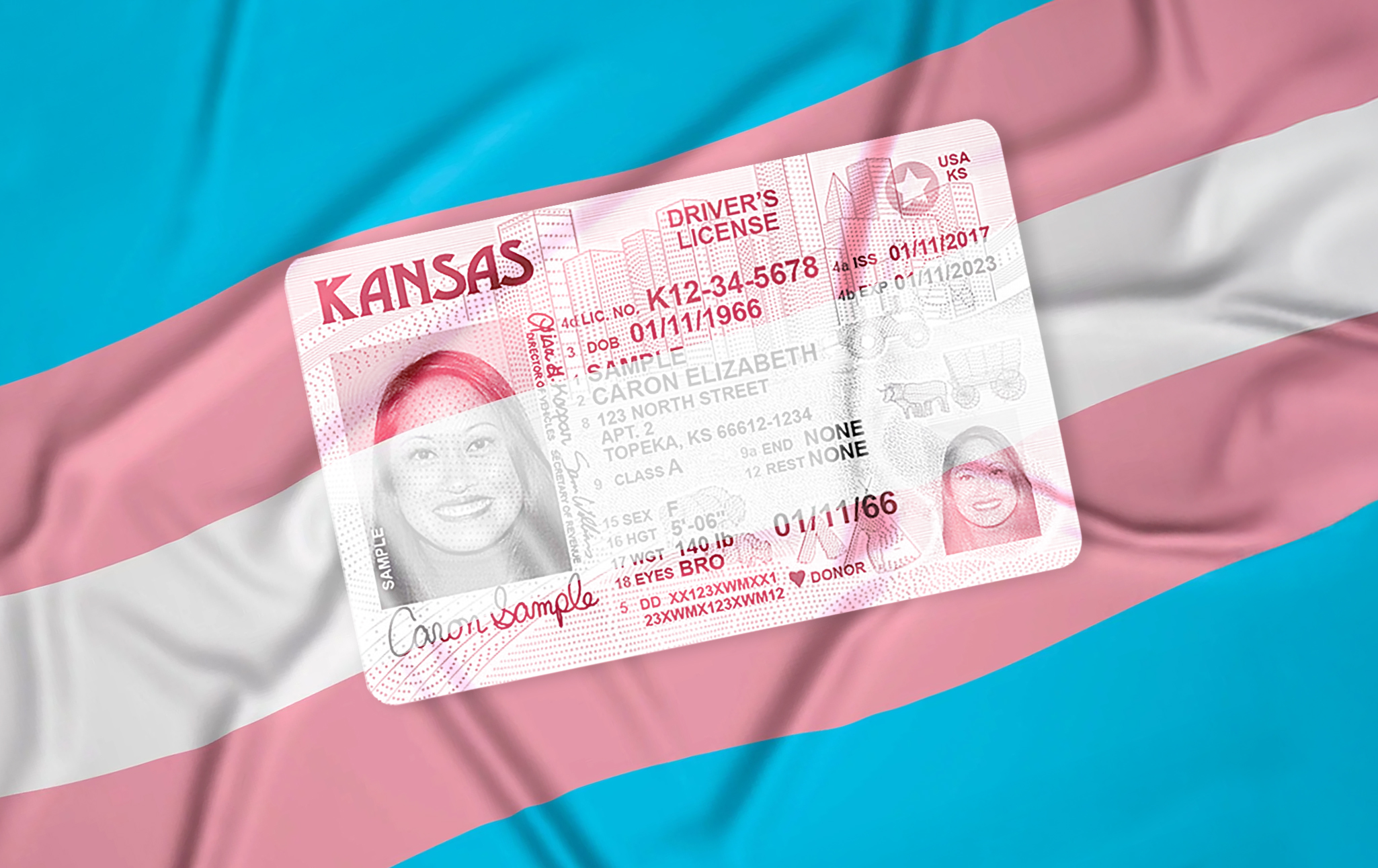
Unfortunately, that has not stopped the state legislature from passing laws that do just that. Just last month, Kansas made national headlines with the passage of SB 244, a sweeping new law restricting the basic rights of transgender people in the state. The most striking measure in this law is that it immediately, without warning, invalidated the state-issued identification cards of anyone whose gender marker on their documents does not match the sex they were assigned at birth. Shortly after the passage of the law, hundreds of trans Kansans received a letter in the mail informing them of the change.
“If you received this notice, our records indicate that, upon publication of this law [...] your current Kansas credential will no longer be valid. Additionally, please note that the Legislature did not include a grace period for updating credentials,” the letter reads. “We apologize for the inconvenience this causes you.”
The law is the first of its kind across the country to invalidate legally obtained identification documents, for any reason.
The law also creates new restrictions on bathroom usage for trans Kansans, allowing private citizens to sue trans people for $1,000 in damages if they feel “aggrieved” by their use of a bathroom in a public building. This essentially creates a bounty-style system in which private citizens are encouraged to “transvestigate” people next to them in the bathroom for the chance to win a cash reward. The law, I suppose, is designed to protect us against the imagined threat of scary transgender people who lurk around public bathrooms for the sole purpose of sexually preying on innocent people. I don’t know about you, but I am personally far more disturbed by the idea of someone who may be incentivized to go on a vigilante investigation of my genitalia in the bathroom than the simple existence of a trans person who dares to pee in public.
This law effectively criminalizes the everyday lives of trans people, as they can now face large fines or imprisonment for doing basic things like driving a car or using a public toilet. If a trans person is caught driving without a valid license or using the “wrong” bathroom three times or more, they can be found guilty of a class-B misdemeanor, facing a fine of $1,000 and up to six months in jail. It is worth noting here that trans inmates in Kansas are housed based on their sex assigned at birth, exposing them to harassment and abuse by staff and other inmates.
This is not Kansas’ first rodeo when it comes to anti-trans legislation. Just last year, the state legislature passed SB 63, dubbed the “Help Not Harm Act,” which banned gender-affirming care for trans youth, including puberty blockers and hormone therapies. In 2023, the state passed SB 180, which sought to legally define the meaning of biological sex. A female, according to the law, is someone “whose biological reproductive system is developed to produce ova,” and a male is someone whose “biological reproductive system is developed to fertilize the ova of a female.” Anyone whose reproductive system does not fit that strict definition, such as intersex people, is considered “disabled.” The law lacked any kind of enforcement mechanisms to enforce these definitions, resulting in long legal battles deciding what exactly the state was supposed to do about it.
Both of these bills, along with the most recent one, were initially vetoed by Kelly before being overruled by the state legislature.
This most recent law, however, represents a marked shift in Republican’s strategy to further their anti-trans agenda. While previous legislation may have been focused on trans youth and pedantic debates over definitions of sex and gender, this most recent attack pierces straight into the private lives of fully independent adults simply existing in the world, limiting their freedom of movement and right to exist in public as fully autonomous, self-determining legal persons.
Without a valid form of identification, everyday life suddenly becomes much more difficult for the transgender Kansans whose state-issued identification cards have suddenly been voided. Most obviously, they cannot legally drive a car. In a car-centric state like Kansas, this means they can no longer get themselves to work, drive to school, to the grocery store, or transport their own children. They cannot even drive themselves to the DMV to get a new driver’s license that complies with the new law. They also cannot perform any other basic task that requires identification, such as boarding an airplane, purchasing certain medicines, accepting a new job, applying for housing, or obtaining financial assistance.
They also cannot participate in the aspects of civic life that are crucial to a functioning democracy. In order to enter a state courthouse in Kansas, you must possess a legal form of ID. State law in Kansas also requires photo ID to vote in elections, meaning those who are unable to obtain a new form of ID and change their voter registration to match that ID in time for the July 14 or October 13 deadlines to register to vote in the primary and general elections will be turned away at the polls.
More insidiously, Kansas could be acting as a testing ground for what Republicans are able to get away with in terms of arbitrarily invalidating identification documents for large swaths of the population right before the midterm elections. One horrifying realization you may have reached by now is that in order to send all those letters, they necessarily must have already made a list of every single trans Kansan they could find by tracking changes in gender markers on birth certificates and IDs. In doing so, the state has proven an extremely effective way to immediately disenfranchise a segment of the population based solely on demographic characteristics.
This fact cannot be taken lightly. Republicans have been increasingly flirting with other ways to suppress the votes of demographics that tend to vote Democratic, such as creating extra hurdles for married women who have taken on their spouse’s name. And in a midterm election expected to be decided on razor-thin margins, it is not difficult to imagine the suppression of a few thousand votes in a few key battleground states shifting the entire power balance of the nation.
With such high stakes at play, you might expect national leaders of the Democratic Party to be in staunch opposition to the clear injustices and threat to democracy enacted by this law. However, the opposite seems to be true. Democratic leadership has increasingly been treating their trans constituents and the “trans issue” in general as somewhat of a burden—a strange, malignant tumor that’s latched on to the party as a byproduct of late 2010s, early 2020s-era wokeness that has now turned into deadly, cancerous disease that the ruling class and their consultants must carefully remove for the overall health of the party. As a result, establishment members of the party have all but given up on the issue, leaving the fate of the trans community entirely up to the sadistic whims of the right-wing.
Following the dramatic defeat of Kamala Harris in the 2024 presidential election, the Democrats have struggled to grapple with what possible issue it could have been that cost them the race. Could it have been Harris’s complicity on that pesky issue of the genocide the Biden administration was conducting in Gaza? Despite evidence showing that it is likely the case, the party has refused to learn that lesson. Instead, in the immediate aftermath of the election, much of the chatter seemed to be centered around the idea that Harris had gone “too far left” on trans issues, opening herself up to attacks from the Trump campaign.
Indeed, the Trump campaign did expend $215 million in ad spending trying to prove that point. Most notably, in the final push of his campaign, the Trump team ran an advertisement featuring an obscure 2019 clip in which Harris expressed support for providing gender-affirming care to transgender prison inmates. “Kamala is for they/them,” the ad said. “President Trump is for you.” The intent of this ad was clear—to posit the vice president as a radical who had gone outside of the mainstream and was overly concerned with issues out of touch with the everyday American.
The ad aired more than 30,000 times, and its far-reaching influence has now trickled down even into the debate over Kansas SB 244. In a recent statement, Kansas Senate President Ty Masterson parroted the catchphrase, stating “Kansas Democrats are for they/them. I will continue to fight for everyday Kansans, and protect women and girls across the state.”
Leadership in the Democratic Party was completely incapable of crafting a coherent response to counter this narrative. During the 2024 election, the strategy of the Harris campaign was to enforce complete silence on the issue, leaving a void the Trump campaign could fill with any messaging it wished. The only public comment Harris made on the topic of trans rights in her campaign came in an interview with NBC that questioned whether she “believes that transgender Americans should have access to gender-affirming care,” to which she vaguely declared “I think we should follow the law.”
Harris’s team never issued an official response to the Trump campaign’s attacks, scrapping a response ad that her team created in favor of another, completely vacuous advertisement that vaguely condemns “negative ads” in general and then proceeds to list a few of her accomplishments without mentioning a word about her support (or lack thereof) for the trans community. The overall response left the impression that yes, I support trans rights, however that’s extremely inconvenient for me right now, so will everyone please just stop talking about it!
If abandoning trans rights from her platform were an effective campaign strategy, she may have won that election. Clearly, she did not. But that has not stopped the Democratic Party from continuing along that very same path. After a short hibernation following the 2024 election, Pete Buttigieg did a rebrand and appeared to the public with a straightened-up appearance—he grew a new beard, donned a new collection of flannel shirts, and carefully crafted a brand new perspective to share on the topic of trans people.
In an interview with NPR, Buttigieg was questioned about an interview in which Rahm Emanuel, former White House chief of staff under Obama, agreed with Megyn Kelly that “a man cannot become a woman,” implying that he does not believe in the legitimacy of trans identities. Instead of disagreeing with this statement, Buttigieg sided with Emanuel and Kelly, stating that we need to treat people who deny the basic dignity of trans people with “compassion.” Buttigieg then, unprompted, decided to go down a rabbit hole expressing his newfound belief that trans youth should not be allowed to participate in sports. Suspiciously, Harris and California Governor Gavin Newsom also reached that same conclusion all within a few months of each other.
Gavin Newsom, who along with Harris and Buttigieg is one of the top three potential frontrunners for the 2028 Democratic primary for president, also recently had a few choice words to share about the trans community. Just last month, Newsom sat down for an interview with CNN to discuss the future of the Democratic Party. He suggested that in order to win in 2028, the Democratic Party ought to become “dare I say, more culturally normal. Less prone to spending a disproportionate amount of time on pronouns, identity politics,” and that they should be “more focused on tabletop issues, things that really matter—the stacking of stress in terms of the electricity bills and childcare costs and health care and obviously housing costs." He then said that even he, historically, has “fallen prey to that” by being “way out front on marriage equality,” seemingly expressing regret over his previous support for gay marriage.
The implications of what Newsom might mean when he says that it’s time for the Democratic Party to become more “culturally normal” are frightening. The unspoken assumption behind that statement, of course, is that the LGBTQ community is somehow culturally abnormal, and that the future of the party simply has no space for them any longer. In Newsom’s view, the Democratic Party probably ought to look a lot more like him—a cisgender, heterosexual, married man who doesn’t trouble himself too much with trivial issues like the systematic oppression of trans people in this country.
The second half of Newsom’s statement, in which he states that he has “fallen prey” to issues like marriage equality in the past, offers us an even more alarming look into Newsom’s perspective on the LGBTQ community. Because not only does Newsom view LGBTQ people as outside of the cultural norm, he also apparently views us all as a sort of predator, as a group of people who are setting traps to capture nice, “normal,” straight folks like himself in an attempt to take over the Democratic Party at large. This type of language draws directly from longstanding stereotypes about LGBTQ people, implying that we have some sort of ulterior motive or “gay agenda” beyond simply securing basic rights and social acceptance.
The last concerning premise behind Newsom’s statement is the idea that fighting for LGBTQ causes and pursuing what he calls “tabletop” issues, i.e., economic ones, are somehow a zero-sum game in which being an advocate for LGBTQ folks somehow necessarily means that you cannot also focus on things like affordability. This is not an assumption that we should take for granted, and it is one that completely misses the fact that social issues like LGBTQ rights and affordability are forever, inextricably linked. For example, how can it be possible that transgender issues are separate from those of the working class when transgender people themselves are twice as likely to be living in poverty than the general population? The needs of LGBTQ people cannot be severed from those of working people, because the vast majority of LGBTQ people themselves are working people. And it is through this lens that a more coherent strategy for the Democratic Party and its position as advocates for the LGBTQ community begins to emerge.
Take recent comments by Graham Platner, a progressive candidate in Maine’s Democratic primary whose popularity has soared in recent months, for example. On the topic of an initiative in Maine that would prohibit trans athletes from playing on sports teams that align with their gender, Platner drew a direct line between issues of affordability and the anti-trans lobby.
“This whole campaign is funded by a billionaire not from Maine,” Platner said, referring to the Wisconsin-based billionaire Richard Uihlein’s recent $800,000 donation to the political committee that got the issue on the ballot. “That’s why it exists. I think there are, like, two trans kids that compete in high school sports in Maine. There are 40,000 Mainers who are going to lose health care because of the lack of the ACA extension. I’m sorry, one of those things seems very important and real to me. One of them seems like an invented culture war to keep people divided.”
Platner’s approach to this conversation proves that it is actually fairly easy, and quite effective, to advocate for both trans rights and affordability at the same time. The difference in Platner’s approach is he understands that it is precisely because of economic inequality that Republicans continue to push for policies that harm trans people, not the other way around. And to acknowledge that does not mean that we need to throw trans people under the bus and give up on them entirely. Instead, it gives us all the more reason to stand in solidarity with them in the face of these injustices.
Bills like the one just passed in Kansas show that this latest push for anti-trans legislation is one that threatens not only trans people, but poses a serious threat to us all—a threat that has serious implications for the functioning of American democracy. At the time of writing this article, there are over 700 anti-trans bills proposed across 42 states. As Republicans continue to ramp up these attacks, it is crucial that leaders on the left stand in the way of them.
Because while establishment Democrats like Newsom babble on about the Democrats needing to become more “culturally normal,” it is actually the right wing that is pushing our country toward the culturally abnormal, and it is them that are creepily obsessing over increasingly bizarre issues like investigating trans people’s genitalia in public bathrooms, arbitrarily invalidating citizens’ identification documents based solely on demographic characteristics, imposing their will on people’s private medical decisions, and demonizing the infinitesimally tiny demographic of trans child athletes. The cultural norm is set by the standards that we as a society agree to, and the cruel behavior of the right wing on this issue should not be considered that of a “culturally normal” person. It is a completely fabricated moral panic that should not be dignified as requiring any serious consideration beside outright condemnation.
Trans people deserve to exist. To say so is not a radical belief, and it is something that we would all benefit from hearing our country’s leadership say more often. The only way forward is to proudly stand in solidarity with the trans community, and to consistently, without compromise, advocate for their right to live happy, healthy, safe, and fulfilling lives.