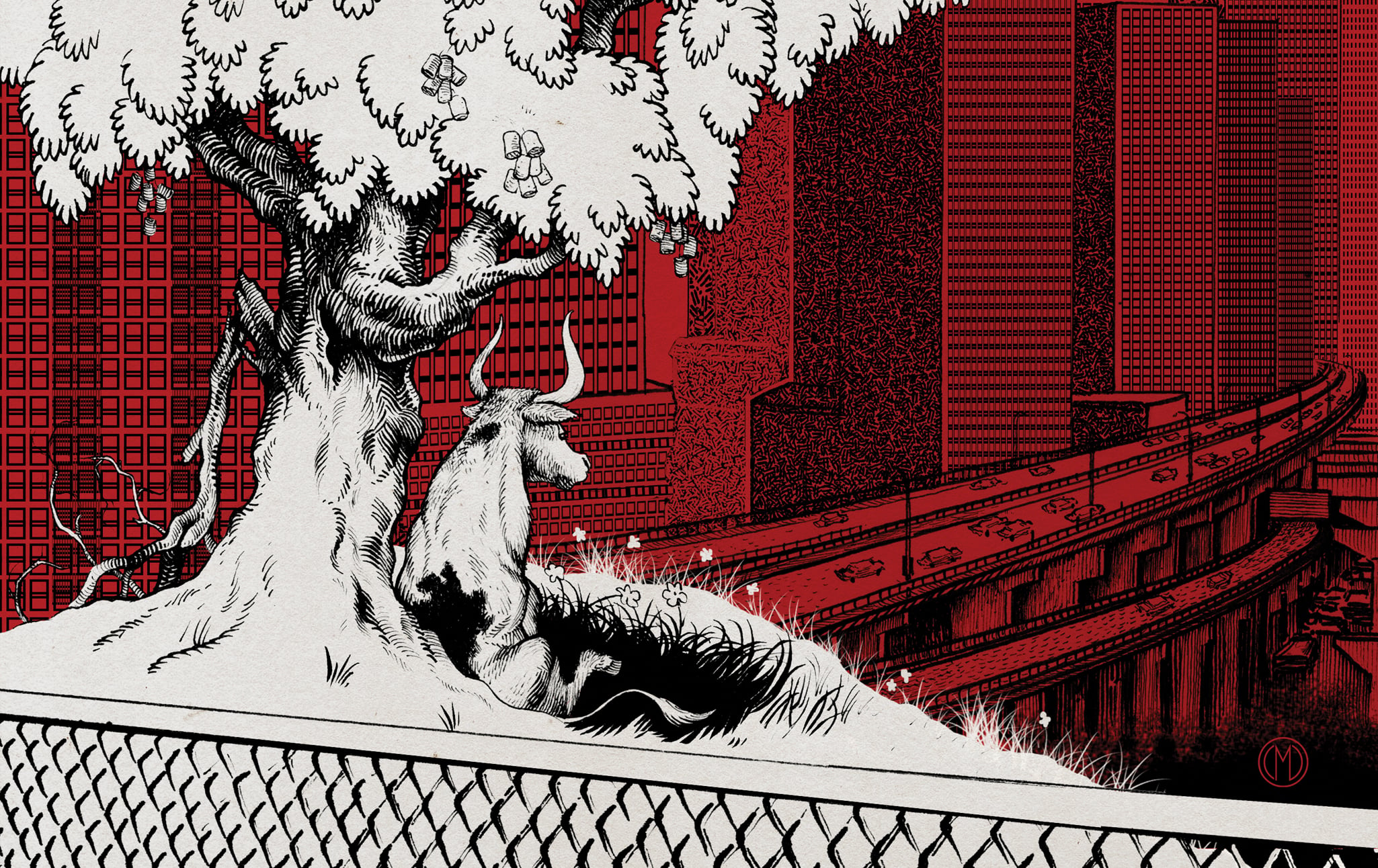
Connected to everything from pacifism to changing gender norms, the cartoon bull is a useful guide to censorship and moral panics over what kids are reading.
One of the most iconic pacifists in American literature celebrates his 90th birthday this year. The bovine hero of the children’s picture book The Story of Ferdinand rose to fame in 1936, when he refused to partake in a bullfight.
Written by Munro Leaf and illustrated by Robert Lawson, The Story of Ferdinand tells the tale of a young bull in the Spanish countryside who prefers smelling flowers and lounging under a cork tree to jumping and butting heads with the others. When five men in funny hats arrive to pick the biggest, fastest, toughest bull to fight in the big city, Ferdinand happens to sit on a bee, causing him to leap into the air and snort in pain. The scouts see a ferocious opponent and cart him off to Madrid. Once in the ring, however, Ferdinand sits quietly sniffing flowers and refuses to fight “no matter what” is done to provoke him. Eventually, the matador admits defeat and Ferdinand returns home to spend the rest of his days in peace.
The pacifist fable is often used as a cultural shorthand for dissent. But nearly a century after its release—amidst a renewed cultural panic over what kids are reading—the book’s uses reveal a far more complicated story about how politics infuses children’s literature.
The Story of Ferdinand was an instant bestseller, garnered critical acclaim, and has remained in print since its debut. It stands as an exemplary picture book: a form that relies on a tight interplay between word and image. Lawson’s simple black-and-white, pen-and-ink drawings communicate visual comedy, and when juxtaposed with Leaf’s matter-of-fact prose, result in a book that’s both straightforward and intricate. The text’s sly humor invites multiple readings.
The tale circulated to a broad audience through the Federal Theatre Project’s Marionette Workshop, Walt Disney’s 1938 animated short “Ferdinand the Bull,” and numerous musical and creative adaptations. In 2026, the Eric Carle Museum of Picture Book Art hosted the exhibit “Under the Cork Tree: The Story of Ferdinand.” Two million copies have been sold worldwide, and it has been translated into more than two dozen languages—and yet, like so many lasting works of art, the book emerged almost as an accident.
Leaf penned the story in just 40 minutes, according to a 1938 article in the New York Times, “as a vehicle to show the public what his friend, Robert Lawson, could do with a real illustrating assignment.” Leaf assured the public that his only message was humor: “If the book fails to make you chuckle there is no excuse for its existence, so far as I am concerned,” he quipped. Yet what the creators dubbed a “perfectly absurd tale,” some saw as a political tract packaged as innocent children’s fare.
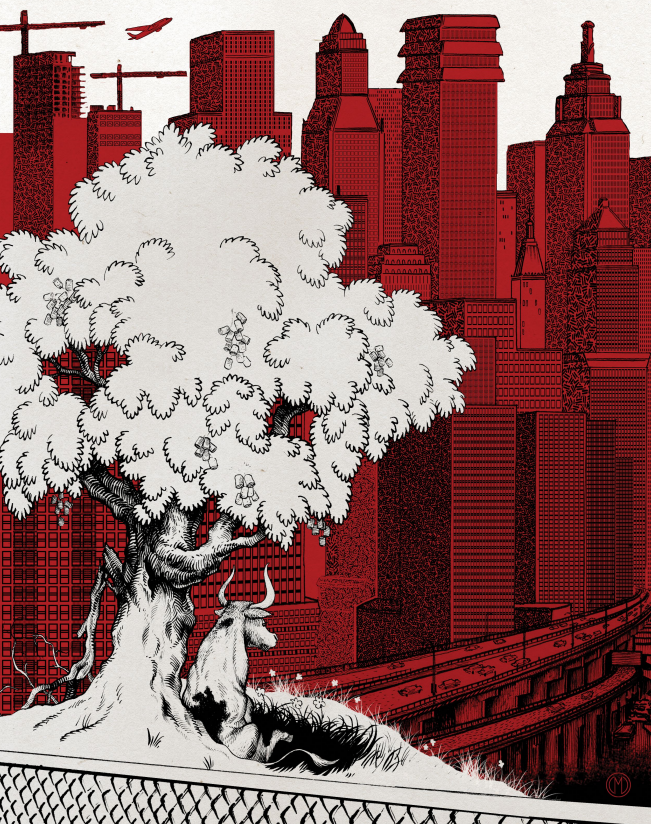
Art by C.M. Duffy from Current Affairs Magazine, Issue 61, September-October 2026
Those concerns weren’t all that surprising given the timing of the book’s release. Published less than two months after the start of the Spanish Civil War, The Story of Ferdinand quickly became a political lightning rod. So much so that Leaf told an audience at the 1937 National Book Fair that letters sent to Viking Press accused him of “deliberately corrupting children of an impressionable age”:
Here in Ferdinand people saw the laissez-faire theory of economics seconded by the bourgeois ideology of utility[…] letters complained that ‘Ferdinand’ was Red propaganda, others said it was Fascist propaganda, while a number protested it was subversive pacifism. On the other hand one woman’s club resolved that it was an unworthy satire of the peace movement.
The New Yorker dedicated a column to the bull’s confounding reception as both a rugged individualist and a ruthless fascist. In the Salinas Morning Post, a reporter referred to Ferdinand as “the guy the mob couldn’t push around,” and quoted Leaf, who stated that people had read into the book “The Communist Manifesto, the Declaration of Independence and Mein Kampf.”
Sales bloomed in keeping with the controversy. In 1938, Life magazine dubbed The Story of Ferdinand “the children’s-book-for-adults” and Ferdinand a “grownups’ hero.” The bull’s enduring popularity with audiences of all ages is in no small part due to the man who sold the world on the idea of childhood innocence: Walt Disney.
Rather than retelling a fairy tale as he’d done for many Silly Symphony shorts and the hit full-length animated musical Snow White and the Seven Dwarfs, Disney optioned the rights to The Story of Ferdinand. Studio animators worked from Lawson’s illustrations, and along the way amplified racial caricatures and gender stereotypes to entertain audiences. (The inept villains in the ring are also caricatures of real-life Disney animators, and Disney himself voiced Ferdinand’s mother.)
Walt Disney Productions’ “Ferdinand the Bull” transformed the quiet story-book hero into a celebrity. “Bull Market Soars as Ferdinand Becomes a Commercial Product,” proclaimed a Life magazine headline for a profile of Leaf, Lawson, and May Massee, children’s book editor at Viking Press, noting that the creators stood to make a substantial profit from licensing the bull’s image.
To create a buzz ahead of the short, the studio released the song “Ferdinand the Bull,” composed by Albert Hay Malotte with lyrics by Larry Morey. Fans could purchase Ferdinand Cartier brooches, dolls, toys, soap, pajamas, ties, umbrellas, raincoats, balloons, and stationery. The bull’s likeness appeared on Post Toasties cereal boxes, and Ferdinand floated in the Macy’s Thanksgiving Day Parade. “Ferdinand the Bull” premiered the next day and would go on to win the hearts and minds of a multigenerational audience as well as an Oscar for Best Cartoon Short.
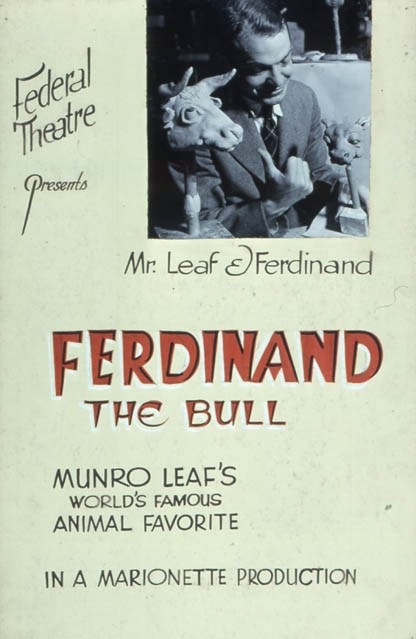
Munro Leaf appears on a 1937 playbill for a marionette production of his best-selling picture book. (Image: Federal Theatre)
Ninety years later, the reputation of The Story of Ferdinand as a political manifesto of one kind or another lingers. Retrospectives often repeat difficult-to-substantiate stories, including that Hitler burned copies of the book or that Spanish dictator Francisco Franco banned it outright. Still, Sharon McQueen’s meticulously researched 2012 The Story of Ferdinand: The Creation of a Cultural Icon found no “historical evidence yet surfaced that substantiates a special burning of the book or of the book being labeled ‘degenerate democratic propaganda’ by any German individual or group.” Likewise, McQueen’s investigation into whether the book was banned until after Franco’s death proved inconclusive.
The International Youth Library in Munich confirms that loans and sales of the first German translation of Ferdinand the Bull, published in Switzerland in 1942, were in fact prohibited during the war. However, the book’s censorship wasn’t due to its pacifist message, but because all of Güttinger’s translations of American and British literature fell into the category of “enemy” literature.
Ferdinand’s actual history is less tidy than the mythology that has accumulated around him: one that exemplifies the childlike wonder with which adults often approach children’s books, as containers of simple indisputable truths. Ariel Dorfman explored this concept in his 1983 cultural critique The Empire’s Old Clothes, contending that children’s media “uses its self-proclaimed innocence as a way of whitewashing—or is it rosewashing—the world.” The fantasy that the small but mighty Ferdinand stood up to totalitarianism reflects the view of children’s books as objects imbued with special powers to subvert and educate, corrupt and save.
Though Ferdinand was both valorized and critiqued for his pacifism, Leaf was by no means an anti-war activist. During WWII, he served in the U.S. War Department, and alongside Theodor Geisel (better known as Dr. Seuss) he created This is Ann: She’s Dying to Meet You, a public health pamphlet used to educate soldiers stationed in the South Pacific about malaria. After the war, Leaf spent much of his career in the employ of the U.S. government.
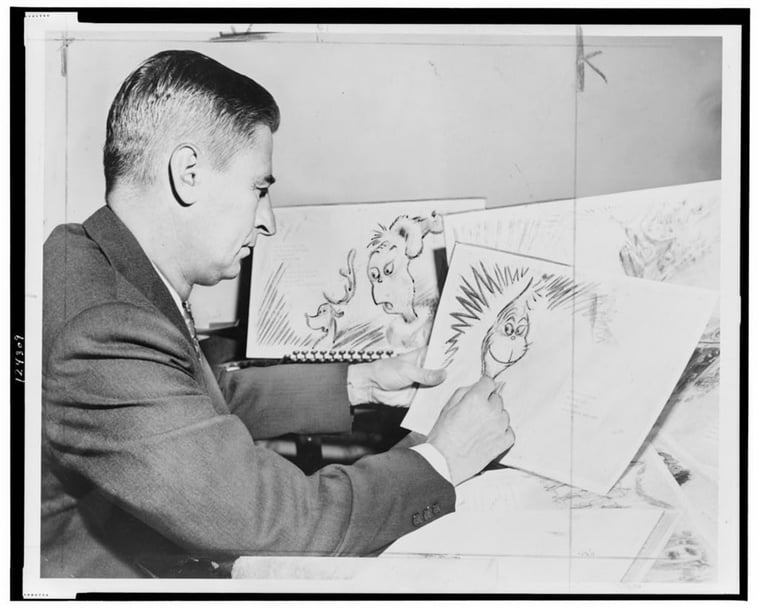
Theodor Geisel (Dr. Seuss) sketches a drawing for his forthcoming book, “How the Grinch Stole Christmas” in 1957. During World War II, Geisel worked alongside Munro Leaf in the animation department of the U.S. Army's First Motion Picture Unit. (Photo: Library of Congress)
Ferdinand, meanwhile, took on a new life as an instrument of American cultural diplomacy, proselytizing peace much further than his creator could have initially imagined. The Story of Ferdinand circulated in postwar Germany during America’s re-education program through Jella Lepman, a German-Jewish activist working as a major in the U.S. army. She organized a traveling International Children’s Book Fair from 1946 to 1949, convincing her superiors that children’s books were educational tools that would imbue lessons of peace and tolerance.
Wanting to give Berlin’s children a Christmas present, Lepman translated the story into German, convinced a publisher to create 30,000 copies of Ferdinand der Stier printed on newsprint, and distributed the low-budget copies to youth to take home. Lepman later stated that Leaf and Lawson should have received the Nobel Peace Prize for their work. In 1949, she established the International Youth Library in Munich, and several years later founded the International Board on Books for Young People—two key organizations for the promotion of children’s literature across the globe. Though not originally written as anti-war literature, the organizations Lepman founded later dubbed The Story of Ferdinand the “earliest anti-war book in modern children’s literature” in a 1998 exhibit, “Hello, Dear Enemy! Picture Books for Peace and Tolerance.”
The same pliability that made Ferdinand useful in postwar Germany made him useful elsewhere, too. During the Cold War, The Story of Ferdinand circulated across the Middle East and other “developing” countries through the Franklin Book Program, a private nonprofit organization subsidized by the U.S. government as well as corporate foundations. The program operated from 1952 to 1978 and published more than 3,000 titles and 50,000 volumes.
Franklin’s first office opened in Cairo, Eygpt in 1953 and expanded to Beirut, Baghdad, Tehran, Tabriz, Lahore, Dacca, Kuala Lumpur and Jakarta, and in the 1960s into Africa and Latin America. In a 2007 Library Trends article, Louise Robbins laid out the program’s mandate:
1. To help strengthen the economic, social, and political structure of the Middle Eastern Countries. 2. To provide information and points of view regarding America, democracy, and the idea of an open society so that, if the people of the Middle East wish this, they can judge fairly, and not with the field having been abandoned to the totalitarians. 3. To further international cultural exchange.
In each country, Franklin staff worked alongside highly-regarded local citizens, who translated and edited the books.
The desire to promote Western values and resist Soviet influence included materials for children. In 1957 Datus Smith, president of the program, celebrated that “‘attractive’ children’s books mirroring the ‘American way of life’ had filled a need that would otherwise be filled by communist material.” In 1963, Publisher’s Weekly noted that the most widely distributed book published under Franklin’s sponsorship was Robert Lawson’s children’s title Robbut (300,000 copies widely used in Egyptian schools). Another highly popular title was The Story of Ferdinand (as well as Leaf’s other works), which the journalist noted “had been published in Arabic and some African vernaculars and was scheduled to go into Bengali.”
Though the program officially ended in 1978, University of Alberta professor Mahdi Ganjavi, author of Education and the Cultural Cold War in the Middle East: The Franklin Book Programs in Iran, verified that “a Persian translation of Ferdinand is now available via Entesharat-e Elmi va Farhangi, a publishing house that emerged from the former Franklin Book Program’s organization after the 1979 Revolution, when Franklin’s assets and publications were confiscated by the new regime. That suggests the book continued to circulate after the Revolution.”
How children, then and now, interpret, resist, or reimagine The Story of Ferdinand is difficult to know. Youth are active consumers, producers, and critics. What is certain is that childhood was integral to cultural imperialism. The imagined child reader of the Franklin Book Program (as well as Lepman’s international library) was a blank political slate, a future ally or enemy, unhinged from economic, social, and cultural contexts, a being that could be easily manipulated, indoctrinated by communism or saved by Western democratic values.
Likewise, in postwar America, a moral panic erupted over 10-cent comics, the most popular reading materials with youth at the time. Unlike The Story of Ferdinand, these graphic narratives were easily accessible and cheap. Adult concerns about sex, violence, and horror in comics that seduced innocents led to bans and burnings in the United States and to the establishment of a 1954 Senate Judiciary Committee’s Subcommittee to Investigate Juvenile Delinquency.
Only three years later, however, the Supreme Court in Butler v. Michigan overturned a law that made it illegal for any person to sell books or other materials that contained “obscene, immoral, lewd, or lascivious” language or pictures “tending to the corruption of the morals of youth.”
The court unanimously struck down the Michigan statute on the grounds of the Fourteenth Amendment. Justice Felix Frankfurter delivered the opinion stating that “quarantining the general public against books not too rugged for grown men and women in order to shield juvenile innocence” violated the individual rights of adults, who under the law would only have access to child-appropriate materials.
The fight over what children should read, in other words, has always been partly a fight over what adults believe children can become. And Ferdinand continued to be recruited into those battles, even as his meaning changed.
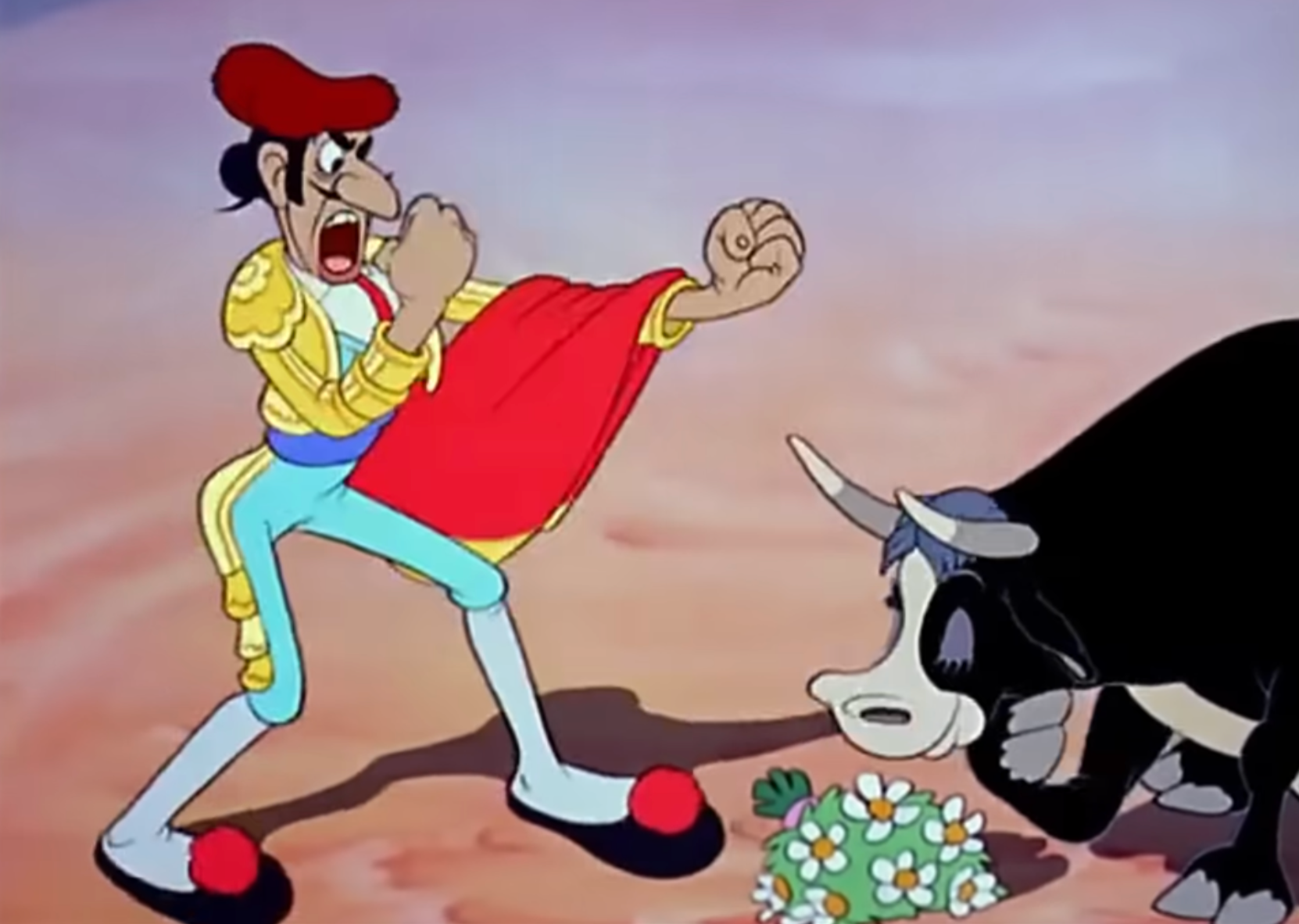
Ferdinand refuses to battle the matador in Disney’s 1938 animated short. (Image: Walt Disney Productions)
At the tail end of the Cold War, The Story of Ferdinand reemerged as a darling of literacy education in both Bush administrations. In the early ’90s, accompanied by special guest Bugs Bunny, Barbara Bush read the story on “Mrs. Bush’s Storytime,” an ABC radio network production in the 1990s.
Years later, the picture book was Jumpstart’s 2007 Read for the Record title choice. Politicians, sports figures, and hip-hop celebrities like Wyclef Jean and Lil Mama supported the initiative, which raised funds for early literacy in underfunded preschools. Penguin published a special Young Readers’ edition of the picture book for the event and the Pearson Foundation donated 50,000 copies to schools. Matt Lauer and Meredith Vieira co-wrote in the foreword that early literacy was a “way out of poverty, a path toward a future full of opportunity and a known deterrent to crime and drug use.”
On September 20, 2007, First Lady Laura Bush appeared on the “Today” show from Pershing Hill Elementary School at Fort Meade in Maryland, with The Story of Ferdinand once again in tow. (No one seemed to pick up on the irony of reading a pacifist children’s book on an Army base four days after Blackwater murdered and injured Iraqi civilians in Nisour Square in Baghdad.) Likewise, Margaret Spellings (on her No Child Left Behind bus tour) read the book to preschoolers at the Wright-Patterson Air Force Base.
The Story of Ferdinand even makes a cameo appearance in The Blind Side, the controversial 2009 white savior film about NFL Super Bowl champion Michael Oher and the well-to-do suburban family who informally adopted him in high school. (Oher sued the Tuohy family in 2023 for using his name for financial gain and for his depiction that left “the NFL people wondering if I could read a playbook.”) In a pivotal scene in the film, Leigh Anne Tuohy (Sandra Bullock) reads the picture book aloud to her son and the teenage Michael (Quinton Aaron), after learning that his absent mom never read with him as a child. The use of the picture book and the character—Michael is nicknamed “Ferdinand” by his white peers, who view him as a “gentle giant”—furthers the movie’s racist and classist stereotypes. Children’s books and early literacy define childhood innocence that Oher was denied.
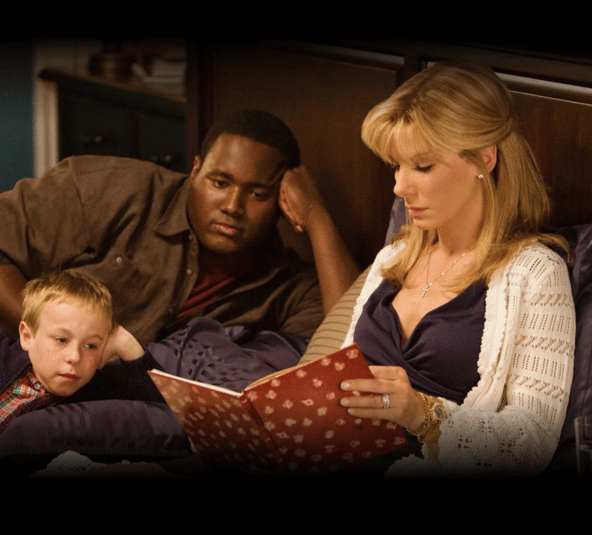
In The Blind Side (2009), offensive lineman Michael Oher is compared to Ferdinand: “Everyone assumed because he was big that he wanted to fight in the ring … do you even wanna play football?” asksLeigh Anne Tuohy, played by Sandra Bullock. (Credit: Alcon Entertainment/Warner Bros. Pictures)
Throughout the 20th century, the domestic and international deployments of The Story of Ferdinand soft launched a number of political agendas. As Leaf recalled in The Los Angeles Times, Ferdinand was everywhere he travelled when working with the U.S. State Department in the 1960s: “Even in the Malaysian bush, Ferdinand was there. He’s a great advance man.” Yet despite his global popularity, some readers questioned whether Ferdinand—with all his flower-sniffing and conflict-avoiding—was really a “man” at all. More importantly: could his influence turn boys weak?
From his first appearance, debates swirled around Ferdinand’s masculinity. A writer for The Cleveland Plain Dealer suggested that “certain irate fathers assert that the book is a deliberate attempt to make mollycoddles out of little boys.” Jazz duo Slim & Slam began their cover of “Ferdinand the Bull” with a voice over: “Ferdinand, you’re a sissy.” Film critic Benjamin Crisler reported that Leaf:
[...]is indignant when wits suggest that Ferinand is a sissy, because he loves to sit under a cork tree and smell flowers. He says Ferdinand is just a superior soul, a philosopher, and that his refusal to fight in the bull-ring [sic] at Madrid when there was a lovely bouquet to smell was a proof of good taste, and strength of character as well.
Walt Disney was asked to weigh in about whether Ferdinand was “a sissy or a pretty wise bull,” according to a reporter for the Omaha Daily Standard, and responded that he was wise.
In 1951, Ernest Hemingway’s parody “The Faithful Bull,” published in Holiday, began, “One time there was a bull and his name was not Ferdinand and he loved to fight and he fought with all the other bulls of his own age, or any age, and he was a champion.” (Spoiler alert: this bovine dies a brave champion in the ring.)
Progressive educators, however, celebrated Ferdinand’s gentle masculinity in articles and on non-sexist children’s book lists, touting the story as a positive influence on young boys. “Watch even the most aggressive, tyrannical youngster listening to the story of Ferdinand. With complete honesty he nods his head, recognizing himself as the peace-loving, flower-smelling bull,” stated an expert in a 1957 issue of Child Study: A Journal of Parent Education.
The debate over Ferdinand’s masculinity has proved remarkably durable. In 2017, Ferdinand hit the big screen again as “an icon of gender nonconformity” in Carlos Saldanha’s animated full-length feature Ferdinand, produced by 20th Century Fox. Saldanha’s Ferdinand was a tough but sensitive hero (voiced by WWE pro John Cena) who challenged the ties between masculinity, violence and bullfighting that Hemingway glamorized.
Told from Ferdinand’s perspective, the audience journeys alongside the bull as he confronts the floor-to-ceiling horns lining the matador’s trophy wall, the butcher’s gleaming steel hooks awaiting carcasses, and the realization that the system is stacked against him. PETA lauded the film on its kids’ site and awarded it an OSCAT (honoring the best animal-friendly films and stars of 2017).

As the news media drums up another boy crisis, Ferdinand’s gentleness remains a feminist touchpoint. In a 2023 piece in the Evening Standard, “How to Talk to Your Children About Andrew Tate and Online Misogyny,” Martha Alexander notes that many of Tate’s followers are school-age children, and recommends reading The Story of Ferdinand as an antidote.
The socio-political backdrop of The Story of Ferdinand’s production shares uncanny similarities with our own—economic precarity, global conflict, and rising authoritarianism within and outside the United States. Likewise, the many ideological interpretations of Ferdinand trace a direct line to highly-contentious conflicts taking place right now over political messages in children’s books.
By the 2010s, political arguments surrounding children’s books became increasingly explicit. Board books for toddlers like Innosanto Nagara’s bestselling A is for Activist! —self-published in 2013 and “written and illustrated for the next generation of progressives: families who want their kids to grow up in a space that is unapologetic about activism” —appeared alongside attempts to challenge the whitewashed histories served up in traditional textbooks. Duncan Tonatiuh’s award-winning picture book biography Separate is Never Equal: Sylvia Mendez & Her Family’s Fight for Desegregation was one such intervention. (It was one of the most banned children’s books of the 2021-2022 school year.) Critiques of offensive racial caricatures in Dr. Seuss’s children’s books led Seuss Enterprises to stop publishing six of his picture books in 2021. Meanwhile, Puffin books hired sensitivity readers to comb through Roald Dahl’s work and edit out adjectives like “fat” and “ugly.”
The Right has responded to these efforts by banning liberal books, and any others they don’t like, claiming to protect youngsters. According to a 2025 report from Pen America, book bans targeting school libraries in the U.S. are now the norm. These challenges and bans are connected to Trump’s executive order to end “radical indoctrination” in K-12 schools via parents’ rights groups like Moms for Liberty. In 2023, Kids1st, an association of parents and teachers in Maryland, filed a federal lawsuit against the Montgomery County Board of Education for “forcing pre-K and elementary-aged children to read controversial books that promote a one-sided transgender ideology, encourage gender transitioning, and focus excessively on romance.” Two years later, in Mahmoud v. Taylor, the Supreme Court in a 6-3 vote upheld parents’ rights to opt-out of curriculum that used LGBTQ+ inclusive picture books.
In addition to lawsuits, the Right peddles their conservative ideologies through their own children’s book imprints like Brave Books, which Politico Magazine aptly dubbed “a literary hub for the wee and anti-woke, searing a conservative viewpoint—and, sometimes, conservative talking points—into the youngest minds.” Kirk Cameron (the former Growing Pains actor, turned evangelist, turned children’s book author) advertises his wares through hyperbolic scare tactics: “our children are under attack.”
Adults have long invested children’s books with the power to save or liberate children, or viewed them as potential vehicles for corruption and ideological indoctrination. Ninety years post-Ferdinand, there exists a persistent belief that picture books can wield extraordinary political power over a child. The question is not whether books matter—they plainly do—but why so much political energy is devoted to controlling what children read while the conditions in which they live receive comparatively less attention.
In a Publisher’s Weekly promo for The Story of Ferdinand’s 30th birthday, Leaf stated:
I have been accused of defending or attacking practically every ‘ism’ that has popped up in the last few years. As far as I am concerned, there is one story there, the words are simple and quite short. They try to make sense and if there is a message in them, as many people seem to want, it is Ferdinand’s message, not mine–get it from him according to your need.
Tracing the cultural afterlives of The Story of Ferdinand shows the political pliability of children’s literature. The battle over what “children of an impressionable age” should or shouldn’t read isn’t new—and it isn’t really about children at all, but rather a smoke screen for adult anxieties.