The brazen hypocrisy of indicting a 94-year-old man whose country is the victim of relentless sabotage and terrorism sponsored by the U.S.
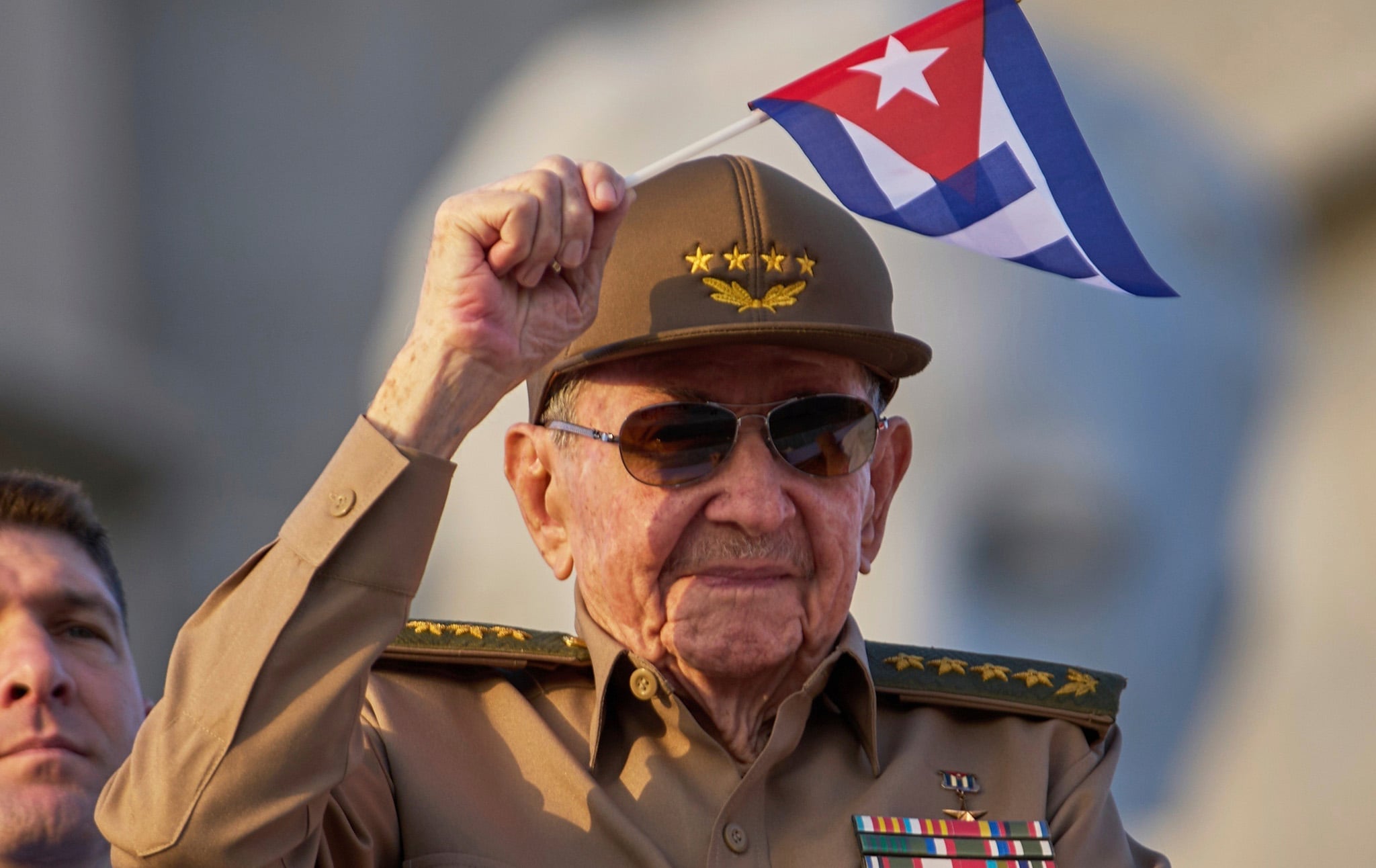
So apparently the Trump administration has decided that what Cuba really needs right now—after decades of economic strangulation, CIA assassination attempts, sabotage campaigns, invasions, sanctions, blackouts, shortages, and more than half a century of failed regime-change policy—is the indictment of 94-year-old revolutionary icon Raúl Castro.
The United States and Cuba do not have to be enemies. In fact, just ten years ago, the two countries were normalizing relations. I was in Panama City at the 2015 Summit of the Americas when, to the delight of everyone there, former U.S. President Barack Obama and Raúl Castro famously shook hands, marking the first substantial public interaction between leaders of the two countries in decades. Obama said, “The United States is not interested in being prisoners of the past,” while Raúl Castro thanked Obama for taking steps toward normalization and called him “an honest man.” The opening was a win-win for both countries: an influx of U.S. tourists, a flourishing of private businesses, and new openings for civil society. Then came Donald Trump, who sent relations spiraling downward once again.
Fast forward to today, with the indictment of Raúl Castro for allegedly ordering the 1996 shootdown of the Brothers to the Rescue planes that left four men dead. I was in Cuba at the time leading a group of U.S. CEOs interested in investing on the island. The next day, we were supposed to meet with Fidel Castro. But after the planes were shot down, the meeting was canceled and the business executives rushed to take the next flight back to Miami.
It was a tragic and regrettable incident—not only because of the lives lost, but also because it hardened political attitudes toward Cuba for years to come, paving the way for the codification of the U.S. blockade into law.
But it’s critical to understand the context.
The group’s leader, José Basulto, was a veteran of the disastrous 1961 Bay of Pigs invasion with a long history of anti-Cuban militancy. He openly admitted, “I was trained as a terrorist by the United States.” The group repeatedly violated Cuban airspace and dropped anti-government leaflets over Havana. Basulto himself declared after one such mission: “We want confrontation.” Between 1994 and February 1996, the Cuban Ministry of Foreign Affairs and Cuban civil aviation authorities documented more than 25 serious and systematic violations of Cuban airspace by aircraft associated with Brothers to the Rescue.
The Cuban government repeatedly warned Washington, the Federal Aviation Administration (FAA), and international aviation authorities that these flights were illegal and dangerous. U.S. officials knew the risks. The National Security Archive’s declassified records, published on May 19, 2026, reveal that high-level US officials understood that continued Cuban airspace violations could lead to disaster. An FAA email from January 22, 1996—one month before the shootdown—explicitly warned of the “worst case scenario” that “one of these days the Cubans will shoot down one of these planes.” The same document acknowledged that State Department officials understood the overflights could “only be seen as further taunting of the Cuban Government.”
On February 23, 1996, White House Cuba adviser Richard Nuccio warned National Security Adviser Sandy Berger that “tensions are sufficiently high within Cuba[…] that we fear this may finally tip the Cubans toward an attempt to shoot down or force down the plane.” Yet the FAA refused Nuccio’s request to ground the flights.
While there is disagreement over whether the planes were ultimately shot down in Cuban or international airspace, the pilots had reportedly filed a false flight plan and again approached Cuban airspace despite direct warnings from Cuban controllers.
The hypocrisy of indicting Raúl Castro nearly 30 years later is staggering, given the long history of anti-Cuban extremists operating from U.S. soil to wreak havoc against the island with bombings, sabotage, and airline terrorism. In 1976, terrorists bombed Cubana Flight 455, killing all 73 people onboard, including the entire Cuban national fencing team. In 1997, a 32-year-old Italian tourist was killed in a hotel bombing aimed at destroying Cuba’s tourism industry. Yet men implicated in these horrific acts, including Orlando Bosch and Luis Posada Carriles, were protected by U.S. authorities and allowed to live freely in Miami.
And let’s remember: The same U.S. government now pursuing charges against Raúl Castro has itself been carrying out deadly strikes on alleged drug-smuggling boats in the Caribbean and Pacific, strikes that have killed at least 193 people since September 2025, with no transparency or due process.

This new indictment is simply a cynical escalation in the long U.S. effort to force regime change in Cuba. Will Washington try to use it as a pretext to invade the island and “extract” Raúl Castro, as it did with Nicolás Maduro in Venezuela? Will it once again send U.S. troops to occupy Cuba, as it did in 1898, 1906, and 1912? Will it ignite a civil war? We have no idea.
But we do know this: Despite unfounded allegations to the contrary, Cuba poses no threat to the United States. And the United States has absolutely no right—zero—to interfere in Cuba’s internal affairs.
Raúl Castro is 94 years old. Let him live out his final years in the country where he was born and for which he fought his entire life. Instead of tightening the blockade and pushing Cuba toward greater poverty, instability, migration, and despair, the United States should finally abandon its failed policy of domination, lift the sanctions, and allow Cubans—not Washington politicians or Miami hardliners—to decide Cuba’s future.
Medea Benjamin is the co-founder of CODEPINK. This piece originally appeared on her Substack.

%20(1).jpg?width=352&name=Parrots_by_a_nest_in_the_Green-Wood_Cemetery_gate_(61841)%20(1).jpg)