Recognizing the rights of other species isn’t just morally correct. It could be a breakthrough on par with the Industrial Revolution.
Two technological revolutions drove human beings to become the dominant species on this planet. The Agricultural Revolution gave us dominion over the biology of Earth. The Industrial Revolution gave us dominion over its physics. Now, powered by breakthroughs in our understanding of intelligence, a third revolution may be imminent. It could solve problems that once seemed impossible, like climate change and war. It could trigger transformations in technology that allow us to cure intractable diseases and send humanity to the stars. It could exponentially increase the wisdom of every human being on earth.
You may think I’m speaking of artificial intelligence (AI). I’m not. That is secondary to another, far more important revolution. This is a Moral Revolution—the expansion of ethical consideration to all sentient beings. And if it is realized, it could allow us to harness a tool far more powerful than biology or physics: the collective will of the universe.

It may seem implausible to think we’re on the cusp of such a change. After all, the moral circle seems to be shrinking by the day. Across the world, right-wing movements are successfully mobilizing people to see “others” as “threats.” But if the claim seems dramatic, it’s only because we’re not looking at the right timescale.
Over a span of centuries, rather than months or years, progress has been steady in expanding our circle of moral consideration. Consider that a hundred years ago, institutional racism was not just widespread: it was culturally ascendant. The film Birth of a Nation, described as “the most reprehensibly racist film in Hollywood history,” showcased Black Americans as predators who would rape or kill white woman. This blatant racism was not just tolerated. It made the film into the most watched film, at the time, in American history. Zoom back another 50 years, and we are in the 1870s, decades before women have earned the right to vote. Susan B. Anthony decided to vote in the 1872 Presidential election anyways, and she was arrested for doing so. The poll workers who allowed her to vote were imprisoned. Finally, zoom back another 50 years, and we are in the 1820s, approximately ten years before the founding of the American Antislavery Society. It was considered relatively uncontroversial that human beings of color could be the property of other human beings. Their lives, their freedom, even their children were not their own. People did not just defend this horrific institution in the 1820s. They fought and died to prevent it from changing. In every one of these time periods, even many of those who were considered progressives and social reformers in their time—like Thomas Jefferson, who himself owned slaves—have been judged harshly by history.
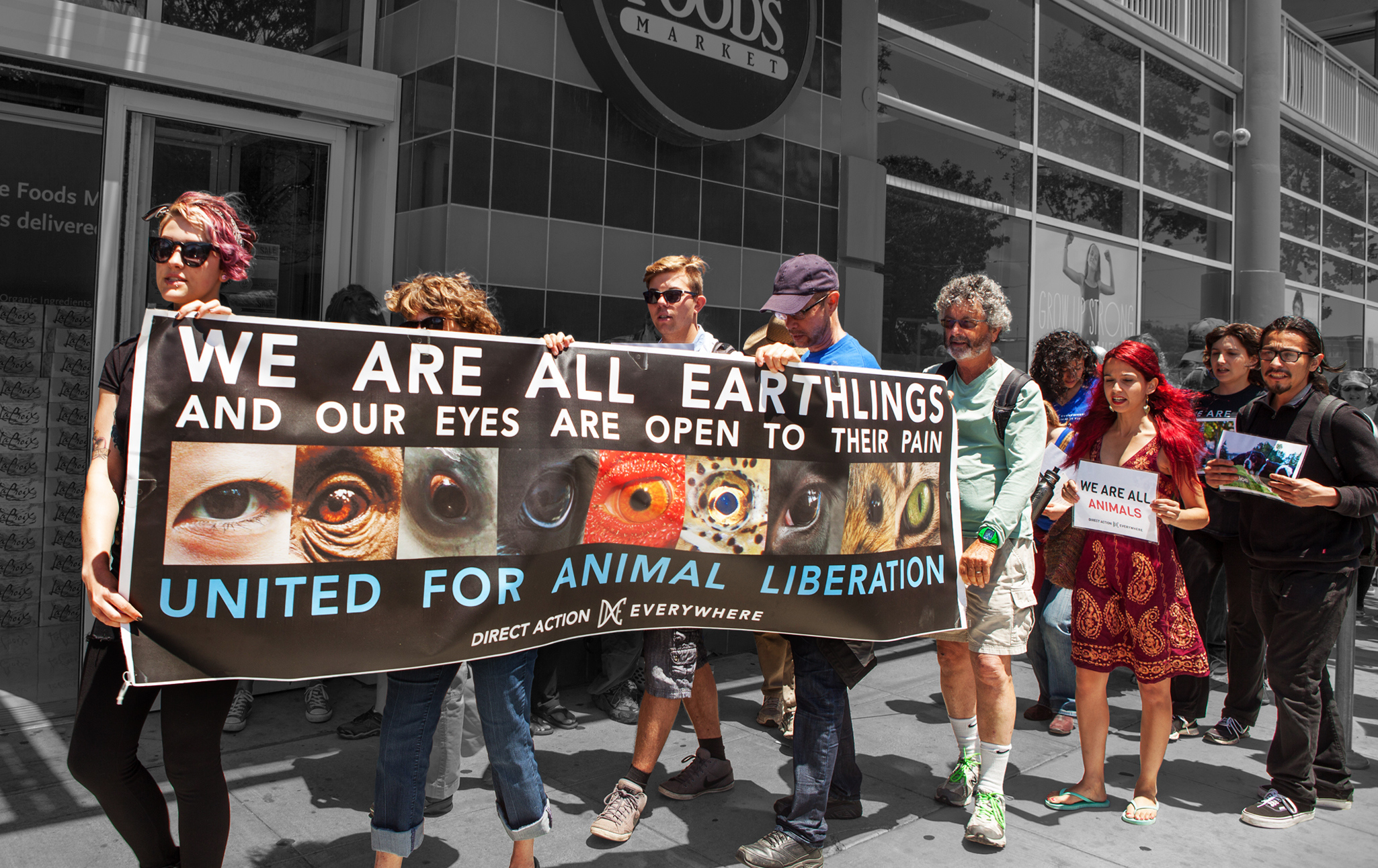
It will be the same when future generations look back on our treatment of animals. Anyone who thinks seriously about it already knows it to be the case. The overwhelming consensus among experts in neuroscience is that animals are conscious, just like us. Every day, a seemingly-unique ability of human intelligence, such as language, is discovered in other animals. And virtually every time a writer or thinker tries to list the ways in which modern society will be condemned by future generations, animal rights is at the top of the list. Consider this op-ed by Nicholas Kristof in the New York Times, written at the height of the George Floyd protests:
As we pull down controversial statues and reassess historical figures, I’ve been wondering what our great-grandchildren will find bewilderingly immoral about our own times — and about us. Which of today’s heroes will be discredited? Which statues toppled? What will later generations see as our own ethical blind spots? I believe that one will be our cruelty to animals. Modern society relies on factory farming to produce protein that is inexpensive and abundant. But it causes suffering to animals on an incalculable scale.

Or consider historian Rutger Bregman’s recent statement in support of animal rights. Bregman is no animal rights activist, yet concludes categorically that “200 years from now… the way we treat animals will rank among our biggest crimes.” Even many conservatives have reached the same conclusion. Charles Krauthammer, one of the nation’s most prominent right-wing columnists, argued near the end of his life that future generations would condemn us for eating animals: “I’m convinced that our great-grandchildren will find it difficult to believe that we actually raised, herded and slaughtered them on an industrial scale — for the eating.”
There are countless other examples. The distinguished philosopher Martha Nussbaum has described species membership as a “frontier of justice” and has devoted much of her recent work to defending animal rights. The futurist Yuval Noah Harari has condemned industrial animal agriculture as “one of the worst crimes in history.” And New York Times’ columnist Ezra Klein has argued that “we will look back on this age of cruelty to animals with horror.”
But why should we be so confident that future generations will continue to expand the circle? The first reason is philosophical. Peter Singer argues that moral systems that expand rights have a natural logic that causes them to win out over their exclusive alternatives. “Rights to me but not to thee” simply doesn’t have much rhetorical power. The second is economic. The Economics Nobel Laureates Daron Acemoglu and James Robinson have shown that nations with exclusive institutions are far more likely to fail. Even people with privilege can see the moral circle shrinking and ask, “What’s to prevent someone from pushing me out next?” That makes them unlikely to invest.
Perhaps the most fascinating explanation for moral expansion, however, comes from evolutionary biologist Joseph Henrich. The secret power of human beings, Henrich argues, is our collective brain. Through cooperation, we are able to coordinate knowledge and effort across vast spans of space and time. The result of this buildup of knowledge is exponential growth in technology and power.
Crucial to Henrich’s thesis, however, is the moral universalism that spread across the world beginning in the 4th century. For thousands of years, human beings and our ancestors had built social networks around those who were our genetic relatives. This limited our ability to cooperate, as families can only grow so large. But when Christianity disrupted this kin-based order in favor of one based on universal moral worth, that bottleneck was removed. Suddenly, nations could facilitate knowledge sharing across millions of people, not hundreds. It was the greatest unlocking of human potential in history.
Could something be similarly unlocked if our moral circle expanded to other species? The idea of animals and humans working together might seem like a biblical fantasy. Yet consider that the domestication of animals has already become among the most successful collaborations, in terms of planetary biomass, in Earth’s history. Of course, that evolutionary success has come at great cost: the enslavement and torture of billions of living beings. (Indeed, our abuse of animals is probably one of the primary reasons we have been able to domesticate so few of them.) But it shows the potential. Two species working together can achieve things that each species alone could never hope to achieve. And that is what expanding the circle promises: a world where all animals can direct our will towards the collective good.

It could not come a moment too soon. AI may soon give far more humans on this planet the ability to create powerful technologies such as bioweapons. If we haven’t learned to harness the collective will of sentient beings towards pro-social purposes, one of these humans (or an AI agent) may unleash another calamity. But there are even greater reasons to fear a future without an expanding circle. If AI becomes supremely powerful, as many fear, then it may see us in the same way we currently see animals—cute but ultimately dumb and morally irrelevant creatures. An expanding circle, beyond the frontiers of intelligence or species, may be the only thing that saves us.
It will do much more than that. The human condition has benefitted immensely from civilizations with diverse populations looking beyond religion, race, or creed. The condition of all sentient beings will be similarly transformed if we expand the circle beyond species.