It might be fun to deploy this discredited system of stereotypes, but we should know better.
I was 26, living in Boston, and working as a cheesemonger when astrology and I first fell out. My friend Allie (not her real name) had just received an email from her boyfriend’s ex containing a triangulation of all their natal charts—and while this hovered near the ceiling of the room I called “normal,” it was 2013, Girls was on the air, and we allowed it.
Then I began dating the man who would become my husband. We were in the annoying phase where he stopped by my work a lot and I had a new coworker, a person I’m not afraid to tell you was named Ren. Ren was young, hot, opinionated, fresh out of college. She had a pink and blonde ponytail, hairy armpits, and a twinkle in her eye. We were all smitten with her for about a week. Then, one afternoon, I told her I couldn’t wait for her to meet my boyfriend.
“When was he born?” she asked, dubious, as we both cubed cheese.
“Why?”
“I hope he’s not a Gemini.”
“Well,” I shrugged, doing something with my eyes meant to convey apology. Hers were doing disgust.
“Does it matter?” I asked. “You’ll love him.”
“I doubt it.”
I laughed, because what else could I do? Her mouth was set in a hard line. “So what,” I said eventually, “You’re going to refuse to meet him?”
“I mean… I could meet him.” She paused to pop a vivid orange piece of Mimolette in her mouth. “But I don’t think you want me to.”

More Americans know their Zodiac sign than know their blood type and, like most millennial women, I spent my first few decades living and dying by this sword. Would I ever be cool? Was I compatible with my crush? Why was my best friend being such a bitch? Reading what my horoscope had to say about these things satisfied something in me—a need to understand what I was, why I did the things I did. It scratched an itch I didn’t yet know the word for, because no one teaches a fourth grader the word “narcissism.”
I’m ashamed now to admit how late into adulthood I was before I stopped to consider the mechanisms grinding under the hood of this cultural milieu, a scientifically murky ecosystem governed by something one Twitter/X user referred to as “birthday racism.” (German social theorist Theodor Adorno called it “fascism” as early as 1952, but we’ll get to that.) I spent four years and thousands of dollars on a liberal arts degree that taught me to question everything, yet I’d never bothered to ask where Virgos came from.
In its most elemental form, astrology is grounded in the idea that the stars in the sky when you were born have some bearing on your personality, your moods, your destiny. And because the moon does pull on our oceans and uterine tissues, this has the glint of believability. But it isn’t the moon or the stars astrology focuses on—it’s the pictures they form. People born under the crab of Cancer are… crabby. People born under the scales of Libra are diplomatic, balanced, fair. People born under the horned figure of Aries are combative, stubborn. These pictures hold the power, and it’s a sizable power—a third of Americans consult them at least once a year. So who chose them? Surely some divine, immutable figure? More likely, it was a couple of Sumerian dudes sitting around a fire, high on whatever they’d found to eat that day. Hey, one probably grunted to another, before pointing up. Doesn’t that kind of look like a fish?
The 12 constellations we afford so much importance today were dreamt up in ancient civilizations throughout Mesopotamia, then refined and compiled by Ptolemy in the second century. What he wrote down is now recognized all over the Western world and transmuted to pre-teens through varied means (in my day, it was Cosmopolitan magazine and The Day You Were Born, a blue-and-yellow book every older sister was required to have).
But unsurprisingly, other cultures saw different things in those stars. Take the asterism known as the Big Dipper, to start with just about the lowest hanging fruit. To many it is a cup or a plough, but to people in Siberia, it’s an elk. To the Dakota, it’s a woman giving birth. To some ancient Greeks, it was a bear. For a while, Egyptians thought Libra was a boat. The Maya thought Pisces was a bat. In China, some believe Cancer represents a cloud of pollen (which you could say about any grouping of stars, but okay). The glorified line drawings behind thousands of life decisions and toxically entrenched personalities turn out to be kind of a cosmic crapshoot.
I had this realization behind the cheese counter, and it lit me up. How could I abide a hobby that made people think they knew a person they’d never met? It violated basic laws of utilitarian morality. It violated the categorical imperative. It violated the golden rule.
And I, no stranger to screaming into the void, got to work proselytizing this. I spent years going on screeds, posting cunty takes—years that ran concurrently with an absolute mushroom cloud of divinatory, crystal-gazing content. Memes and quizzes and charts maligning Scorpios and heralding Leos were everywhere. The Twitter account Astro Poets amassed over half a million followers. Cosmo expanded their print coverage of astrology from one column to nine pages. For a few years, everyone I knew had the Co–Star app. Millennial women were hanging on the every word of New York Magazine’s Madame Clairvoyant or Astrology Zone’s Susan Miller or the Canadian activist-astrologer Chani Nicholas. It was a bubble that seemed destined to burst.
So whenever I got the opportunity to share my revelations, I went for it. And I, humiliatingly, often went in thinking I’m going to blow people’s minds. But when I trotted out my point about pictures in the sky, something weird happened. No one cared.
Isaac Newton got into Euclidean geometry only after trying and failing to understand astrological charts. The field of astronomy apparently arose out of an attempt to do better astrology. That it’s been around so long, that it predates modern science, that it can get quite mathy, are all things astrology’s defenders point to as justification for its existence. And it’s true, it was widely practiced and respected from the second through the 15th century—years when we were also treating most medical anomalies with leeches.
But then the Enlightenment happened. Astrology was unscientific; you couldn’t study it. There was no way to isolate the variable of “personality” in a world where people were told what their sign said about them before they even learned to read. So it faded from the world of academia, finding a new and lasting home amid the occult. But although its intellectual cachet shifted, we never quite quit it. We, in fact, went back to it whenever things got hard. Robber barons like J.P. Morgan consulted it about the Panic of 1893. The first modern astrology column was commissioned in 1930, right after the market crashed. It was in a post-World War II climate, with A and H bombs looming and astrology columns proliferating, that Adorno wrote The Stars Down to Earth, one of the most damning astrology critiques of the last century.
More widely known for interrogating jazz, Adorno had a bone to pick with culture industries that claimed to promote independent thought while serving the interests of capital. He wanted to know what made our society so susceptible to things like this, writing that “Only very strong instinctual demands” could explain how, in a world in which “every schoolboy knows of the billions of galaxies, the cosmic insignificance of the Earth, and the mechanical laws governing the movements of stellar systems,” anyone could believe this trash. He located those strong instinctual demands in the human urge to depend on somebody or something bigger than themselves—to pass the buck, to let Jesus (or Neptune, or whoever) take the wheel.
Christopher Lasch took up this question 40 years later in his 1976 New York Review of Books article “The Narcissist Society,” in which he argued that Americans were retreating to “purely personal satisfactions” out of a “growing despair of changing society.” Having lost any hope of improving the world around them, Lasch argued, people had “convinced themselves that what matters is psychic self-improvement.” Just four years later, Americans almost unanimously elected Ronald Reagan, a president who reportedly consulted a White House astrologist before every major decision of his administration.
Fifty years post-Reagan and ten years post-Ren, Adorno’s is still the most rational critique of astrology out there. A Google search for “astrology takedown” nets the astrologist-penned Adorno roast: “A satisfying takedown of ‘aStrOloGy iS A gAtewaY tO fAscIsm.’” Journalists have admittedly had their hands full lately, but investigations into this cultural phenomenon have nevertheless been particularly craven. When the New Yorker profiled the founders of Co–Star in 2019, I thought, Finally, a thinking person’s take. No way would they escape unscathed from this world-famous fact-checking department, this institution known for integrity and journalistic rigor. To my abject dismay, the writer Christine Smallwood deemed astrology harmless because “it doesn’t teach dogma, or prescribe action.” What is a horoscope, I scribbled in the margins, if not a prescription for action?
For something that set out to untangle the thorny knot of modern divinatory culture, the article “[failed] to mention a crucial fact—that astrology is nonsense” (read one Letter to the Editor that, no, was not from me). By the end of the piece, Smallwood is joining a group of astro entrepreneurs to cast a spell on the Brooklyn Bridge.
The Washington Post didn’t fare much better in 2023, quoting a yoga instructor who described her approach to horoscopes as “you pick and choose what resonates with you,” offering a pretty succinct definition of confirmation bias.
I turned next to Lauren Oyler’s tongue-in-cheek take in the side-eye-heavy pages of the Baffler. Surely they would succeed where legacy media had failed, right? But while Oyler did call out the Co–Star app for feeding her the same pithy one-liners multiple times a day, she also said this “does not make [them] any less true.” Many epistemological questions are begged by this statement, the most basic of which concerns Oyler’s definition of truth.
Astrology, which Oyler says “exerts no measurable or material influence,” sits behind a $12.8 billion industry expected to reach $22.8 billion by 2031, according to a study by Allied Market Research. And because numbers that big can feel abstract, consider that the Bluey franchise, including all merchandise for the most streamed show in the world, is valued at $2 billion. People charge $300/hour for chart readings. Chani Nicholas, who has more than 680,000 followers on Instagram, has used astrology to determine the impact of Saturn on the future of the U.S. immigration policy DACA.
We’ve seen this tide ebb slightly in recent years—you won’t find a purple stick of amethyst in every one-bedroom apartment in Brooklyn anymore, and doubting “western medicine” is more aligned with MAHA conservatives than Silver Lake witches. The nation’s foremost authority on public health is an anti-vaxxer, so whatever grasp we still have on objective fact and scientific truth is being clung to with a white knuckle grip.
And yet… the stench of astrology still permeates the internet, the culture, probably the Oval Office. Co–Star is still one of the top apps in the U.S., and astrology dating sites, books, podcasts, and meme accounts are still surging. On Hinge, your sign is still listed under your “Vitals.” Just last year, a friend of mine was turned down for a room in an apartment in Bushwick because one of the current tenants had lived with Libras before and said it “just never works out.” I know people who’ve planned their IVF embryo transfers around avoiding an undesired sign. At the birthday party of my friend’s one-year-old last winter, a bartender asked who we were celebrating and when I told him, responded: “Capricorn—yikes.” At my own most recent birthday dinner, the servers opined loudly about how much they hated Aries season (which began that day) while I opened my presents in front of them.
As recently as September 2025, the New York Times published “Your Zodiac Sign is 2000 Years Out of Date,” a news article that accepts as a core premise that your Zodiac sign means anything, an article that presupposes belief, an article that questions nothing. One friend who likes to rib me about these things said in one breath that she knows astrology isn’t real, but refuses to accept the Times’ reassignment of her sign because “no way am I a Sagitarrius.” Cue me flailing my arms and screaming out the nearest window.

We are, Oyler says, a generation “deeply confused about what irony is, whether it's acceptable, and if we are in fact employing it right now,” and maybe it’s this shifting relationship to earnestness that makes it so hard to know where my peers stand on this nonsense—why so many act like it means nothing, yet bristle at attempts to discuss it. People seem to want to make fun while simultaneously deriving a genuine sense of themselves from it.
I’m speaking not of Ren or that person with an empty room in Bushwick, but brilliant scientific minds, people with Ph.D.s, people with no shortage of arguments in favor of me shutting up. I’m talking about a professor who wears a Pisces necklace, an electrical engineer who checks their horoscope before making important life decisions, a therapist who uses clients’ signs to unpack their behavior. Astrology means something to these people; they use it as a tool for self-reflection. I’ve been told by some friends that it helps them process reality, by others that it gives them access to a notion of identity that’s accepted by the culture at large when their other identities (gender, ability, sexuality, race, ethnicity) are not. It is a modern religion, at a time when so few of us have religion. It is something willing to take the wheel for a while.
And we live in a polytheistic world—astrology being poly-constellational is not a knock against it any more than the existence of Christianity is an argument against Hinduism. (Many do believe that, but it won’t get you very far in a global debate). Different cultures have different relationships to truth and objectivity, to the metaphysical and the rational. While I’ve so far focused on Western astrology, such mysticisms exist all over the world—in Indian Jyotish, or Vedic astrology; the Jewish Zohar; Islamic cosmology and Sufism; the Chinese zodiac; the Yoruban Ifá and West African Orisha. These require, like any religion, a leap of faith.
But we should be careful associating rationalism with Western thought—to paraphrase a comment I saw on the Vedic astrology subreddit, Eastern schools were doing rationalism while Westerners were still bopping each other over the head with clubs. And not all rationalism is oriented against the divine—the rationalism that led me away from astrology is opposed not to having a spiritual connection to the Earth, but to the idea that some people, be they Muslims or Libras, have greater access to that connection.
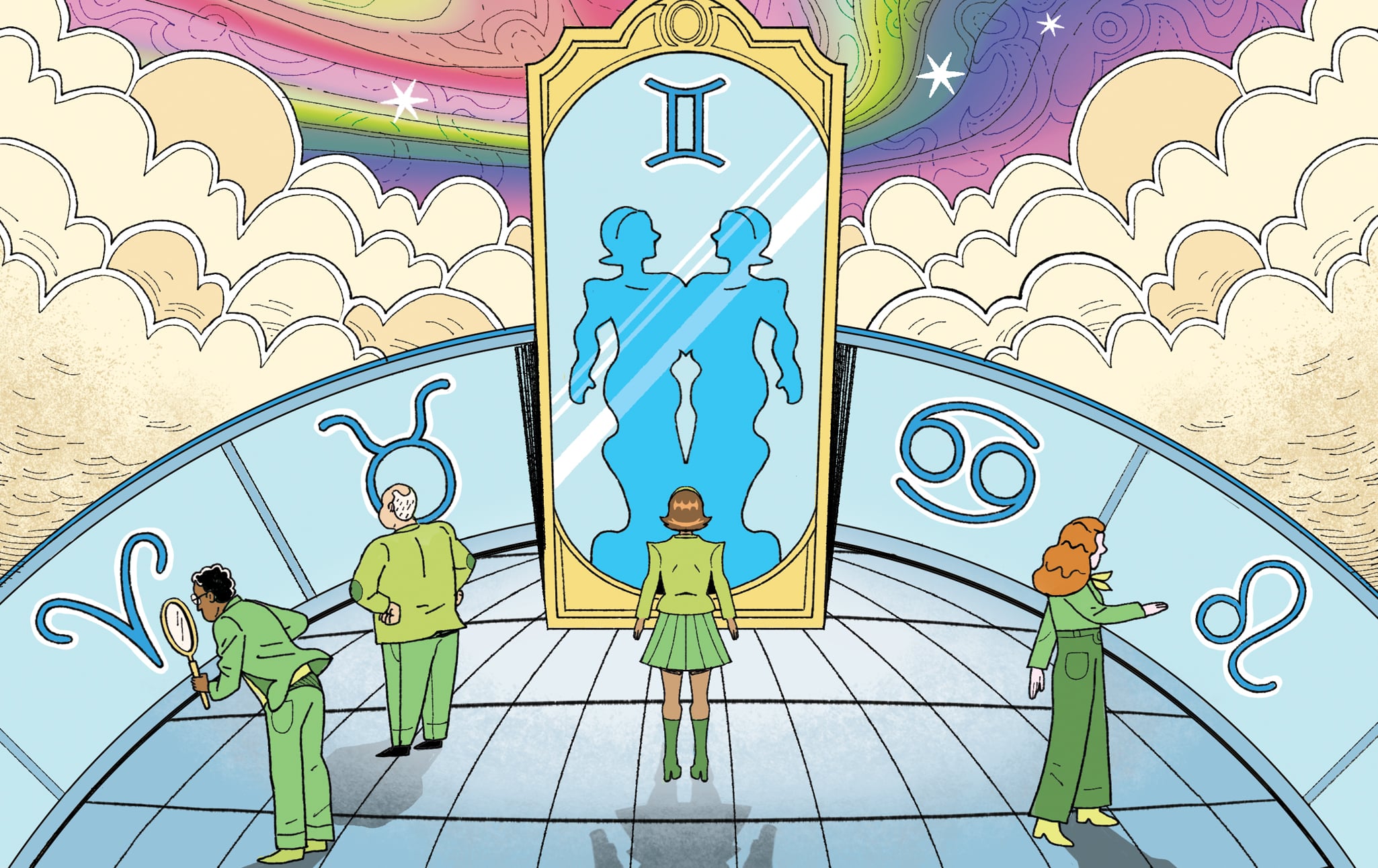
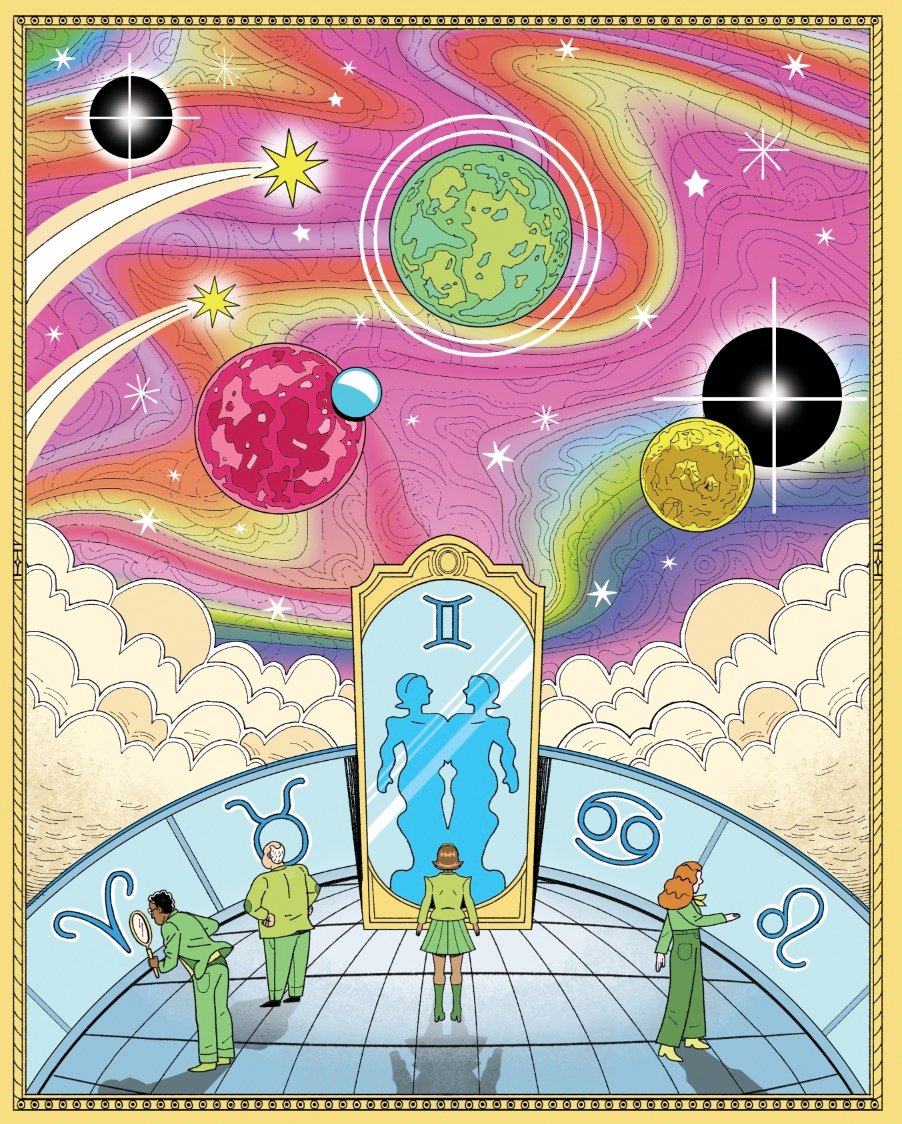 art by chelsea saunders
And while human science is limited (we did use those leeches for quite a while), we can say with pretty much utmost certainty that a few random balls of fire appearing to look like either a fish or a bat does not mean people born while that is in the sky will grow up to behave fishy or batty. Highly subjective shapes are not personalities, and the belief that one’s sign is rooted in anything, be it science or religion, is dangerous because it will always be dangerous to assign character traits to someone based on where or when they were born.
Some say it’s just meaningless fun, but the general unwillingness to let it go implies otherwise. Its meaning is undeniable, even if it lies only in the solace of self-definition it provides. And while that pull toward defining ourselves may seem innocuous, it stems from something darker, more capitalistic, less in our control than we think.
The way we use the internet today rewards, even necessitates, self-definition. People want to know, and be able to tell the world, who they are in the amount of text that fits on a screen—and the acceptance this brings is a heady, dangerous drug. Increased social media use by minors has been linked to suicidality in reports by the National Institute of Health, Centers for Disease Control, and American Medical Association. The high of online approval is so potent, some psychologists think it has eclipsed sex. And we’ve resorted to many identity shorthands to get it, of which astrology is just one: Myers-Briggs, Enneagram, the introvert/extrovert binary, attachment styles, love languages; being an empath, being “Type A,” being Gen Z, being a [fill-in-the-blank] girly. Even our attempts to resist the gender binary were thwarted by girl dinner and the male urge to talk about the Roman empire. I am not immune to this—my favorite podcast is two comedians debating whether arbitrary things (lunch, fermentation, Denver) are gay or straight. We can’t help ourselves. It is in our nature to put things in boxes. It helps us make sense of the world. It feels better to say I’m a hedonist because I’m a Taurus than it does to say I’m a hedonist like any other, to live in the murk of category collapse.
Because that murkiness can drive people crazy. I once went on a trip to Greece, where restaurants generally do not assign you a table—you’re free to sit wherever you want—and by the end of the trip, I was yearning to be dommed by a good old-fashioned American hostess. I would rather be unhappy with a choice made for me, I proclaimed, than unhappy with a choice I made for myself! This is, I think, a little bit what we’re up to with astrology—narrowing our options, shrinking the world into manageable size. Even the smartest people are, at the end of the day, human—and humans are creatures of instinct, who rely on mental shortcuts and cognitive biases to simplify what goes on in our big, complicated brains. But you can’t compress the world around you without compressing the people in it, too. And compressed people are easier to judge, to be rude to, to hate.
I mentioned the categorical imperative earlier, philosopher Immanuel Kant’s idea that we should abide only by principles we’d be comfortable applying as universal laws—in other words, don’t dish it out if you can’t take it. Ren may be ready, even eager, to be judged by her birthday, but Ren is not someone I want making my universal laws. Fighting with her about what she thought she knew about my future-husband’s personality was a little bit like fighting with my in-laws about race—to ignore the socioeconomic or systemic factors of someone’s upbringing implies that inequality is the natural order of things. In 2025, we’ve poked enough holes in this theory that you could drain pasta through it. Why go on pretending we haven’t? “The discovery of our deficiencies,” Kant said, “must produce a great change in the determination of the aims of human reason.”
I was in a group chat recently where a friend shared this tweet: “men are so quick to dismiss astrology but if your dick bled every time the moon was in waxing gibbous i bet you’d suddenly be real interested in the patterns between the planets and our lives.”
I think I played it more or less cool in the chat (don’t fact-check that), but this obsessed me. Within it I found everything I’d been railing against for years—the pretense of scientific justification for something extremely unscientific; likening imagined pictures in the stars to the very real physics of moons, tides, and magnetism. And all while belittling the intelligence of women! It was pseudo-intellectualism, half humor, logical laziness. (“Semi-erudition” was Adorno’s term.) It offended me as a reader, a thinker, a member of post-Enlightenment rational society.
“Why,” my Gemini husband wanted to know, “do you care what other people do for fun?”
Because I don’t like seeing my generation hold our intellect so loosely. Not to go all In this house, we believe on y’all, but I’m uncomfortable letting pseudoscience have any cultural capital in these times—times of fake news and deep fakes; of dissociative episodes and depersonalization; when you can drop “simulation theory” into casual conversation; when people joke that we “timeline-jumped” in 2020, in 2016, on 9/11; when it often feels like we’re living in the wrong reality. Nigh on 75 years after Adorno, astrology has not led us into fascism—but some would say we’re closer than we’ve ever been. Astrology keeps us at arms’ length from the real world at a time when I find it important to keep a hand firmly on the ground.
This perspective is written off as belonging to the likes of trolling atheists and Silicon Valley bros. The Co–Star site even preemptively counters it, promising to allow “irrationality to invade our techno-rationalist ways of living.” New Age practitioners like to scoff at efforts to apply hard data to the numinous mysteries of the world. But what is astrology, if not an attempt to label, to pin down? When someone doesn’t fit into the confines of their sign, astrologists do not marvel at the unpredictability of human nature—they retrofit explanations of how that behavior could have come about. Maybe your rising sign, maybe your moon sign, maybe Jeffrey Epstein’s Mercury-Uranus-Venus-Mars configuration explains his desire to have sex with children (a real speculation I saw on a Reddit forum—one that makes you wonder why, if the star charts were predicting child molesting, someone didn’t alert the authorities). Celebrating unpredictability isn’t acting like the answers to age-old metaphysical questions lie in the shapes we choose to see in a deeply impressionistic sky—it is living with the not-knowing.
Yes, it’s terrifying to admit that we don’t know why we’re here. But there is so much we can know. Why be here, alive, in the age of limitless information, to forsake your critical thinking capacities for a cheap dopamine hit? To embrace the kind of clan thinking that leads to bigotry? To use the immense tools at your disposal to find out when Jupiter is orbiting your seventh house? Aren’t we more brilliant than this? This isn’t techno-rationalist cynicism, but deeply humanist optimism. Being human is learning to grow and change. We are adaptable, omnivorous, shapeshifting. We have more power than astrology gives us credit for.
Kant and Adorno made names for themselves critiquing dogmas, and no argument against astrology is complete without them. But they weren’t tearing things down just to watch the world burn. They genuinely felt there was more freedom in reason, more value in our ability to think for ourselves than in creeds offering to do the thinking for us.
And while astrology may prompt introspection, self-reflection is about accountability—about understanding what we bring to the dynamics in our lives. These days, astrology is more often used to excuse bad behavior (I’m a Pisces, forgetfulness is my nature) than to help someone take responsibility and grow. And what is self-reflection without growth but navel-gazing?
We didn’t get this way on our own. Astrology preys on an instinct you developed when the first grown-up asked you your favorite color, when you took your first personality quiz, when your school made you take a career assessment test. Everything in our world screams you should know who you are, that knowing is the key to success. We pray to higher powers to find out, but we don’t need a higher power to tell us that. We have each other. We never see ourselves as clearly as the people around us do. Getting to know others, be they Gemini scum or Pisces royalty, is how I come to understand myself.

It does me no good to know that my friend cries a lot because she’s a Cancer. When a friend of mine is crying, I need to know how to comfort her, and that knowledge comes from within me, from my lived history with her. My capacity for emotional and intellectual progress comes from intense effort on my part, not from the constellations that were above Chicago’s Columbus Hospital at 7:45 a.m. on March 22, 1987.
Everyone can be—in the space of a year, a week, even some days—crabby, diplomatic, self-indulgent, creative, fiery, watery. This is why horoscopes work. And it puts walls around me to territorially proclaim: I’m an Aries so I’m stubborn and ambitious. It says these are my things, i.e., they can’t be your things. Wouldn’t it do us more good to embrace our commonality? I want to live with all of you in the soup of our own ignorance, bleeding through borders, making meaning together. Sure, I am stubborn. (I wrote this, didn’t I?) But I bet you can be stubborn, too. And in many ways, I’m a lot less stubborn than I used to be. In fact as I’ve gotten older I’ve learned from the flexibility of the people around me, who entered this world in a multitude of seasons and places.
For a while, astrology was just a toy, a parlor game, a pastime. There may be room to keep it around in that capacity, but only if we don’t lose sight of what it really is. What makes me want to take the toy away is misuse—we lose our Lego privileges if we start throwing them at other kids. Maybe astrology could have a similar place in our world as the 6 p.m. beer you drink on a Friday—a lark, an indulgence, something there to lighten the mood of living. Like that Friday night beer, you can’t take it too seriously. Like that Friday night beer, holding too fast to it kind of ruins the fun.