You won’t find “The Spook Who Sat By the Door” on major streaming platforms, but more than 50 years after its release, it’s still relevant.
The 1970s is a decade known for its legendary cinema. Films like The Godfather, Dog Day Afternoon, Alien, Apocalypse Now, and One Flew Over the Cuckoo’s Nest cemented themselves in history during this time period, sparking the careers of directors like Martin Scorsese and Francis Ford Coppola and creating the “blockbuster” as we know it. But one revolutionary piece of cinema, just as compelling as any of those household names, is conspicuously missing from the usual lists of ’70s classics. The Spook Who Sat by the Door, directed by Ivan Dixon in 1973, should be brought up every time someone speaks of the lasting impact of films from this era. Despite not being picked up by a major distributor, facing mountains of suppression from the FBI, and almost becoming completely lost before being converted to DVD, the film survived to become one of the most radical works in the history of Black cinema.
The Spook Who Sat by the Door is an adaptation of a 1969 novel by author Sam Greenlee. It follows the fictional story of the CIA’s first Black operative, Dan Freeman, who resigns from the agency and returns to his hometown of Chicago with a secret plan—to train members of his former gang in guerilla warfare in an attempt to start a revolution. The book was rejected 40 times by publishers between 1966 and 1969. After finally being released by an independent press in London, the novel went on to make bestseller lists and earn “book of the year” mentions in major British newspapers, eventually securing over a dozen printings in the United States. It became such a success worldwide that it was later deemed required reading at the FBI Academy in Quantico, Virginia.
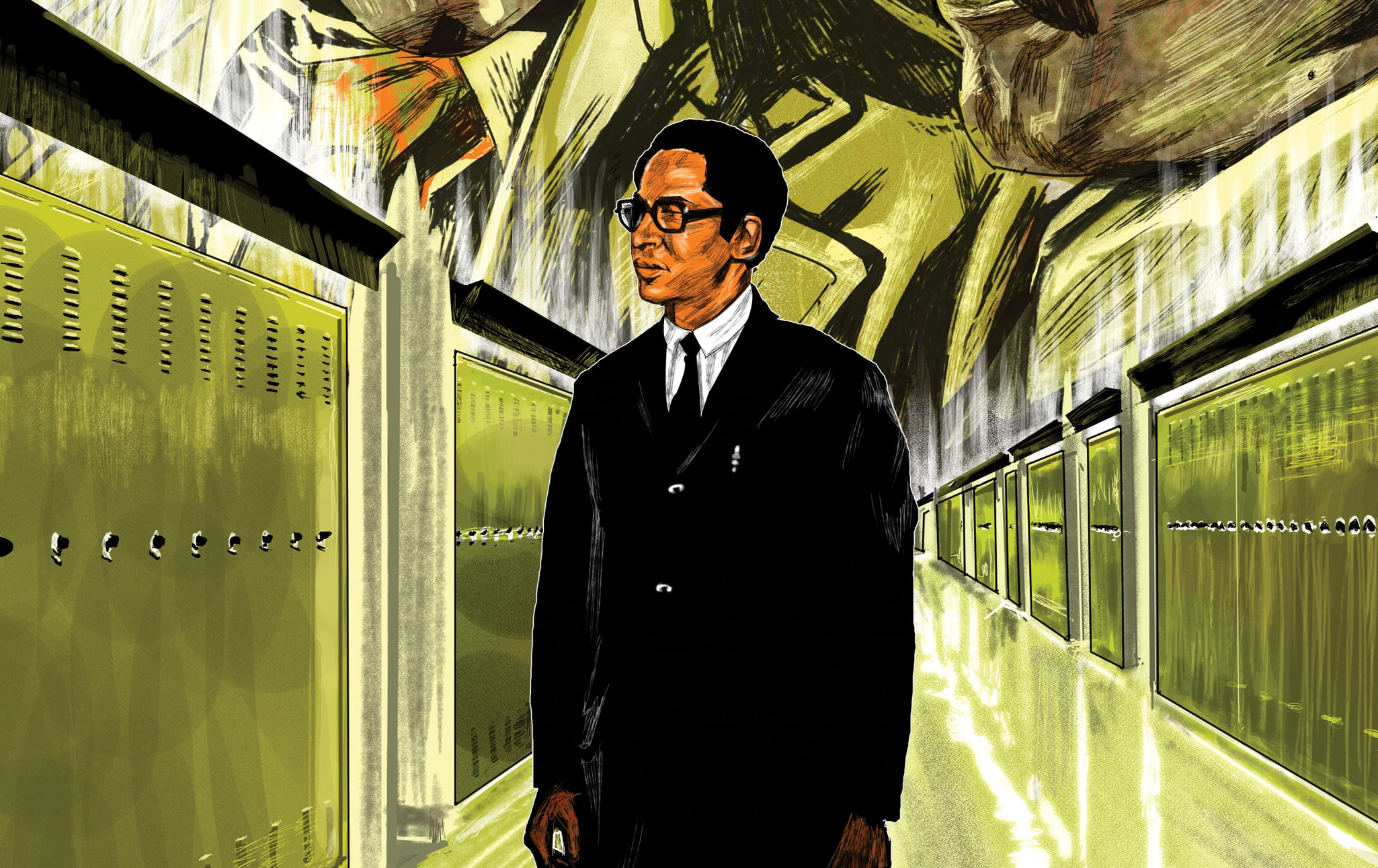
The film adaptation begins in the office of a white U.S. senator who is running for reelection. There, two campaign staffers notify him that if the election were to end that day, he would lose by just two percentage points due to his decline in the polls with Black voters. A frenzy breaks out, with the politician and his team brainstorming ideas on how he could earn the Black vote on short notice. Suddenly, an idea emerges: one of the staffers reminds his boss that the CIA has no Black agents at the time, and suggests that he accuse the agency of discriminatory hiring practices in his next speech to regain support from Black voters. This accusation would inspire the agency to hire its first Black agent, which is where we are introduced to the main character, Dan Freeman (played by Lawrence Cook.)
The whole situation displays pure irony and cynicism. Every character in these scenes is talking about racial diversity, but nobody actually cares about it, leading the CIA to hire a Black agent solely for the purpose of seeming progressive—and in the process, unintentionally creating their own worst enemy.
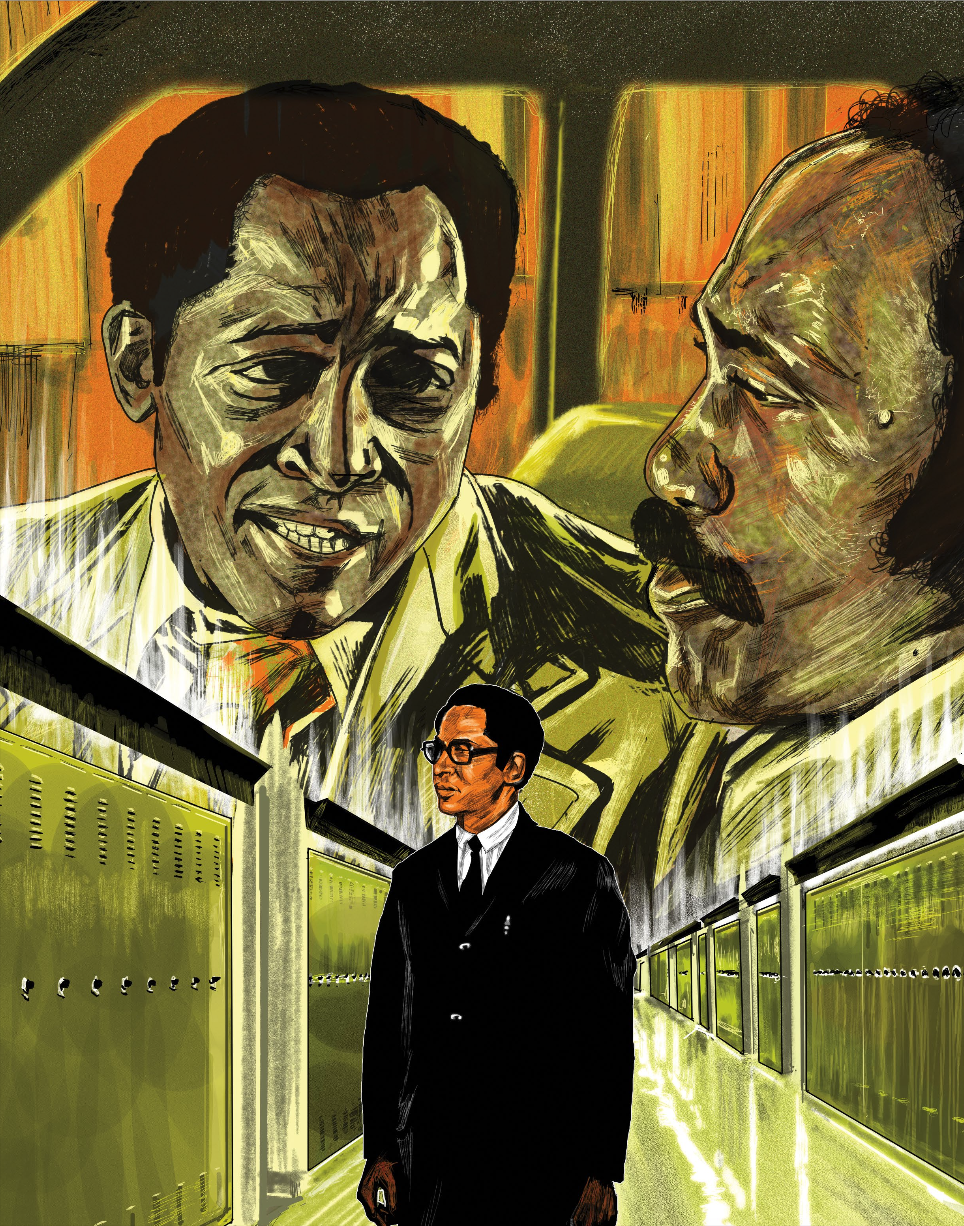
Art by Craig Johnson II from Current Affairs magazine, Issue 60, July-August 2026
After a careful screening process that involves both physical and psychological tests, the agency narrows down the applicants from over 400 to ten. These men are labeled as “the best of their race” by the high-ranking CIA official who briefs them, and are put through a rigorous training course. Only Dan Freeman is able to successfully complete it, and throughout the process, his every move is watched meticulously. The agency takes cautious note of establishments he has frequented and how he has interacted with others. They bug his room and even interview a woman he is seeing. It’s apparent that the agency is doing this for racist reasons, applying levels of scrutiny to Freeman that they never would to a white candidate. And yet, after all of the intel the agency digs up, they can’t muster up any reason why Freeman would not be CIA material.
You might assume that after this intensive process, the CIA would put Freeman out into the field. Instead, he’s assigned to a copy room in the basement of the agency’s headquarters under the title “Top Secret Reproduction Center Section Chief.” It’s not until the agency assigns him to give visiting senators a tour of the headquarters that they even contemplate placing him in a front office on the main level to “show visitors that the agency has integrated.” Although The Spook Who Sat By the Door was released more than 50 years ago, this practice is not unlike hiring practices that are still prevalent to this day, which place people of color in visible positions that hold very little power. For example, Black women occupy a large portion of both nursing and education positions in the United States. yet hold comparably smaller influence in these fields, are often severely underpaid, and consistently face discrimination when on the receiving end of service from these sectors. This occurs in other arenas too: Black athletes are heavily represented in revenue-generating sports such as football and basketball, making them among the most visible figures on many university campuses. Yet athletic directors, university presidents, and major donors—the individuals who control budgets and policy—have historically been far less diverse. As Kwame Ture stated in 1967, “Black visibility is not Black Power.”
After several years of this treatment, Freeman notifies the agency that he will be stepping down and going to work in his hometown of Chicago to better serve his people as a social worker. Freeman’s supervisor gives him his utmost support and tells him to let the agency know how things are back home. Unbeknownst to Freeman, though, the officer assigns someone to keep tabs on his whereabouts and associates after the move.
This film being primarily set in 1970s Chicago is noteworthy. At the time Greenlee’s original novel was published, the Rainbow Coalition was taking Chicago’s political scene by storm. Not to be confused with the later Rainbow Coalition led by Reverend Jesse Jackson, the original was spearheaded by Fred Hampton and the Chicago chapter of the Black Panther Party, and was an alliance of radical groups in the city that united to confront the issues that affected Chicagoans. Members of this coalition included the Black Panther Party, the Young Lords, the Young Patriots, Students for a Democratic Society, the Brown Berets, and the Blackstone Rangers street gang. The Blackstone Rangers’ role is especially noteworthy in relation to the premise of this film. In an attempt to bring down Fred Hampton and create division amongst leaders in Chicago’s major organizations, the FBI forged a letter that was sent to the Blackstone Rangers leader, Jeff Fort, in which there was a lie about a “hit” being put out on him by the Black Panther Party. Hampton denied the accusation, and then the groups went on to work together before Hampton’s assassination by FBI agents in 1969, the same year the book version of The Spook Who Sat by the Door was released.
Upon his arrival in Chicago, Dan begins to work on his ultimate purpose: recruiting and training members of a gang (the Cobras) to form an underground guerilla organization that would span across multiple major cities nationwide. Throughout this process, we begin to finally get a glimpse of the real Dan Freeman. We learn that his intelligence reaches far beyond what the CIA taught him, and how committed he is to the struggle of Black liberation. The film reveals that Dan was active in campus protests during his college years, and has kept his revolutionary spirit under wraps up until this point.
Greenlee has said that prior to writing The Spook Who Sat by the Door, he spent close to a decade traveling to postcolonial countries in order to learn how they gained freedom. Specifically, Greenlee was in Iraq when the British-backed Hashemite Monarchy was overthrown in 1958. (His 1976 novel Baghdad Blues was based explicitly on these experiences.) What he learned would become the basis of what Freeman teaches the Cobras in the film. Freeman instructs his trainees in marksmanship, how to create propaganda for their cause, the basics of guerilla warfare, hand-to-hand combat, and how to build an underground revolutionary organization that will span across the country. “What we got now is a colony, what we want to create is a new nation,” Freeman tells the Cobras. Freeman noting that Black people represent an internal colony in this nation is significant because it articulates the specific forms of oppression that Black people face in the United States, as well as laying the foundation for the revolutionary acts that he and the Cobras commit later in the film.
The original plan for Freeman and the gang is to not publicly utilize their guerrilla tactics until the perfect moment, which they want to define on their own terms. But events force their hand after a Black man is killed by the city police, which leads to an uprising. The former CIA officer is forced to live a double life: publicly acting as if he is attempting to quell the rebellion with the police and other authorities, due to his day job as a social worker, while privately directing the Cobras and their clandestine movement in a calculated response to the police repression. As the violence escalates, the Cobras deploy the guerilla tactics they’ve trained on, in ways that to this day viewers seldom see on screen: ambushing members of the National Guard, setting traps for police officers, and even bombing the Mayor’s office.
The Cobras are at war with the police, and they’re winning, and the film shows its viewers exactly how. It’s practically a paramilitary field manual, put on the big screen—or, as one NPR critic called it, “a Panavision version of political Armageddon.” Incredibly, according to supporting actor Pemon Rami, some of the rioters in the film’s pivotal uprising scenes weren’t actors at all, but bystanders who “just came to beat up the police” when they saw a chance: “There’s a scene where there’s a woman fighting with her purse. She wasn’t with us. She just happened to be walking down the street and got involved with it.”
In the midst of this war with the police, a pivotal scene takes place: a heated argument between Freeman and his longtime friend Dawson, a high-ranking police officer. Dawson represents the middle-to-upper class of Black people, who after establishing themselves and reaching a certain salary tend to belittle the lives and societal impact of any Black person with a class status below theirs. He only knows the public Dan Freeman, who is a social worker and former CIA employee, so he attempts to include Freeman in this class category, alluding that both roles are one and the same. He also shows a sense of relief that the National Guard is now in Chicago to help put an end to the uprising and movement the Cobras have sprung. Freeman immediately dissents:
DAWSON: “We have to maintain law and order, or we might as well be back in the jungle.”
FREEMAN: “The ghetto is a jungle, always has been. And you cannot cage people like animals, and not expect them to fight back someday. It has always been an army occupation here, with police badges and uniforms. You and me, a cop and a social worker, we are keepers of this goddamn zoo.”
DAWSON: “The streets have to be safe.”
FREEMAN: “Safe for who? You’re here to protect property, not lives.”
DAWSON: “Well, that’s what it’s all about, isn’t it? You worked hard to get what you got, didn’t you? And you want to keep it just like I do.”
FREEMAN: “Bullshit! You think because you’ve got a badge, and I’ve got a couple of degrees, that makes a difference? You know what white people call people like us, in private?”
This scene represents the conflict between people who have bought into “the system” and those who despise it; those who believe the system can be changed from the inside, and those who believe the system is irredeemable and must be destroyed; those who believe in reform and those who believe in revolution. It’s a debate that still rings true today.

The creation of this film is a miracle in itself. Since the setting was in Chicago, it was originally supposed to be shot fully in the city, too. But Richard Daley, who was Chicago’s mayor at the time, refused to grant the production permission to shoot there upon learning about the subject matter. During his tenure as mayor, Daley became infamous as an authoritarian and an opponent of progress. It was Daley who oversaw the raid of Fred Hampton’s apartment in 1969, which led to his assassination, Daley who ordered police to shoot to kill those uprising after Martin Luther King Jr.’s assassination, and Daley who infamously sent the National Guard to beat protesters at the 1968 Democratic convention. The majority of the film, then, was shot in Gary, Indiana, while certain scenes were still sneakily shot in Chicago “guerilla style,” unbeknownst to the Mayor.
To get picked up by a distributor, the editing team had to re-cut many of the action scenes. These edits made the movie seem more like the Blaxploitation films that were becoming popular during that era, rather than the revolutionary piece of cinema that it is. Sam Greenlee and Ivan Dixon went through a tumultuous process shopping the film to major distributors before it eventually found a home with United Artists. Shortly after the film was released, though, numerous theaters that were playing the film and United Artists itself were approached by government authorities and told to stop showing it, due to the impact that it could potentially have on viewers. This led to a sparse theatrical run, box office earnings of just $270,000, and constant surveillance of the cast and crew by the FBI. Several members of the cast, including Lawrence Cook, would go on to struggle to book acting roles, or never act again, due to the blackballing of people who had anything to do with the production. The film disappeared for decades, circulating only as a bootleg. As Asantewa Olatunji, director of programming with the Pan African Film Festival, told Our Weekly, “it was quite an underground thing—you couldn’t find it anywhere.”
Over 50 years after its release, The Spook Who Sat By The Door has stood the test of time. In the era of Black Lives Matter and the George Floyd uprisings, it’s more relevant than ever to our current political climate, even as major Hollywood directors are reluctant to even acknowledge art being political. In 2012, the Library of Congress surprisingly included this film in its National Film Registry and subsequently gave it a 4k restoration. The late, great Nipsey Hussle even showed immense love for the book by almost naming his last album after it and comparing his status in hip-hop to Dan Freeman’s on his song “Blue Laces 2.” Yet still, it is not available on any of the major streaming services, and there have been very few screenings of the 4k restoration. With a score from the legendary jazz musician Herbie Hancock as its backdrop, The Spook Who Sat by the Door beautifully portrays the spirit of the Black Power movement and the revolutionary fervor of the 1960s and ’70s. Upon viewing, you immediately see why this film was pulled from theaters shortly after its release: it has the potential to reinvigorate a movement led by those who have been constantly persecuted since this country’s inception.

.png?width=352&name=Screenshot%202026-09-04%20at%204.00.52%20PM%20(1).png)
%20(1).jpg?width=352&name=miasma-1%20(1)%20(1).jpg)