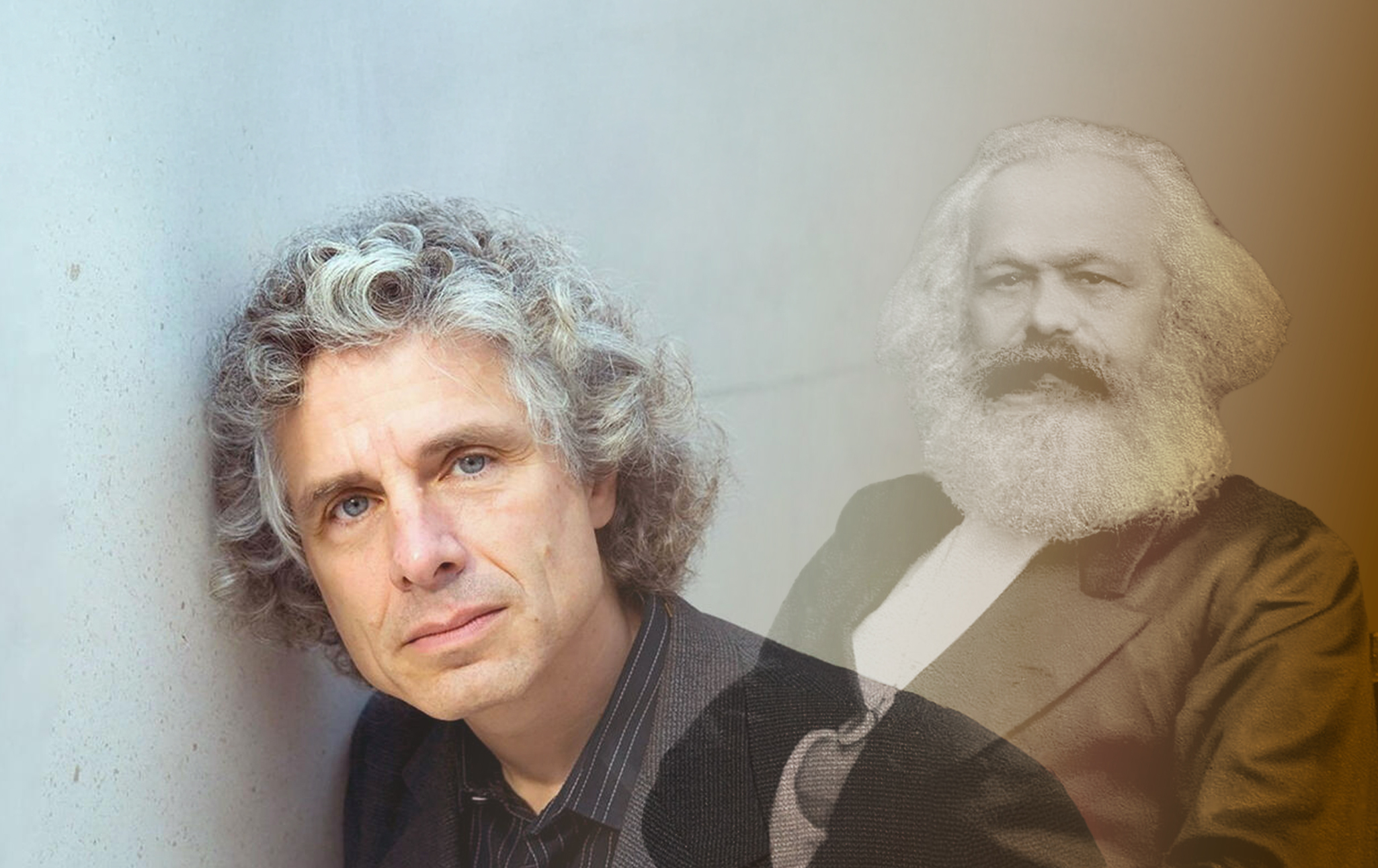
Bill Gates’ favorite writer keeps spewing out lazy clichés about Marxism being a “disaster” whenever it’s “implemented.” But he’s way off-base, and Marx deserves better critics.
Some things are eternal (Marxists would say “transhistorical”) truths. A will always equal A. (That remains true even if it doesn’t require cutting the top income tax rate, as Ayn Rand oddly seemed to think.) The Toronto Maple Leafs will never win the Stanley Cup. And center right commentators will criticize Karl Marx in weird ways without engaging with the substance of his work.
This most enduring of truths was pressed home again not too long ago, when Bill Gates’s court philosopher Steven Pinker decided to weigh in on Marx and Marxism in a recent podcast with Pooja Arora. Pinker rolled out all the Daily Wire-style hits. Pinker claimed that what’s “remarkable is that Marxism has been tried.” In a smirking way, he allows that “defenders of Marxism say it hasn’t really been tried anywhere,” but he dismisses this on the grounds that “the people who implemented it claimed they were implementing Marxism.” He goes on to cite the history of moral and economic failure in authoritarian societies like the Soviet Union and Mao’s China. Somewhat bizarrely, he also throws in Venezuela, which was never socialist by any definition that wouldn’t also include, for example, Sweden or Norway or Denmark. (Indeed, a smaller percentage of Venezuelans than citizens of any of these other countries work in the public sector.) In every case, Pinker says, the result of trying to “implement” “Marxism” was “disaster.”
This isn’t the first time Pinker has offered his takes on the Prussian firebrand. In his bestselling Enlightenment Now, Pinker wrote that while Marx “possessed no wealth and commanded no army” the “ideas in the reading room of the British Museum shaped the course of the 20th century and beyond, wrenching the lives of billions.” As he warms to his theme, Pinker insinuates that Marxism is a kind of primordial intellectual evil that, even in watered-down forms like “quasi-Marxist” critical theory, threatens to turn back the clock on penicillin, the internet and the Atlantic magazine:
More insidious than the fettering out of ever more cryptic forms of racism and sexism is a demonization campaign that impugns science (together with reason and other Enlightenment values) for crimes that are as old as civilization, including racism, slavery, conquest, and genocide. This was a major theme of the influential Critical Theory of the Frankfurt School, the quasi-Marxist movement originated by Theodor Adorno and Max Horkheimer, who proclaimed that ‘the fully enlightened earth radiates disaster triumphant.’ It also figures in the work of postmodernist theorists such as Michel Foucault, who argued that the Holocaust was the inevitable culmination of a ‘bio-politics that began with the Enlightenment, when science and rational governance exerted increasing power over people’s lives[…] Though Critical Theory and postmodernism avoided ‘scientistic’ methods such as quantification and systematic chronology, the facts suggest they have the history backwards. Genocide and autocracy were ubiquitous in premodern times, and they decreased, not increased, as science and liberal Enlightenment values became increasingly influential after World War II.
In this version of intellectual history, what the bearded socialist was cooking up as he took notes on all those books in the British Museum entailed a dangerous rejection of the Enlightenment values that made the world great.
Steven Pinker Doesn’t Understand Marxism
Just as it’s unsurprising that mega-billionaire Bill Gates called Enlightenment Now his “new favorite book of all time,” it’s unsurprising that Pinker instinctively loathes Karl Marx and everything he stood for. Fish swim, birds fly, and billionaire-flatterers dislike Marxism. What’s more notable, and disappointing, is that Pinker knows so little about Marx’s work.
By analogy, neither of us are fans of the political visions of Plato’s Republic or Aristotle’s Politics. (The former suggests that all poets should be excluded from living in a well-run city except for the reliably non-subversive ones who stick to writing “hymns to the gods and panegyrics to the good.” The latter takes it for granted that women don’t belong in politics and endorses the thought that some humans are born as “natural slaves.”) But we do think that someone who goes around confidently spouting off about philosophy should know some basic things about what Plato and Aristotle thought. These are major figures in the history of ideas that other major figures were building on or criticizing or reacting to in various ways. The same is true of Karl Marx—and even an honest interlocutor who loathes his central conclusions should be able to acknowledge that much.
Somehow, though, Harvard professor Steven Pinker, who writes airport bestsellers where he discusses history and philosophy and economics—the favorite public intellectual of not only Gates but multiple recent presidents—doesn’t seem to know the most basic things about Marx’s political and theoretical views. This makes all the invocations of “Enlightenment” more than a little ironic, since one gets more heat than light from Pinker’s take. Most of his analysis of Marxism seems to be based on irrational hunches and instincts rather than careful analysis of history or theory. One way to avoid having to lean on such unenlightened sources is, dare we say, knowing something about the subject matter you choose to weigh in on. Which Pinker doesn’t.
We’ll start at the political level. In the conversation with Pooja Arora, Pinker speculated about why intellectuals are attracted to Marxism despite what a “disaster” it was when it was “implemented.” In the course he lays out his description of what he thinks Marx wanted society to be:
[O]ne of the appeals of Marxism, though, and more generally of heavy, strong influence of government guided by intellectuals, which is that there are certain kinds of reforms that you can state as principles. You can articulate them verbally as propositions—like equality, human rights, democracy—but there’s other kinds of progress that take place in massive distributed networks of millions of people, none of whom implements some policy. But collectively, there is an order, an organization that’s beneficial. So that can happen organically through, for example, the development of a language. No one designed the English language. It’s just hundreds of millions of English speakers. They coin new words. They forget old words. They try to make themselves clear. And we get the English language and the other 5,000 languages spoken on earth.
Likewise, a market economy is something where knowledge is distributed. You don’t have a central planner deciding how many shoes of size 8 will be needed in a particular city, but rather information is conveyed by prices, which are adjusted according to supply and demand. And you’ve got a distributed network of exchange of information that can result in an emergent benefit. Now, intellectuals tend to hate that. They like rules of language—of correct grammar. They like top-down economic planning. They like cultural change that satisfies particular ideals described by intellectuals. And so rival sources of organization, like commerce, like culture—traditional culture—tend to be downplayed by intellectuals.
All of this simply takes for granted that Marx called for a “heavy, strong” super-state that would be “guided by intellectuals” as it engaged in “top-down” planning. This theme echoes Pinker’s claims in Enlightenment Now, where he criticizes “totalitarian planned economies” for imposing “scarcity, stagnation, and often famine.” Echoing von Mises and F.A Hayek’s critiques of command economics, Pinker commends the market for “reaping the benefits of specialization and providing incentives for people to produce what other people want,” and thus solving the “problem of coordinating the efforts of hundreds of millions of people by using prices to propagate information about need and availability far and wide[…].” This, according to him, is something “collectivization, centralized control, government monopolies, and suffocating permit bureaucracies” don’t allow.
Anyone perusing Marx’s writings for evidence that he advocated a top-down regime of bureaucracy and centralized control will come up empty. He just didn’t. (More on that below.) Even so, Pinker’s critique has a rational kernel to the extent that he’s retreading the “socialist calculation debate” that raged between different kinds of socialist and anti-socialist economists starting in the 1920s. Even a democratic, bottom-up form of economic planning, free-marketeers like Hayek and Von Mises argued, wouldn’t be able to efficiently allocate resources to meet needs in the absence of price signals. Later on, the theoretical problem was empirically illustrated by the many pathologies of the form of economic planning that existed in societies like the Soviet Union. These days, even many socialist economists from Thomas Piketty to Mike Beggs argue that even a highly egalitarian and democratically organized economy could and should leave some space for markets and price mechanisms. They don’t think that we have to give up on a socialist reorganization of the economy, but they do think that problems first pointed out by our ideological enemies should lead us to re-think how a viable socialist economy would have to work.
Where does Marx fit into this? Mostly, he doesn’t. Pinker seems to think that “Marxism” is the name of a model of social organization, present somewhere in old books and ready to be “implemented” after the end of capitalism. But this is a fundamental misunderstanding.
It’s true enough that several 19th-century socialists proposed such models. (Robert Owen actually went as far as to specify the shapes of the buildings in which people would live and work in his future utopia. For reasons we aren’t entirely clear on, he seemed to think communal bonds were best served when mid-sized communities lived together in large rectangular structures). Karl Marx, though, very emphatically wasn’t one of them. In fact, in a preface to his masterpiece Capital, Marx famously declined to “write recipes for the cookshops of the future.”
Instead, Marx devoted the overwhelming majority of his formidable intellectual energies to analyzing the society that already existed, and the way that different forms of social organization rose and fell over the course of history. He was interested in the ways that fault lines within the existing economy could lead to the emergence of something better, not in making predictions about what the successor system would look like. And to the very limited extent that he hazarded any thoughts about how socialism might work or what a transition between capitalism and socialism might look like, there could hardly be less resemblance between those ideas and the dictatorships that wrapped themselves in his mantle in the 20th century. The handful of times that Marx uses of the phrase “dictatorship of the proletariat” are sometimes taken as evidence that he was a political authoritarian, but the “dictatorship” in question wouldn’t be the rule of a single political party (never mind a single leader), but of “the proletariat” (i.e. the modern working class), which Marx assumed would form the great majority of the population in any society where conditions were ripe for a transition to socialism.

What Marx Thought a “Dictatorship of the Proletariat” Would Look Like
At the end of the first chapter of Capital, Marx describes the future socialist society he anticipated as “an association of free men, working with the means of production held in common, and expending their many different forms of labour-power in full self-awareness as one single social labour force.”1 Similarly, in a document Marx wrote for the delegates to the Provisional General Council of the International Working-Men’s Association in 1866, Marx talked about the “despotic system of the subordination of labour to capital” being one day “superseded by the republican and beneficent system of the association of free and equal producers.”
And when it comes to the transition from capitalism to socialism, the model of rule by the proletariat that Marx pointed to was the ultra-democratic Paris Commune, in which workers, small artisans, and rank-and-file soldiers briefly seized control of the city of Paris at the end of the Franco-Prussian War in 1871. In The Civil War in France, he singled out the most radically democratic features of the Commune for particular praise. These included abandoned factories being turned over to be run democratically by associations of workers, the replacement of the standing army with an armed populace organized into the National Guard, the capping of the salaries of public officials at the average wage of a skilled worker, and elections that the communards’ hastily drafted constitution said would happen far more frequently than anything that was standard in liberal capitalist democracies. The ease of voting representatives out of office would mean, Marx wrote, that instead of “deciding once in three or six years which member of the ruling class was to misrepresent the people in Parliament, universal suffrage was to serve the people” in much the same way that “individual suffrage serves every other employer in the search for the workmen and managers in his business.” Capitalists hire managers to run things for them, but also get rid of them the moment they become unhappy with the way they’re doing the job; Marx wanted people to be able to do the same with their political leaders.
What Marx liked about the Commune was everything that made it dramatically unlike the picture Pinker paints of what a “Marxist” society would supposedly be like. The Communal Constitution specified that even state bureaucrats and magistrates would be directly subjected to democratic recall, a feature that, Marx enthused, would turn them from “the haughteous masters of the people into its always removable servants.” He was concerned about the potential for even socialist politicians to concentrate power in their hands if not immediately accountable to the electorate. You can argue that some aspects of the communards’ vision that so appealed to Marx would be impractical or inefficient if they’d won France’s civil war and had a chance to implement their ideas on a wider scale. But you can’t (honestly) deny that he deeply valued democracy. If anything, a more plausible worry is that the hyper-democratic quality of Marx’s position in The Civil War in France triggers an old argument against socialism: that, as Oscar Wilde may or may not have actually said, it would simply “take up too many evenings.”
Another fair criticism of Marx is that he overcorrected from the hyper-detailed recipes for what socialism would be like, along the lines of Owen’s rectangular “parallelograms,” and he said far too little about how socialism would actually work in practice. His attitude seemed to be that the citizens of a future society that had actually embarked on a socialist transition would figure it out when the time came. They would encounter problems no armchair intellectual trying to write recipes in advance could possibly anticipate, and solve them in their own way, and it would be arrogant and anti-democratic to try to preempt that process.
Today, though, the potential problems and pitfalls that can afflict attempts to reorganize the economy are far better understood. As late as 1964, no less an anti-socialist than Ronald Reagan, in his famous “Time for Choosing” speech, predicted that the “darkness” of socialism would last for a thousand years. These days, it’s an article of faith among anti-socialists than any attempt to do away with a free market will collapse far more quickly than that, and after the experience of the deeply flawed and authoritarian socialisms that Pinker discusses in the 20th century, those of us who still hold out hope for a better kind of socialism do need to write some recipes, if only to convince skeptics that some economically viable and politically desirable form of socialism is possible after all.
So, criticizing Marx on the grounds that he was too vague about socialism is legitimate. But the idea that he advocated a “suffocating” system of “centralized control” by an all-powerful state just doesn’t withstand contact with his writings.
At this point, Pinker might want to retreat to the claim that the very processes that Marx thought would give rise to a radically democratic form of socialism instead gave rise to a politically authoritarian and economically dysfunctional system. So, even if true “Marxism” wasn’t “implemented” as a final project, it was at least “implemented” in the sense that anti-capitalist revolutions happened in various countries in the twentieth century. That these revolutions often ended disastrously proved that the means Marx sometimes endorsed can’t lead where he hoped they would.
That sounds plausible… until, again, you actually read some Marx. Let’s start with the question of revolution. It’s true that Marx thought that armed revolution would be necessary to put the working class in power in those countries in Europe that were ruled by kings or emperors. Nor was he some shrinking pacifist who thought that if the capitalist class resorted to violence to stop an elected socialist government from coming to power, the workers should just resign themselves to their fate. But as Igor Shoikhedbrod notes in Revisiting Marx’s Critique of Liberalism, Marx went out of his way to emphasize that in countries like Britain and the United States that had already taken significant moves in the direction of at least universal male suffrage, the workers should try to pursue a peaceful electoral road to socialism. And he took it for granted that a transition from capitalism to socialism required a sufficiently well-developed capitalism that, first, the working class was a majority of society, and second, enough material abundance was present that socialism wouldn’t be a doomed experiment in more equally sharing out crumbs.
When you put all this together, it’s awfully hard to see how the means Marx envisioned for getting us from capitalism to socialism are supposed to resemble the various ways that the dictatorships Pinker is talking about came to power, at the head of peasant armies (China) or guerilla forces hiding out in the mountains (Cuba) or jungles (Vietnam), by toppling weak states in underdeveloped agrarian societies, or imposed from outside by the conquering Soviet army (the “People’s Democracies” of Eastern Europe). So, what we’re left with is that radically different means than the ones Marx had in mind generated radically different outcomes than his preferred ends. It’s hard to see how this adds up to “implementing Marxism” leading to disaster.
-gif-1.gif?width=1024&height=300&name=Pitch-Ad-Horizontal-V2%20(1)-gif-1.gif)
If “Marxism” Isn’t a Recipe for the Cookshops of the Future, What Is It?
We talked about the political level, now let’s move onto the theoretical one. Is it true that Marx and Marxism reject the Enlightenment, giving way to a host of identity-fixated critical theories that can only end in Gen Z girlbosses and woke M&Ms?
This is, again, a ridiculous claim to make, which even a cursory reading of Marx would cure you of. Marx was emphatically, as even a critic like Ian Shapiro notes, a thinker of the “mature Enlightenment.” Marx was a great admirer of Darwin, even sending him a copy of Capital, and he claimed to show how economic laws developed over the course of history much as Darwinian science charted the evolutionary development of organic nature. In the preface to the French edition of Capital, Marx justified making his readers wade through so much technical economic material in the early chapters before they got to the juicy stuff about class conflict on the grounds that “[t]here is no royal road to science, and only those who do not dread the fatiguing climb of its steep paths have a chance of gaining its luminous summits.”2
What did readers find on the “luminous heights”? One way of understanding Marx’s core insights is that he offered both a theory of the stages of history and a theory of the transitions between those stages—in other words, a theory of historical change. The historical stages are differentiated by which “relations of production” are dominant. In other words, who’s producing the goods and services, and who’s running the show and extracting wealth from the “immediate producers”? Do you have lords and serfs, slave-owners and slaves, capitalists and proletarians, or “associated producers” in a socialist future? Marxism is, among other things, a theory of each of these stages, although of course his overwhelming emphasis was on the capitalist stage, since that’s the one that humanity was stuck in during his life (as it still is now). Marx wanted to think hard about how capitalism works, and how we can collectively get past it.
The central topic of Capital is an analysis of capitalism as a class society based on domination and exploitation, like feudalism and slavery were before it. Under feudalism, serfs were allowed to farm their own little plots of land within a larger estate most of the time, but they had to do a given number of weeks a year of corvee labor for their lord. Under both slavery and capitalism, Marx points out, the same kind of division between “necessary labor” (in which the immediate producers are laboring for themselves) and “surplus labor” (in which they labor for a ruling class) isn’t apparent on the surface of social relations. Under slavery, every hour of labor seems to be labor for the slave-owner, and none to meet the slave’s own needs. Under capitalism, every hour of labor seems to be labor for which the worker is paid. But, Marx argues, both of these appearances are misleading. In a slave society, the resources slave-owners use to feed and clothe slaves have to come from somewhere—where could that be if not the labor of the slave class? And under capitalism, workers in effect only spend part of the day working to generate the value of their wages. They also perform hours of surplus labor every day to generate profits for the boss. (Otherwise, why hire them? The capitalist isn’t running a charity!)
Much of Capital is devoted to exploring various mechanisms by which capitalists can squeeze more surplus labor out of workers, whether by extending the length of the working day (Chs. 9-11) or by technically revolutionizing the production process itself so that workers have to spend less time producing their wages and a greater proportion of each day can be spent generating profits (Chs. 12-15). At the climax of his analysis of capitalist dynamics in Ch. 25, Marx argues that the capitalists’ incentives will lead them over time to invest less capital in hiring wage labor and more in machines, leading to more and more working-class misery. (That’s a prediction that inspired a good bit of skepticism from 20th-century readers. In 2026, when you can’t open up a news website without finding a story about a new industry being automated with AI, it seems painfully obvious.)
Ultimately, Marx thinks that the working class is the part of society that has a unique combination of interests and capacities to overcome capitalism. People sleeping under bridges and begging for food have an interest in bringing about a more equal society, but very little capacity to do so. (They can’t, for example, go on strike.) And the capitalists themselves have tremendous capacity to make change. They could just make a gift of the means of production to the rest of society. But doing that wouldn’t be in their interests! The workers have both. In the last part of the book (Chs. 26-33), Marx traces the origins of capitalism through the mass dispossession of peasants from their land, but he expresses the hope that the capitalist “expropriators” will themselves be “expropriated” by the emerging working-class majority of society. He hopes that this could be done far less violently than the original expropriation of the peasants, since in that case it had been “a matter of the expropriation of the mass of the people by a few usurpers” whereas now it would be “the expropriation of a few usurpers by the mass of the people.”3
One of the key differences between Marxism and earlier kinds of socialist thought was that Marx thought that, for all its horrors, capitalism wasn’t an avoidable moral mistake but a necessary stage of historical development. This relates back to his broader theory of history. In Ch. 15 of Capital, Marx chronicles the myriad ways that the introduction of factory-machinery that could in principle have been used to increase the leisure time of the immediate producers (which is exactly how Marx hoped new technological developments would play out in the socialist future) were instead used to increase working-class misery. For example, the use of child labor in Victorian factories became much more extensive when jobs that once had to be done by physically strong adult men had become mechanized enough that the small, light-weight body of a child would do just fine. Even so, in Ch. 24, Marx emphasizes that in “ruthlessly forc[ing] the human race to produce for production’s sake,” capitalists were fulfilling their historical role, spurring “the development of society’s productive forces and the creation of those material conditions of production which alone can form the real basis of a higher form of society, a society in which the full and free development of every individual forms the ruling principle.”4 Only after going through the capitalist night, in other words, could society hope to be able to make it to the socialist dawn. Some socialists have disliked this conclusion (for example, on the grounds that claiming only highly developed countries are ripe for a socialist transition is Eurocentric). Whether you agree or disagree with Marx’s view, though, he’s hardly some Enlightenment-hating anti-rationalist. He was engaged in a sustained and serious attempt to use all the tools of social science as he understood it to lay bare the workings of the capitalist system and arm the working class with the understanding they would need to overcome that system.
Even Marx’s theories about ideology and commodity fetishism have an Enlightenment thrust to them. Marx echoed the claims of philosophers like Kant that very often we fail to use our critical faculties to think for ourselves. Nowhere is this more true than when we are pressed to analyze human institutions, practices, and politics. In Capital, Marx constantly excoriates bourgeois economists for not looking behind the legal surface of market society, where it looks like everyone is free and equal, to examine the underlying mechanisms of domination and exploitation that keep the machinery running. But where Marx enacted a considerable breakthrough was his awareness of how errors about the social world were not just cognitive errors the individual was responsible for. They were often the result of social processes. In the grip of these illusions, though, people tended to take social institutions as eternal and natural when even a cursory glance at history showed them to be contingent and transitory. Part of Marx’s project was unmasking the “pleasing illusions” conservatives like Edmund Burke defended in Reflections on the Revolution in France for helping conciliate different social classes to the status quo. Marx wanted us to interpret the world correctly, but he realized that would be very difficult for many of us until the world was changed and the sources of pleasing ideological illusions negated.
Of course, just because Marx was committed to the mature Enlightenment project of using reason to accurately describe the world doesn’t mean that he succeeded. Even some major latter-day Marxists like G.A Cohen and Erik Olin Wright expressed reservations about how Marx (in their view) linked his theory of exploitation to empirically dubious premises about value and prices, and they worked hard to revise the theory. In this respect Marxism works more or less like every other theoretical paradigm in the history of ideas, giving rise to more and less “orthodox” or “revisionist” versions and evolving over time. But it can’t be seriously denied that Marx, whose core influences (as Lenin would famously summarize them) were French socialism, German philosophy, and English political economy, was a quintessential product of the Enlightenment.
Interestingly, we aren’t the first ones to raise this objection. In a 2019 interview Pinker is pressed on this point about Marx by Quillette magazine. Quillette is a center-right outlet. We’ve both written for it—we aren’t fans of the contagion theory of magazines!—but we have no illusions about its ideological inclinations. Quillette could never be accused of excess sympathy for Marxism. Nevertheless, the interviewer there presses Pinker on precisely this point. Shouldn’t “Marx be counted as an Enlightenment thinker?”
In response, Pinker retreats into a conceptual haze worthy of Jordan Peterson, saying there can be “no correct answer to the question of whether some writer deserves to be counted as part of the Enlightenment.” He goes on to say that “words mean what people take them to mean” and as far Pinker is concerned Enlightenment stands for “the ideal of using reason and science to advance human welfare…”
Now of course Pinker is right that big terms like “Enlightenment” aren’t logically airtight. They are often fuzzy, and there are figures who may be peripheral or ambiguous members. But there are limits to this ambiguity, and it must be said if Marx doesn’t count as a person committed to using “reason and science to advance human welfare” then no one is. If he’s not an Enlightenment thinker, there are no Enlightenment thinkers.
If anything, a common critique made by better-informed critics of Marxism is precisely that Marx was too much a product of the Enlightenment. In particular, via his very Pinkereseque optimism that human history was going to continue to advance: the technological forces of production would continue to develop under capitalism, this would last until capitalist relations of production became a fetter on their further development, and then capitalism would be transcended by a higher form of society which would be more free, equal and democratic. Technological progress would continue under socialism until we’re all living in post-scarcity idyll where everyone can pursue their own projects without income needing to be tied to labor contributions, and there will be so much to go around, everyone can simply take what they want. (This is the famous “from each according to his abilities, to each according to his needs” formulation from his Critique of the Gotha Program.) At this point, as Marx puts it in Capital Vol. 3, the “development of human powers” would become an end in itself for the first time.
Later, in Socialism: Utopian and Scientific, Engels—usually more given to speculation than Marx—gave his own take on what the socialist future would look like. He predicted that, in the absence of class antagonisms, political struggle would be replaced by an apolitical scientific “administration” for the welfare of all. Here Marxism is almost an aggressively rationalistic version of the Enlightenment project, down to hypothesizing that we can replace politics and its ideologies with an almost science of social welfare.
Was Marx right about all of this? Not necessarily. On at least some of these subjects, we think he could have been more ruthlessly critical of some of his assumptions. We share Marx’s optimism to the point of thinking that capitalism isn’t eternal and some kind of socialism is possible, but we wouldn’t place all our bets on some of his and Engels’s most exuberantly optimistic predictions. (For one thing, whatever technological progress brings in the future, we’re fairly sure any given society’s resources at any given time will be finite, if only because the planet itself is. And we tend to think that, even in the absence of class conflict, humans will always find things to fight about. Politics, for better or worse, will still be with us.) But to quote Steven Pinker himself, “Enlightenment thinkers were men and women of their age,” and Marx was hardly unique in predicting better things were coming. Jefferson, Paine, Kant, Wollstonecraft, Mill, and plenty more all indulged in sometimes over-exuberant Enlightenment optimism.

Marx Still Deserves Better Critics
Pinker isn’t the worst critic of Marx to heap mistake on mistake. It’s a very, very competitive category in a world that contains Hillsdale College, Prager “University,” Jordan Peterson, and the Daily Wire. But that itself is telling. The fact that Pinker is not the worst critic of Marx and still doesn’t even know the basics says something about the nebulous space that Marx occupies in 21st century discourse. He’s too manifestly important a part of intellectual and political history to ignore altogether, but he has so few defenders with any real prominence in media, establishment circles, or even academia (whatever the Right might try to tell you!) that his critics can say damn near anything about him without any real fear of correction.
There’s also a larger issue here, beyond the particular case of Karl Marx. For a long time, establishment-beloved centrist intellectuals like Pinker have been able to coast along, confidently assured of the truth of their self-evident principles and often lavishly funded by the grateful rich. In the increasingly dark political time in which we live, that is no longer going to cut it. The tragedy is that Marx could offer distraught liberals a lot of wisdom about how we got into a Trumpian mess. He’d have been unsurprised at the emergence of a Bonapartist faux-populist who combined clownish bombast with sinister authoritarianism. Marx would have been all too willing to predict how the country’s oligarchs would line up behind their new benefactor, and correctly diagnose the whole thing as a symptom of our society’s more basic inequalities. This is why Marx deserves, even needs, better critics than Pinker. A good critic learns from his target. A bad critic is incapable of achieving such enlightenment.
1: P. 170. All quotations from Capital are from the Penguin edition. Note also that, unless otherwise indicated references to “Capital” below are to Vol. 1, which was completed in Marx’s lifetime. The later volumes, which Marx’s collaborator Engels had to edit together posthumously from various manuscripts Marx left behind, delve into other areas of economics, often making interesting connections between Vol. 1’s core analysis of capitalist exploitation and the subjects more commonly studied by contemporary academic economists. For our purposes here, though, we’re just talking about Vol. 1!
2: P. 104
3: P. 929
4: Pp. 738-9