As state violence escalates around the country through ICE, people are considering mass labor action as a way to fight back. Could general strikes make American workers an organized political force to reckon with again?
On January 24 of this year, Alex Pretti was killed by U.S. Immigration and Customs Enforcement (ICE) in Minneapolis, Minnesota, while he was disarmed, pepper-sprayed, and lying on the ground. Pretti is now one of many people who have been murdered or irreparably harmed by ICE this year, including Renee Good, also in Minnesota, Keith Porter, who was killed by an off-duty ICE officer at his own home, or Liam Conejo Ramos, the five-year old boy detained with his father, then returned home, and who the Trump administration is now targeting again for deportation. Human rights violations, including torture, are being credibly documented on a daily basis within Department of Homeland Security (DHS) detention centers. With a political system unequipped or unwilling to take action, many people are wondering what can be done, if anything, to stop this rapid descent into fascism. Calls for general strikes are resurfacing, a once-powerful political and economic tool that has long lain dormant in American labor politics.
Since Pretti was killed, Trump has removed Gregory Bovino, who was leading the deployment in Minneapolis, and there are reports that ICE will largely be moved out of Minnesota (though some ICE agents will remain there). There were some calls for DHS’s Kristi Noem’s firing or impeachment, even from some Republicans. Still, Democrats have not leveraged this anger, remaining extremely slow and hesitant to act. Minnesota Governor Walz sent in the National Guard (though primarily to ”support local law enforcement”). He still has not called for the arrests of Good’s or Pretti’s killers. Meanwhile, Democratic leadership’s primary move has been threatening to block further budget expansions for ICE (after already having enabled an approximately $75 billion allocation to it). This has led to a partial government shutdown, though ICE’s funding is largely protected from it.
While this may seem a solid political move, many have taken note of Democrats’ resistance to actually dismantling ICE, instead using the shutdown to bargain for reform efforts. This is despite the fact that a majority of Americans polled now support ICE abolishment. And still, some Democratic party leaders continue to hedge for the agency. In a recent interview, California Governor Gavin Newsom, considered a favorite for the next Democratic presidential candidate, agreed with far-right podcaster Ben Shapiro in saying ICE was not engaging in “state sponsored terrorism.” Pennsylvania’s Governor Josh Shapiro said it was “abhorrent” to compare ICE to Nazis (despite many parallels between ICE, Nazi tactics, and neo-Nazi ideologies). This indicates Democratic leadership is lapsing into a state of compromise, despite weeks of growing anger and fear.
Democratic voters are recognizing the failure of the party to pose an oppositional political force which would be fast and willing to act comprehensively to enact voters’ will. In fact, the party was deeply embedded and an active participant in creating ICE as it is today. It overwhelmingly supported the agency’s creation in the post-9/11 frenzy to build up the U.S. security state and continually failed to curtail the agency or DHS, despite their documented history of abuse. ICE has long broken American legal requirements as well as basic human rights standards, including during the years in which a Democratic president was at its helm. This directly led to the situation seen now, wherein ICE has been allowed to essentially become a paramilitary force under the President’s direct control. Many fear ICE’s practically unchecked force, but feel they have no direction to turn when the established political channels have failed them. This is where calls for a general strike have arisen.

The Resurgence of General Strikes
Americans are taught that protest movements can address deep-rooted structural, political problems like this. We are told that the system will eventually correct itself upon these mass mobilizations. What we are given, however, is a somewhat toothless recount of protest history. We are not told the mechanics behind protest movements. We aren’t told about the strategic thinking behind them. They were not some spontaneous outpouring of the collective consciousness, but a sustained, and coordinated campaign, organized, and crucially, disruptive. Economic justice and the power to withhold one’s labor have animated these movements. Activists like Dr. Martin Luther King Jr. knew the truth that those in power will maintain the status quo until their bottom line is threatened, and that labor action and civil rights are thus intertwined.
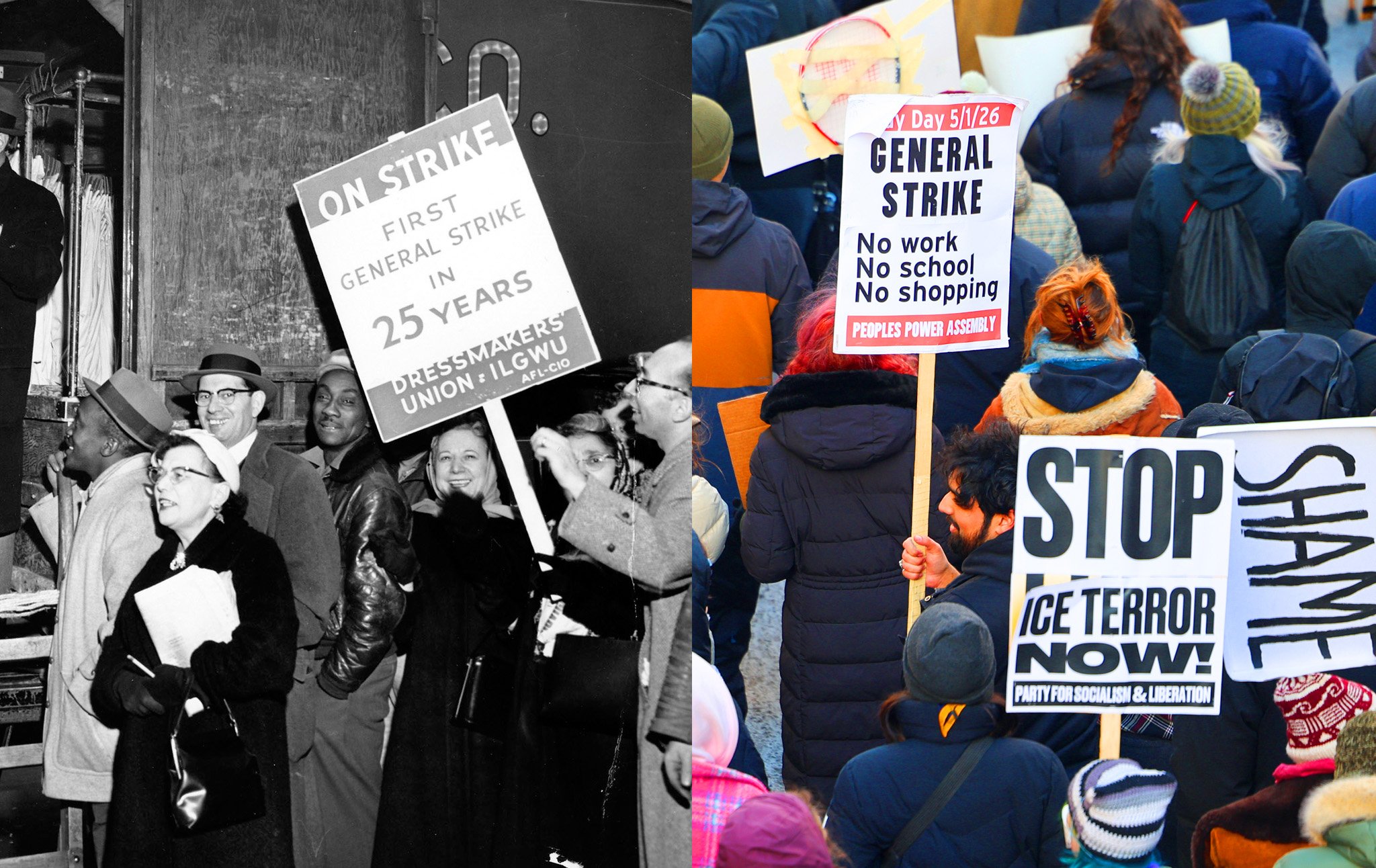
For this reason, general strikes are becoming a topic of conversation at a rapid rate in the U.S. today. General strikes are typically thought of as organized work stoppages at a mass scale, as opposed to work stoppages with a specific employer. The concept behind both a general strike and a single-employer strike is the same: to withhold your labor in order to make those in power realize the losses they would sustain outweigh the potential benefits of refusing to negotiate with workers. Both are also risky for workers. A single-employer strike is usually thought of as a last resort for unions, undertaken after all other attempts to negotiate have been exhausted. Livelihoods are often at stake, making workers fearful of the risks they would sustain in striking. This risk can be cushioned by organized unions through strike funds, or through the legal architecture meant to protect workers from being terminated or replaced over strikes in certain circumstances. However, general strikes have no such cushion. They are unprotected by the law, meaning participants may be fired or disciplined for participating. And historically, they have been met with fierce resistance and violence from the state. Still, given the rapid pace with which the Trump administration has been acting to enact violence and the failure of politicians to oppose it, people are devising strategies to organize them.
Just one day before the murder of Pretti, Minnesota organizers held what they called a “unified statewide pause in daily economic activity” of between 50,000 and 100,000 people. One of the requests the organizers—a combination of local unions, immigrants’ rights non-profits, faith groups, and democratic socialist groups—made of participants was simply to not work, except for emergency services. Their demands were for ICE to leave the state of Minnesota, for the officer who killed Renee Good to be held legally accountable, and for no additional federal funding to be given to ICE in the upcoming budget. The exact economic impact of the action is not known, and neither is the extent to which workers faced repercussions for participating. However, the political impact could be notable. The strike brought international news coverage, and many participants hoped this was only the beginning of similar actions across the country.
The Decline of Labor Consciousness in the U.S.
The power to withhold our labor is not often recognized as a power by many Americans. Labor consciousness has been systematically dismantled over the centuries. Economic and political power were decoupled, in the hopes that people with economic grievances would channel their frustrations into a political system with no true workers’ party.
In the past, however, labor militancy was stronger. It was recognized for what it was, a source of political power. And many profound societal and legal changes came from U.S. general strikes, even in the face of unchecked employer and state violence. These included the eight-hour workday and overtime pay, wage increases, and eventually union recognition and protections under the law. A tipping point was considered to be three citywide general strikes in 1934, in San Francisco, Toledo, and Minneapolis, during the height of the Great Depression. Again met with state violence, pressure mounted and Congress passed the National Labor Relations Act the next year, 1935.
There is an important historical caveat to note, however, which also partly demonstrates why general strikes are not commonplace today. After the passage of the NLRA, which formalized unions, unions grew steadily in density. However, the red scare, combined with organized backlash from employers’ groups, resulted in the Taft-Hartley Act of 1947, stifling progress for private-sector unions. Among other things, Taft-Hartley allowed for the “right-to-work” laws which gutted union membership over time, linked to a fall in real wages as well. It also outlawed wildcat and secondary boycotts and strikes. This means that workers can only legally strike against their own employer under a certain set of proscribed circumstances. They cannot strike without union authorization (a common tactic used to continually raise working standards during World War II) or in solidarity with other employees or unions (which could lead to achieving broader political goals). General strikes are therefore functionally illegal, meaning they have no protection under labor law. Taft-Hartley even gives the President the extreme power to intervene in labor disputes and break up strikes that he believes threatens national health or safety (used most recently by George W. Bush in 2002). Strike activity has declined along with union density in the decades since Taft-Hartley. And because of the decline of labor power, working people have lost their understanding of the role strike actions have in enacting political change.
Global Lessons on General Strikes
It would be remiss to not mention how powerful general strikes have remained around the world, however, whether they were considered legally protected or not, and even when they faced violence in their respective regions. In India, for example, there has been a long history of short-term nationwide general strikes, notably from 2020 to 2025, to push change on large economic and social issues like privatization or price increases. Linking farmers’ movements with trade unions, formal and informal workers across the country’s gigantic, differentiated economy, these cost the state and private employers billions. In Mexico, starting in 2019, factory workers began to strike to protest both U.S. companies for dictating the poverty wages they were paid as well as their captured unions. They won a 20 percent pay raise as well as a 32,000 peso annual bonus, but also sparked a strike movement to extend those wins to other workers employed by U.S. owned entities like fast food chains or supermarkets. In October 2025, in response to Israel’s violations of international law in intercepting the Global Sumud Flotilla and Italy’s continued provision of weapons to Israel, Italy’s largest trade union, the Confederazione Generale Italiana del Lavoro (CGIL), and a grassroots group named Unione Sindacale di Base (USB), called a 24-hour strike. This prompted similar protests in other European countries like France, Spain, and Greece. It also set the stage for further coordinated action, especially amongst dockworkers, which pose a material threat to the continued provision of weapons to Israel. These are just a small selection of many general strikes which combine political and economic aims. Often facing violence or the threat of layoffs, especially in the Global South, workers still make the calculated risk to advance these aims.
There is something to be said here about a general American complacency with the status quo. Yes, our state police forces (encompassing ICE, police, and the National Guard) are extremely well armed and resourced, but that has not stopped protesters in similar circumstances and under an even shakier rule of law. We therefore cannot use American exceptionalism in the realm of state force as a way to talk ourselves out of taking material action if we are serious about building resistance.

Lessons from the Past
In all of these mobilizations, working people unify around clear, articulable demands, even if they are not all in organized labor. There are also generally clear leaders in organizing, who keep coalitions together and ensure demands are not misconstrued. It is important to note that in the U.S. context, the largest mass mobilization thus far against the Trump administration has been the “No Kings” protests. They lacked such a demand, instead being vaguely framed as anti-Trump. No Kings also appears to be relatively opaque when it comes to disclosing its organizers, listing its “partners” instead. Those were a large list of generally progressive organizations, from unions like SEIU to various environmental and voter action groups. Coverage of the protests in June and October 2025 appeared to be more about the turnout of the event and the fact that it angered Trump than any specific call to action. The protests were arguably helpful in showing popular dissatisfaction with Trump and Republicans’ consolidations of power. However, without any specific demand or clear organization, one could ask what was materially accomplished by them. Energy and momentum from protests like these must be solidified into specific demands and must lead to real consequences to the powers that be for action to be taken. There is another No Kings protest being planned for March 2026. There is deep systemic and structural rot that people are confronting which goes far beyond Trump, being laid bare by the Epstein files and the lack of a political reckoning in their wake. These protests may therefore have higher numbers, but need to advance actual demands beyond disapproval.
The Black Lives Matter uprisings of 2020 also serve as both a reference point and a warning to current struggles against racialized state violence. Also beginning in Minneapolis upon the murder of George Floyd by police, public sentiment broadly supported actions to at least hold the officer and police station who killed George Floyd accountable. More people were raising calls to defund police or fundamentally reassess the institution as a whole. Demands, while not uniform, were at least centered on a primary objective, to address racialized police violence. Consciousness and participation in the protests were wide-ranging, including long-time activists to everyday, typically “non-political” people. Even the burning of the Minneapolis police station saw a majority of public support in polls (with 54 percent supporting it), indicating that even police, the usually untouchable institution, were being seriously questioned.
But while there was large-scale public support of some form of fundamental change to policing, political powers did not cow to public demands. There was a systematic effort to water down these demands, moving from abolishment of the police to defunding them to reforming them. Democrats played a large role in this effort, as well as the expansion in the police state in the years since. Under the guise of providing police more money for supposed reforms, little has meaningfully changed to address systemic police violence against Black people. It is notable that Philando Castile, a Black man who was killed by police under circumstances similar to Alex Pretti for his legal possession of a weapon, did not receive the nationwide outcry that Pretti did. And today, years later, there are disparities in the amount of media attention given to the killings of Keith Porter Jr. and Alex Pretti.
What is also notable about the situation unfolding now, however, is that these structures of state power are being questioned further, and by people who had not thought to question them before. This is because many of the contradictions concerning our legal rights and the security state are becoming glaring, the gaps between purported “safety” justifications and true power maintenance and control functions. Even some mainstream news outlets and politicians agree that ICE represents a slippery slope leading quickly toward mass repression or fascism. However, the failure (or rather, structural inability) for state mechanisms to check ICE and state institutions is becoming clear as well. Police and National Guard are not protecting protesters, and may not even be able to under their mandates.
Energy is not being channeled as readily into the Democratic Party as it was before, given that leadership has not decisively taken action and appears to be stifling calls to abolish the institution again. There is more knowledge that politicians are not coming to save anyone, and that local, community efforts that provide material support, like mutual aid and coordinated ICE watches, are key. While momentum could be lost, this could be a moment, again, to examine the failure of state institutions to protect working people and their lack of accountability. General strikes, again, could serve as a means to both push for material change as well as to demonstrate political power that can be exercised outside the traditional channels which could weaken it.
Current General Strike Organizing Efforts
The American calls for a general strike did not materialize out of thin air. United Auto Workers (UAW) President Shawn Fain announced a preliminary idea for one in 2023. This was after the large-scale, strategic Stand-Up Strikes of 2023, where workers challenged the “big three” automakers and secured substantial wins like 25 percent wage increases. The UAW, moving from a defensive to offensive posture under Fain, is asking other unions to join the effort for a general strike. Fain has described the goal of the proposed general strike to be political gains for working people, like universal healthcare and raised retirement benefits. Thus far, it is being planned to occur on May 1, 2028, International Workers’ Day. This date is the date on which contracts the UAW negotiated with the big three are set to expire. The UAW has also encouraged other unions to negotiate their contract dates to expire on that date as well. By timing future strikes with the date of the contracts’ expiry, this would circumvent contracts with no-strike clauses and would also set an exact date for mass, coordinated action which is more disruptive and more powerful. Setting the date years in advance also gives unions and other groups time to plan, especially if strike funds are needed. However, given that so much has happened only weeks into 2026, people are calling for immediate action, fearing what else could happen between now and 2028.
While more organized general strikes with a centralized decision-making body could potentially make more of an impact, their effectiveness could be constrained by the very low levels of unionization in the country. Only about 6 percent of private-sector workers are unionized, a stark contrast to earlier eras when unions had far greater reach. Nevertheless, participation in these strikes would not be strictly limited to unions that have joined the UAW’s effort. Workers outside these formal organizations should still play a role in collective action efforts, though they, too, would need to accept the risks of unprotected strike action. This could include participation in work stoppages but also other forms of economic or logistical disruption timed strategically, like targeted boycotts of ICE’s corporate collaborators. Everyone has a role they can play, which is why Minnesota organizers are using tactics from airport sit-ins to school walk-outs.
Coordination is also needed between organized labor and the immigrant rights movement. There are some indications of this happening, though explicit demands formulated through the UAW general strikes’ planning could solidify these connections. The importance of workers’ solidarity, no matter their citizenship status, is central to maintaining workers’ bargaining strength, and this cannot be foregone here. Because of unions’ relative organizational capacities and resources, the UAW general strike could be the most well-positioned to bring forth movement demands to build on and to educate those within emerging movements.
Another lesser-known effort is generalstrikeus.com, which has been amassing followers on its Instagram page and received some social media references from celebrities. It describes itself as a “decentralized strike network” or “people and organizations committed to striking once we reach 3.5% of the U.S. population, or 11 million people.” The idea, they write, is that this number is a threshold which has been proven to "bring about change” (an idea postulated by political scientist Erica Chenoweth, questioned for its veracity). The groups involved include activist groups and coalitions from across the country which cover issues from economic justice to climate change. They also have chapters throughout the country available for people to join via Discord. In order to commit to the strike, people are asked to sign a strike card online with their name and phone number. The effort is run through donations.
The website’s FAQ does not answer exactly how long the strike would be, were it to happen, or set demands. However, it notes that these would be set and more plans made at a later date, after enough strike cards are signed. This is an ambitious effort, though it is important to note the formality necessary for undertakings like a general strike. Given the potential for backlash, the potential need for strike funds, and the need for sustained momentum, a disaggregated structure has some drawbacks in efforts like this. Still, the group is notable given the work that can be done to normalize the idea of a general strike itself.
There was, in fact, what has been considered something of a general strike on January 30, 2026 as well. Almost immediately after Pretti was killed, protesters began calling for a general strike again. The Somali Student Association at the University of Minnesota led the charge in pushing for an action similar to the January 23 one. The demand of this action appears to be saying “no to ICE funding.” It was not entirely clear whether this is in reference to the pending budget resolution which Democrats have proposed not voting on or on broader budget allocations to ICE. However, on January 30, the “national shutdown” took place with people across the U.S. joining in protests and heeding their call. The economic impact of the protests, which have been called a general strike, has not yet been comprehensively estimated. However, a tracker from Payday Report indicates that thousands of businesses in over 120 cities were affected by the shutdown. It is yet to be seen how this momentum can be built upon for future actions. While this effort was not meticulously planned, the speed with which it came together is notable, and energy could be harnessed for even more economically impactful actions.
In these early stages, it is important to articulate what organizers should seize on in this particular moment. It is not only the inability for state institutions to protect the material interests of working people, but also their ability to deploy violence at will, without accountability. The violence which has long been exported to sites of imperial domination, like to Palestinians in the West Bank, or to racialized groups in the U.S., like Black Americans in inner cities, is now being seen and felt by others. ICE is not a cause, but a symptom of this system which has devalued average workers’ power and prioritized a ballooning security state to police them. Demands could include ICE abolishment, but ideally would reach further to build labor consciousness and power. Most Americans want economic stability for more than the one percent, which can be helped through raising tax rates on billionaires. Many want universal government-funded healthcare, which has been denied to us for far too long for the sake of the insurance lobby. Both major political parties contributed to American workers’ declining quality of life, protecting wealth accumulation for the richest by channeling taxpayer money into the security state domestically and the U.S. war machine abroad. These issues should therefore be connected in the minds of workers, strengthening collective action and resolve against the status quo of party politicking.

What Will Happen Next
There will be backlash if a general strike were to become a true threat to capital. There are already efforts underway by the FBI to investigate the Signal group chats that people in Minneapolis were using to share information about ICE movement for rapid response. FBI Director Kash Patel, in an interview with a right-wing podcaster, alleged that such efforts did not deserve full First Amendment protection because they were likely to provoke imminent unlawful action. This paves the way for this justification to be deployed in almost any organizing context, and organizers should prepare with this understanding.
Independent journalist Ken Klippenstein received what was purportedly a leaked “Homeland Threat Assessment.” Klippenstein notes that while these assessments have been prepared since 2020, this one stands out for its inclusion of “class-based or economic grievances” as a source of potential domestic terrorism. This term is not clearly defined in the document, and it is not certain that this term will be in the final version of the document. However, the inclusion of the category reveals an underlying acknowledgement of class grievances as a point of central contestation. It paves the way for them to be stifled under the guise of a terroristic threat. In the past, this was done to impose extreme charges on environmental justice activists opposing “Cop City.” It could very well be done to other protesters.
Finally, in response to demands for ICE to be withdrawn from Minnesota immediately after Pretti was killed, Attorney General Pam Bondi suggested a tit-for-tat exchange of Minnesota’s voter rolls in return for withdrawals. This is startling in its clarity, illustrating just what is coming next. Voter suppression will likely be attempted en masse, as already outlined in Project 2025. It instructs the executive to condition DHS grant funding on providing the federal government with voter rolls and department of motor vehicles records. The plan is already set in motion to obtain as much information about state populaces as possible, and to deploy ICE to harass and intimidate voters. Steve Bannon has said ICE would be present at polling places, and the White House has not denied that claim. Intimidation tactics would similarly be deployed against organizers of strike actions.
ICE is currently planning to spend $38 billion of its massive budget on converting warehouses around the country into “regional processing centers.” There is more fear that these will become unaccountable black-sites where people can be disappeared to. ICE is expanding its offices across the country, allowing for it to become a second shadow police force with nationwide presence. ICE is already laying the legal groundwork to justify arrests and detention of U.S. citizens and non-citizens alike.
And other states, like Pennsylvania, Colorado, and Ohio, are bracing for ICE deployments and “occupations” similar to Minnesota’s. Far-right parties around the world are hoping to mirror ICE as well, likely taking note of its ability to strike fear in dissidents and expand the police state. We must make efforts to show that ICE-style policing cannot be sustainable.
History shows that general strikes are powerful, but concerted political will is necessary to organize and best leverage them. For Americans, this is somewhat new terrain. Yet economic action and the rebuilding of labor consciousness are emerging as some of the few real means to deliver justice for those harmed by ICE and the vast U.S. security apparatus. The time to act is now.
Sumona Gupta is a freelance journalist and writer from Alabama. She specializes in labor and human rights in the U.S. South and the Global South. All opinions expressed here are her own.