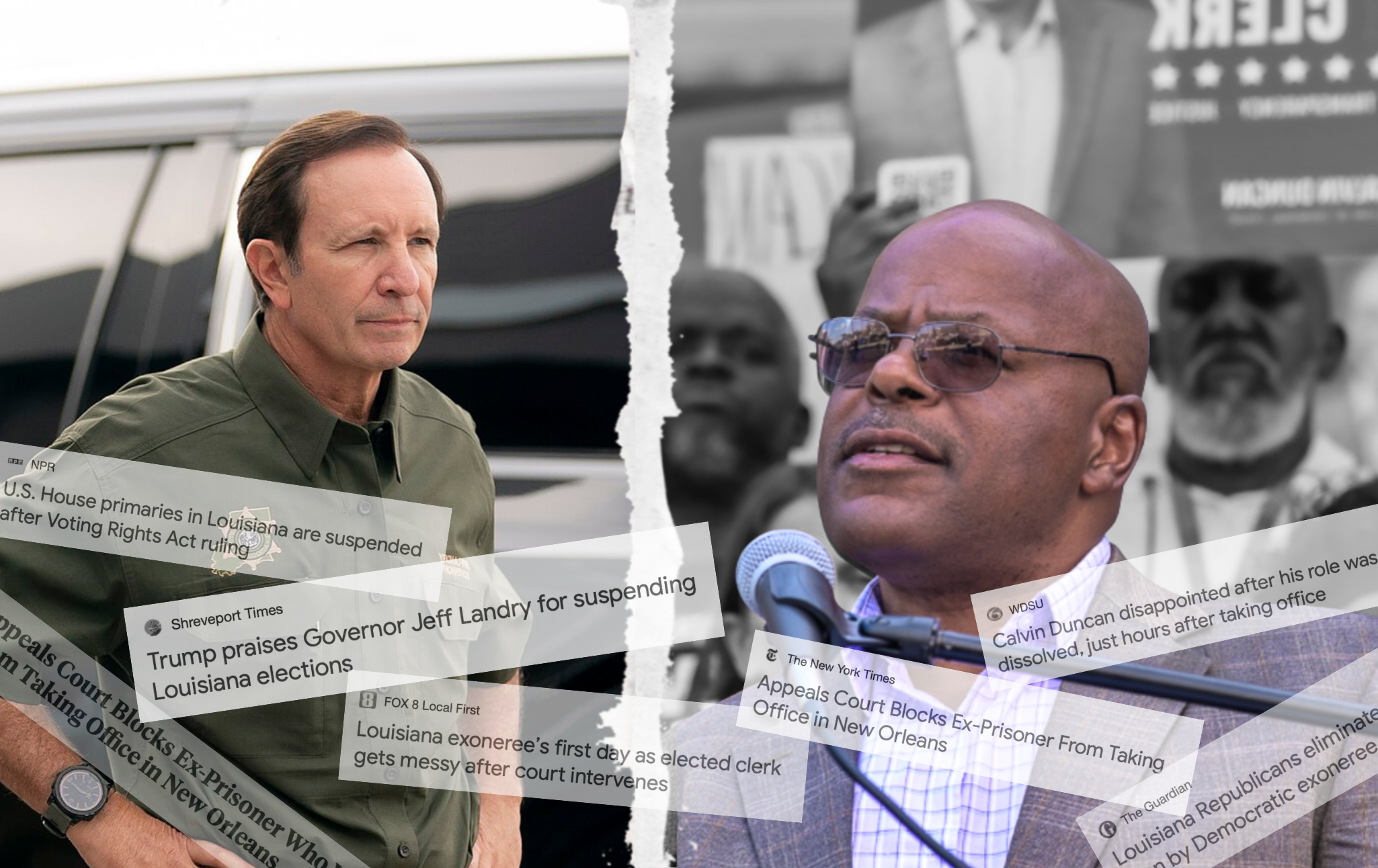
Governor Jeff Landry’s attacks on elections and Black voting power could become a national blueprint.
In Louisiana, democracy is conditional; the condition being, of course, that you vote in the interest of our governor. Fail to follow that one tiny rule, and you may well see your ballot revoked.
In the last several weeks, Governor Jeff Landry blocked a Black man from assuming his elected position in New Orleans after he won in a landslide, then suspended primaries for the House of Representatives after voting had already begun, so that Republicans can redraw districts in their favor. The new map is expected to take the state delegation from four Republicans (all of whom are white) up to five, reducing the number of Democrats (both of whom are Black) down to one, by eliminating one of the state’s two majority-Black congressional districts. One state representative has warned that the state could actually lose both. Meanwhile, confusion over the suspended race has led some voters to falsely believe that elections are cancelled entirely.
Readers across the U.S. should be warned that the South does not exist in a vacuum. Our country is only as strong as its weakest link, and right now, the precedent being set in Louisiana is threatening to break the entire chain. If one tyrannical, racist leader can effectively toss your ballot in the trash, what is stopping the rest of them?

For those who have been following closely, the story of Calvin Duncan’s ascension to New Orleans city office—and then swift removal from it—represents the most infuriating age-old tale in the United States. Even when justice prevails, when the public proves that we can and will demand better, the ultra-wealthy will conspire to pull the rug out from under our feet.
As a teenager in 1982, Duncan was arrested for murder in connection with a fatal robbery in New Orleans, then swiftly sentenced to life at Angola Prison. He maintained his innocence for 28 years behind bars, using the time to expand upon his ninth-grade education and teach himself law. Like many inmates, Duncan could not even afford access to his own case file; legal documents cost up to $3 per page, and prisoners at Angola are paid as little as two cents an hour, often earned by literally picking cotton and other crops in the surrounding fields.
New evidence eventually cast doubt on the conviction, and Duncan was released from prison on a plea deal in 2011. Despite being forced to accept lesser charges in order to walk free, he never stopped trying to clear his name. Finally, ten years later, a judge agreed that Duncan was factually innocent of all crimes and exonerated him entirely. The self-taught lawyer went on to publish a best-selling memoir, earn his bachelor’s from Tulane University and a law degree from Lewis and Clark, and co-found several organizations dedicated to helping former prisoners.
But Duncan took it all a step too far, according to the Louisiana government, when he actually tried to gain political power.
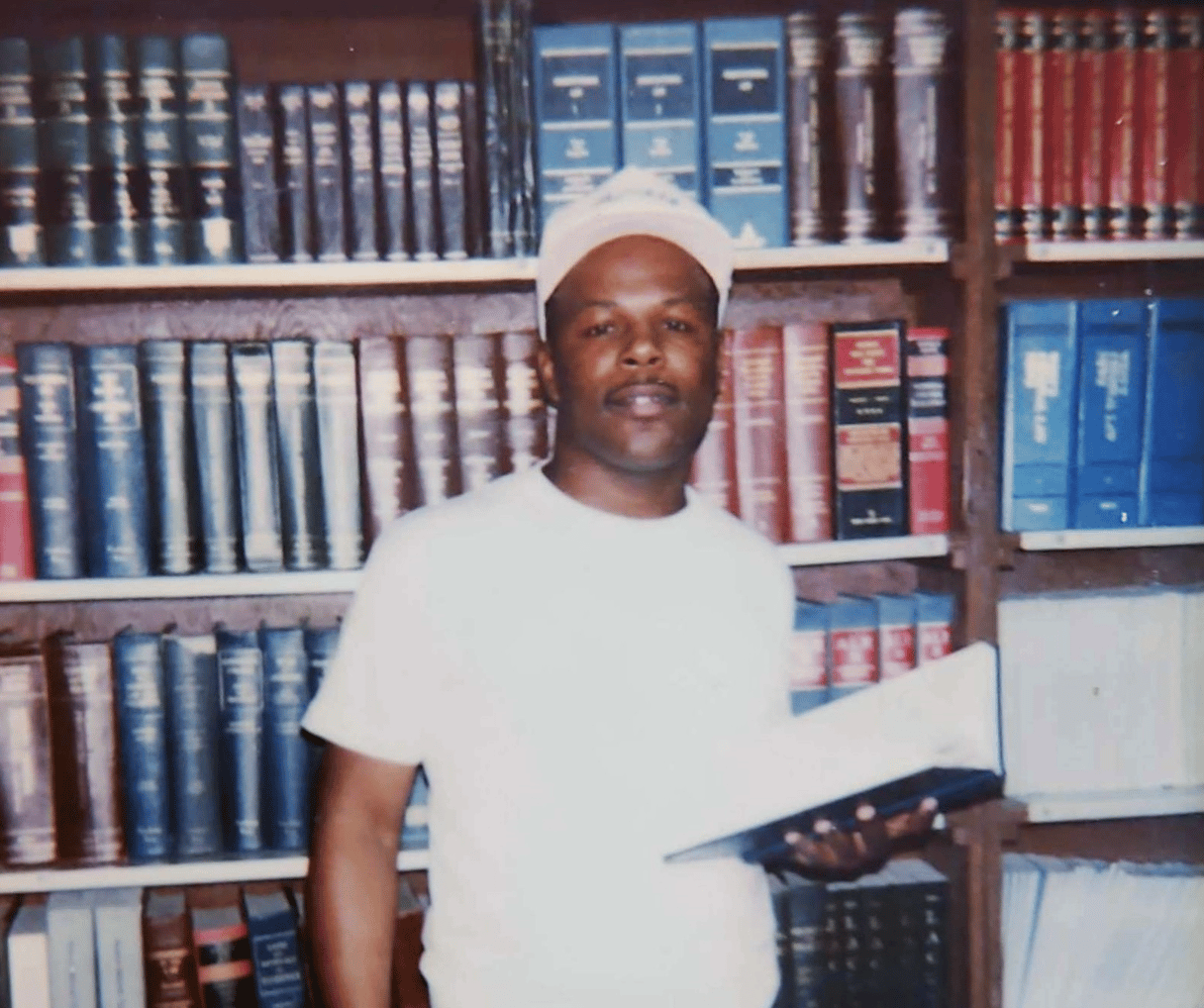 Calvin Duncan is pictured in 1986 in the law library of "Angola" Louisiana State Penitentiary, where he was falsely imprisoned for nearly 30 years.
In 2025, Duncan ran for Clerk of the Orleans Parish Criminal District Court: the very office that denied him access to the records he desperately needed while in prison. He won by an overwhelming 68 percent of the vote.
Republicans were already familiar with Duncan’s name—and having spent years trying to defame him, they weren’t exactly thrilled by this new position of power.
As Jack Brook and Sara Cline write for the Associated Press:
As state attorney general in 2023, [Louisiana Gov.] Landry opposed Duncan’s petition to be compensated for his wrongful conviction. Duncan withdrew the petition after Landry’s successor, Liz Murrill, threatened to go after Duncan’s law license in the state. When Duncan ran for clerk, Murrill vowed to take “further action” against him if he did not stop calling himself “exonerated.”
That’s despite the fact that Duncan is listed on the National Registry of Exonerations, his exoneration was signed by 160 lawyers and legal experts, and he was legally exonerated by a judge. If speaking the truth out loud pisses off a right-wing racist, however, they can simply threaten you to shut up.
The threat wasn’t empty: in 2026, after Duncan won, Governor Landry instructed a state senator to introduce a bill that would eliminate his position entirely, effective August 1. After realizing that Duncan would already be in office by then—and the Louisiana Constitution doesn’t allow for slashing the terms of elected officials for no reason—Republicans realized they’d need to act faster. Senator Jay Morris amended his measure so that it would become effective immediately upon Landry’s signing, and before Duncan could be sworn in. A federal judge ruled the law unconstitutional this week and temporarily blocked it, but Landry’s administration successfully appealed the decision hours later, leaving it in effect for now. When it comes to denying the will of his constituents, Landry is determined to fight tooth and nail.
The governor and his cronies have insisted that the bill isn’t personal, and is designed to maximize efficiency and reduce costs by absorbing Duncan’s duties into another department. But a new investigation by The Lens reveals that the data Senator Morris used to justify his cuts is completely inaccurate. The report he cited—while arguing that the New Orleans court is “bloated” with too many judges and staff compared with the number of defendants—reportedly counted “only half of the defendants who move through the courthouse.” (It’s not clear why Senator Morris cares about the efficiency of New Orleans city government anyway, since his district is about as far away as physically possible, nearly 300 miles north.) In any case, the Associated Press writes that “eliminating [Duncan’s] clerk position saves the state about $27,000 and the city $233,000 according to the office of the legislative auditor.”
Both of those figures are basically chump change in terms of government budgeting. (Last year, state funds were used to purchase a $5.5 million passenger plane, which Landry uses to jet around on a whim.) But it’s especially doubtful that Landry gives a damn about saving New Orleans any money: time and time again, he’s proven both his animosity towards Louisiana’s liberal epicenter and his willingness to use money as a weapon against it.
In 2022, when the New Orleans City Council passed a resolution to prevent city funds from being used to prosecute abortion cases, Landry yanked $39 million in critical funding for flood control, smack in the middle of hurricane season. “If they want this project to move forward, rescind the resolution,” he said, adding that state legislators should “use the tools at our disposal to bring them to heel.” The money was slated to build a new power station, one year after Hurricane Ida plunged the entire city into darkness and sent a 400-foot energy tower crashing into the Mississippi River amid 150 mile-per-hour winds. In the wake of the storm, at least ten people died due to extreme heat. Stronger power infrastructure could prevent the same tragedy from repeating—but because city officials refused to send women to jail for having abortions, Landry refused to protect his residents from the next disaster.
After even Republican allies stated that Landry had taken it too far, the funding was restored. New Orleans officials didn’t back down, and our easily bruised governor has continued his pattern of punishment ever since. Ahead of the 2025 Super Bowl, Landry sent state police into the city to bulldoze homeless camps, forcing more than 100 unhoused people into a warehouse under threat of arrest. The “transitional facility,” which he arranged under a no-bid contract, had no heat and few blankets, all while New Orleans was buried in snow. This little stunt cost the state an estimated $20 million after the federal government refused Landry’s request for a reimbursement. (Remember the whopping $27,000 Louisiana plans to save by ousting Calvin Duncan?)
Landry’s apparent disdain for New Orleans was perhaps best captured hours after an armed terrorist killed 14 people by plowing a car down Bourbon Street on Jan. 1, 2025. The governor responded by posting a photo of himself grinning and giving a thumbs-up outside a French Quarter steakhouse: "Ate dinner tonight in New Orleans. Proud to be a part of this incredibly resilient city. See everyone at the game tomorrow!" Landry is no part of New Orleans. If he were, he'd have an ounce of empathy for its residents, and might even allow them to choose their own leaders.
Clearly, the real threat Louisiana Republicans see in Calvin Duncan’s election isn’t efficiency or cost, but Duncan himself. The lawyer spent nearly three decades inside America’s largest prison—named Angola after the slave plantation that once stood there, itself named after the African country where most of the enslaved were kidnapped. It’s a place where inmates, the vast majority of whom are Black, are still forced to perform slave labor today, working for hours under the blistering sun, while armed guards stand watch on horseback. Their average sentence is 93 years.
If a man condemned to die there—one who arrived with no money and little formal education—can be freed, based solely on his own determination, who’s to say what he will accomplish in office? Republicans seem terrified of finding out.
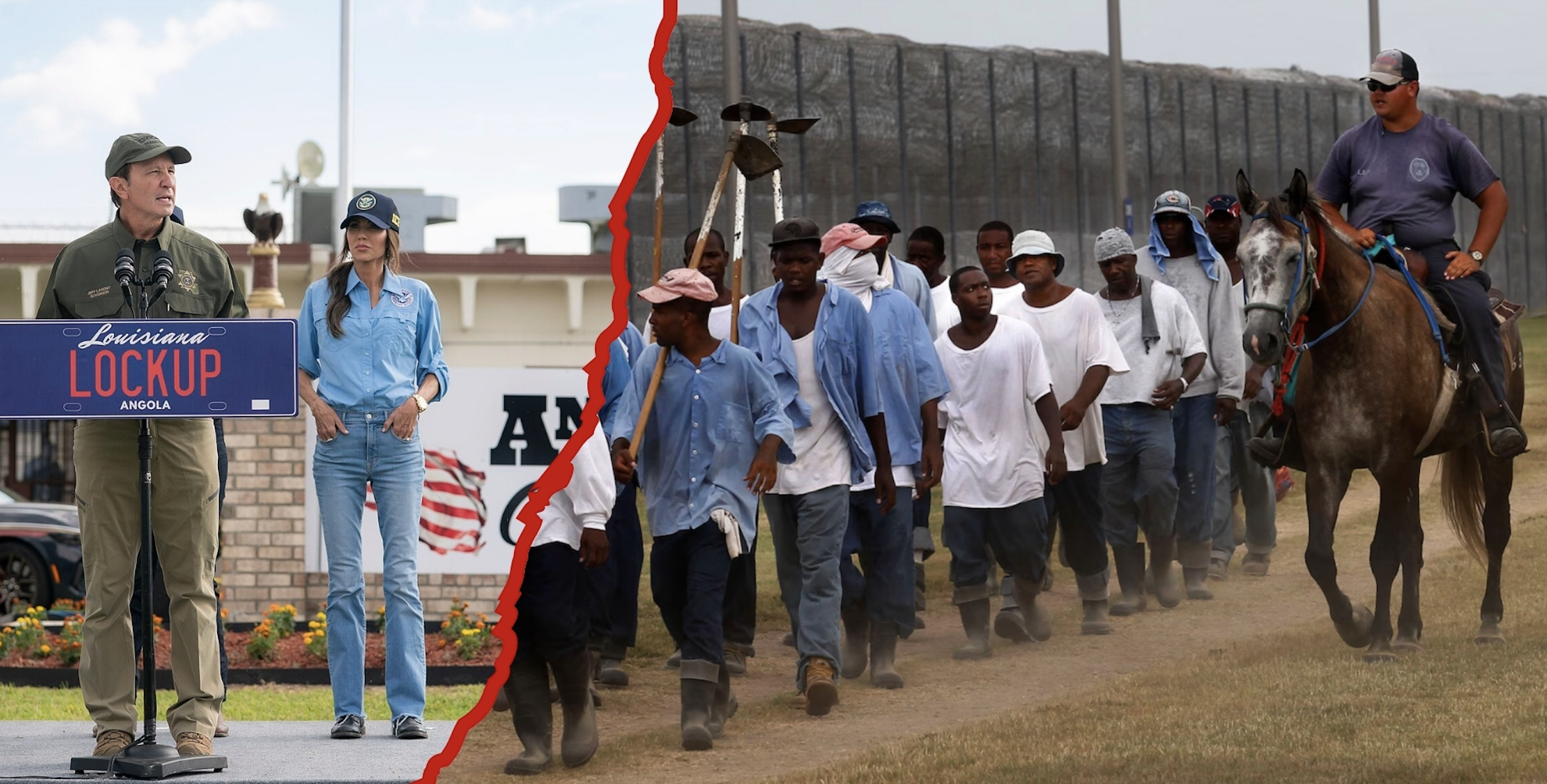 Gov. Jeff Landry speaks at a 2025 press conference outside of Angola Prison, where Calvin Duncan was formerly incarcerated. Multiple lawsuits have alleged “cruel and inhumane” conditions at the facility.
Duncan campaigned on a platform of restructuring the court office, focusing on digitizing records and improving access for Louisianans, saying: "I'll fight for your rights like I fought for my own freedom." Landry’s approach to criminal justice, on the other hand, is primarily rooted in cruelty.
As I previously wrote for this publication:
The former cop’s tough-on-crime rhetoric has always been a thin veil for his sadism; in Landry’s first year in office, he passed a law allowing for the perpetrators of certain sex crimes to be surgically castrated, and added two new methods of execution: the electric chair and suffocation by nitrogen gas. (If you’re someone who believes the punishment fits the crime, remember that Louisiana has the second-highest rate of known wrongful convictions in the country and New Orleans, as a city, has the first.)
For now, Calvin Duncan’s position is stuck in a legal purgatory. But the state’s willingness to disenfranchise their constituents did not start or end with one man. Duncan’s removal from office represents a larger trend: when elections threaten Republican control, the elections themselves suddenly become negotiable.
Louisiana’s May 16 election is fast approaching, and 42,000 absentee ballots had already been cast when Governor Landry abruptly suspended the state’s races for all six House seats. Following the Supreme Court’s recent slashing of the Voting Rights Act, Landry declared what he called an “emergency of unconstitutional maps” and postponed the elections so the Republican-controlled legislature could redraw the districts first—in their favor.
Residents can still vote on city candidates and other measures, just not congress. The ballots have been printed and our six representatives’ names still appear on them, but any bubbles filled out in that section are now a waste of ink: no one will be counting.
The move is almost unheard of. Nearly every time a U.S. election has been delayed while already underway, it’s been due to catastrophe. Louisiana postponed a number of races following Hurricane Katrina in 2005, as many voters had evacuated and polling stations were destroyed; after 9/11, New York’s mayoral race was pushed back for the same reason. In April of 2020, Wisconsin’s Democrat governor Tony Evers attempted to delay the election due to the pandemic, but the state’s Supreme Court ruled against him, and it proceeded on schedule.
What Landry is attempting is a hostile takeover, explicitly designed to dilute Louisiana’s Black vote. For decades, Louisiana had only had one majority-Black district, despite Black people making up roughly a third of the state’s population. When it came time for the Republican-controlled legislature to draw the maps again in 2022, the NAACP Legal Defense Fund and other civil rights groups sued. Finally, in January 2024, the state approved a new map with a second majority-Black district—and barely two years later, Republicans want to take it away.
The Supreme Court case that triggered this most recent re-districting was filed by a group of self-described “non-African-American voters” in Louisiana, led by lead plaintiff Phillip Calais. Little is known about Calais, except that he was formerly a local election supervisor and apparently attended Jan. 6, according to reporting from Democracy Docket. What is especially bizarre about this case though, is that many of the plaintiffs involved don’t really seem to care about it: when the New York Times contacted one of the filers, he said he wasn’t even aware that he was a part of a lawsuit. The 78-year-old “speculated that perhaps he had received ‘a direct mail piece’ about challenging the voting map,” and that’s why his name was included. Another plaintiff’s husband was reached by phone, and said he didn’t know anything about the case either and didn’t think his wife was involved. Not a single one of the filers testified at the three-day federal trial that helped propel the lawsuit to the Supreme Court.
And yet, when the case landed in the lap of Justice Samuel Alito, he agreed that all 12 white voters “suffered unlawful, intentional discrimination based on race.” Louisiana’s 2024 congressional map with two Black districts was ruled unconstitutional, and sent back to the drawing board for Republicans to rewrite. Critics of the ruling argue the Court knowingly created chaos immediately before an election. The Supreme Court’s Purcell Principle forbids federal courts from changing voting laws too close to a race, but the “inconsistency” in actually enforcing that rule “has the remarkably coincidental effect of benefitting Republicans,” writes Georgetown Law Professor Steve Vladeck on his Substack page.

Now that Louisiana’s map has been struck down due to supposed “racial gerrymandering,” states across the country are bracing for a new wave of challenges to majority-Black districts— particularly in the South, where hard-fought Voting Rights Act gains have always depended on explicitly race-conscious maps. Because Black Louisianans overwhelmingly vote Democrat, battles over district lines are also battles over partisan power. While it’s easy to assume that Louisiana bleeds red to its center, as of 2025, there were roughly 45,000 more registered Democrats in the state than Republicans. (When you only count registered voters who actually cast ballots in the last two federal elections, however, Republicans take the lead.)
What leaders like Gov. Jeff Landry are banking on is exhaustion. The more Democrat voters come to see Louisiana politics as predetermined, the less likely they are to show up at all. The recently suspended election has also added confusion to existing apathy: many voters want to cast their ballots, but falsely believe the elections are cancelled entirely. The chaos might work in Landry’s favor.
Two of the constitutional amendments still appearing on the May 16 ballot are basically reworded versions of similar proposals Landry put forward last year—both of which voters shot down in a landslide, along with all of his other amendments. At the time, LA Illuminator wrote:
In a stunning rejection of Republican Gov. Jeff Landry, Louisiana voters turned down all four of his constitutional amendments Saturday, including the governor’s plan to overhaul the state’s tax and budget laws.
Nearly two-thirds of voters rejected all of the amendments in an election that could have broader political implications for the rest of Landry’s term.
The governor, who has sometimes relied on strong-arm tactics to get his agenda through the Louisiana Legislature, could become more vulnerable to pushback after failing to pass his most ambitious policy proposal at the ballot box
Now, a year later, it appears that Landry’s newest strong-arm approach may be to confuse voters into not casting their ballots at all, allowing a pathway to force through his wildly unpopular agenda.
The governor has proven his mantra: when voters show you what they want, simply cheat or change the rules in order to implement the opposite. If New Orleans voters elect a Black man you don’t like, erase his position a month before he takes office. If there are more registered Democrats in the state, redraw the maps in the eleventh hour before an election so their votes are diluted. If the people of Louisiana prove in a landslide that they hate your legislation, just reword it slightly and try again.
The state of democracy in Louisiana is in limbo. Calvin Duncan showed up for work on Monday morning this week, ready to serve the people, despite the strong possibility of his office no longer existing. A federal judge briefly blocked the law from eliminating his role, before an appeals court reinstated it pending further litigation. Duncan’s attorneys continue to argue that Louisiana cannot retroactively nullify the will of the voters.
Meanwhile, Louisiana’s old congressional map is dead, the new one does not yet exist, and the courts appear poised to spend the rest of the election cycle fighting over whatever comes next. Representative Mandie Landry (no relation to the governor) has stated: “I really do not know how to answer all of your questions … I am guessing the legislature will try to pass new maps before we end on June 1, or maybe we’ll come back, who knows.”
“I predict a 6-0 map,” she continued, meaning six red districts led by white representatives, and zero Democratic, Black ones. “Truly shameful to be from Louisiana right now.”
As far as our state’s leadership, she is right. But the battle is far from over, and Louisianans have shown that they won’t back down. Neither should Americans across the country, where similar battles are likely to unfold in other states as the November primaries draw near. Last year, voters crushed every single amendment proposed by Jeff Landry, and we can do it again. Across the South, voters and civil rights groups have dragged hostile legislators back into court again and again over illegal district maps, often winning in spite of the odds. The victories have not been permanent, but neither have the defeats.
Looking towards the uncertain future, local New Orleans outlet Antigravity put it best: “do your research and be prepared to fight for your vote after it has been cast,” they urged readers. “Things are dark, and they seem to be getting darker, but there is strength in numbers—and the numbers show we are plenty.”