
The tomb and womb, once tranquil places, have become another battlefield in Gaza.
“They started bombing the graves. There’s no safety for the dead even.” That is a message I got from my sister R., then 13 years old and living in Rafah, on May 14, 2021. Those words came from a child who, four months prior, had buried our father; a child who was for days under Israeli bombardment and who, like most kids in Gaza, survived several wars of aggression. Later that day I found this photo, showing the aftermath of Israel’s bombing of the Shejaiya cemetery.
This is an under-appreciated form of state crime in Gaza. While most news networks and academic studies discuss crimes against the living, I document Israel’s invisible crimes against the dead and the unborn. Most cemeteries in Gaza have been destroyed or damaged by bombing, bulldozing, and quasi-random exhumations: thousands of bodies displaced, dismembered, scattered, looted. The unborn also became collateral damage. Hundreds or even thousands of unborn children killed, directly or indirectly, through the killing of pregnant women; a massive increase in miscarriages caused by psychological trauma, severe injuries, malnutrition, dehydration, infectious diseases, and lack of obstetric care; destruction of embryos in IVF centers.
I write about the killing of unborn babies because my father, an obstetrician who worked in Rafah for two decades before he passed away, told me in 2009 that after heavy bombing, women came to his clinic suffering miscarriages from trauma. I document crimes against the dead in honor of my grandparents, whom I never got to meet and who never found peace, even after death.
A Century of Crime in Palestine
Israel’s atrocities in Gaza come in a context of exceptional prior criminality and accompanying impunity. For the past century, Palestinians have been subjected to some of the worst crimes in modern history, all tolerated by global institutions supposedly in charge of international peace and justice. As documented in my prior work, Palestinian “life” remains marked by settler–extractive colonialism, one of the last active colonial projects in the world, and the longest (illegal) military occupation in modern times. Its criminal record also includes ethnic cleansing; apartheid; war crimes, crimes against humanity, and human rights violations; a deliberately failed and failing “peace” process; and third-party complicity: from the United States’ military and diplomatic role in sustaining these crimes, to the United Nations’ failure to challenge the crimes, as well as the corporate profit derived from colonialism, occupation, annexation, and war. All these layers of crime bring Palestinian life closer to a slow death.
The ongoing genocidal, ecocidal war on Gaza came with a continuation of these crimes—against living, dead, and unborn humans, as well as against nature and nonhumans—at horrific scale. Following Hamas’ massacre against Israelis in October 2023, when 1,180 were killed and 251 taken hostage, Israel has reduced the Gaza strip to rubble. By July 2025, over 125,000 tons of explosives had been dropped on Gaza, destruction unprecedented since World War II. The housing, medical, sanitation, and food infrastructure have been obliterated, creating a humanitarian crisis of apocalyptic proportions, with millions homeless, humans and animals starving to death, children’s limbs amputated without anesthetic, and millions of cases of infectious diseases.
The United Nations Office for the Coordination of Humanitarian Affairs reported on September 17 that Israel has killed 65,062 Palestinians (83 percent of them civilians, according to the Israeli military). It has also injured and maimed 165,697, with thousands missing (dead under the rubble or abducted by Israel), and displaced 1.9 million people, almost the entire population of Gaza. The bombing has destroyed or damaged 92 percent of housing units, 88 percent of commerce and industry entities, and 77 percent of the road network. And those are the conservative estimates. Multiple studies indicate a higher death toll, if we include missing people and indirect deaths caused by the genocidal conditions imposed on Gaza. A study from 2024 estimates over 186,000 deaths, while others believe over 335,500 people might have died by the end of 2024. A study published in July 2025 indicates the total death toll might be 680,000 when including indirect deaths. Over the first year of the war, life expectancy in Gaza dropped by an astonishing 34.9 years.
The atrocities in Gaza have not just harmed humans. As documented in my research on animals and nature in Gaza, Israel has killed, injured, displaced, and starved hundreds of thousands to millions of animals and has destroyed nature, turning much of Gaza into a toxic wasteland which can no longer sustain life. This continuity between genocide and ecocide is not exceptional, but a common manifestation of colonialism. Fundamental principles of international humanitarian law—distinction, proportionality, necessity, humanity—have also been persistently violated in Israel’s operations in Gaza. While numerous reports document how the conduct of Israel’s war on Gaza has breached the Genocide Convention and the laws of armed conflict, the war itself is illegal, given its illegal aims: permanent control, fragmenting population, and obstructing statehood.
Both the crimes in Gaza and their global recognition have passed the point of no return. A massive global movement has been resisting the ongoing crimes and thousands of experts agree that Israel is committing genocide: legal scholars, genocide scholars, UN commissions of inquiry, UN Special Rapporteurs, human rights NGOs (the Palestinian Centre for Human Rights, B’Tselem, Physicians for Human Rights Israel, Amnesty International), Holocaust survivors, as well as humanitarian workers, physicians and army veterans who’ve returned from Gaza. Yet, the genocidal assault expands, foreign governments continue aiding and abetting genocide, international peacekeeping and accountability bodies remain in paralysis, and corporations continue profiting.
Since the dead and the unborn have not been spared from atrocities, I seek to shed light on those unseen or forgotten. These are not just harms to abstract entities: those no longer here and those not yet here, but crimes against the living, whose lives are broken by these crimes against the absent ones still so present in their soul. The vague, narrow, and unenforced provisions on protecting those living, and the even more precarious norms protecting the dead and the unborn, show the inadequacy of international law to prevent, halt, or repair mass atrocity.

Israel’s Crimes Against the Dead
Israeli leaders seem not simply satisfied with clearing Gaza of living Palestinians—they wish to remove all evidence that these people existed in the first place. Israel’s 2021 assault on Gaza, which included the bombing of the Shejaiya cemetery, mentioned earlier, and of other cemeteries, is documented by the Euro-Med Human Rights Monitor in the report “Inescapable Hell”. In that earlier assault, long before October 7, hundreds of Palestinians were killed, thousands injured and maimed, and over 120,000 displaced. Gaza’s Shejaiya neighbourhood was turned into a bloodbath. By now, the Shejaiya district has been obliterated by Israel. On August 7, 2022, Israel attacked a graveyard once again, killing five children in Al-Faluja cemetery in the Jabalia refugee camp. Four of them, cousins, were visiting their grandfather’s grave. After first blaming the murders on rockets supposedly misfired by Islamic Jihad forces, later an Israeli military investigation confirmed that the five children massacred in the cemetery were indeed killed by Israeli missiles.
The barbarism inflicted on the dead and the living in Shejaiya, Al-Faluja, and other cemeteries echoes the destruction of other Palestinian burial grounds over preceding decades. The killing of children in a refugee camp cemetery encapsulates the intergenerational trauma central to the Palestinian experience. The bodies of those just starting life are blown to pieces, and so are the remains of their forefathers. Most of these grandparents are refugees, as were my grandparents, displaced in 1948 from Sawafir (replaced with the Israeli moshav Shafir), who lived and died in Rafah. The blood of the young touches the bones of the dead, united by the unending violence which has come to define Palestinian existence.
The dead have been afforded no respite in Israel’s latest assault on Gaza: bombing, bulldozing, and tanks driving over graves are documented at numerous cemeteries. By the end of December 2023, satellite imagery, footage by Gazans, and witness accounts by reporters confirmed at least sixteen cemeteries in Gaza had been desecrated: “Israeli bulldozers turned multiple cemeteries into staging grounds, leveling large swaths and erecting berms to fortify their positions.” This included the Shejaiya cemetery, once bombed and now flattened by machinery, and the Bani Suheila cemetery near Khan Younis, bulldozed and replaced with military outposts. CNN and other sources document that at several burial grounds, Israeli forces also exhumed Palestinian bodies, supposedly searching for the remains of Israeli hostages taken by Hamas.
Many Gazans visiting cemeteries over the past one year and a half could no longer find their relatives’ resting places. In January 2024, Euro-Med Human Rights Monitor reported “extensive levelling operations that included digging up graves and tearing apart some shrouded corpses” at the Al-Batsh cemetery; “the majority of the bodies were removed, dismembered, and looted.” The desecration has continued since: in March 2024, reporters documented the bombing of a makeshift cemetery in the Jabalia refugee camp, the bodies of those recently killed by Israel emerging out of the soil. At the Al-Tuffah cemetery, Israeli forces dug up over 1,000 graves, removing over 150 recently buried bodies. At the Sheikh Shaaban cemetery, “the Israeli army destroyed scores of graves and trampled over the dead bodies.” In stark contrast to the destruction of Palestinian burial grounds, the Gaza War Cemetery (where British, Australian and other foreign soldiers from World War I and II are buried) remained intact in early 2024 despite massive damage to nearby infrastructure.
One year into Israel’s “war on Hamas,” most Palestinian cemeteries in Gaza were damaged, totally or partially, from bombing, bulldozing, and quasi-random exhumations. Many dead bodies were dismembered, scattered around, or disappeared. In July 2025, Israel continued bulldozing and exhuming bodies at a makeshift cemetery in Al-Mawasi, southern Gaza and at other sites. One Israeli soldier returning from Gaza described bulldozer drivers running over hundreds of Palestinian bodies, dead and alive, until “everything squirts out.” (Curiously, the CNN article with this quote focuses on Israeli soldiers struggling with PTSD and suicide/suicidal ideation—as if they were abducted by occult forces and thrown amid mass atrocity. As if they are unable to be conscientious objectors instead of war criminals or genocidaires.) Adding to the grief of survivors, the bodies of hundreds of murdered Palestinians have been returned decomposed and unidentifiable. In September 2024, Israel sent a truck to Gaza carrying 88 unidentified corpses, which was refused by Gazan authorities, who demanded proper details about their identity, time, place, and cause of death.
While most cemeteries in Gaza were destroyed or damaged, a few remained safe, forcing the living to cohabitate with the dead. That has been the case for a family who, after having their home bombed, have been living in tents in the Ansar cemetery in Deir al-Balah. Confessing that he sleeps on top of a baby’s grave, given no other available space, Ahmad (a pseudonym) avows, “We are as dead as the ones beneath the graves. […] The only difference is that our forebears are under the ground, and we are above it.” While digging to set up a septic tank for his bathroom, Ahmad came across bones and corpses, as many graves had lost their gravestones so it was not evident anymore where precisely the dead are buried. The desecration of cemeteries is thus not done only by Israeli bombs and bulldozers, but also by Gazans themselves, forced to absurd actions amid genocide.
The continuity of violence after death is not unique to Gaza. In occupied East Jerusalem, dead Palestinians—witnesses and victims of colonial crimes—haunt Israeli society and resist attempts to erase Palestinian identity, as described by criminologist Nadera Shalhoub-Kevorkian. She documents how the separation between the dead, the living and the land is legalized by Israeli court rulings, which have revoked Palestinian Jerusalemites’ right to bury their dead in cemeteries like Bab al-Asbat and Mamilla: places of rest for Muslims over the past centuries. The Israeli court justified barring Palestinians from these cemeteries by arguing that the sites contain “great archaeological importance,” and Muslim graves might “conceal ancient remains.” In reality, Shalhoub-Kevorkian argues, “these graves obscure the racial story of the land belonging exclusively to the Jewish people, represented by the belief that ancient remains will authenticate only the Israelis’ narrative of history.” In other cases, Palestinian cemeteries in Jerusalem have been desecrated and replaced with parks and other public spaces, part of Israel’s weaponization of “conservation.”
Another policy against the dead is the routine withholding of the bodies of Palestinians killed by the Israeli army, held by Israel in secret cemeteries or in freezers. This is used to obstruct autopsies which might unveil evidence of unlawful killing and is also used as collective punishment, to prevent families from having closure without a proper burial. This practice has been widely documented by Al-Haq and other human rights NGOs, and analyzed by scholars such as Daher-Nashif, Shejaeya, and others. In March 2025, 676 Palestinian dead bodies were still withheld by Israel, including some bodies dating back from the 1960s and 1970s.
Israel’s violence against the dead is not unique. Other states have also used the destruction of communal places of significance like cemeteries to inflict terror on the population and to erase the collective memory of the oppressed. Besides historical examples such as the Nazi destruction of Jewish cemeteries or the destruction of cemeteries during the Yugoslav Wars, we find evidence of destruction, desecration, and vandalism by state and non-state actors at cemeteries in Algeria, Azerbaijan, Egypt, Pakistan, South Africa, Turkey, and other countries.
Under international humanitarian law, the destruction and/or desecration of religious sites are forbidden. The Hague Conventions and Geneva Conventions stipulate the protection of the dead and of burial grounds during armed conflict. The destruction of burial sites can constitute war crimes and/or crimes against humanity. During the Yugoslav Wars, hundreds of religious and cultural sites, including cemeteries, were destroyed or damaged. The United Nations International Criminal Tribunal for the Former Yugoslavia recognized the destruction of cultural heritage as a crime under international customary law and systematic crimes against cultural heritage can also amount to crimes against humanity. Legal commentary is redundant here, as Israel has violated with impunity, for decades, basic norms of human rights law, humanitarian law, and criminal law.

Crimes Against the Unborn
While the dead have not been spared from violence, the unborn also became collateral damage of Israel’s genocidal and ecocidal operations. Whether living, dead, or unborn, no Palestinian seems exempt from atrocity. Following the news day and night, thousands of kilometers away, behind the safety of a laptop screen, I remembered something my father, an obstetrician who worked in Rafah for 22 years before he passed away, told me during Israel’s assault on Gaza in 2009: the trauma caused by bombing causes miscarriages among Gazan women.
For decades, Palestinian children have been murdered and brutalized, yet the criminals rarely face justice. Israeli soldiers are prosecuted only in 0.87 percent of the complaints filed against them, reports Israeli human rights organization Yesh Din. Israel’s “politics of unchilding,” the state-sanctioned eviction of children from childhood, theorized by Shalhoub-Kevorkian, includes the targeting of children through killing, injuring, maiming, torture, imprisonment, internment and home arrest, displacement and dispossession. To me, the killing of unborn Palestinian babies is also part of Israel’s colonialism–occupation matrix, with its accompanying demographic engineering. I thus see unbirthing (to conceptually extend Shalhoub-Kevorkian’s “unchilding”), Israel’s deliberate or accidental prevention of births in Gaza, as another facet of the systematic destruction of Palestinian life.
I identify several direct and indirect modes of killing the unborn in Gaza: the murder of pregnant women; miscarriages caused by psychological trauma; miscarriages due to severe injuries, malnutrition, dehydration, infectious diseases, and lack of obstetric care; and the destruction of embryos. While we lack concrete numbers, I will approximate the harm based on the available data, with the disclaimer that some details are not available or imprecise given the massive murder of locals and of journalists, the constant internet and electricity cuts, and other factors which hinder accurate reporting. Significantly, the reported harm is probably an undercount, as shown earlier when it comes to the death toll.
First, Israel’s massive bombing and destructive ground operations for 23 months have injured and killed thousands of women, some of them pregnant, who lost their babies. UNOCHA indicates that by July 31, 2025, at least 9,735 women had been killed, added to the 165,697 people injured by September 17 and many others missing. Some of these killed, injured and missing women were pregnant. Over 50,000 women in Gaza were pregnant at the onset of the war, with over 180 births daily. In April 2024, the International Rescue Committee documented that 37 mothers in Gaza have been killed daily since 7 October 2023. That amounts to 6,660 mothers in Gaza, some of them pregnant women, murdered only during the first 180 days of the war, with additional thousands if using the same daily toll for the 23 months so far.
Second, the psychological trauma of relentless killing, injury, displacement, famine, and destruction has caused miscarriages among Gazan women, as attested by my father during prior wars and by other obstetricians during this genocidal war. Miscarriages in Gaza have risen by 300 percent since October 2023, according to the International Planned Parenthood Federation. Obstetrics studies show that maternal stress contributes to preterm birth, miscarriage, and to other complications. Gazan women interviewed by Human Rights Watch substantiate how the psychological and physical stress led to miscarriages.
A third mode of killing the unborn comes from the genocidal conditions imposed on Gaza, primarily extreme shortages of food and clean water since early 2024. This has caused severe famine; as recognized in 2024 by a UN special committee, Israel has used starvation as a weapon of war. On August 15, 2025, famine was officially confirmed in Gaza by the Integrated Food Security Phase Classification. Forensic Architecture and other organizations, as well as experts on famine like Alex de Waal, have documented its severity and deliberate nature. Now 100 percent of Gazans are facing high levels of acute food insecurity and 96 percent of households face water insecurity, as shown in the latest report on Gaza by the UN Office for the Coordination of Humanitarian Affairs. Alongside Yemen and Sudan, Gaza experiences the world’s worst starvation crisis of the past decades.
Pregnant women in Gaza also lack prenatal supplements: folic acid, iron, calcium, vitamin D, and other nutrients needed for healthy fetal formation. Already by December 2023, over 155,000 pregnant and breastfeeding women were at high risk of malnutrition. In July 2025, Medical Aid for Palestinians reported that 44 percent of pregnant and breastfeeding mothers in Gaza were suffering from severe malnutrition. From July 2025 to June 2026, over 55,000 pregnant or breastfeeding women in Gaza are projected to need treatment for acute malnutrition. Maternal malnutrition contributes to spontaneous abortion, to birth defects, and to other adverse pregnancy outcomes.
Since Gaza has been turned into a toxic wasteland, the risk of birth defects is also compounded by the massive contamination with hazardous substances released by munitions and destroyed infrastructure. This introduces a significant epigenetic and intergenerational component. Studies document epigenetic alterations in individuals exposed to chronic stressors—psychological trauma, exposure to toxic substances, impoverished diets, infections, extreme heat or cold, and other factors—and the inter-/trans-generational transmission of some of these epigenetic changes. The stressors documented here—toxic contamination, famine, physical and psychological trauma—are likely to cause epigenetic changes, impacting Gazans for generations.
Another facet of the genocide which contributes to miscarriages is the destruction of the healthcare system: the damaging or destruction of nearly all hospitals through bombing and ground operations, a severe shortage of medical supplies (including essentials like antiseptics, analgesics, anesthetics, antibiotics) due to the blockade, as well as the killing of at least 1,580 doctors, nurses, and paramedics by July 2025, with other medical staff injured, abducted, imprisoned, and tortured. The decimation of healthcare in Gaza is documented by Physicians for Human Rights, Doctors Against Genocide, B’Tselem, the United Nations Office for the Coordination of Humanitarian Affairs, Schmidl and Diamond, Kelly, Osman, and Jallad, Perugini and Gordon.
Exacerbating this is the collapsing sanitation system, the 17-year long fuel and electricity crisis which disrupts every aspect of daily life and often takes lives (for instance, prematurely born babies dying in failing incubators), and the displacement and homelessness crisis. Nearly all Gazans have either had their homes destroyed or were forced to flee them. These conditions have led to a public health disaster, with the spread of flu, COVID-19, pneumonia, dysentery, cholera, polio, measles, meningitis, hepatitis, and other infections now rampant, as reported by the International Rescue Committee in spring 2024. By July 2024, the World Health Organization recorded over 1.8 million cases of infectious diseases in Gaza.
Already in January 2024, UNICEF warned that babies in Gaza are born “into hell” and many others killed, injured, or maimed amid the relentless violence and collapse of the healthcare system. Ferhan Güloğlu, co-founder of the Safe Birth in Palestine Project, noted in February 2024: “This is a war on birthing people, this is a war on birth.” In April 2024, the International Rescue Committee noted that 60,000 pregnant women in Gaza had little to no access to prenatal services, and over 183 women were giving birth daily without access to doctors, midwives, and healthcare facilities. In February 2025, the World Health Organization estimated 50,000 Gazan women were pregnant, with 180 deliveries daily amid extreme healthcare and living conditions. Human Rights Watch reported in early 2025 that most pregnant women in Gaza are experiencing malnutrition and infections, and some: hemorrhage, sepsis, miscarriages, preterm labor, or stillbirth.
Fertility clinics have not been spared, which constitutes yet another form of killing the unborn. In December 2023, Israeli shelling caused an explosion at Al Basma IVF Center, Gaza’s largest fertility clinic, destroying over 4,000 embryos and 1,000 sperm specimens and unfertilized eggs, stealing the last hope for hundreds of Gazan couples facing infertility: “All these lives were killed or taken away: 5,000 lives in one shell,” laments Bahaeldeen Ghalayini, the obstetrician who established the clinic in 1997. I see all these factors—the killing of pregnant women, destruction of embryos, miscarriages due to physical and psychological trauma, due to malnutrition, dehydration, infectious diseases, and lack of obstetric care—as crimes against the unborn.

International law offers limited protections amid war to women and unborn babies. As with protections for the dead, these norms are vague, insufficient, and lack enforcement. Article 16 of the Fourth Geneva Convention stipulates that expectant mothers shall be given “particular protection and respect” and Article 23 notes that states must permit the free passage of “essential foodstuffs intended for […] expectant mothers and maternity cases.” Among the various conventions relevant here is also the 1989 United Nations Convention on the Rights of the Child. Yet, this does not even mention the unborn. The right to life of unborn babies is guided by national laws and remains contentious, morally and legally. We need to recognize however the distinction between a woman’s choice to terminate a pregnancy for medical, economic and other reasons, and that termination being brutally forced on her, as has been the case in Gaza for numerous women whose unborn babies were killed by a genocidal war.
The 1948 UN Genocide Convention should also be considered here, given the applicability when it comes to crimes against the unborn of the genocidal acts listed under the Convention’s Article II: “(a) killing members of the group”; “(b) causing serious bodily or mental harm to members of the group”; “(c) deliberately inflicting on the group conditions of life calculated to bring about its physical destruction in whole or in part”; and “(d) imposing measures intended to prevent births within the group.” Despite the International Court of Justice ruling in South Africa’s genocide case against Israel that there was plausible case of Israel committing genocide and its ordering provisional measures, the atrocities have continued unabated.
From Womb to Tomb: Open-ended Genocidal Violence
While the tomb and womb are assumed as tranquil spaces, in Gaza they’ve been turned into another battlefield. If compassion and accountability are lacking for the suffering of the living, there are even smaller reservoirs of empathy towards the dead and the unborn, much lower on conventional hierarchies of victimhood. It’s easier to unsee someone not easily visible, like those in tombs or wombs. My prior work has shown that unseeing—the denial and rationalization of crime—is central to Israel’s colonial enterprise: drawing on psychology and neuroscience, alongside interviews with leading activists in Palestine/Israel, I’ve documented how those perpetrating crimes or benefitting from them, which arguably is the entire Israeli Jewish society, choose to not see/understand criminality. To me, this generalized unseeing is akin to the blindness epidemic in José Saramago’s dystopian novel Blindness. Though blindness there is literal, his work can be interpreted as an allegory for the different forms of figurative blindness affecting individuals and societies.
Can the dead die twice and can the unborn be unbirthed? For Palestinians, life and death lack fixed boundaries. While death transforms the body, leaving behind only bones, those bones get scattered around by Israeli bombs and bulldozers. The same bombs get the unborn “terminated.” In a colonial site, victims’ bodies and spirits are trans-formed continuously by violence, in both life and death. Cleansing the space of one’s crimes and of the other’s resistance to those crimes requires the elimination of the unborn, the living, and the dead. Breaking the bond between the people and the land includes dislocating those who return into the ground and those who have not yet stepped on the ground. For those in Gaza who’ve lost loved ones dislocated from tombs and wombs, the grief is mutilated: for 23 months, the constant terror of bombing, mass murder, displacement, hunger, illness, heat or cold has not allowed Gazans a break to process their grief.
The dead and the unborn, both “accidentally” hunted, now haunt their families…and their killers. No final resting place or time remains in the promised lands. Compromised as the conscience of criminals may be, millions have chosen to challenge Israel's atrocities, putting their careers, finances, and even bodies on the line. The tide is turning, as shown by the unprecedented global Palestine solidarity, anti-genocide movement. Apathy and cowardice amid mass atrocity are no longer viable options.
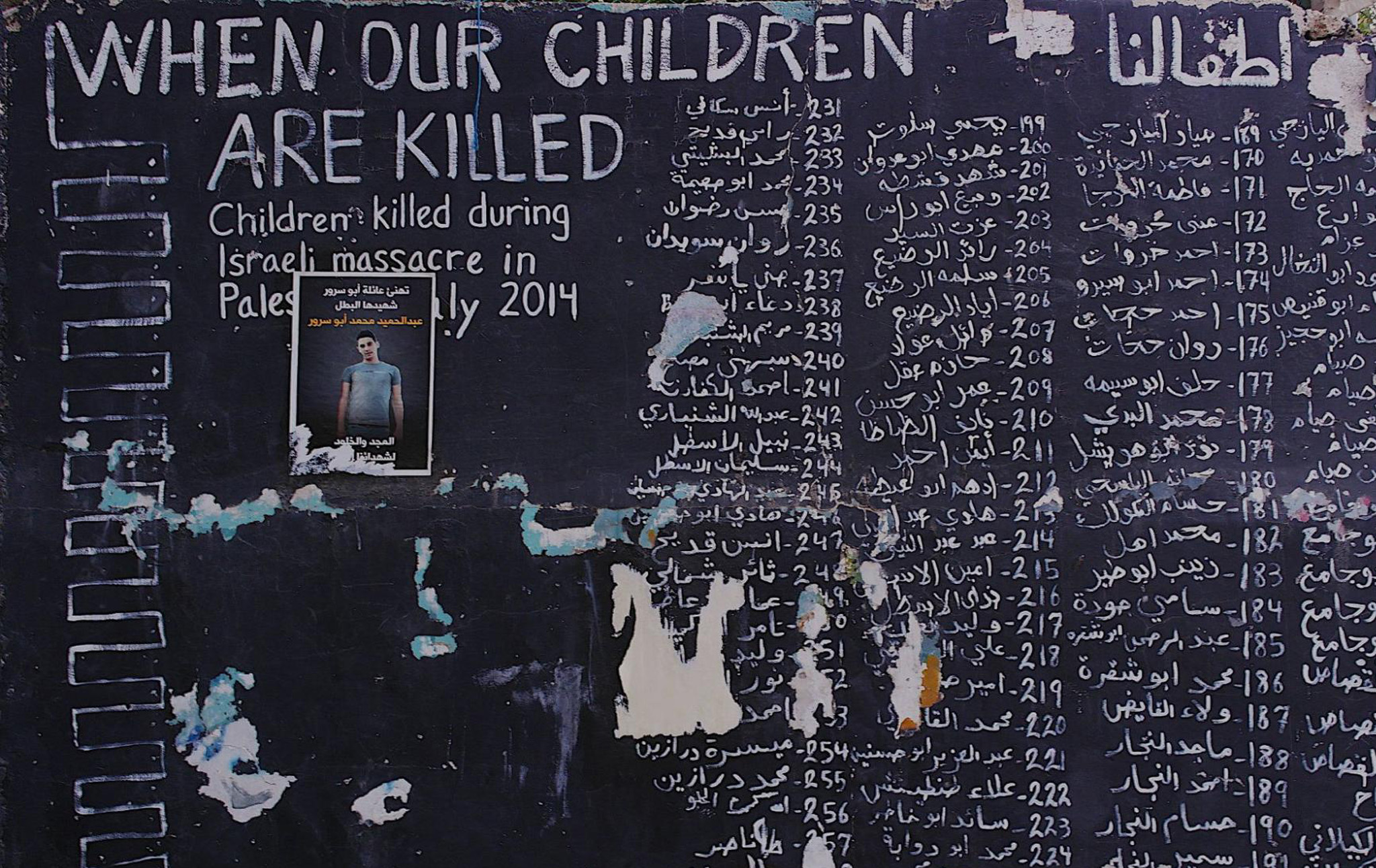
Top photo: Wall listing the names of the hundreds of Palestinian children massacred during Israel's 2014 war on Gaza. Aida refugee camp, Palestine, 2016. Photo by Rimona Afana.
A longer version of this article is a chapter in the upcoming Routledge Handbook of State Crime.



.png?width=352&name=Screenshot%202026-09-04%20at%204.00.52%20PM%20(1).png)
%20(1).jpg?width=352&name=miasma-1%20(1)%20(1).jpg)