International relations scholar Daniel Bessner explains how the US-Soviet conflict was avoidable, and what the real lessons of the period known as the "Cold War" are for us today.
Daniel bessner is an Assistant Professor in the Henry M. Jackson School of International Studies at the University of Washington, the co-host of the American Prestige podcast, and a nonresident fellow at the Quincy Institute for Responsible Statecraft. In an essay last year for the Ideas Letter, Bessner reviewed recent scholarly literature on the Cold War, concluding "that responsibility for the Cold War lies, in the final analysis, with the United States." He is the co-editor of the new book Cold War Liberalism: Power in a Time of Emergency, available from Cambridge University Press. Prof. Bessner joined Current Affairs editor-in-chief Nathan J. Robinson to discuss why it is so vital in our own time to examine and learn the lessons of the Cold War.
Robinson
Your new book is about Cold War liberalism. But before we dive into who the Cold War liberals are, we need to trace the scope of the Cold War a little bit, because one of the things I got from reading your Ideas Letter article is that it's not even accepted or agreed among scholars when the Cold War was or what is being described by that term. So in order for us to have a discussion where we know what we're talking about, perhaps you could tell us first about how we decide what we mean when we are saying "the Cold War"?
Bessner
It's an important question. Most scholars actually do agree. Anders Stevenson, who's a historian at Columbia, doesn't necessarily agree with the consensus. And I actually partially agree with Stevenson, or at least I understand where he's coming from. So most scholars date the Cold War from either 1946 or 1947 until the fall of the Berlin Wall in 1989, and they define it as US-Soviet rivalry. There are generally two broad periods of the Cold War. There's the mid to late '40s until the 1970s when the Cold War was really imagined to be centered in Europe, even though there were "proxy conflicts" in Korea and Vietnam, and then in the 1970s—under the influence of Odd Arne Westad's book, The Global Cold War—it really shifts to the "Third World." The Third World becomes the primary battleground of the Cold War in the 1970s and 1980s, even though the Cold War has its most prominent effects in Asia, as the historian Paul Thomas Chamberlin shows in his book, The Cold War's Killing Fields. In both of the Cold Wars, death and displacement occur in Asia, which is an interesting thing that we could talk about.
But Ander Stevenson, who is a prominent historian at Columbia—I believe he's emeritus now—argues that is just a too common-sensical definition of the Cold War, and that the "Cold War"actually refers to a specific thing. He maintains that cold wars are wars in which at least one side of a conflict doesn't recognize the other side as legitimate. And generally, what he means by legitimate is that you can, for example, reach an agreement with them. So Stevenson argues in a series of essays, recently released as a book of collected essays, essentially that the Cold War really only lasts—he differs at points—from the classic 1946/1947 starting date until the Cuban Missile Crisis of 1962, really the signing of a nuclear agreement between the United States and the Soviet Union in 1963, which started to limit the types of nuclear testing that one can do. Stevenson argues that it's really between the late '40s and the early 1960s that one side of this conflict, the United States, did not view the other side, the Soviet Union, as legitimate.
That's really what a cold war is. And then the Cold War proper ends in 1963-ish, and then what you have for the remainder of the 20th century is a classic great power conflict that's not a true cold war.
Robinson
So if I understand that correctly, the early period of the Cold War, from the 1940s to the 1960s, is the period in which the United States presidents view themselves as locked in a kind of existential conflict with the Soviet Union, where there can be no real accommodation or negotiations, and then it sort of builds to the peak of hostility at the point of the Cuban Missile Crisis, where the Soviets plant missiles in Cuba, and we threaten to essentially bring about nuclear Armageddon if they don't back down; they do back down, and from that point on, there remains mutual hostility. But he's saying "war" isn't really the right word, because we're essentially treating them as a kind of normal country. There are diplomatic agreements reached, and it's not right to think about it in the same way after that period.
Bessner
That's precisely correct. He would argue that there's a totally different quality of relationship. And I would agree. Most famously, you can't have détente in a true cold war, Stevenson would argue, because that accepts the Soviet Union as a legitimate power, that it's going to be there, and so it's really a question of legitimacy. And so Stevenson builds on earlier work examining the religious wars in Europe, for example, where the Protestants and Catholics did not view the other as legitimate. There's this deep strand in Western thought of sort of delegitimizing an enemy and basically just thinking that the only way that one could deal with them is through eradication. And then he would say that this becomes secularized over the course of modernity, and it reaches its apogee in the "Cold War" of the late '40s to the early '60s. And so, for example, I'm not sure if he's ever commented on this, but the United States has never been in a "cold war" with China. Even though the U.S. has mutual hostility with China over various issues, it deals with China, which wasn't true of the United States and Soviet Union between the late '40s and early '60s.
Robinson
People might miss this if they just look at the rhetoric of U.S. presidents. Everyone remembers Reagan's "evil empire" speech, and so you might see a continuity between the periods. But then it's always wild to me that, at least according to Reagan, he got close to an agreement with the Soviet Union to eliminate nuclear weapons altogether.
This is not just an academic debate. We're talking as if this is just scholars discussing which concepts to apply. But one of the reasons that this disjunction is important, looking at the period of that absolute hostility and failure to recognize the legitimacy of the Soviet Union, is that you mention in your Ideas Letter article that if we don't understand correctly what this was and exactly what happened, we set ourselves up for the possibility of something this dangerous and disastrous happening in the future. So if we do confine ourselves to that period where the United States wouldn't deal with the Soviet Union as a legitimate partner, that brought us, as I've mentioned, towards the end point where the entire future of the world was threatened.
Bessner
Not only that. I think you didn't even need to have a cold war. Imagine if in this country we didn't link social welfare to military Keynesianism, for example. And this is, I think, one of the big takeaways of new literature, particularly on the Soviet Union, by a wonderful scholar named Sergei Rodchenko, who I also reviewed in the Ideas Letter in the dual review of Stevenson's and Rodchenko's books. He shows the degree to which Stalin was really willing to deal with the United States in the 1940s and make a deal.
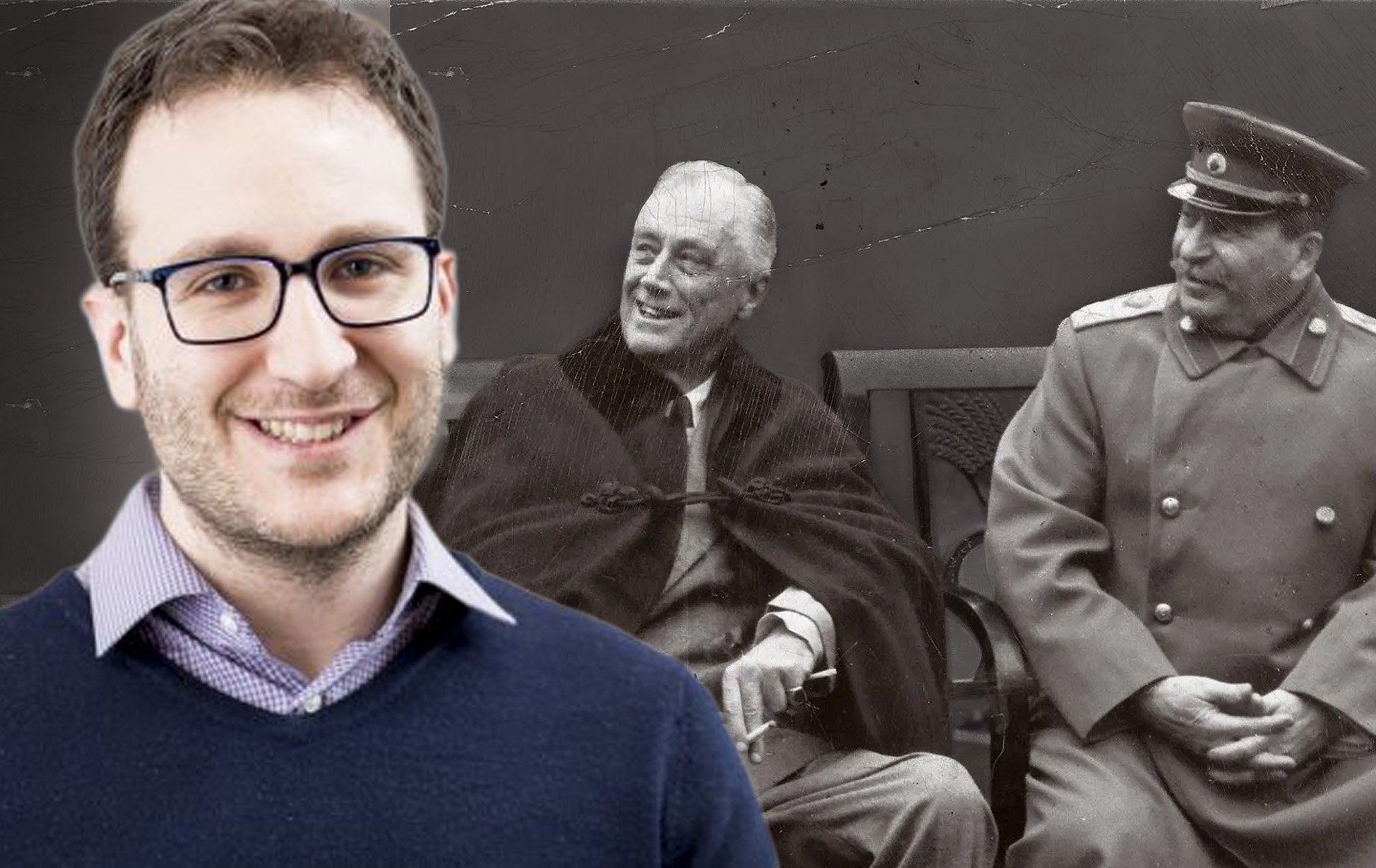
Now, this is, I think, maybe a problem for the left—or liberal left, because I think the left is a bit fuzzy on its thinking about international relations. But essentially, Stalin and FDR came to, I would say, a mutual understanding, which was that they were going to divide the world into spheres of influence. This is FDR's famous Four Policemen model of international relations. What I think would have happened was FDR—unlike Harry Truman, who replaced FDR when he died in April 1945 as president—would have "given" or not contested, really, Soviet domination of Eastern Europe.
And that is uncomfortable for most leftists of the 20th century, because that is essentially saying that the countries of Eastern Europe were not going to have democratic control over what they wanted and were going to be dominated by an imperial power in the Soviet Union. But I think on balance, we have to ask: would that have been "better," at least for international development? For the United States not militarizing its society, etc.? It's an uncomfortable question, because I think it's a question that we're really facing today.
And this is another piece I'm actually writing for the Ideas Letter now, which is, what is the role of spheres of influence thinking for leftists? I end my first Ideas Letter piece by really trying to think through this question of spheres of influence, which is certainly very uncomfortable for universalistic liberals of the 1990s and 2000s, but is also a bit uncomfortable for leftists, because it's essentially abandoning internationalism and embracing a form of power politics. And then we could talk about whether that's wise or whether that's not, but I think this is what ultimately the question of the Cold War raises when we're talking about contemporary politics.
Robinson
If I could just summarize my understanding of a couple of things that you've said there. First is that the origins of this conflict are not truly—as they would have been presented by Harry Truman—an ideological conflict over freedom versus the expansion of Communist tyranny. They are, in fact, in conflict over whether the Soviet Union was entitled to the kind of dominance over its neighbors that, importantly, the United States claimed for itself. So it's not a principled conflict over whether spheres of influence should exist. We on the left might have that debate because we are opponents of U.S. imperialism, but this is a debate about whether we are going to allow Stalin to operate internationally in the same way that the United States operates.
When you see through all the rhetoric about Soviet expansion and look into the record, I think what you argue here is that Stalin, for as much of a madman as he may have been domestically, was a fairly rational actor internationally who could be dealt with. And that's important, because that shows one of the points that you make in the piece and have said here is that the Cold War really was a choice. It could have gone differently.
Bessner
FDR and Stalin had very similar understandings of international relations, which was essentially 19th-century spheres of influence politics. FDR did not have the type of universalistic liberal vision that became dominant in U.S. foreign relations when he died. This is not to discount ideology, because I think one of the reasons that Truman, and the people around Truman, viewed the Soviet Union as they did was due to ideological reasons. They hated communism from the '20s onward for various capitalistic imperatives, etc. It's a complex issue.
But basically Stalin expected, and I think FDR suggested, that when the war ended, the United States would to a significant degree, if not totally, "return" to its hemisphere. The United States would have a much larger presence in Western and Central Europe than it did in the '20s and '30s or it ever had before. I think that was understood. But that it wasn't going to contest, basically, the Soviet domination of its near abroad, which continues to dominate Russian foreign policy with Ukraine. This is the long-standing geopolitical problem of Kyivan Rus' going back to the late medieval period, which is: how do you prevent the Soviet Union and its western plains from being invaded from Western and Central Europe? This is the primary geopolitical problem. It happened during the Napoleonic Wars. It happened during World War One. It happened during World War Two.
So that's the major issue that Stalin is confronting, and FDR was going to "allow" him to dominate Eastern Europe. When you look into the record, this is what Stalin was expecting to happen, and he was actually surprised that post-FDR, Truman and what we would now call today the liberal internationalists around him were unwilling to do that. And so this is why I think it's best to understand the Cold War as an American choice: the United States could have adopted a pure power, political realist perspective and said, These are spheres of influence, etc. But it chose not to do that for universalistic reasons about the United States leading capital "H" History and capital "P" Progress going forward and the need to spread universal liberal values around the world. And so yes, I believe you're correct. I just wanted to clarify exactly what I meant there.
Robinson
And I take it you regard this choice that was made, essentially the choice to begin the Cold War by the United States, as a mistake. I would then ask you to elaborate a little bit on why you think this was such a fateful choice, the choice not to deal with the Soviet Union in this kind of realist way but to use this hysterical rhetoric and to take this confrontational posture and to escalate an arms race. What are the consequences of that you view as so negative, and the reason that you think it's so important to return to and examine this period to avoid such a mistake in our own time?
Bessner
Well, with a lot of these issues, where you stand is where you sit. So if you're a French person or a West German or someone in London, the Cold War was good for you. If you were a Vietnamese or Korean peasant, it was less good for you. So I think that we have to understand that there will be differing perspectives on this, which is why you have a very powerful Atlanticist tradition, which is probably what you and I were both trained in at these various elite institutions that thought the Cold War was necessary because it was really good for what one might think of as the imperial metropole. If you're Dutch, West German, French, British, etc., the Cold War was good for you. But if you were in Asia, the Cold War's killing fields—to borrow the phrase from Paul Thomas Chamberlin—were less good. So it's really how you analyze the Cold War.
When I look at the Cold War—and I try to do it from a humanistic perspective; that's my ultimate approach to ontology, I think all human lives are equal—it just caused an enormous amount of death and destruction, both by the United States and also by the Soviet Union. Tens of millions of people dead; tens of millions of people deracinated; cultures destroyed; the militarization of domestic society; the formation in the United States of an international, global posture that I think diverted resources from welfare to warfare. I don't think, for example, you get what we have today in Minneapolis without the Cold War: the militarization of domestic society.
So I think there are a number of domestic and international perversions that were caused by the Cold War. On balance, it might have just been better, particularly given the fact that we also didn't push Stalin or, in the language of the time, "roll back" the Soviet Union from Eastern Europe, and just spent a lot of money, time, effort, and lives fighting a war that I really do think could have been avoided. But where one stands on this issue is how one analyzes the historical record of the Cold War, and people will have different understandings of that.
Robinson
You've mentioned the Cold War's "killing fields," the fact that tens of millions died. One of the important conclusions that leads to is that the Cold War is an entirely misleading name for what this was. "Cold" suggests an absence of explicit violence and the existence of tension. But that framing rather erases all of Asia. It erases the lives of all the people who died in this war, and then we have this framing that suggests, actually, we made it out intact. A lot of people didn't make it out intact. Until we understand that, it will seem like a "cold war" is not that bad of a thing to lapse into, as long as you can sort of navigate it and hold the tension steady.
Bessner
Yes, it's North Atlantic centrism versus looking beyond the North Atlantic. That's really what it is. And so you have a lot of discussion in the '80s and '90s about the Cold War as a long peace. And that's why I think, actually, Chamberlin's book is subtitled "Rethinking the Long Peace."
Robinson
Oh, we got rid of violence!
Bessner
Yes. So again, if we're thinking of world systems theory, it's the metropole versus the colonies. Where you look depends on what you think about it. And so again, from a humanistic perspective, I think the Cold War was just one of the most destructive wars in modern history. Not quite as destructive as World War Two. It wasn't as confined in a time period, but it was really terrible, and I think it led to a lot of the post-Cold War perversions that we saw, whether you're talking about Afghanistan, Iraq, or Libya, or really the militarization of domestic societies. I don't think it happens absent the Cold War.
Robinson
And the place that we ended up in with nuclear weapons is still terrifying. We don't talk so much about it anymore, but we are now seeing, at this present moment, the erosion of the last limits on weapons production. To me, the lesson of the Cuban Missile Crisis certainly is that you can genuinely get to the point where, if you combine a cold war with a nuclear arms race, the obliteration of the entire future of civilization is genuinely threatened.
Bessner
Yes, and it doesn't take that much. When I looked into this a few years ago, I think it was 100 Hiroshima-level bombs being exchanged, and the model scenario was India-Pakistan, because that is oftentimes looked to as a place where there might be a nuclear exchange. Hiroshima-level bombs, which are not hydrogen bombs—they're quite old—could cause a global famine. It's things like that that people really don't appreciate, which is why, for example, I was against the United States fully backing Ukraine, just because of the potential to ignite a nuclear war. It's truly devastating in a way that it's difficult for people to understand, because we don't think about it like we used to. But really, on civilizational levels, it could be affected by that.
Robinson
But people say, "You're giving in to nuclear blackmail. You can't let that govern your decision-making." But the future survival of the human race is actually quite an important factor in determining your decision-making. Again, I don't like it. We don't like spheres of influence. But if you are, as you say, a realist who recognizes the way power is aligned in the world that we live in, you have got to make these ugly choices.
I wanted to read this little paragraph that you wrote. You say,
"The Cold War was, to borrow Stevenson's phrasing, a US project. It was ultimately an American choice. This fact has crucial implications for US foreign policy in the 21st century, an era in which the United States faces China, a great power that, like the Soviet Union before it, has designs on it and its near abroad. To put it bluntly, the future of international relations will be shaped by Americans who will either try to prevent the People's Republic from achieving dominance in its potential sphere of influence, or will accept the realities of Chinese power. If Americans don't choose wisely, a third world war might very well break out."
And that's one of the reasons I wanted to have you on today: to discuss how going back to this period should affect our thinking about relations with China.
Bessner
The U.S. shouldn't fight World War Three over Taiwan. The United States is very far from East Asia. China is enormously powerful and is going to become more powerful. So the question is, how will the United States accommodate itself to that rising power? And I just think the United States should essentially leave the region. You don't want to do it willy-nilly, which is what I think will actually happen. What I think will happen is that in 2028, 2033, or 2038, China is going to do something with regard to Taiwan, the United States is going to decide it's not going to fight World War Three over Taiwan because it is just not of enough interest to the United States, and it's just going to leave.
I think wise policymaking would basically have a transition period in which the United States would set up its allies—Japan, South Korea, the Philippines, wherever—to be able to more effectively try to affirm their own authority vis-à-vis China. The reality of the situation is that, just like the countries of Latin America today, even though we might not like it, they are going to accommodate themselves to the United States, and the countries of East Asia are going to have to accommodate themselves to China. So the question is how the United States leaves the region, not if the United States leaves the region, and the question is when. And so, I would advocate adopting at least a more medium-term perspective, although the U.S. foreign policy establishment isn't exactly known for its wisdom.
Robinson
I don't know how you feel about this, but I have also always felt as if the confrontational stance of the United States towards China over Taiwan actually increases the likelihood of China trying to retake the island by force. I think we would see that as obvious in a situation where China was arming and backing a small island off our coast. If there is a chance to avoid the ugliest situation, probably that chance is increased the most by the absence of an antagonistic stance.
Bessner
Right. But the U.S., ultimately, isn't interested in that. The U.S. is interested in power and power production, and so that's the problem.
Robinson
Which is important. It's important that the entire justification of protecting Taiwanese autonomy is bullshit.
Bessner
Yes, it's bullshit. All this stuff is bullshit—well, it's not bullshit; people need to sleep at night. They believe it. I think that most people who say those things do believe them, though, I would argue, on the final analysis, to borrow the old Marxist phrase, it's about power production, and it's about a universalistic liberal vision of global power and global hegemony that is just materially impossible. And if people want to read why I think it's materially impossible, I wrote a cover story for Harper's, I think it was in 2022, called "Empire Burlesque," that goes into just the material realities on the ground. The U.S. is just not going to be able to be dominant, or even a major power, in East Asia, I think, in a generation. So the question is, how do we deal with that?
Robinson
We could deal with it through a suicidal conflagration.
Bessner
That's what Primo Levi said. I think I'm remembering correctly. Primo Levi, in his books, said the only freedom left in the Holocaust was suicide. That was the ultimate freedom. So I guess one could say that.
Robinson
Well, we do have a long tradition of rather disturbingly Manichaean rhetoric and "give me liberty or give me death" type ideology. So it does worry me that many people would rather see the world burn than see the United States lose even a tiny bit of power in Asia, thousands of miles from our coast.
I want to close by discussing the Cold War liberals because, of course, they're the subject of your new book. One of the things you do in the beginning of your introduction is you puncture the Kennedy mythology. So why don't we talk a little bit about JFK?

Bessner
Yes. We're both veterans of graduate school close reading. I've never come across this reading of it, so not everyone would agree, but Kennedy's famous comment from his inaugural address, "Ask not what your country can do for you—ask what you can do for your country" I argue, is actually flipping on its head what should be normal politics, which is that the state should be in service of society, and that society should be in service of the state.
Robinson
It's awful.
Bessner
Yes, it's kind of funny because the common-sense reading of it is, of course, a call for civic renewal. And that's how it's mostly been understood. But from a certain perspective, this is actually kind of perverse in that you sort of subjugate yourself to the service of the state, the elites running the state, as opposed to the opposite way, which is the more democratic way.
So that's how I start this type of genealogy, discursive exegesis, of Cold War liberalism and its place within, or what I tried to do in the piece, the long history of liberalism going back to what I see as liberalism's foundation, as being in the wake of the French Revolution in the early 19th century.
Robinson
I suppose we can't really get out of this without the discussion of what liberalism means. It's this contested, amorphous term. So tell us a little bit about what you mean by Cold War liberalism.
Bessner
Sure. So I think liberalism, like many of the great political ideologies, has a series of ideas that are associated with it, related to, in this case, individual liberty—negative freedoms for some liberals, positive freedoms for other liberals. But I think it's important to situate liberalism also as a practice and a sensibility. And so this is why I actually think it's important to understand where liberalism comes from. So, other scholars, particularly Helena Rosenblatt, I think, really first identify the beginnings of a genuine liberalism. As I mentioned, in the early 19th century, people like Benjamin Constant and Madame Germaine de Staël, who were essentially French intellectuals, were trying to navigate between reactionary monarchism on one hand—the monarchism of Louis and Marie Antoinette, which had been severely discredited in the 1780s and ultimately erupted in the French Revolution of 1789—and the revolutionary terror of Robespierre and the coterie around him.
So I think liberalism is essentially, at its base, trying to chart a middle path between reaction and revolution, and it tries to do that in numerous ways. That's ultimately how I define liberalism. And so one of the reasons why it's so difficult to define this term is, to some degree, especially in the United States, we're all liberals. Both the Republican Party and the Democratic Party, the big instantiations of politics in this country, emphasize different elements of 19th-century liberalism. The Democrats are more sort of positive freedom, broadly speaking, and the Republicans are more negative freedom, although that also breaks down when you start thinking about things like the military. But broadly speaking, we're all liberals now. If you think about the 19th century and ideology, you have the emergence of these various ways of responding to industrial modernity in the 19th century. The question is, is the aristocracy and monarchy going to be able to do it? Not really. Liberalism is one response to it. Communism or socialism at the time is one response to it. Later on, fascism is another response to it.
And I think, over the 19th and 20th centuries, you see the actual victory of liberalism as an ideology, at least when we're talking about the North Atlantic world. Nowadays, I think what you're seeing is actually the withering away of ideology, because we're all essentially capitalist, and so I think we're entering a new phase where ideology is going to matter less than it did in the 19th and 20th centuries because of one political economic form that was supported by an ideology. In this case, liberalism has totally dominated.
So interestingly, I think you're going to see ideology wither away. Fukuyama, in The End of History, argued that liberalism was ultimately triumphant. I think he was kind of right, but also kind of wrong. I think what you see is when capitalism totally dominates, you don't actually need the justifying ideology any longer. And so China is capitalist, Russia is capitalist, and the US is capitalist—basically everywhere but North Korea is capitalist—but not everywhere is liberal. So it seems like you could just have the political economic form without the ideology. And so I think that's where we are today. Cold War liberalism, just to get back to the point, is just a particular instantiation of liberalism that dominated U.S. politics from the 1940s until the late 1960s but is particularly important because I think it's the ideology that defines a lot of the institutions that have come to define the national security state in the American empire. And we could go into that if you'd like.
Robinson
Well, you say in the introduction to your book,
"Above all, when it came to domestic and geopolitics, Cold War liberals such as Kennedy believed two things: that elites, not the mass public, must make most policy decisions of consequence, and that the United States needed to dominate the world."
So you're trying, in this book, to understand what the core commitments of Cold War liberalism are. Specifically, these two beliefs you said were the defining political features of the Cold War liberals.
Bessner
And that's where history really comes into account. Because I think in the 1920s and the 1930s there are a lot of possibilities about the future of social democracy and liberalism. And interestingly, the historian Kevin Schultz discovered that FDR only started using the term "liberalism" in 1932 because he didn't want to use "socialism," because he needed a term that is really not indigenous to the American context. Before the 1930s and really before the 1940s, the United States didn't use the political spectrum of Europe. The US doesn't use the left-right political spectrum. Our matrix here is different. We have populists, we have progressives; there are right-wing progressives, there are left-wing progressives. There are severe regional differences. So this left-right thing is really flattening, and it's only used because the New Deal liberals, many of whom become the Cold War liberals, essentially adopt the European framework to identify themselves as the rational center. But that's sort of an orthogonal story. But what happens in the 1930s is basically two big things, the Great Depression and the rise of Nazi Germany, and, to a lesser degree, the Soviet Union. That comes later. But essentially the Great Depression, which saw panic movements, bank runs, and the rise of Nazi Germany, which appeared correctly to be the emergence of the result of a mass public, basically made people on the left and this emergent liberal left reembrace earlier aspects of what might be termed the pessimistic or skeptical liberalism about mass democracy itself.
So under the emergency of the Depression and, more importantly, under the emergency of Nazi Germany and later the Soviet Union and the advent of nuclear weapons, Cold War liberals argued that politics was simply too important to be left to a naive and ignorant public and needed to be totally led by elites. And that with the universalizing millenarian perspective of the United States, which goes back to the founding of the Republic—the John Winthrop speech in 1630 on the way over about the United States being the "city on the hill"—there's a millenarian Protestantism inherent in this country that also needed to dominate global politics in an almost eschatological sense.
These two ideas come together to basically create the Cold War liberals. And it's the Cold War liberals who create the modern American state: the National Security Council, whose national security advisor, for example, is not appointed by the Senate—that's how Henry Kissinger comes into power; the CIA, which is highly secretive; even the Department of Defense, which basically has no democratic accountability except to Congress for funding—but for many, many decades, they just fund it, essentially, besides a brief period in the 1970s; and the National Security Agency. These are all Cold War liberal institutions that are essentially designed to make and implement policy without any public interference and even without any congressional interference.
So even after the Cold War liberals were basically pushed aside in the late 1960s primarily as a result of Vietnam, but also to a lesser degree of the "urban crisis," they're no longer a dominant political force, even though there are figures like Anne Applebaum and Timothy Snyder—there are elements of Cold War liberalism in their thought. The institutions of American policymaking, particularly American foreign policymaking, are Cold War liberal institutions, so they continue to shape how Americans interact with the world.
Robinson
Now you've given a lot of the history of ideas. They're condensed into a very small space, but I want to conclude here with kind of the upshot, the implications, and the lessons. Because one of the things I take from reading your work here on the Cold War liberals is if we are humanitarians, leftists, small "d" democrats, egalitarians, and we are concerned about imperialism, global conflagration, the potential for a third world war, and the erosion of democracy, it is very easy in the age of Trump to see the threats there as coming from the hard right, and the hard right must be stopped.
But one of the things that your work shows is the degree to which these very serious problems over the course of the 20th century were worsened by people who spoke in very noble liberal rhetoric. The degree to which, as you say, the national security state is built by liberals; the degree to which, as you say, we wouldn't have ICE if it weren't for the Cold War. The Cold War was a choice made by a Democratic administration, by Harry Truman, by someone who is speaking the language of internationalism, of humanism—that's one of the core sort of takeaways that I get from reading your book here.
Bessner
Yes, and there are a couple of ironies here. The Cold War liberals were often quite good on civil rights, for example. They really do support the Civil Rights legislative revolution of the 1960s; they support the judicial revolution of the 1950s with Brown v. Board. But an irony happens, because as the formal franchise expands, particularly with Black Americans, but also with the women's movement, the gay liberation movement, the Chicano movement, etc., the actual, practical effect ordinary people can have on policy restricts.
So there's a deep irony with the second half of the 20th century history. And beyond that, in terms of the far right, first, I think the far right must be stopped. But the question is, how does one understand its rise? And to my mind, the far right had an opening because of the failures of liberal hegemony. I think the moment that we're experiencing here is the coming apart of the 1930s and 1940s hegemonic project of global muscular liberalism that was reformed several times over the second half of the 20th century. I think you could even see neoliberalism in the Reagan Revolution as a reformation of liberalism. We use the language of conservatism in the United States, but Reagan, I think, is just emergent from a particular strand of 19th-century liberalism. But what we're seeing now is that this liberal hegemonic project is almost totally delegitimized. People don't believe it could provide another space; the sort of left side of liberalism, the Democratic Party, is not providing any forward-thinking vision, and the right side is also not providing any genuine forward-thinking vision. Make America Great Again—a return vision. And Trump himself is a personalist leader who oftentimes uses 19th-century tactics like tariffs and gunboat diplomacy. So he himself is a bit strange in the history of liberalism. He's almost harkening back to a pre-liberal period in the United States, but that gets more complex.
But the big thing is that as liberalism is coming apart, there is no ideology that is coming to displace it, which is unique in the last 200 years. It leads me to make this argument that ideology might have actually been only important for a particular period of time. This is not to say that ideas don't exist. I just don't mean that there are these totalizing ways of understanding something as complex as industrial modernity that emerged in the 19th century. Nothing equivalent is emerging in the 21st century to a communism or a fascism or a liberalism that has a total vision of what you're going to do with these forces.
So I think that partially explains this sort of discombobulation of the era. I think that also partially explains the rise of the far right, which is also why I don't think the far right will be able to create—or really, Trump has shown no interest in creating—this type of Gramscian hegemony that would enable something to govern for decades, like the New Deal order or the neoliberal order. So I think we're very much in a moment that's similar to the late 19th and early 20th centuries, where you're going to see a ping-ponging back between political parties. There's a general dissensus; there's a general decomposition; there's a general coming apart. But the difficult thing, the scary thing, is that nothing is coming to replace it. And so this is what I think is the problem of the age, which, looking at the history of Cold War liberalism, helps you appreciate because you're seeing the coming apart of that hegemonic project.
Nathan Robinson
I think you and I are around the same age. This is just a silly question, but do you feel a sense of dread when you think you might live for another 50 years and you have to watch where all of this goes?
Bessner
Climate is a really big deal. It's very difficult to keep your hand on it, but it really is accelerating, and it's really accelerating in really bad ways that I think we don't know what the effects are. So when I think about the future, that's the big one I think about. That might be the type of exogenous shock, the Alan Moore alien that will reshape systems, because it just might be so devastating that it will just have to accommodate itself. That's what I mostly think about when I think about the future.
Robinson
I don't like that we're at a point where the Third World War is number two on the list of worries.
Bessner
Yes, the climate is terrible. My cohost on American Prestige, Derek, really follows it closely, and so I get these updates. It just is bad, and it's getting worse. Maybe China will develop the technology, but I'm skeptical.
Robinson
Yes, our only hope is that China is a rational enough country.
Bessner
But it's also burning a ton of coal. Because they also need to develop it. So as they're doing the green technology, they're also burning the carbon-emitting technology. So that's the thing that I think about when I think about the future.
Robinson
Sorry, I didn't mean to end this by taking it back towards the abyss, but...
Bessner
No worries.
Robinson
Everything leads back toward the abyss.
Bessner
I was born in the darkness, Nathan. I was born in the darkness.
Robinson
And of course, the response to the accelerating problem is accelerating the denial, which I'm sure will go fine.
Transcript edited by Patrick Farnsworth.