Investigative journalist Waqas Ahmed of Drop Site News exposes the diplomatic meddling that deposed a Prime Minister.
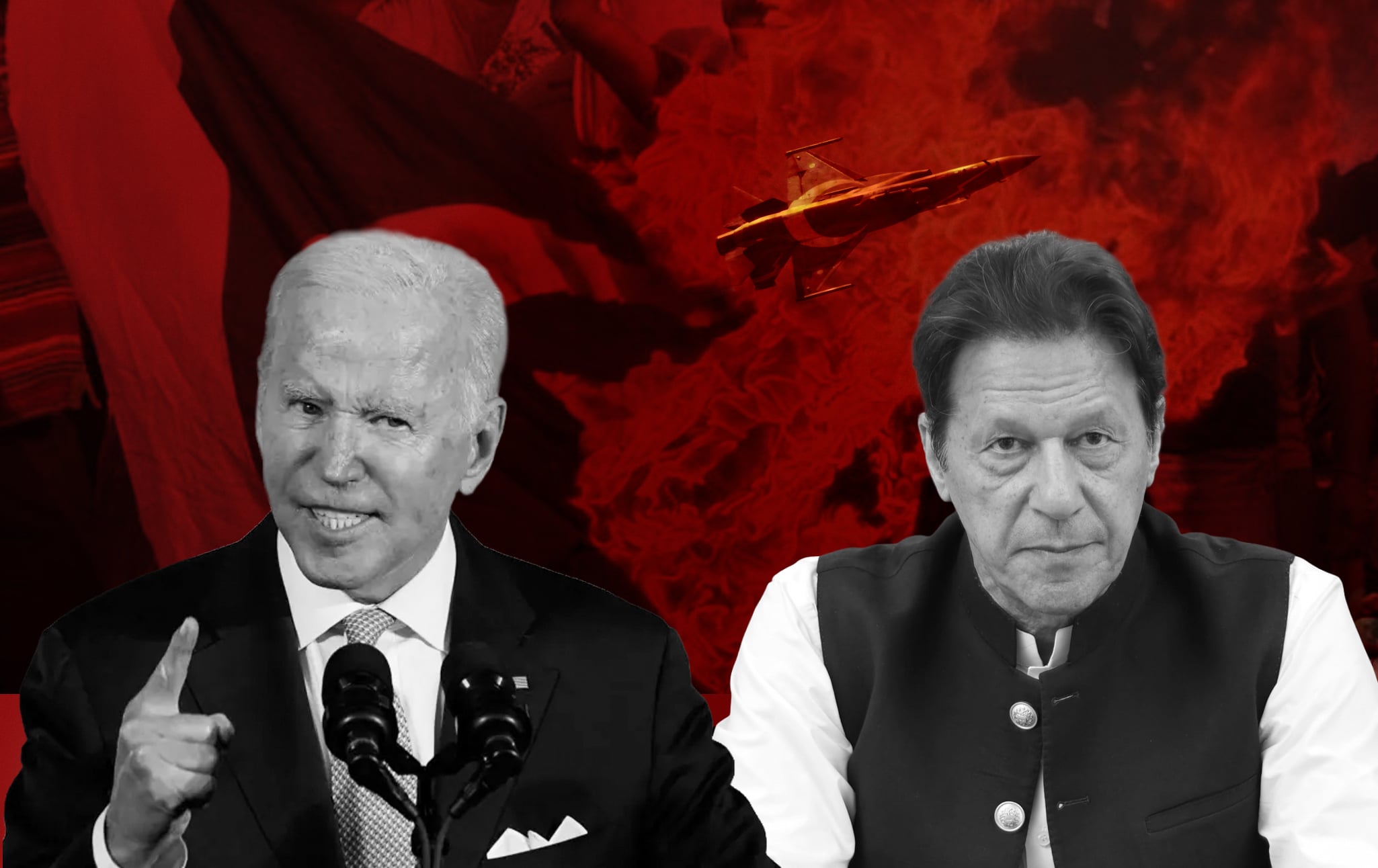
Waqas Ahmed is an investigative journalist at Drop Site News and the Intercept, specializing in Pakistani politics. Recently, he co-wrote a long piece with Murtaza Hussain and Ryan Grim exposing years of U.S. interference in Pakistan’s democratic process, leading up to the 2022 ouster of Prime Minister Imran Khan. Ahmed sat down with Current Affairs editor-in-chief Nathan J. Robinson to discuss his reporting, and how the U.S. has demolished democracy and human rights in Pakistan.
Nathan J. Robinson
Let’s go back in time a little bit. Your piece that you’ve co-reported with Murtaza Hussain and Ryan Grim looks at the last five years or so of the U.S.-Pakistani relationship, and you look at what that relationship was like under Donald Trump’s first term, under Joe Biden, and then in the second Trump administration. So let’s maybe go back to the beginning of this period, and you can tell us a little bit about where things stood when Donald Trump was leaving office and Joe Biden was coming in.
Waqas Ahmed
Yes, when Donald Trump was leaving, if you remember that time, the main thing that was happening was these Afghani negotiations, and Trump was looking forward to fulfilling his campaign promise of withdrawing completely from Afghanistan. Nobody had seen logistically how that would look, because there was a lot of equipment and soldiers in Afghanistan, so it was anticipated that it could go bad and it could go wrong. So there were negotiations going on. The Doha Accord, as it is now called, happened during this time, and the supposed withdrawal was supposed to happen much earlier. It was supposed to happen during the end of the Trump administration, but Trump got busy. I don’t know how things unfolded at the end of that administration, but it so happened that he handed over the presidency to Joe Biden to complete that process. Now, Biden inherits this promise that they’re going to withdraw from Afghanistan, and he inherits a deadline set by his predecessor, and if he delays from that deadline, that affects him politically with the voters—with the U.S. public. They have a negative opinion of staying in Afghanistan because people have done that over and over again. Obama, when he campaigned, said that they’re going to withdraw from Afghanistan, and then he increased the troops. So this is what Biden inherits, and Biden’s interest at this time is to make sure that this withdrawal happens properly, and to do that, they think that they need bases in Pakistan. And that is a foreign policy priority at this point vis-à-vis Pakistan.
Robinson
And so what is the relationship between the United States and the Pakistani government like at this point that Trump leaves and Biden comes in?
Ahmed
Pakistan has been a U.S. ally since the beginning of the war on terror in 2001. First, with the Bush administration, Bush says, “You are either with us or against us.” Pakistani generals decide that they can be both, and this happens as early as 2001. The US wants to invade Afghanistan; Pakistani generals try to convince the United States not to invade Afghanistan. They fail to convince them. Nobody is listening. In America, there’s a huge amount of anger at 9/11, and America is willing to destroy anyone at this point. They can bomb anyone back to the Stone Age; this is where the phrase “I will bomb you back to the Stone Age” comes from. So, Pakistani generals decide just to step away from this oncoming train and let it pass through, so they direct it towards Afghanistan, and they say, “Okay, we will be your ally.” And then they realize that this alliance comes with a lot of money; all they have to do is pretend to be an American ally, and they continue to do that year after year. Also, they’re afraid of the blowback from the Taliban.
So, what they do is they balance both of these two sides; they keep on supporting some factions of the Taliban and provide them safe haven in Pakistan, because in their long-term strategy, they still need a compliant government in Afghanistan. And they keep telling the Bush administration that “we are with you.” So they do this for 20 years. They are partners in the war on terror, but they’re also stabbing America in the back. So, there’s a lot of anger in the American deep state, or the elements within America that do not change with presidential administrations, that Pakistan has been stabbing America in the back. There’s so much literature about that, about Pakistan’s duplicity during this time. So, by the end of the war, the loss of the war is also being blamed on Pakistan, because if it weren’t for Pakistani duplicity, for the crucial support in 2008, ’09, and ’10 that Pakistan provided to these Taliban leadership safe havens in Quetta—if Pakistan had not provided that, America could have decisively won that war and saved all that embarrassment. So the Americans are not happy with Pakistan as the withdrawal is happening. They’re asking, “If you could provide us with bases, this could make up for all the stuff that you’ve done over the 20 years, taking around $50-60 billion in U.S. aid from the coalition support fund and various heads.”
Robinson
But you point out that relations worsen between the United States and Pakistan because of the country’s refusal to accommodate U.S. bases and because of its neutral stance on the war in Ukraine. This is during the Biden administration and is pretty crucial. And so perhaps you can explain to us what happened during the Biden administration that altered the character of the U.S.-Pakistani relationship.
Ahmed
When Biden takes office, he’s supposed to call various heads of state; if he wants to have a relationship, if he has foreign policy priorities with specific countries, he’s supposed to call them and discuss something, and this is the call that the Prime Minister of Pakistan was really waiting for. And after the publication of the story, there are multiple sources that have come forward to fill in the gaps at this point. So Biden doesn’t call Imran Khan. Imran Khan was the Prime Minister of Pakistan at that time. He doesn’t call him because he thinks that Imran Khan is anti-American. Well, there could be various CIA briefings that he’s getting that Imran Khan is not really receptive to America, so Biden doesn’t call him. On the other side, the Prime Minister of Pakistan is being told that you should talk directly to Biden, Biden should call you, and maybe you should put some pressure on America to make Biden call you.
So, there’s this one thing that happened in June 2021: William Burns, director of the CIA, flies to Pakistan, and he wants to meet the Prime Minister of Pakistan. The Prime Minister of Pakistan is told that the director of the CIA wants to meet him, and interestingly, this is so funny, the head of the Pakistani military says to the Pakistani Prime Minister that “you should not be meeting the head of the CIA, because he’s not your equal. If you hold off right now, Biden will call you.” This is the message that he gets. And the prime minister says, “Biden should call me.”
According to the protocol, a head of state is supposed to talk to the head of state, but the CIA director doesn’t see it that way. The CIA director is head of the state in many states, and the Gulf kingdoms recognize that if the CIA director comes to your country, you are supposed to answer his call. It doesn’t matter what international protocol dictates; you take the CIA director’s call. The Prime Minister of Pakistan doesn’t take that call. Who takes that call? The Chief of Army Staff of Pakistan takes that call, and he says in that meeting, “Our Prime Minister is insane; he thinks too highly of himself; that’s why he’s not taking your call,” and meanwhile the Prime Minister thinks, since he’s held off the CIA, probably Biden is going to call him, because this issue is important enough for Biden to be personally interested in. We now know that Biden had health issues, or whatever. He was not completely lucid during these four years, so he didn’t know he was supposed to call. Had Biden called Prime Minister Imran Khan at that time, they could have reached an agreement, and this whole chaos that happened by the end of the Afghanistan withdrawal might not have happened. But there is no direct, top-level coordination between the Pakistani government and the U.S. government about Afghan withdrawal during the Biden administration. Burns tries to talk to the Prime Minister, but he fails, and after that, I think Burns decides that this guy, Imran Khan, the prime minister of Pakistan, is maybe too stuck up or anti-American or whatever his situation is, but he’s not conducive to the Pakistan-U.S. relationship,
Robinson
And you point out that the other decisive event in the souring of the Biden administration on Imran Khan was the war in Ukraine, where he took a neutral stance and wouldn’t accede to the U.S. government’s demand that he not meet with Vladimir Putin, and that apparently causes the Biden administration to further conclude—I’m summarizing it. You can summarize how this went.
Ahmed
Yes, so in February 2022 this happens. So now we already have this background of Imran Khan not talking to the CIA director, him waiting for Biden’s call, and insisting that the president himself call him so he can figure things out. Along comes February 2022 and Russia attacking Ukraine, which coincidentally is the same day that the Prime Minister had already planned on this trip to Russia. Before that, Jake Sullivan calls Pakistani NSA (National Security Advisor) Moeed Yusuf and says, “Do not let your prime minister travel to Russia.” So, there’s already a warning on the table. There is a meeting in Pakistan in which the prime minister, the army chief, and top ambassadors sit together, and they talk about this warning that they’ve gotten from America, and everyone, including the army chief in that meeting, says this meeting has already been planned.
Pakistan was going through an economic crisis at that time. So, Russia is selling cheap fuel, and he thinks he should continue with this tour of Russia. Imran Khan flies to Russia that day, and all hell breaks loose. Americans are really mad, and Europeans are really mad. A bunch of European ambassadors wrote a letter on that day to the Prime Minister of Pakistan, saying, “Do not talk to Russia; do not have this visit with Russia.” And they do not send this letter directly to the Prime Minister. They publish this letter in a newspaper. They write an open letter, sort of embarrassing the Prime Minister, breaking diplomatic protocols. Yet the Prime Minister doesn’t listen. He goes to Russia because he wants to pursue an independent foreign policy, not knowing that to pursue an independent foreign policy, he needs to have his own military under his control. The military does not think that it wants to have an independent foreign policy because the military has understood for the past 70 years that it is dependent on America for its equipment, for its training, for foreign courses, and for its economy—the Pakistani economy is dependent on the IMF. These things the military understands much deeper than the first-term Prime Minister Imran Khan, who does not have a background in Pakistani politics, of ruling Pakistan.
Robinson
It does seem as if he interpreted the message from Jake Sullivan as optional or a recommendation, whereas in fact, when the United States gives a warning, they are indicating that you may not be long for the leadership of your country if you choose to act otherwise. What’s remarkable is what happens next: this sort of seemingly explicit warning that they’re going to support the undermining or getting rid of Imran Khan from power. Can you describe exactly what happened here? This message that was telegraphed and how it was sent.
Ahmed
In March, after all of these things happened, finally the Pakistani Ambassador to the United States, Asad Majeed, meets Assistant Secretary of State Donald Lu. He’s Assistant Secretary of State for the South Asia region—South and Central Asia. They met for a lunch meeting in Washington, DC, and during this meeting, Ambassador Lu brought this up. He says that there’s basically an impeachment movement happening in Pakistani parliament, and if that impeachment succeeds, everything will be forgiven, and a new chapter of the Pakistan-U.S. relationship will start. But if that impeachment does not succeed, then things will be very tough for Pakistan, and Pakistan will be isolated internationally.
Now, a lot of people say that this is not a threat or did not cause anything, but imagine being a Pakistani general and receiving this message, seeing that if you do not remove your prime minister, your country will be isolated. And now, after four years of that happening, we can imagine what that decision was, because Pakistan was not isolated, and the prime minister was removed, and the field marshal that came as the result of it is the favorite field marshal of Donald Trump. So we can imagine what the answer was. And people say that America giving this threat had no effect on the calculation of Pakistani generals. I don’t think that’s even possible; it doesn’t work this way. To receive this kind of message and then to do nothing is more unlikely than considering that this was a threat. I think this was a threat, and Donald Lu intended it to be, or at least a message to all the stakeholders in Pakistan that if you do not support this, then you will be isolated.
There are layers to Pakistani society. There are rich Pakistani billionaires who do business with America. These are the people who work in the Pakistani energy sector, who control the majority of the Pakistani energy sector. They have also received this message. These are the people who fund elections, who fund political parties, who own Pakistan, so to speak, as in any capitalist country. They have also received this message. The Pakistani military has also received this message. All kinds of different factions in Pakistani society have received this message, and their lives are dependent on having a good relationship with America. What will they conclude? So, nobody basically resisted, except for this Pakistani middle-class electorate. Nobody resisted when Imran Khan was removed. Everyone was on board. The business community of Pakistani society did not resist. They joined the Pakistani military. The politicians, who are traditional politicians, did not resist. They joined the Pakistani military.
Everyone was on board, because what Imran Khan was trying to do to—pursue an independent foreign policy—required the country of Pakistan to go through a lot of pain in the short run, which is really interesting. It happened with India, so there is a mirror image case of what happens to India as a result of pursuing foreign policy. After 2022 and the Russia-Ukraine war began, India, because it’s big and it thinks that it can pursue an independent foreign policy, buys the cheap Russian oil. It continues to have a relationship with Russia. It does not listen to the United States, and over time bad things start to happen. It’s spooky. Gautam Adani gets this massive case against him, the biggest energy businessman of India. This DOJ case is started against him. Then these massive tariffs start getting applied to India. Then the war with India and Pakistan happens. This is a really interesting data point. So, the night when the 2025 battle between India and Pakistan happens, Pakistan allegedly shoots down three or four of the latest Indian planes. There is no one in the whole world to verify it. So, this CIA official calls the Associated Press and says, “We can verify that Pakistan shot down Indian planes.” So helpful to Pakistan, because that turns the tide in that war, in that battle of narratives that night. And then, according to President Trump, he threatens Prime Minister Modi of India and says that if you do not stop this war, I will increase your tariff. He has said that he threatened Modi with tariffs so that both countries could stop the war. These bad things happen to India as a consequence of them pursuing an independent foreign policy.
Robinson
And I would argue that a great deal of the history of U.S. foreign policy is the history of countries defying the will of American presidents and then finding out that doing so is heavily punished in a number of ways, ranging from the withdrawal of financial support up to and including the invasion and overthrow of your government. This was not a case where it was a U.S. coup, but what you’re explaining is that the U.S. made it clear that it did meddle deliberately in internal Pakistani politics because it wanted this leader, Imran Khan, who had made decisions it disliked, out. And as you say, there were two paths that the country could take. It could take a very difficult path, in which it would have to run up against U.S. power, in which the U.S. would be actively finding ways to punish it, or it could have a favorable relationship with the United States. And you point out that, as you say, the favorable path was taken, that Imran Khan was ousted. Perhaps you could just say what happened to him in this process, because it is quite extreme.
Ahmed
Yes. He was ousted in April 2022. From April to October, thousands of Pakistanis are arrested. One Pakistani journalist is killed. First, he’s exiled and sent to Kenya. In Kenya, he’s murdered under very weird circumstances. This is the most famous news anchor in Pakistan. Imagine the equivalent of the top-rated anchor in America getting killed. First, he’s exiled out of Pakistan, and then he’s murdered. Complete clampdown on Pakistani civil society. In May of 2023, Imran Khan was surrounded by these SWAT teams, grabbed by the collar, dragged into this police van, and arrested. Protests erupt, and then the court frees him. After that, there are around 200 cases against him and his wife. They attack and destroy parts of his house and take him, and since then to this date, he has been under solitary confinement. Since last year, nobody, even his lawyer, has been allowed to meet him. His sisters cannot meet him. He is in a similar condition to how Mohamed Morsi was, for a similar kind of sin, in a similar kind of way. Basically, the Egyptian playbook is being repeated here. The Pakistani military dictator is trying to do the same thing that they did to Morsi in Egypt. He has been sick and not allowed to see his doctor. He has lost vision in one eye since then. He was an extremely fit man, by the way. He’s a sportsman. He would go to the gym, even though he’s 70-something. As the prime minister, he was still going to the gym every day. There would be photos of him running in the morning. He was a physically very fit man, and he would take care of that as a former world-class athlete, but now he’s extremely sick inside the jail. He’s been denied human contact. The jail guards are told not to talk to him. His wife also has similar kinds of issues and can’t see with one eye. I don’t know what they’re doing in jail, but there are real fears that he’s been given slow poison of some sort so that he dies of natural causes one or two years down the line.
Robinson
And his party’s been outlawed and is banned, correct?
Ahmed
Yes.
Robinson
So what happened then is that the United States made clear they wanted him removed. He’s been removed, imprisoned, and is being slowly killed in accordance with what the Biden administration, a Democratic administration, indicated would be their preferred outcome. And as you say, domestically, since then, there’s been a real backsliding in civil liberties and a consolidation of a military dictatorship. Is that right?
Ahmed
Yes. Ten thousand people have been arrested. We have lists of 10,000 people who have been arrested. There are people who are not even part of PTI (Pakistan Tehreek-e-Insaf party). I have a friend who lives in Canada; his name is Hamza. We’ve been talking on Twitter and stuff. He’s a researcher, an academic. He traveled to Pakistan and was doing research about this democratic backsliding. They picked him up, and he disappeared for two or three days. Nobody knew where he was. No court case, nothing. His family didn’t know who took him. After three days, because he’s a Canadian citizen, the Canadian government asks the Pakistani government, “Our citizen was in your country; what happened? He disappeared.” So then they produce him in court, and then they say that the police arrested him. And this is a guy who was a Canadian citizen, and that’s why he had some rights.
There are so many people, dozens of people, who have been disappeared in Pakistan. We don’t know. There are two people who have disappeared in the UAE. The Pakistani government called the UAE government—we did a story about that last year—to arrest these two men, and nobody knew where they were for months. Nobody knew. Eventually, some nice guy in the Saudi intelligence finally let these two teenagers—not kids, in their early 20s—call their parents and say that they’re alive. But these kinds of insane things that I’m hearing from Pakistan are unprecedented. Pakistan has had three military dictatorships. I have not heard these stories from them. I’m a journalist based in the United States. One of those stories I did a month ago caused them to go to my family and threaten them. They forced them to sign letters saying that they will be responsible for any new story that I do, and for that, doing this story gives me so much anxiety.
Robinson
Yes, you must be afraid for them.
Ahmed
Yes.
Robinson
My goodness. But during this time, one would expect that the United States’ relations, which take a formal position that we oppose autocracy and dictatorship around the world, with Pakistan would have gotten worse as this unfolded. But what you point out in your article is that actually after the ouster of Imran Khan, and as conditions in Pakistan were worsening for dissidents and civil society, relations with the United States were getting better and better.
Ahmed
Yes. And there are groups in the Pakistani diaspora in the United States, doctors’ groups, that donate a lot to political campaigns. There is a path back. These people try to put some pressure on the Trump administration early on and say that they should put pressure on the Pakistani government, at least with respect to human rights, but the Trump administration used all of that. They used that to put pressure on the Pakistani government to make sure that the Pakistani government supports the Trump administration. That worked out so well for everyone involved because the Pakistani military and the government were from the beginning so compliant that they really didn’t want anything bad to happen, so they helped Trump with everything. They helped with the crypto situation. Whatever crypto scams that the White House has going on, they helped them with that. They were on board. They were with Zach Witkoff—this crypto company that they have going on with Steve Witkoff’s and Trump’s sons. And all kinds of weird, tiny, corrupt things that Pakistanis could help them with, with the rare earth metals. Even though Pakistan doesn’t have them, Pakistan pretended that we had discovered rare earth so that they could make Trump happy. All of this.
And Trump doesn’t care about human rights. We all know that. The Biden administration also didn’t care about human rights, but there used to be a pretense of that. The last Biden administration broke that pretense because so many Pakistanis insisted that they should do something about this human rights backsliding, and they didn’t. Surprisingly, the Europeans, too, who have constantly talked about human rights and how much they care about human rights, have been so quiet about all of this. Every five years, the EU sends a delegation to monitor the Pakistani general elections. They did that in 2018, they did that before that, and they did that into 2024 as well. The 2024 elections were the most rigged in Pakistani history. The military and the military-gathered coalition lost, and Imran Khan’s party, even though it was outlawed, the independent candidates from that party overwhelmingly won. The European delegation was monitoring that election. It saw how the elections were eventually rigged, the results were changed overnight, and how the military-backed parties won. It monitored all of that, wrote a report, took it back to the EU, and then it classified that report. It did not release it. In 2018, they released that report. They had the election report, proofs, and stuff. They have their people on the ground. They released that report for 2018, but in 2024 they’re suddenly like, “We’re not going to release that report.”
There are European citizens who filed their FOI, or whatever the freedom of information law is called in the EU, cases against them. The cases have been followed for two years, and at every point, the EU says that if they release this report, the relationship between the EU and Pakistan would suffer. This is on the record. This is available if you Google it. This is the EU’s official opinion about this: if they release that report, the relationship between Pakistan and the EU would suffer. The EU has another thing called the—I’m forgetting this. It’s a tax thing. So the EU has a tax fee arrangement with Pakistan, according to which any country that fulfills its human rights obligation would be able to export things without paying EU taxes, and the EU has this arrangement with Pakistan. This is specifically, according to the EU, to induce countries to follow human rights laws and stuff. But actually, they use it to push governments to be more compliant with EU foreign policy goals. Pakistani citizens have been pushing the EU to take away this tax arrangement with the EU, but the EU wouldn’t budge. The EU is primarily supporting the Pakistani regime with this tax arrangement.

Robinson
Your piece is a piece of reporting, and you go through a number of incidents and facts, and you go through the relationship of Pakistan to Russia, China, and the United States. But it seems to me that at the heart of your story is, if people are wondering sort of what the takeaway here is, certainly one of the things that I got was a story of the really shameful way in which Western governments, European and mostly the United States, under both Biden and Trump, have essentially indicated they’re perfectly fine with dictatorship if a country compliantly serves our foreign policy goals.
Ahmed
Yes, it seems that this was always so. And maybe when I was younger and more naive, like so many of us, I thought that there might be some truth to the idea that countries do have concern about other countries’ human rights situations, but that is not so. The world is pretty plain in that nobody really cares about human rights. We saw a genocide happen in Gaza, and nothing happened, and democratic backsliding in Pakistan is nothing compared to that. Everyone is cynical, and nothing is based on principle. And maybe this is what we need to be working on: making sure that we elect governments that have some principles at some minimum level.
Robinson
Finally, people may have seen Pakistan in the news because of its role, or supposed role, in the U.S.-Iran negotiations, and they may have seen Pakistan touted as a mediator. I think one of the things that you do in your reporting is indicate that there’s a little more to the story than people are aware of. Perhaps you could clarify what’s actually been going on there.
Ahmed
So, Pakistan is supposed to fight on behalf of Saudi Arabia by a pact. Pakistan signed a mutual defense pact with Saudi Arabia last year, according to which, if Saudi Arabia is attacked by anyone, Pakistan is supposed to come to its aid, and if Pakistan is attacked by anyone, Saudi Arabia is supposed to come to its aid. Saudi Arabia cannot aid anyone in any military conflict because Saudi Arabia doesn’t have any kind of realistic military to speak of. So, basically, in practical terms, this is a one-sided attack in which if Saudi Arabia is attacked, Pakistan is supposed to defend it. But who is going to attack Saudi Arabia? Iran is attacking Saudi Arabia. So, is Pakistan supposed to attack Iran to defend Saudi Arabia? This is a pickle that Pakistan has found itself in. So it doesn’t want to attack Iran because Iran is Pakistan’s neighbor, and Iran has missiles that can reach Islamabad and then include Pakistan in the targets of these missile attacks. Pakistan doesn’t want to be a part of it, but Pakistan also has signed a pact with Saudi Arabia, and Pakistan wanted to get financial benefits out of Saudi Arabia by signing this pact.
So they’ve already taken the money, now they’re supposed to do the job, and they want to avoid doing this job. Everything Pakistan has done in the past two to three months has been to avoid fulfilling their promise. That’s their ulterior motive. They do not want to do that, so they’ve been trying to finagle a situation in which everyone keeps talking and forgets about the war, and I think they’ve been largely successful in this. It has become a meme, but unlike Iranians, Pakistanis are coming in duplicitous, or the Pakistani generals are very smart in certain ways. They will never say “no” in front of you, and that is what Iranians refuse to understand. That you can say “yes,” but still do “no.” You don’t have to do that forever. You just have to do that for four years until one administration changes, and then the new one comes, and then you say “yes, yes, yes” for three years. By the end of three years, the administration will get mad at you, but they’re already going out and won’t be able to do anything. All you have to do is manage American presidential cycles, which Iranians have not understood for a long time. So the Pakistanis have tried to convince Iranians and also give Trump this way out, this little thing where he can squeeze out of the situation, where he can pretend that he didn’t lose a war and get humiliated in front of the world in two months. He can pretend that he has some leeway, that whatever happened happened at the request of Pakistan. And Pakistan doesn’t care. It has no reputation; there’s no one judging it, except for Donald Trump, except for the CIA and the Pentagon. They are the clients, the people they have to make happy. Not like you and me judging them. We can judge them however they want; they don’t care.
Robinson
Well, I do recommend that everyone who wants to understand some of the ugly workings of power and what is actually going on beneath polite diplomacy should check out this remarkable new piece that you have with Murtaza Hussain and Ryan Grim in Drop Site News. Thank you so much for joining us, Waqas Ahmed.
Ahmed
Thank you for having me, Nathan.
Transcript edited by Patrick Farnsworth.