Louisiana’s long history of extracting profit from human captivity now fuels Trump’s deportation surge.
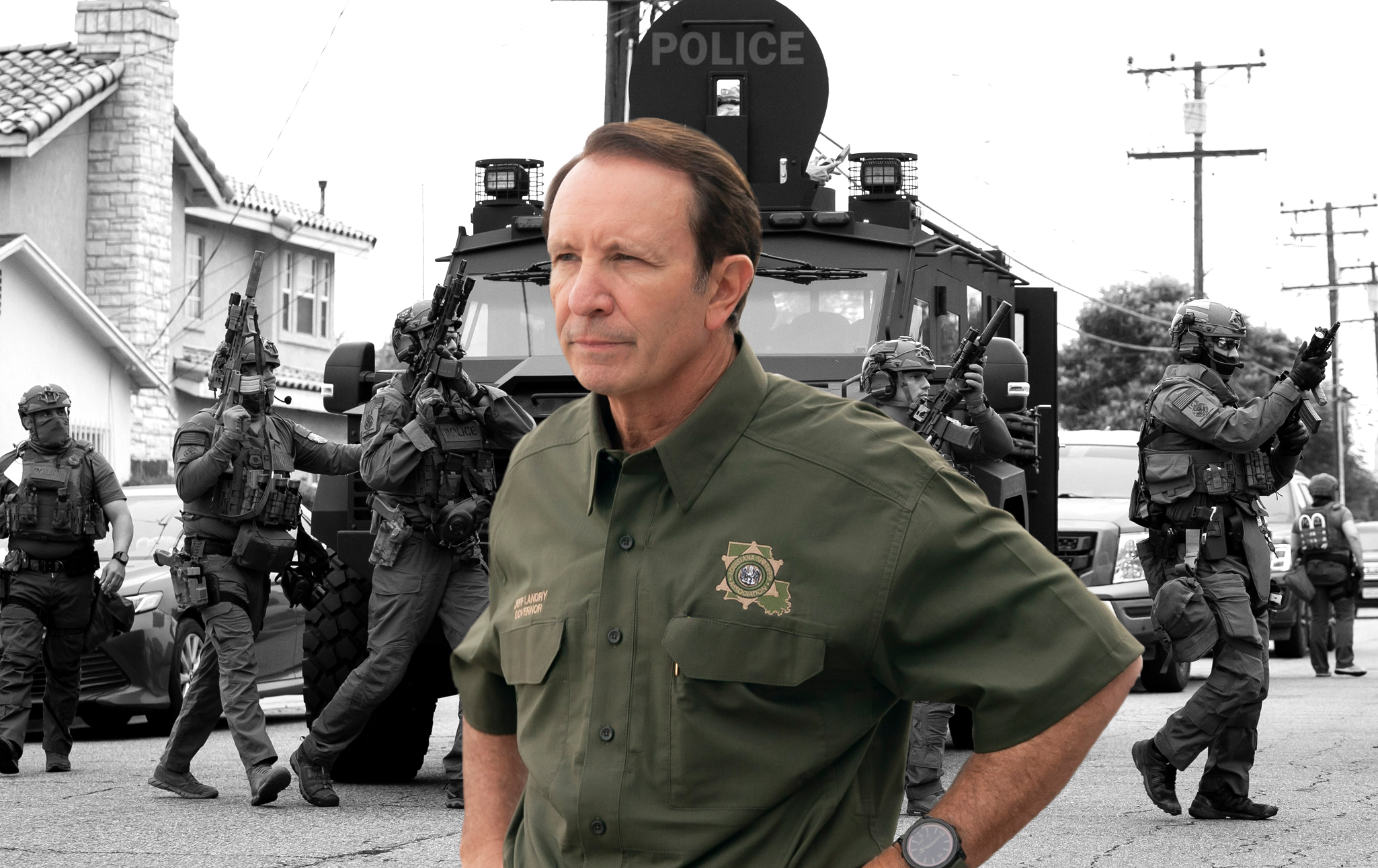
Louisiana’s commander-in-chief could hardly contain his glee on Fox News this week as he announced that Donald Trump’s Gestapo force would soon be entering New Orleans: “I will tell you that when ICE is ready, we certainly welcome them to come into the city and be able to start taking some of these dangerous criminal illegal aliens off of our streets,” said Gov. Jeff Landry, explaining that local police have already been working with the agency.
But it was this next part that really made him smile: “And we’ve got a place to put them—at Angola.”
The Louisiana State Penitentiary, nicknamed “Angola” after the slave plantation that once stood in its place, is the largest maximum-security prison in the country. It has also been called “the bloodiest.” Angola gained national attention this September as the site of Louisiana Lockup, a new partnership between the state and DHS to “expand detention space by 416 beds” and “house some of the worst of the worst criminal illegal aliens arrested by ICE.” Secretary of Homeland Security Kristi Noem said the prison was specifically chosen for its notoriety—a place where inmates still toil in the fields, surrounded by armed guards on horseback and alligator swamps—in hopes that it might scare immigrants into self-deporting. The facility is also known for its racism; in an ongoing class-action lawsuit, one inmate reported a white officer telling him, "We need a good hanging because these boys are out of line."
It is no surprise that Gov. Landry seems thrilled by the prospect of rounding up “criminals” in New Orleans and sending them there. The former cop’s tough-on-crime rhetoric has always been a thin veil for his sadism; in Landry’s first year in office, he passed a law allowing for the perpetrators of certain sex crimes to be surgically castrated, and added two new methods of execution: the electric chair and suffocation by nitrogen gas. (If you’re someone who believes the punishment fits the crime, remember that Louisiana has the second-highest rate of known wrongful convictions in the country and New Orleans, as a city, has the first.)
But the reason Louisiana has become the center of mass deportation goes further than our governor’s personal cruelty and racism. A significant factor is profit.
When you take a look at demographics, ICE’s upcoming Operation Swamp Sweep doesn’t make much sense. Only about 6.5 percent of New Orleans’ residents are foreign-born, a paltry number compared to much larger cities like San Francisco (34 percent) or Dallas (23 percent), neither of which have been the focus of large-scale, publicly-branded operations. Yet according to documents obtained by AP News, DHS has plans to arrest 5,000 migrants in this next sweep—significantly more than the number arrested in Chicago, a city whose metropolitan area has nine times more people than New Orleans.
But like everything in this administration, Operation Swamp Sweep has nothing to do with public safety and everything to do with pocket-padding: In Louisiana, migrant detainees are literally worth more money than ordinary inmates because their housing is federally funded. We also have a higher incarceration rate than anywhere in the world—besides, notably, El Salvador—and a track record for treating those inmates like filth. That means we have plenty of prisons to house people and we’ll do it at a fraction of the cost of other states.

Deportation is a booming industry, as ICE’s acting director Todd Lyons has said himself. “We need to get better at treating this like a business, where this mass deportation operation is something like you would see and say, like, Amazon trying to get your Prime delivery within 24 hours,” he said at a border security conference earlier this year. “So, trying to figure out how to do that with human beings.” If Donald Trump is looking to hit his end-of-year arrest quota, then this next immigration raid is exactly what it looks like: a Black Friday sale on human beings.
In Louisiana, local sheriffs are paid on a per diem basis, meaning the more inmates in their facility, the more money they make. This is doubly true of ICE detainees. PBS has reported on how this system plays out at Jackson Parish Correctional Facility, a jail in rural Northern Louisiana:
The agency (ICE) pays the Jackson Parish Sheriff's department $74 a day for each migrant detainee. That's about three times what the state pays to house someone convicted of a crime. Though the $74 does cover some added ICE requirements, including translators and additional healthcare providers, it's been a windfall here.
There’s little evidence to show that the extra money actually goes towards additional services. One detainee at another rural ICE lockup recently described migrants “pleading with staff for hygiene products to keep themselves clean” and being “denied access to medical care and other services,” while a Honduran migrant said “(staff) don’t treat us like humans … If you don’t speak English, you can’t have anything.” Instead, the extra cash simply incentivizes more arrests: “Our local sheriffs have figured out that they can make more money on housing ICE detainees than they can on housing convicted Louisiana prisoners,” Katie Schwartzmann, the Legal Director of the Louisiana ACLU, told PBS.
And the federal government wins too. While Louisiana only asks for $74 a day per detainee, the average national price tag is $165. Operation Swamp Sweep might as well be called Operation Penny Pinch. But while 2025’s immigration crackdown certainly provides new financial opportunities for the state, the partnership is nothing new—it actually started years ago, during Trump’s first term.
There was a point in time, miraculously, when the state of Louisiana actually wanted to do something positive for its citizens. In 2017, then-governor John Bel Edwards, a Democrat, signed into law a sweeping list of criminal justice reform bills, declaring, “I’m not proud of our title as the most incarcerated state, but that now is going to be part of our history.” He meant it, and within a year, Louisiana incarceration rates had dropped dramatically.
But the beds wouldn’t stay empty for long. As Edwards released more people from prison and slowed down new admissions, ICE stepped in to fill the gaps. By 2018, the agency had begun teaming up with private facilities to house detained immigrants, doubling its state capacity. After the partnerships began, Mother Jones correctly predicted that Louisiana would soon surpass California in total ICE detainees; today, we house nearly twice the amount, trailing only Texas. Shipping detainees to the swamp also has a few additional benefits—for one, it makes it much more difficult for families and home state lawyers to get into contact. Mother Jones reported:
Louisiana has far fewer immigration attorneys than states like California and Texas. ICE’s New Orleans office, which oversees all detainees in Louisiana, denies nearly every parole application, meaning detainees have to fight their cases and assemble the documents that back up their claims from jail.
When asylum seekers finally make it to court, Louisiana’s immigration judges deny almost all of their asylum claims. One judge, Agnelis Reese, denied every asylum claim she’d heard between 2014 and 2018. For an administration intent on quickly deporting asylum seekers with minimal due process, there is probably no better place to send people than Louisiana.
Now that Donald Trump’s anti-immigrant mania has reached psychopathic heights, that statement is truer than ever. CEOs and Wall Street investors also benefit from the influx of new bodies, considering nearly “98% of people in Louisiana's immigration detention facilities are held in for-profit prisons run by Geo Group and La Salle Corrections.” Both companies profit from crowded facilities; by contracting with the federal government, they receive a portion of the $74-per-day check given to local jails, the rest of which goes to the sheriff’s department. (As a publicly traded company, GEO Group’s stock price surged by about 41 percent after Trump’s re-election.)
Jeff Landry, too, benefits from this operation like a seasoned tycoon. Louisiana is a state with limited economic opportunities and many small towns survive only because of the prison system. Yet a facility like Jackson Parish Jail—managed by the sheriff, contracted through LaSalle Corrections—creates over 200 jobs and contributes hundreds of thousands in profits to the local law enforcement budget. Sheriff Andy Brown told PBS that this allows him to fund his office and keep the area afloat: “I’ve got mixed feelings about that, I do,” Brown admitted, when asked about profiting from incarceration. “I do understand why somebody would say that. And, you know, again I’m not in it for the profit. I’m in it to better the area where I live.”
It’s a helpful system for our governor, who has never even attempted to better the state of Louisiana. He doesn’t have to create jobs, expand schools, or increase wages, because the prison system does it for him. Jeff Landry doesn’t give a damn about safety. Like all fascist, right-wing leaders, his rabid vitriol towards foreigners is simply a cover for his complete and utter failures as a leader. Louisiana has some of the highest crime rates in the country despite having relatively few immigrants. Our education system regularly toggles between 48th and 49th in the nation. Landry has expanded gun access with permitless open carry, despite Louisiana boasting the nation’s second-highest rate of gun deaths. Meanwhile, his rhetoric about immigrants “taking jobs” is laughably hollow: two companies owned by Landry reportedly employed hundreds of Mexican laborers to complete construction projects, ignoring local workers entirely.
But the weight of this hypocrisy never stops the governor from holding his head up high. During Landry’s Monday night appearance on Fox News, he had one more accomplishment to boast about (beyond the imminent wave of terror to be unleashed on Louisiana residents): a full-page ad he recently published in the Wall Street Journal, declaring, “In Louisiana, we value capitalism”.
And there it is, in large print. Like everything he does, Operation Swamp Sweep is nothing more than Jeff Landry selling fear, then cashing the check himself.

%20(1).png?width=352&name=obrien-trump%20(1)%20(1).png)