Across her novels, political essays, and now her memoir, Roy has never stopped challenging the status quo and dreaming of a more humane world.
Arundhati Roy’s brother did not pretend to be sad when their mother, Mary Roy, passed away. However, it was different for Arundhati. She writes, “I came undone. If I could understand myself better, I’d probably understand a lot more about the world and certainly about my country, in which so many people seem to revere their persecutors and appear grateful to be subjugated and told what to do, what to wear, what to eat and how to think. There is something knotty here, something puzzling about the human condition in all of this.”
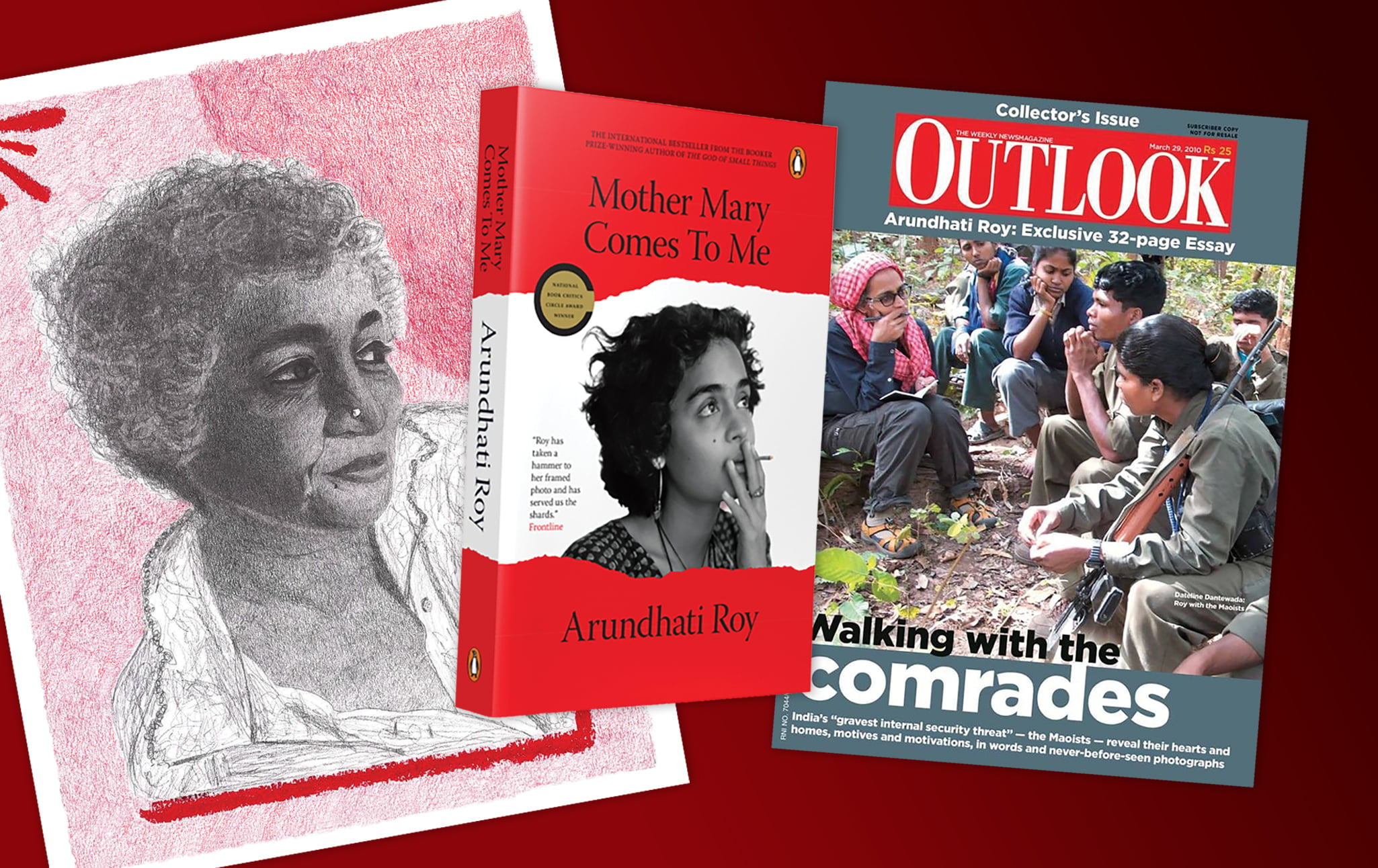
The day my copy of Arundhati’s memoir, Mother Mary Comes to Me, arrived in my mail, I photographed it lying on my bed. The edition published by Penguin Random House India is a bright red hardback only partially covered by a book jacket that is half as big as the book itself. A young Arundhati Roy holds a cigarette to her lips on the front of the jacket; at the back, an older Arundhati smiles, looking into the distance. At the back, it says “In these pages, my mother, my gangster, shall live. She was my shelter and my storm.”
“Gangster” might seem an unusual way to describe one’s mother, but here, the term fits Mary Roy perfectly. To her children, Mary could be a tormentor. Yet she was also a fiercely determined woman who, cornered by patriarchy, battled against the institutions that sought to deny her and her children a life of dignity. In the process, she became a source of both fear and fascination for her children, who were often the targets of her misdirected anger. In pushing back against Mary’s authority, Arundhati Roy inherited her mother’s courage and defiance. In many ways, Mary paved Roy’s path to freedom. Roy’s memoir is an attempt to make sense of that paradox.
Author of numerous essays and over 20 books, including the Booker Prize-winning The God of Small Things in 1997, Arundhati Roy has spent much of her public life courting controversy across the political spectrum. While conservatives in India have targeted her for her vocal opposition to Hindu nationalism, liberal elites have also faulted her for her positions on Kashmir, her criticism of neoliberal economic reforms, and her romantic ideas about pre-modern life.
In an act of assertive nationalism, Roy’s Booker win was celebrated by the Indian establishment as a symbol of India’s rising global stature in 1997. Roy, however, refused to play along in the role of a national literary icon. She responded the following year with her essay “The End of Imagination,” detailing the horrors of the nuclear bomb tests that India had conducted in the state of Rajasthan. This marked the beginning of Roy’s contentious engagement with the Indian ruling elites.
Spanning a public life and career of nearly three decades, Roy has routinely challenged her country’s establishment. Her incendiary essays of dissent that appeared in magazines and newspapers over the years were collected into a thick volume of nearly 900 pages, titled My Seditious Heart, published in 2019. At a time when fascist leaders are criminalizing dissent all over the world, Roy insists that her readers never stop imagining a better world. Across her fiction, journalism, and now her stirring new memoir, Roy returns to a single, urgent warning: a society that tolerates the oppression of its most vulnerable members eventually becomes captive to systems of violence that spare no one.

A few days after starting Roy’s memoir, I met a woman at an independent bookstore in Delhi’s Lodhi Colony. We hit it off and started talking about the books we were reading at the time. I asked her if she had read Mother Mary Comes to Me. She told me that her father was a Malayali Christian, and Mary Roy was more popular than her daughter in their community.
Her most enduring legacy was her legal challenge to discriminatory inheritance laws governing Syrian Christian women in India, which culminated in the landmark Supreme Court case Mary Roy v. State of Kerala in 1986. Both in the courtroom and outside it, Mary fought a patriarchal society with extraordinary determination and courage. In the process, she became something of a “gangster” herself—a woman with both authority and economic power in the small town of Kottayam, where she founded and ran one of India’s most respected educational institutions, a bilingual school rooted in gender equality.
Mary Roy founded this small school with the help of a British missionary by renting space in a Rotary club. It was Mary’s calling to become a benevolent educator (benevolent for other children, at least, if not her own). She instructed her own children to call her “Mrs. Roy” instead of mother so her students would not feel as though she treated Arundhati and her brother Lalith Kumar Christopher (nicknamed LKC) any different. In time, Roy realized that her mother had three children, and the school was her favorite child.
Mary Roy was nothing short of a revolutionary feminist, and Kottayam had not seen many of those in the 1960s. Nobody had. For women around her and her girl students, Mary was the burning flame of courage and defiance, and she disabused male students of the sense of entitlement they had acquired at home. Forever challenging the balance of powers, she held up a bra in her hands during a special assembly at her school. She had learned that boys had been teasing the girls about bras. Holding up the bra, she said, “This is a bra. All women wear them. Your mothers wear them, your sisters will too, soon enough. If it excites you so much, you are very welcome to keep mine.” It was just one of many incidents where Mary Roy challenged patriarchal control over women’s bodies and choices, while schools in India continued to instill shame in young girls about their changing bodies.
However, Roy also writes about Mary Roy’s darkness. She ruled over her employees mercilessly, and they were helpless victims of her turbulent moods. While Mary was an extraordinary mentor to her students, she reserved her worst for her son. On more than one occasion, she told LKC that he was ugly and stupid, and even that he should kill himself. She called her daughter a bitch and kicked her out. Mary taught Roy how to think freely and write honestly, then resented the writer her daughter became.
Even in the days of her childhood, Arundhati could see that Mary Roy’s emotional violence against her children was a direct result of the exclusion and shame society heaped on her. She had arrived in Kerala as a single mother, with no means to earn a living and no place to house her little family. She was immediately made an outsider in her Syrian Christian community, itself a minority. To value Mary Roy for the extraordinary woman she was, Arundhati had to put distance between Mary and herself, and learn to see her through lenses that were not entirely colored by the experience of being Mary’s daughter.
Roy writes that for her mother to shine her light on her students, her children had to “absorb her darkness.” However, she also writes that she is “grateful for that gift of darkness,” which turned out to be “a route to freedom.” Mary instilled in Roy everything she needed to face the world head-on. Her hold over Arundhati was so powerful that she had to cut herself free. In doing so, Roy gained a measure of emotional independence and agency that was unavailable to many women of her generation. This became the seed for her unsparing writing that would later challenge authority, question orthodoxy, and shape her political life.
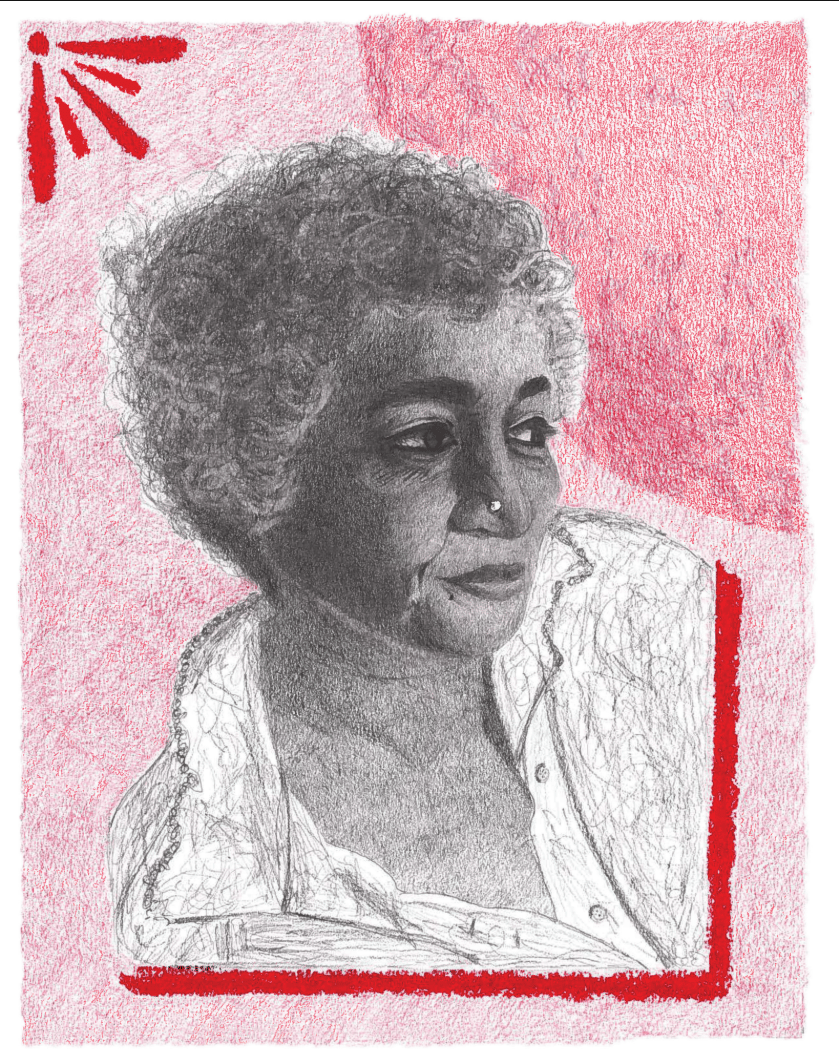
Art by Sarah Singh from Current Affairs magazine, Issue 60, July-August 2026
For most readers, it is hard to talk about Mother Mary Comes to Me without talking about Roy’s Booker-winning debut novel, The God of Small Things. Harder still is to discuss either without talking about the fragile faultlines of India—a country fragmented along the lines of caste, religion, and gender.
The God of Small Things is the story of countless tragedies, among them the accidental death of a child, Sophie Mol, and the murder of a Dalit man (from the most oppressed caste, formerly Untouchable) who challenged the love laws dictated by caste. The book is also about the disgraceful return of divorced Ammu, mother of the twins Estha and Rahel, to her paternal home in Ayemenem, Kerala. The hollow promises of Kerala’s Communist government collide with caste politics and love laws, and Ammu’s tiny family of three is fractured beyond salvation.
The bright red cover of Roy’s memoir is a laal salam (red salute) to her communist politics. It reminded me of Roy’s beginnings in Kerala and The God of Small Things. In the novel, the twins float through the wreckage of life, struggling to belong. As I read Mother Mary Comes to Me, I learned that Roy had struggled her entire life to belong to her mother, to her chosen families, and to her beloved country.
The God of Small Things and Mother Mary Comes to Me, when read together, form a tender portrait of a family. The boundaries of one book blur into another—Roy’s grandfather was an Imperial Entomologist under the British colonial government, and so was the twins’ grandfather in the novel. In both of Roy’s worlds, the grandfather split open the grandmother’s skull with a vase. Roy’s uncle and Mary’s brother, G. Isaac, had returned from Oxford, having failed to make a life in England, much like the twins’ uncle Chacko. Like Chacko, G. Isaac ran a pickle factory upon his return to Kerala, which he ran into the ground. Ammu had left her alcoholic husband at the tea estate in Assam where he worked and returned to Kerala with her two children. So had Mary Roy. Arundhati and LKC may have been as close-knit as the two-egg twins from The God of Small Things had it not been for Mary, who tried to keep them apart.
In The God of Small Things, Ammu carries in the pit of her stomach the terrible knowledge that for her, life has been lived. Life was over when she arrived in Ayemenem with her twins. She had one chance at a happy life, but she blew it by marrying the wrong man. Ammu’s twins worry for their mother. Somewhere buried deep within is a feeling that they are the reason Ammu is unhappy. Roy writes, “Ammu loved her children (of course), but their wide-eyed vulnerability, and their willingness to love people who didn’t really love them, exasperated her and sometimes made her want to hurt them—just as an education, a protection.”
At times, Ammu withdraws her love from her twins, inflicting wounds that feel irreparable. Ammu is a figure hauntingly familiar to many South Asian children—the woman who became a mother before her girlhood could end. A mother who hurts her children in careless, childlike ways. This reality carries a particular weight for daughters. Last year, at 28, I found a photograph of my mother at 29. Sitting on her lap are two girls, the elder of whom would be ten years of age soon. I am 28, looking at my mother who is 29, holding me and my sister. My mother is glowing in the picture; she has somehow retained her youthful look through some of the most difficult years. It will last a while more. One day she was a college student, and the next, a wife and a mother. And I always wonder who she would be if she were given a choice.
In her novel, Roy demanded that the readers be empathetic to Ammu’s desire for a second chance at life and love, insisting that it was only natural for Ammu to contain madness, anger, and desire. In Roy’s world, feminism is for everyone. We all make mistakes and are allowed to love and be loved regardless. Mary Roy, on the other hand, hated even the faint whiff of desire. To her, it was scandalous. While a 13-year-old Arundhati was away at boarding school, Mary Roy shot dead Arundhati’s first dog, Dido. Dido, an Alsatian, was caught mating with a stray indie dog. Arundhati called it an “honor killing.”
Arundhati Roy had transgressed. In 1997, she was accused in court of corrupting public morality. The text in question was the sensuous last chapter of The God of Small Things, in which Ammu, too, transgresses. The madness in Ammu dared to break the laws of history that dictated who would be loved, and how much. A divorced woman and a mother of two, she had fallen in love with a man from another caste. A Savarna (upper-caste) woman had had sex with a Dalit man!
In those days, men in India often spent their leisure time watching cinema where the rape of women was used to exact revenge from the woman’s family; it was used to “teach a lesson” to the woman. Scenes of sexual violence were casually thrown in the mix if a movie was becoming boring. The same people who condemned Roy’s writing had long tolerated popular cinema in which sexual violence against women was trivialized. Such contradictions exposed the deep misogyny and caste prejudice embedded in Indian society and its public institutions, making Roy’s resistance even more remarkable.
Arundhati dislikes being described as a “writer-activist,” a term she compared to a “sofa-bed”—absurd because it suggests that writing about the forces shaping people’s lives somehow falls outside a writer’s natural role. Unfortunately, India’s increasingly authoritarian atmosphere has created a similar divide in journalism between “journalists” and the “activist-journalists.”
In any case, her work did take on a more explicitly political character as time went on. In 1999, she wrote the essay “The Greater Common Good” after joining the grassroots organization Narmada Bachao Andolan. The group resisted the construction of the Sardar Sarovar dam over the Narmada river, which would threaten the homes and livelihoods of tens of millions in the states of Madhya Pradesh, Gujarat, and Maharashtra.
Another member of Roy’s chosen family, her long-term friend Sanjay Kak, became a filmmaker who accompanied her into the Dantewada forest in central India. The experience would lead him to make the documentary film Red Ant Dream, which introduces viewers to the world of India’s Naxalite Maoists, including outfits that are considered by the Indian state to be its “most significant security challenge.”
In the Dantewada forest, Roy witnessed Maoists and villagers’ armed struggle to defend their Adivasi (indigenous) communities and their mineral and resource-rich homeland against one of the biggest paramilitary operations by the Indian government. Her own coverage of this conflict appeared in Outlook India, and was later published as a 2011 book titled Walking with the Comrades.
This was a battle for the soul of India. Roy wrote that half the guerrilla army was made up of women who had witnessed sexual violence inflicted by paramilitary forces and vigilante groups. Some had joined the army to escape the patriarchal bonds of traditional society. It would be impossible to read Walking With the Comrades without experiencing a political awakening. Roy was building a case for social justice, and attacking the sycophancy of the Indian masses.
Roy writes that without the Naxalites, there would be no forests left. As a result, she was labelled an “Urban Naxal” and “intellectual terrorist” by the Indian establishment. Some liberals argued that forests should instead be protected through non-violent movements. Roy responded by pointing out that Gandhian non-violence cannot function for forest communities that have long been excluded from mainstream society and treated as non-citizens. There is no sympathetic audience to watch the Gandhian performance unfold in a forest where paramilitary forces are murdering and raping.
Roy’s fiction and essays have consistently exposed a deep dependence of the Indian masses on oppressive hierarchies. Many people in India, she writes, seek both authority to submit to and communities beneath them to control—someone to be oppressed by, and someone else to oppress in turn. In many ways, Roy’s grandfather—the Imperial Entomologist—was the model Indian man who was deeply loyal to British imperial power. In time, the departing white colonizer was replaced by an oppressor caste of Indian men who pillaged indigenous and marginalized communities, now with the help of the Indian political establishment. This created a society stripped of compassion, whose antipathy Roy challenges.
The Ministry of Utmost Happiness, published in 2017, is not as widely read as Roy’s other books. Ministry is set between two graveyards. One graveyard is the beautiful Kashmir Valley, where Kashmiri Muslims remain after the mass exodus of Kashmiri Pandits (Hindus) that began in the 1990s. The other graveyard is in old Delhi where the main character, Anjum, builds Jannat Guest House, enclosing graves where society’s castaways find a resting place. Roy takes the reader into the heart of Kashmir, where death seems to have more value than life. Death can reward an officer with a cash prize, medals, honors, and promotions. Preserving life, on the other hand, offers no incentive. Grief has been devalued, and the result of all this is an internal, unforgiving, fearless war in the hearts of Kashmiris.
Today, the Kashmir valley is one of the most densely militarized places in the world. Phone and internet services are often suspended for weeks and months at once, and curfews that turn Kashmir into an open-air prison are enforced. Ordinary citizens disappear all the time, never to be found again.
Political speech about Kashmir is scrutinized, too, and Arundhati Roy herself remains under legal threat for her dissent on the subject. In 2024, the Delhi Lieutenant Governor granted sanction to prosecute Roy under the Unlawful Activities (Prevention) Act (UAPA) in connection with remarks she made at a New Delhi conference 15 years ago. Parts of her speech were taken out of context and manipulated by the media, and the United Nations’ human rights office has urged the criminal case to be dropped, but the ultimate outcome remains to be seen.

Indian liberals would have liked to claim Roy, if it were not for her refusal to align with a single political party in India. After her criticism of the corrupt Hindu nationalist party, they expected her to support the corrupt secular party. She did neither. She has repeatedly written against the Bharatiya Janata Party’s rampant violence against minorities. At the same time, she points out that it was former prime minister Rajiv Gandhi’s rise to power in the aftermath of the anti-Sikh riots carried out by associates of the Congress party in 1984, and his casual acceptance of that violence, that first sent a dangerous message to Indian politicians: that targeting minorities could help consolidate majority support and win elections.
Moreover, The God of Small Things highlights the political failures of a democratically elected communist government in Kerala. Savarna communists, too, looked away from caste-based violence and lynching, accepting the status quo once they came to power. In her new memoir, Roy writes criticizing India’s communist parties: “In Kerala, because we had a Marxist state government, there were huge marches in support of Ho Chi Minh and the North Vietnamese. But we heard little about the Soviet Gulag, the famine in Ukraine, or the Great Leap Forward in China, in which millions had perished.”
A few years ago, barely out of college, I was working for a middle-aged Indian woman who had returned from living in the United States. She did not know the first thing about literature, but had somehow managed to leverage her contacts in Indian publishing and entertainment industries to found a media platform that offered promotions to writers, filmmakers, and “thought leaders.” The company was entirely run by young, underpaid creative women. Once, as we discussed Indian women in literature, the subject of Roy came up. My boss said proudly that she had read The God of Small Things back when she studied in the U.S. and she couldn’t understand the reception it got all over the world. She said that Roy wrote best what the West wanted to read about India—a land riddled with violence and corruption. What she failed to recognize was that Roy was not manufacturing this reality for foreign consumption; she was merely holding up a mirror to Indian society, and my boss wanted to look away. Her discomfort perhaps stems from the fact that Roy’s writing wrecks the polished and exotic image of India that sections of the elite diaspora wish to project to the world.
I had learned to filter out most things my employer said after I watched her rant on social media about her domestic helpers who did not want to clean her toilet. She complained that it took a lot of nagging and negotiations to get them to clean up her shit. She made the unclever observation that this was about stigma around cleaning toilets in India. What she refused to acknowledge was her caste-based entitlement—the expectation that, as a Savarna woman, she had an absolute right to get her toilets cleaned by marginalized people. To her, money should have neutralized any resistance. Since then, I have used the subject of Arundhati Roy as a litmus test for those I encounter.
There is another type of Indian liberal—mostly men of a certain age—who feign indifference toward Roy. In the safety of closed circles, they dismiss her accolades as unearned. They claim that she catered to Western appetites for Indian stories and cultivated a brand of personality. Yet beneath the surface of their critique, the undercurrent of wounded male pride is easy to read. One can also sense their deep-seated fear of a woman who is hard to shame and harder to control.
The very first time I read Roy, I was in my late teens. I bought a copy of The God of Small Things from a roadside book seller in my neighborhood. I had seen the book being sold everywhere. The copy I purchased had been in the rain. Its pages curled up. As I started reading the book, I immediately wanted to look away. Middle-class Savarna Indian children were trained to look away from caste and patriarchy while abiding by its laws. After reading it, I returned my copy to the seller in exchange for a copy of Eat Pray Love. However, I couldn’t shake the images that Roy’s fiction had left me with.
Kerala, shining green and moist. The smell of the rubber plantation and the Meenachil river. The images stayed with me, resurfacing from time to time until I decided to read the book again after three years. Among those beautiful images of Kerala, others were burnt into my memory: a policeman tapping Ammu’s breasts with his baton as if he was choosing mangoes, Dalits walking backwards and sweeping their footprints off the ground so Savarnas wouldn’t pollute their feet, the corner in Velutha’s hut that was reserved for the dead and the slowly dying, a pregnant spider drowning in the Meenachil river, bursting her sack from which emerged tiny spiders who would evolve and learn to swim. A woman crossing the river at night in a small boat to get to her lover, breaking all the love laws. A dark man covered with blood and three teeth embedded into his lip, and a dark cold moth that spread its wings on the hearts of the two-egg twins.
At the Delhi University college where I was studying, jokes about Roy being “anti-national” were common, and violent remarks against her were trivialized, mostly made by young men mimicking majoritarian leaders and TV anchors. Unsurprisingly, these students had never read Roy’s books. They did not need to; the era of fake news had arrived. And yet, Roy’s debut novel continued to be sold near the college campuses.
The copy of The God of Small Things I own now was purchased from a charity book shop that sold me a first edition for close to nothing. On the cover, a bright, beautiful pink lotus blooms on the surface of a river covered by green lotus leaves and other floating vegetation—a mesmerizing cover hiding a devastatingly dark tale about love and humanity.
Upon their return to Kerala, adult Rahel and Estha sneak into a temple to watch a Kathakali performance that has already begun. It will go on for hours, into the early hours of morning light. Roy writes:
It didn’t matter that the story had begun, because Kathakali discovered long ago that the secret of the Great Stories is that they have no secrets. The Great Stories are the ones you have heard and want to hear again. The ones you enter anywhere and inhabit comfortably. They don’t deceive you with thrills and trick endings. They don’t surprise you with the unforeseen. They are as familiar as the house you live in. Or the smell of your lover’s skin. You know how they end, yet you listen as though you don’t. In the way that although you know that one day you will die, you live as though you won’t. In the Great Stories, you know who lives, who dies, who finds love, who doesn’t. And yet you want to know again.
These words best described my re-reading of Roy’s novel for a second time. This time around, I knew that Ammu and her twins were doomed, and Velutha was doomed from the day he was born. The more I read Mother Mary Comes to Me, the more I found myself returning to The God of Small Things. Roy’s memoir could not compete with her debut novel. I hope that every reader who picks up her memoir is eventually led back to the fiction. In many ways, The God of Small Things is as close to the truth as Roy’s memoir.
Roy spent years trying to establish emotional and physical distance from her mother. Given her family background and her access to the English language, it is not surprising that, following a few years of struggling in Delhi, she eventually found herself among the intellectual elite. She fell in love and married filmmaker Pradip Krishen, who resided in one of the most affluent neighborhoods in the country at the time. However, the lingering shadows of her childhood spent with Mrs. Roy compelled her to retreat from traditional marital bliss. Though she remained deeply in love with Krishen, she soon moved away from him and his family.
Roy sensed that Mary’s life was drawing to a close when she received a text from her, brimming with motherly love and pride for the woman that Roy had become. As the elder Roy’s own cold moth settled on her heart, it reminded the reader that without Mary, there would be no Ammu, no Imperial Entomologist, and no cold moth. Ultimately, without Mary, there would be no The God of Small Things.
Arundhati Roy faced backlash in 2014 when she published the book The Doctor and the Saint, which listed her as a co-author. Technically, she hadn’t written the book. It was actually a re-issue of Dr. B.R. Ambedkar’s The Annihilation of Caste, with a new introduction by Roy. Annihilation of Caste is a critique of Hinduism and caste, but Dalit writers and scholars across the country rejected Roy’s interpretation. Anu Ramdas, editor of Round Table India (a media portal dedicated to anti-caste issues), said, “We object to Roy’s text not because of her non-Dalit origin but due to her poor grasp of the seminal text and even shallower and sensational out-of-context introduction to the original text at risk of maligning Ambedkar.” Roy misinterpreted B. R. Ambedkar as being biased against the Adivasis, which was far from true. She was also criticized for not acknowledging her own caste capital and trying to profit from Ambedkar’s work for marketing gains. She has also faced backlash for holding romantic views of globalization and development that are at odds with her own easy access to modern comforts.
Decades after Roy won the Booker prize, though, The God of Small Things remains a permanent fixture of the Indian literary landscape, selling in massive numbers across digital platforms and bookstores. The roadside hawkers sell weathered second-hand copies and affordable pirated editions to younger readers. Yet, for many Indian authors, a Booker win remains an unattainable goal, requiring not just literary merit, but the social capital required to navigate elite literary circles that leads to a timely international publishing deal. Arundhati Roy is a gifted writer for whom all these factors aligned.
Roy’s dissent against the political elites of India pushed her into the public limelight. Television anchors at news channels owned by corporate giants called for Roy’s arrest and imprisonment. She has fought multiple court cases over the years, and in 2002 she spent one night in jail for her role in the Narmada dam protests. To readers like me, it appeared as though one woman had decided to take on the entire Indian establishment. This wasn’t entirely true, of course. She was bolstered by a network of lawyers and supporters, and her significant earnings from the publication of her books provided the financial security necessary to sustain her legal battles and aid others who were fighting similar battles against fascist forces.
Roy’s stance against global capital and neoliberalism has invited scrutiny. Many expected her to adopt a Gandhian asceticism, divesting herself of the wealth accumulated from her international publishing deals. Some questioned why Roy chose to publish her latest memoir with a corporate giant like Penguin Random House in India rather than an independent Indian press (of which there are a good few in New Delhi). I wondered if Roy was being asked to perform an ascetic type of living. We seem to demand that our writers and activists effect change from a position of financial insecurity masquerading as modesty. We want them to remain seemingly powerless.
As the COVID-19 pandemic shut down India, I stayed locked inside my home. Like many other students at the time, I suffered mentally from the bombardment of devastating news from around the country. I was terrified for my parents’ fragile life, convinced that I could survive a COVID infection but they couldn’t. I was convinced that a “normal” future was no longer possible. As I spent entire days hiding under the covers, I came across a piece Roy had written for the Financial Times, titled “The pandemic is a portal.” She writes:
Nothing could be worse than a return to normality.
Historically, pandemics have forced humans to break with the past and imagine their world anew. This one is no different. It is a portal, a gateway between one world and the next. We can choose to walk through it, dragging the carcasses of our prejudice and hatred, our avarice, our data banks and dead ideas, our dead rivers and smoky skies behind us. Or we can walk through lightly, with little luggage, ready to imagine another world. And ready to fight for it.
Everything told me otherwise, but I let myself hope she was right. What I really wished for was a new world order, a kinder one. India’s “normal” social and political order had delivered us our own unique nightmare, turning us into callous voyeurs of the suffering around us.
As the coronavirus spread, the BJP-led Indian government imposed a nationwide lockdown, leaving millions of migrant daily-wage workers from eastern and central India without employment. The subsequent suspension of transportation services stranded them in the cities. Facing starvation, many began walking hundreds of kilometers to return home with their families. On May 8, 2020, 16 migrant laborers were killed after a cargo train ran over them in Aurangabad district. The workers were walking back to Madhya Pradesh and are believed to have fallen asleep on the tracks, assuming that trains were not running.
Reading this news, the crippling nature of my grief shocked me. The moral indifference and passive acceptance of this institutional cruelty by the Indian middle class shocked me more.
Roy once said during a Paris Review interview in 2011, “I always find it interesting that when you’re with people who are really at the receiving end of oppression, you find a lot less despair than you do in middle-class drawing rooms. In these situations, despair is not an option. I wonder if the amount of information that is hammered into our heads day and night leads people to think that the world’s problems are so huge they’re insurmountable.”
We were witnessing the failures of a fascist and hyper-capitalist Indian state. It had convinced me that these problems were insurmountable, the devastation unavoidable. The pandemic had made it abundantly clear that while all of us were facing dangerously turbulent waters, we were, in fact, not in the same boat.
Roy’s two books of fiction, her latest memoir, and her various essays published over the years establish one thing: when citizens grant ruling establishments, capitalists, and their henchmen impunity for displacing and pillaging powerless communities, they become complicit in the creation of a dangerous system of violence that eventually demands unconditional submission from everyone. Generations end up living inside this system where despair and helplessness are widespread feelings. Empathy and justice have no place in such a system where power silences everyone. This is as true for India as it is for the West. Recently, from Gaza, to Iran, to Lebanon, to Venezuela, we have witnessed a shocking capacity for violence in a shockingly brief window of time. Each attack is more vicious than the last as forces of fascism grow stronger and greedier. Across the globe, citizens are being funnelled into a totalitarian reality that criminalizes dissent, where their collective exhaustion fuels leaders who act with total disregard for human life. In such times, writers like Roy remind us that humanity demands camaraderie. It demands that though a better world seems far out of reach, we never stop dreaming.