%20(1).jpg)
From New York in 1677 to India in 2025, the people who collect our trash are among the labor movement’s greatest heroes.
Every child knows that garbage collectors are heroes. Nobody has to tell you; it’s just obvious. When I was about six years old, I remember standing in my grandparents’ kitchen window and watching, fascinated, as their local garbage truck pulled up. This was rural Pennsylvania, so it was a small operation—just a purple pickup truck with “H&D Waste” painted on the side, a picture of a pig sitting in a trash can, and a square bin mounted to the truck bed to hold the trash. Two people, a woman and a man, would get out, grab the three or four black bags from the curb, and hurl them into the truck like Olympic athletes launching a shot put. Garbage Day had everything—a loud piece of machinery, feats of physical strength, a frisson of the gross. My younger self was captivated. The experience seems to be a common one, too. Ten years ago, a small boy named Quincy Kroner went viral online after he brought his toy garbage truck out to the street to show it to his local trash collectors, then became overwhelmed and cried when he actually got to meet his idols. The kid knew what was up.
But as people get older, they run the risk of becoming cynical, avaricious, and cruel. Worst of all, some of them get into management. Across the world today, the people who run large companies and city budgets seem to have forgotten what they knew in their youth, and they disregard the sanitation workers who keep us all from drowning in our own filth. They cut corners on safety, refuse to raise wages, and try their best to keep trash collectors doing dirty, dangerous work for peanuts. And so labor wars break out, in cities from New York to Birmingham to Chennai, as the garbage workers are forced to go on strike. It’s been happening for centuries, but 2025 has been a landmark year for sanitation strikes, and for the ruling classes’ opposition to them.
Politicians and the police have conspired to keep the workers down, the billionaire-owned media have spread propaganda against them, and scab laborers from their own cities have betrayed them for the sake of a quick buck (or quid, or rupee). Still, the garbage workers fight on. Theirs is one of the most important labor struggles of all, and one everybody ought to support to the hilt. It’s obvious, but it bears repeating: the people who do society’s most basic and vital work ought to be paid well and respected for it. Anyone who stands on the opposite side of that particular picket line belongs in the bin with the rest of the trash.
-jpg.jpeg?width=2048&height=2560&name=CA-57-GarbageWorkers-CMYK%20(1)-jpg.jpeg) Art by Ellen Burch from Current Affairs Magazine, Issue 57, January-February 2026
Art by Ellen Burch from Current Affairs Magazine, Issue 57, January-February 2026
From New Amsterdam to the “Summer of Stink”
The American garbage strike is as old as organized garbage collection itself. In fact, the practice is significantly older and more respectable than the United States as a nation. As labor historian and poet Joe Hall records in his remarkable book Fugue and Strike, the first strikes on record were all the way back in 1677, when New York City had just ceased being New Amsterdam. At that point, a small guild of mostly Dutch “cartmen” spent their Saturdays “carting household ‘dirt’ to a dump for ‘ten stivers seawant’.” In today’s money, that’s approximately $30 per cartload. Not much. So it shouldn’t have been a complete surprise when they eventually got fed up, and ground their carts to a halt.
As Hall writes, the city government was able to quell the 1677 strike using a favorite tactic of bosses everywhere: divide-and-conquer along racial lines. Instead of a pay raise, they just banned Black workers from getting the licenses necessary for “carting or portering,” giving a form of racialized job security to their white counterparts. But “the wages of whiteness wouldn’t remain sufficient” for long, and a second strike followed in 1684. This time, though, the segregation policy backfired on its creators. It limited the potential pool of scab laborers to only white men, who were less likely to need money badly enough to come out and break a garbage strike. So when the council put out a call, it couldn’t recruit enough of them. They had to re-hire the cartmen they’d just fired for striking, and eventually give them raises too. America’s first garbage strike was a victory—just not for everyone.
It wouldn’t be the last. About 180 years later, a plucky new daily newspaper called the New York Times recorded another strike of “streetsweepers and dirt-cartmen” in 1865. Establishing its anti-labor credentials straight out of the gate, the Times condemned the workers, writing that the strike was “a wicked trifling with the lives of the people” that should be “swept aside” by the police. And just like the colonial government of 1684, the Times urged the recruitment of scabs, saying city government should “strain every nerve to get the requisite force, in place of those who refuse to work.”
Across the decades, the Times kept up this anti-worker editorial line. It showed up again in 1907, four years after the Teamsters union was founded to represent horse-cart drivers of all kinds. On that occasion, the Times blasted New York City’s latest trash strike as “a stench in the public nostrils” and demanded “an un-pampered set of workers” to take the unionized ones’ place. Apparently, city officials agreed. When the next strike broke out in February 1911, the Times reported with palpable satisfaction that “A few non-union drivers of garbage carts yesterday removed a small part of the day's accumulations under strong police guard,” and wrote that “in no contingency should the demands of these strikers be submitted to.”
What were the demands, you might ask? Only that workers not be expected to pick up the trash in the middle of the night, in the dead of winter. In the early 1900s, that was standard practice. “Our men are already falling ill with pneumonia and rheumatism and[…] they demanded the right to work in the sunlight and the warmer weather of the daytime,” said one union official, adding that “a 200-pound can was a mighty big load for one man to lift[...] on a slippery winter’s night.” But even this was too much for the New York Times, which said that the striking workers “are utterly in the wrong and must be compelled to submit by any means the authorities can command.” Soon, the editors got their wish. Mayor William Jay Gaynor was “resolute in rejecting their demands,” and thanks to the unremitting stream of newspaper propaganda, there was “little public support” on the union’s side. They were forced to return to work on the same terms as before, with punishments in some cases for daring to strike at all.
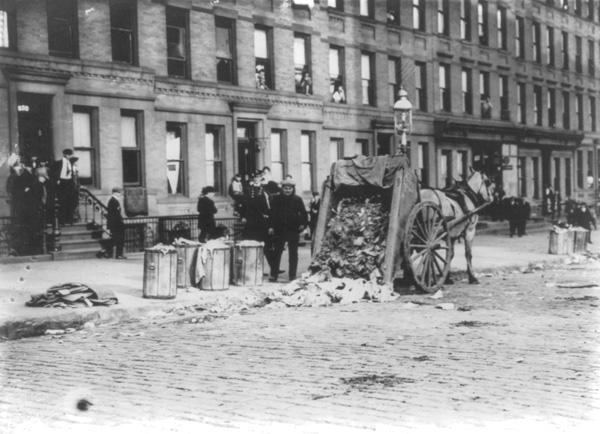
Workers dump the garbage from their carts in protest during the 1911 strike. (Photo: Library of Congress)
The New York Times, as it often is, was dead wrong. Garbage collectors are anything but “pampered,” and given the unpleasant nature of the work itself, they have every right to demand concessions. Think, for a second, about what it’s actually like to pick up other people’s trash for a living, every day for years. Every dirty, disgusting substance humans are capable of producing, garbage workers have to deal with hands-on. Feces, whether in diapers or dog-walking bags. Used condoms. Maggot-infested food. Rats, both alive and dead. Someone gets drunk and vomits directly into a trash can. People throw away needles and razor blades and don’t bother to wrap them in duct tape first. It’s downright hazardous out there.
According to the Bureau of Labor Statistics, “refuse and recyclable material collector” is the fourth most deadly job in the United States today, behind only roofing, commercial hunting and fishing, and logging. Interestingly, “police officer” doesn’t crack the top 10—so for all the “thin blue line” sloganeering, garbage workers are objectively braver and more deserving of praise than cops. They get hit by cars a lot, and as climate change continues to ramp up, more and more of them suffer from extreme heat exhaustion. In 2023 alone, 41 of them were killed on the job. To know all that, and then advocate for these workers to be “compelled to submit” to poor pay and working conditions—and all from the safety of a newspaper desk—is one of the most detestable forms of propaganda imaginable.
Thankfully, not everyone thinks like a New York Times editor. The Reverend Dr. Martin Luther King Jr. didn’t. In 1968, he spent his final year on Earth marching alongside trash collectors in Memphis, Tennessee. As in New York 57 years prior, safety—or rather, the way Black workers were deliberately denied any safety—was the primary issue. Two men, Echol Cole and Robert Walker, had been crushed to death in their own garbage truck. There were a few reasons, all of them grim. The truck itself was old and known to malfunction; people had complained already that it was a “disgrace” it was still on the road. There was also a hideously racist city policy which forbade sanitation workers, the vast majority of whom were Black, from taking “shelter stops” in neighborhoods on cold days, lest white people see them and feel uncomfortable. So on February 1, Walker and Cole were using the interior of the truck itself as a makeshift shelter from the cold wind, only to get pulled into the trash compactor when it unexpectedly turned on.
It must have been a slow, horrible death. But Mayor Henry Loeb, a white man with a reputation for being a “penny-pinching, anti-union segregationist,” didn’t care. He’d deliberately hired “men with arrest records who were unlikely to organize, held down wages, and bought the cheapest trucks and equipment,” and he’d helped to crush three previous attempts to unionize the garbage workers in 1963, 1964, and 1967. Even after Walker and Cole’s deaths, he offered their families only $500 in compensation, not even enough to pay for a $900 funeral. This was the last insult that drove everyone onto the picket line, and that brought Dr. King to town.
This was the era, as Lily Sánchez has written for Current Affairs, of the more radical King, the one you don’t often get told about in American schools—certainly not after Southern governors like Jeff Landry and Ron DeSantis are done stripping the curriculum of so-called “divisive” political concepts. Beyond simply fighting racism and segregation, King had started to champion a more comprehensive left-wing politics, opposing the invasion of Vietnam and waging the “Poor People’s Campaign” against economic injustice. He still framed his politics in the language of his Christian faith, calling his goal simply “a better distribution of wealth within this country for all God’s children,” but he was unmistakably a socialist. In Memphis, he joined the workers’ picket lines and marches as they carried the famous “I AM A MAN” signs, demanding they be treated as fully human for the first time. Some of his oratory from 1968 still sounds revolutionary today. From his final speech, everyone remembers the “I’ve been to the mountaintop” line, but you might not remember what came before it:
The issue is injustice. The issue is the refusal of Memphis to be fair and honest in its dealings with its public servants, who happen to be sanitation workers. Now, we've got to keep attention on that. That's always the problem with a little violence. You know what happened the other day, and the press dealt only with the window-breaking. I read the articles. They very seldom got around to mentioning the fact that one thousand, three hundred sanitation workers were on strike, and that Memphis is not being fair to them[...]
Now we're going to march again, and we've got to march again, in order to put the issue where it is supposed to be. And force everybody to see that there are thirteen hundred of God's children here suffering, sometimes going hungry, going through dark and dreary nights wondering how this thing is going to come out. That's the issue. And we've got to say to the nation: we know it's coming out. For when people get caught up with that which is right and they are willing to sacrifice for it, there is no stopping point short of victory.
The implication behind that last phrase—“no stopping point short of victory”—is enormous. Far from the meek caricature presented in today’s more conservative textbooks, King told people to fight, and not to stop fighting until the existing economic order had been completely upended.
Just a day later, a white man killed him for it. Not for that speech alone, or even for his involvement in the Memphis strike, but for all of it—the antiracism, the socialism, the Vietnam activism, the dedication to human rights. An avid fan of white supremacist George Wallace, James Earl Ray wanted the threat King posed to the status quo silenced for good. (Though it should be noted, too, that several members of King’s family don’t buy the FBI’s assertion that Ray acted alone.) In that, he failed. In fact, it was the outpouring of support that followed King’s death that finally forced Mayor Loeb to recognize the garbage union and raise wages.
It was fitting, in a way, that King died fighting for the most neglected and despised workers in the South. It was perfectly in line with the best parts of his Christian gospel—the parts that say “as much as ye do for the least of these my brethren, ye do unto me.” The Roman Empire killed Christ for saying things like that, too; he and King have that in common. Except, of course, that the striking garbage workers of Memphis were not the least of Americans, but the greatest.
Dr. King’s work remains unfinished in a lot of ways, as you probably know if you’re unfortunate enough to read the news regularly. Formal segregation might be gone, but anti-Black racism is still an ugly feature of American life, both in blatant forms and more subtle structural ones. And garbage workers in this country still aren’t getting the money or respect they’re due.
This year, cities across America saw a renewed wave of trash strikes as the sanitation unions were once again forced to stand up for their members. In Philadelphia, District Council 33 of AFSCME—the American Federation of State, County, and Municipal Employees—went on strike for the first time in almost 40 years, after Mayor Cherelle Parker offered them a contract with only an 8 percent pay raise spread across three years. For reference, that’s only 2.6 percent per year, and the U.S. rate of inflation for 2025 was roughly 3 percent, with rents and grocery prices rising even faster. So in terms of actual purchasing power, the proposed “raise” was in fact a pay cut. Already, the union pointed out that its members “earn an average of $46,000 a year, well below the estimated $60,000 needed for a single person to live in the city.” So a strike was an absolute necessity—and there were similar situations in Boston, in Seattle, in Manteca, California, in Cumming, Georgia, in Ottawa, Illinois, and several other cities, where the Teamsters were battling a private sanitation company called Republic Services for the same reasons. The BBC termed it the “summer of stink.”
Again, the country’s biggest corporate news outlets explicitly denounced the strikes. The Bezos-owned Washington Post published an op-ed by the economics editor of the National Review, Dominic Pino, who not only pooh-poohed the Philadelphia garbage workers’ specific demands, but argued that “they should not be allowed to collectively bargain in the first place.” This was just a few months after Bezos issued his edict that the Post would always defend right-wing “free market” economics in its opinion pages; clearly, the command was being obeyed. Rupert Murdoch’s Wall Street Journal chimed in too, writing that “Public unions are often at odds with the public interest” and blaming them for a “trashy Fourth of July.” In both pieces of propaganda, the emphasis is entirely on the people who are inconvenienced by a strike, with frequent references to the smell, the trash bags piling up uncollected on the curb, and so on. Meanwhile, there was no serious discussion of the economic desperation that would lead people to resort to striking, nor of the danger inherent to the work. For the billionaires and their pet reporters, it’s as if those things don’t exist—or don’t matter, compared to the possibility that more comfortable people might catch a whiff of something funky on the wind.

In the end, the Philadelphia strike ended in disappointment. As Kim Kelly wrote for the Nation, the union had momentum behind it. Public opinion was starting to turn against Mayor Parker, with the slogan “What’s that smell? Blame Cherelle!” catching on, and celebrities like LL Cool J cancelled their performances in Philly in solidarity, generating more media coverage. But just eight days in, the AFSCME leadership chose to accept a contract with only a 9 percent raise across three years, barely better than the mayor’s first offer. As DC-33 president Greg Boulware explained, “we felt our clock was running out” as the workers were poised to miss their first paycheck. The Teamsters did a little better: in Cumming, Georgia, they won a 17 percent raise over four years, with 7 percent the first year, in one of their many battles with Republic Services. Still, the “summer of stink” was somewhat anticlimactic.
But there’s a note of fear in those ruling-class accounts of the 2025 strikes that’s telling. In the Wall Street Journal, the editorial board sounded distinctly anxious when they wrote that the Philadelphia work stoppage was “a reminder of how public unions can hold a city hostage.” As usual, they didn’t acknowledge why the unions can do that: because their labor is so vital, the city can’t function without it. But they definitely took note of the power itself. And that suggests it’s possible for the workers to win much more than they have so far, if their leaders are willing to be more aggressive about it—and if the public stops believing the anti-union narratives that the world’s richest men feed them. As a new year approaches, the labor war around American garbage is far from over.
“Untouchable” in India
The United States isn’t the only country where the garbage workers’ strikes are bound up with the other great collective struggles of their era. Here on our shores, it was the life-and-death fight for Black civil rights in the 1960s. In India, it’s the long battle against the brutal hierarchy imposed by the caste system.
It can be hard for American readers to understand how profoundly caste has shaped Indian society and labor, because there’s really nothing comparable here. The treatment of Black Americans under Jim Crow was something like what lower-caste Indians have historically dealt with, but it’s far from a perfect analogy. A look at India’s national literature offers a better insight. In his 1935 novel Untouchable, Mulk Raj Anand told the life story of Bakha, a garbage collector and cleaner of latrines from the Dalit, or “untouchable” caste. As the name implies, these are the people who were condemned from birth to do the dirtiest, most disrespected jobs in Indian cities, and who were treated as almost literally subhuman. Anand himself was born to the higher Kshatriya caste, but as a child he transgressed the lines, becoming friends with a Dalit “sweeper boy.” His friend was also named Bakha, and he later became the inspiration for the protagonist in Untouchable. The novel made Anand a leading figure in India’s Marxist literary movement, although his own politics were more influenced by Tolstoy’s socialism than Marx’s.
Comparable to Ralph Ellison’s Invisible Man a few decades later, Untouchable is one of the most vivid literary portrayals of the mental violence that hierarchies of class and caste inflict on people. Its pivotal scene, where Bakha forgets to announce himself as he passes through a crowd, then brushes against a higher-caste man and “pollutes” him, is agonizing:
“Keep to the side of the road, you low-caste vermin!” he suddenly heard someone shouting at him. “Why don’t you call, you swine, and announce your approach! Do you know you have touched me and defiled me, you cockeyed son of a bow-legged scorpion! Now I will have to go and take a bath to purify myself. And it was a new dhoti and shirt I put on this morning!” Bakha stood amazed, embarrassed. He was deaf and dumb. His senses were paralysed. Only fear gripped his soul, fear and humility and servility. He was used to being spoken to roughly. But he had seldom been taken so unawares.
This is the heart of the issue: a society where upward mobility is all but impossible, where people are told every day that they’re worthless because of the accident of their birth, and where they come to believe it themselves—even as they do the sanitation work that keeps the whole society from collapsing.

Officially, the caste system was abolished in 1950 with India’s new constitution. In practice, it remains a pervasive part of society, and centuries of ingrained privilege determines who gets what jobs. The children of elite Brahmin families—like, say, Vivek Ramaswamy or Usha Vance’s parents—get good educations, start lucrative careers in finance, law, and technology, travel the world, and become rich. The children of Dalit families stay in India and clean up waste. In an article for the New York Review of Books, Ratik Asokan describes the daily life of sanitation workers, known as Safai Karamcharis, in Mumbai in the early 2000s:
Their job is to collect the city’s trash and sweep its streets, clean sewers and septic tanks, load and unload garbage trucks, and sort waste at dumping grounds. Many of them labor with primitive tools and without uniforms, as [photographer Sudharak] Olwe’s pictures show. In one, workers sift through mounds of waste with scraggly brooms and rakes. In another, two workers in vests and shorts sit atop trash in a garbage truck. In a third, a worker glares at the camera as he stuffs a dead dog into a bin.
Even more so than in the U.S., this is grueling, unsanitary work, often in blistering heat. The pay is low, safety protections are often nonexistent, and the social stigma of "untouchability" makes changing jobs difficult or impossible. As Assa Doron and Robin Jeffrey note in their book Waste of a Nation: Garbage and Growth in India, the rise of disposable plastics also means there’s more garbage to deal with than ever before. And so, just like in the United States, the labor strikes have come.
Asokan records uprisings among Dalit workers starting “as early as 1953, when the Prantiya Valmiki Mazdur Sangh, a local Safai Karamchari union, and the Communist Party of India led a joint campaign to demand better wages and benefits for sanitation laborers employed by the Delhi Municipal Corporation,” culminating in “mass arrests.” Later in 1996, another union called the Nagarpalika Karamchari Sangh launched an “eighty-day statewide strike in Haryana demanding timely pay,” and was met with a brutal crackdown from the BJP—now Prime Minister Narendra Modi’s party—who “fire[d] six thousand Safai Karamcharis and jail[ed] some seven hundred more for up to seventy days.”
Prime Minister Modi himself has attempted a kind of patronizing conciliation with his country’s sanitation workers. In 2019, he theatrically washed the feet of five Safai Karamcharis at a Hindu religious event called the Kumbh Mela, which revolves around ritual bathing, calling them “karma yogis.” But in January 2025, three of those same workers told reporter Prashant Srivastava that “nothing has changed in our tents” after Modi’s gesture. “We live in a slum. We could not get a house elsewhere since we belong to a community of sanitation workers,” one said. “We are still untouchable by caste and also by facilities. These hoardings are for big people, not for us,” another added. It was all lip service, with no real reform behind it. And this past year, a new wave of sanitation strikes has erupted across India.
In Nirmal, the workers “left the town filled with piles of garbage” after their salaries weren’t paid on time, according to the Siasat Daily. In Junagadh, 700 of them went on strike, seeking “permanent employment” and “fixed salaries” instead of informal, precarious hiring arrangements. In Hoshiarpur, they targeted a holiday week to strike, causing what the local legislators described as “severe filth” in the streets. In Chennai, another 13 workers went on hunger strike to protest the privatization of city services, and were arrested for it. And in Bihar, a particularly angry group of trash collectors simply dumped their loads of garbage at the door of the local Panchayat government office when their pay didn’t come promptly. Indian workers, it’s safe to say, know how to get their point across, and it doesn’t look like this spirit of rebellion is going away until their demands are met. You can only keep people quiet with foot-washing and talk about “karma yogis” for so long.
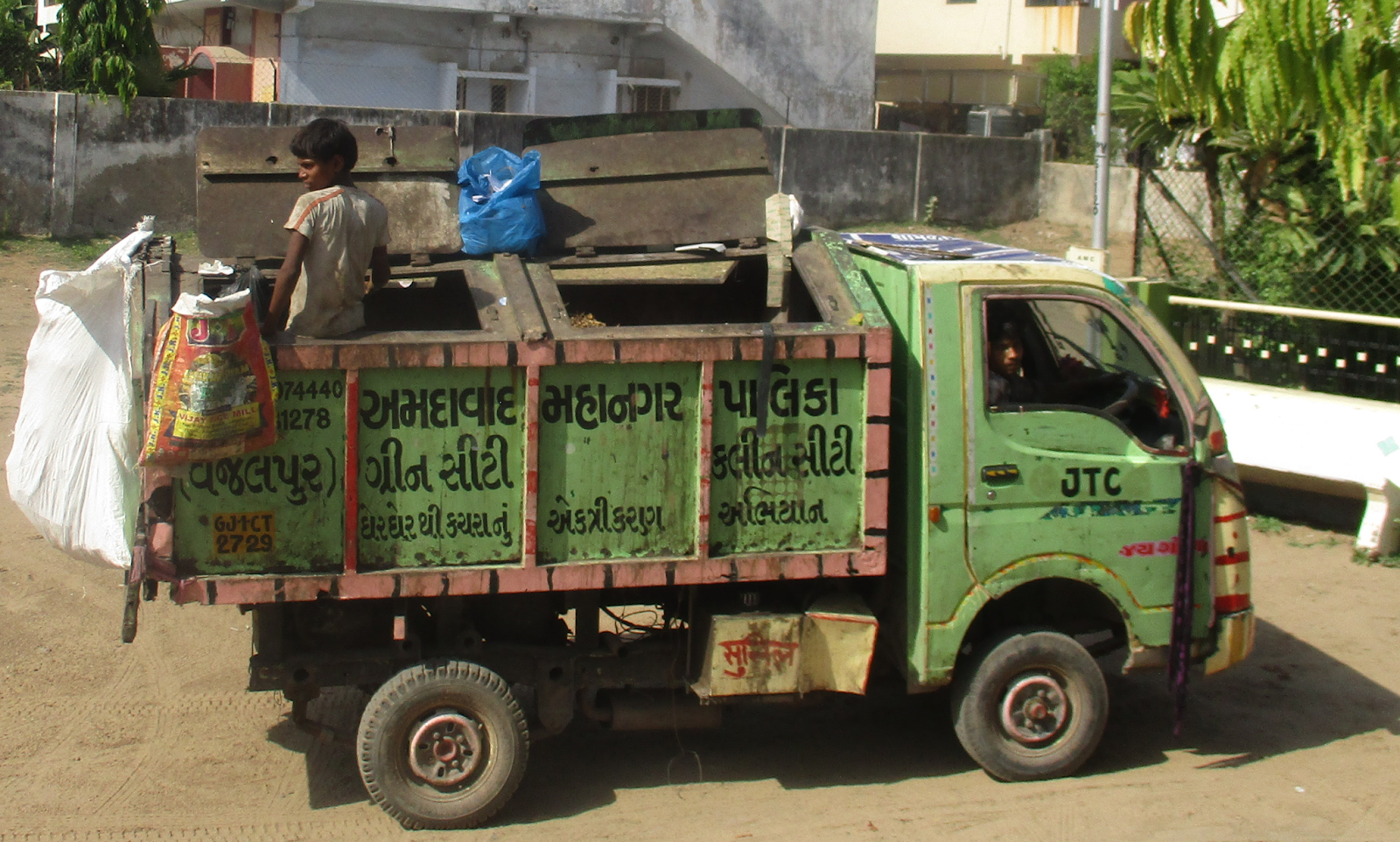
A garbage truck in Ahmedabad, a city in Gujarat, India. Note what appears to be a child laborer in the back.
The Betrayal of Birmingham by the Coward Sir Keir Starmer
Finally, we have to take a brief stop in India’s former colonial sovereign, the United Kingdom. There, people collect “rubbish bins” rather than “trash cans,” but the labor struggle is the same. In Birmingham, the garbage collectors have been on strike since March 11, 2025, when the city council announced plans to eliminate the role of “Waste Recycling and Collection Officer” from its workforce designations. That decision could result in pay cuts of up to £8,000 a year for anyone who currently has that job—at least 150 people would be “downgraded,” by the local unions’ count. And that pay cut would be coming as the U.K. is already dealing with a brutal cost of living crisis, particularly around food prices. It would literally take food off people’s plates. Fortunately, the bin collectors are organized under the powerful Unite trade union, which has around 1.2 million members across the U.K. and Ireland, and so they went on strike, where they’ve remained for over nine months.
Now, the solution here is obvious: just give the workers what they’re asking for. At this point, the economic hit from keeping wages at the same level as before (not even a raise) is dwarfed by the economic hit from months of trash piling up, which has been estimated as high as £14 million. But for the Birmingham city council, it’s clearly become a power thing. Instead of conceding, they’ve called in a private staffing company called “Job and Talent” to supply them with scab workers during the strike, carrying out the same rounds the city workers usually would at a higher cost. They’ve even called in experts from the Army to advise them on how to remove large mountains of trash. And, it seems, they’ve been planning a campaign of retaliation for when the strike eventually ends. In October, a manager with Job and Talent was caught on video telling the company’s workers that “those people that do decide to join the picket line, then the council have confirmed to us that they are not going to get a permanent job” afterward. Assuming that wasn’t an idle threat, it’s a clear case of blacklisting for union activity.
The really wretched thing, though, is that Birmingham has a Labour Party council, and the United Kingdom has a Labour Party prime minister. But instead of advocating for labor, they’ve been working directly against it. Back in April, Sir Keir Starmer denounced the Birmingham strike as “completely unacceptable,” saying he supported the Birmingham council declaring a “major incident”—essentially a state of emergency—to deal with the strike. That allowed Birmingham officials to send police to intervene, setting up barriers to control where the picketing workers can walk and preventing them from blocking the scab-driven garbage trucks as they leave the depot. Previously, Starmer had also discouraged Labour members of parliament from joining picket lines of any kind, and fired a member of his leadership team who defied that ban. It used to be the Conservative Party under Margaret Thatcher that did things like that, waging all-out war against sanitation workers in London and Liverpool during the “Winter of Discontent” strikes in 1979. But as I’ve written for this magazine before, Sir Keir Starmer’s politics are barely different from Thatcher’s at this point, and the Labour Party is increasingly ironically named.
Starmer and the Birmingham council are in trouble now, though. As of November 17, many of the temporary trash collectors from Job and Talent have also gone on strike, leaving Birmingham with even fewer sanitation services than it had before. It seems their bosses’ gloating about blacklisting people didn’t sit well, and “unsustainable workloads and a toxic workplace culture” within the company were the final straw. Ironically, solidarity between workers has been ignited even in the heart of a strikebreaking company. So by trying to defeat the Birmingham strike, Starmer and the (anti) Labour Party have made it bigger, and made their own defeat more likely. Great job, Keir!

“No Stopping Point Short of Victory”
Around the world, the situation for garbage workers reveals one of the core absurdities of capitalism. Namely, that there’s an inverse relationship between how important your work is, and how well you’ll be paid and treated. If you’re a farm worker who helps to keep the world fed, a garment worker who keeps everyone clothed, or a sanitation worker who keeps filth and disease from overrunning a major city, odds are you’ll get paid a pittance, and be stomped down by the police if you object. But if you’re an advertising executive, a hedge fund manager, or a peddler of cryptocurrency or sports gambling, and you contribute nothing of value to anyone’s life, you’ll probably be richly rewarded. The phrase “perverse incentive” doesn’t begin to cover it. Capitalism is a funhouse mirror world, where up is down, evil is good, corporations are people, and people are as disposable as anything else.
But the garbage workers also show us the way forward. They remind us that, because our labor is what makes the world run, we have the capacity to take the running of the world into our own hands. All we have to do is withhold that labor. When that happens, the Powers that Be start to look powerless remarkably quickly. Even the world’s richest mansion will become a dump if someone doesn’t empty the bins.



.jpg?width=352&name=ap%20iran%20(2).jpg)