Even the smallest sea slug feels pain. That means we have a responsibility not to inflict it.
When I was 26, my right first molar fell to pieces. It had been decaying from a cavity hidden between my teeth, and I was a part-time service worker who had not seen a dentist in years. But the United States healthcare system permitted my parents’ insurance to cover me for several more months, so in shame, I visited my mother, who brought me to a dentist, both affordable and negligent. He conducted a root canal with insufficient anesthetic. I lay, sentient, as he severed each of the three nerves anchoring my tooth with a drill. It was excruciating.
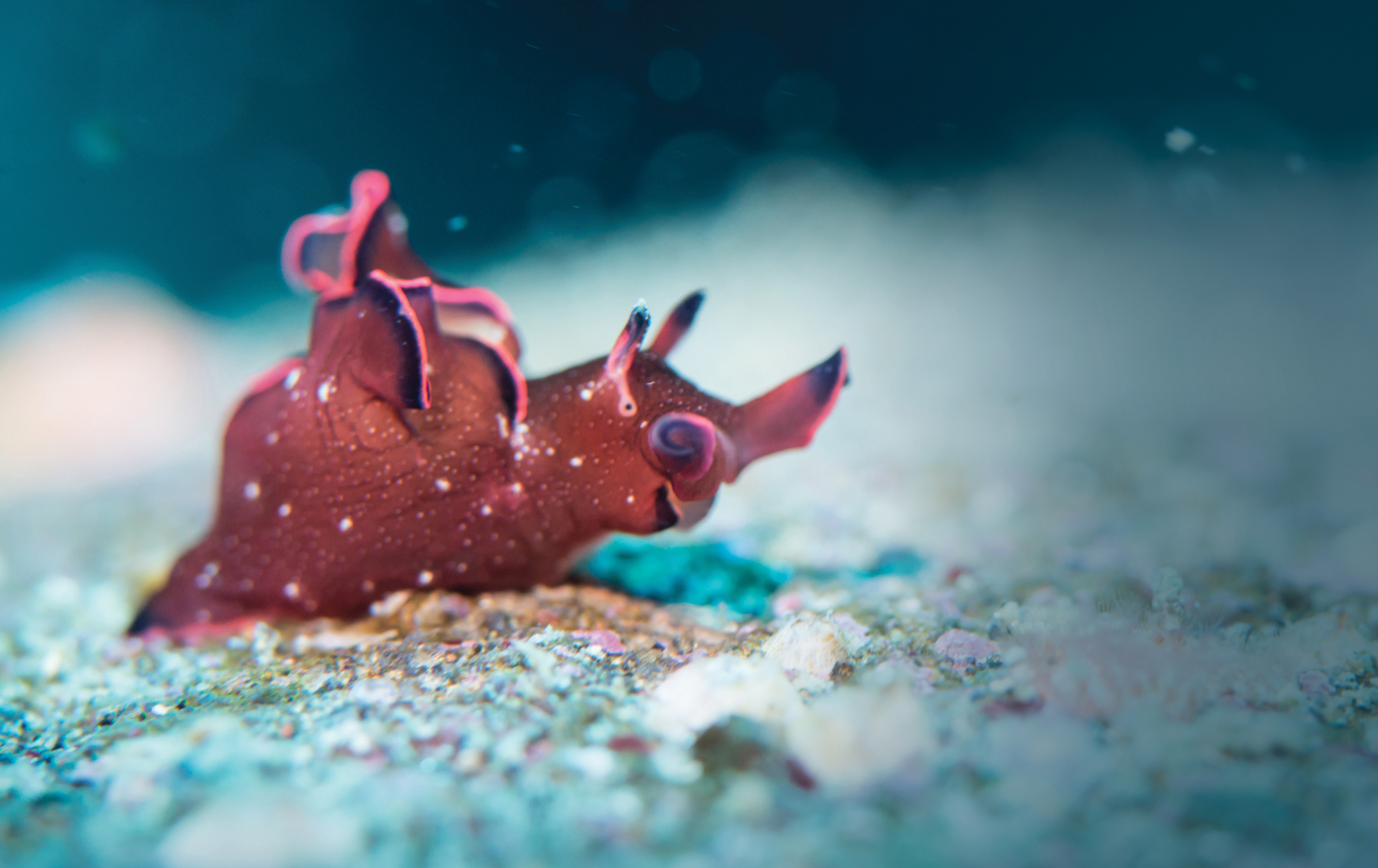
I thought of Aplysia—the giant sea slug genus commonly known as “sea hares,” despite being slow. In 1970, neuroscientist Peter Harley pinned over 80 California sea hares (A. californica) to dissecting tables and severed the nerve cord to their right pleural ganglion. These methods would lay groundwork for experiments by associates of Eric Kandel, whose Nobel-winning research described neural memory: the fundamental biomechanics of learning. Vivisecting all these slugs helped achieve major advances in neuroscience, establishing concepts such as habituation and sensitization, despite the clear implication we biologists prefer to gloss over: it had to hurt.
Sentience is ill-defined. Many conflate it with consciousness or self-awareness, but its etymology stems from the Latin verb sentire: to feel. Its earliest known use in English dates to the 1600s, in reference to “the power of… sense-perception.” The Merriam-Webster dictionary defines sentience as “feeling or sensation as distinguished from perception and thought” [emphasis added]. It is one of the five primary human senses, the tactile sense carried by electrical signals throughout the nervous system. Sentience is more than just pain; it is the gratification of an itch and the stimulation of a tickle, the warmth of a caress and the chill of a first kiss. But acute pain is its most lucid and universal expression—the manifestation of a neurological process known as nociception: the perception of noxious stimuli.

A great diversity of life forms possess nociceptors and other neural machinery associated with nociception, indicating that pain is a fundamental evolutionary adaptation. Over billions of years, the simple nerve nets that animate sponges and jellies branched out into stunning complexity, imparting incredible cognitive capacities, from the escape artistry of the octopus to the spatial memory of the orangutan. These cognitive feats are built from the common heritage of all animal life: the capacity to feel.
It is critical to differentiate concrete concepts like sentience and cognition—the processing of sensation—from abstract ideas, such as consciousness and emotion. Philosophers past have described the benchmark for consciousness as “subjective experience,” a standard often interchangeably used for sentience. Yet abstractions like this cannot be empirically substantiated. Objective evidence of subjective experience is a contradiction in terms, an impossible standard that sets animals up to fail. The concept of sentience, however, allows us to acknowledge that other species can suffer, even if we can never know what they think. Consciousness is an endless philosophical question. To evaluate sentience, let us deal in observable phenomena.
Western science has been reluctant to acknowledge the sentience of other animals, just as it has been toward other theories that challenged the myth of human supremacy, such as natural selection or the heliocentric universe. Since antiquity, decorated thinkers have confidently asserted that other animals were mindless and incapable of suffering. This belief has been a fixation of western philosophy, from Aristotle to Descartes, who proclaimed other animals to be soulless “automata” as he cut open their beating hearts.
While today, most believe the mammals Descartes mutilated suffered horribly, similar arguments persist with respect to species such as fishes. In response to objections rising to the popularization of recreational fishing in the 1960s, South African ichthyologist J.L.B. Smith articulated some of the first scholarly arguments against the sentience of fish, reasoning that sea life was “primitive,” the same reason he believed Africans felt “comparably less pain than Whites.” While researchers have since shown that fishes’ brains light up with electrical activity upon exposure to noxious stimuli, after which they breathe heavily, rub their injuries, and seek analgesic, the thrust of Smith’s argument remains relevant.
Often in science, the benchmark for sentience is set exceptionally high, moving the goalposts to standards we don’t expect as evidence of other sensory systems. For instance, when observing that another animal has functional eyes, few will challenge whether the animal can see. Yet when presented that an animal has nerves, their faculty to feel inspires vigorous debate. Some may concede that animals with nociceptors might feel, yet question, “Can they feel pain?” This is like looking at the rod photoreceptors and asking, “But can they see shades?” This is precisely the purpose of the organ—and we can test whether it functions by observing the animal’s reaction to a stimulus. Of course we can never know exactly what they experience, but the presence of functioning receptors is considered sufficient evidence of vision, olfaction, sound reception, and yet we have carved an exemption for sentience. This is not shrewd skepticism. It is cognitive dissonance.
As a result of this motivated mystification of sentience, even far more complex cognitive indicators are more readily accepted. Take mirror self-recognition, in which an animal is shown their reflection, then marked on their face and shown the mirror again, testing whether they gesture or react to the mark. The earliest of these experiments on primates were considered breakthroughs toward establishing evidence of non-human self-consciousness. They were then applied to other species, becoming a sort of cognitive benchmark.
Mirror tests are inherently biased toward visual species with appendages to gesture or facial musculature to convey reactions. Even still, animals from red ants to cleaner wrasses are now considered to have passed, challenging us to examine our default assumption, or null hypothesis, that other animals are unconscious or unfeeling until proven otherwise. Instead, considering that no animal has ever been proven to lack consciousness, evidence is far more robust for a new paradigm: assuming that all other animals are self-aware.
However, our sentience and self-awareness does not make us superior life forms. Often, philosophers have attempted to use sentience to “draw the line” of moral worth on the proverbial tree of life. In 1975, Peter Singer drew it “somewhere between a shrimp and an oyster” in his book Animal Liberation, arguing bivalves had no capacity for sentience and cognition. He wasn’t looking closely.
Every oyster is born a planktonic larva, at a metamorphic stage called the trochophore. After several weeks, their final larval stage, the pediveliger, begins searching for a home, listening for the sound of a reef. Like larval fishes, crustaceans, and corals, these “sonic youth” preferentially settle in healthy habitats. There, the oysters take their final form, living up to decades in aggregations. Oyster colonies exhibit fascinating social behavior, reorganizing in response to changes in light, noise, and water chemistry.
Other bivalves are equally complex. Clams will pump water to disperse their scent when a predator is near. They hide their sensitive mantle when shadows pass above. Mussels can differentiate the scents of predators, burrowing deeper when a lobster approaches and huddling together when they smell a drilling snail. They can also learn from past exposure to parasitic trematodes, intaking less water and forgoing food to avoid infection. Scallops construct a mental representation of their environment from their many eyes, which they use to try to escape dredge nets, but become disoriented in bright lights, like deer. And of course, just like their close gastropod relatives in laboratories, bivalves avoid noxious stimuli.
Still, debate persists over whether bivalves and gastropods can really feel. Some argue they lack a central nervous system (CNS) and a brain—yet this is disputed by marine biologists and, regardless, can be argued of all invertebrates. The vertebrate CNS includes the spinal cord, which invertebrates of course do not have. If the spinal cord is a requirement for sentience, then a lancelet would pass and an octopus would fail. Furthermore, invertebrate “brains” like that of the octopus are analogous structures to ours. We also say the octopus has “arms,” but of course we don’t assume they function like our own. Both the human and octopus brains are neural processing centers, yet are constructed from entirely different organs in wildly different organizations. Finally, if centralization indicates sentience, octopuses might fail this metric as well, as around two-thirds of their neurons are outside the central brain structure, distributed throughout a brain-like ganglion in each appendage.

Of course, an oyster does not bear the cognitive complexity of an octopus, but to point to the octopus’ advanced cognition as a justification to ignore that of the oyster is the same logic as using the human intellect to justify exploiting a chicken. At once, the extraordinary nervous system of the octopus has evolved both convergently toward ours, and divergently from molluscan ancestors who share the same fundamental neural organs and mechanics as their fellow invertebrates—just as we do with other mammals, reptiles, and fishes. Sentience is therefore expressed across a great radiation of life with many gradients and intricacies.
This, of course, raises the question of plant sentience. Indisputably, plants react to tissue damage and sometimes tactile stimuli. Certainly animals, with our unique nervous systems, have a distinct ability to feel pain, but could plants possess an analogous sense, using chemical neurotransmitters through vascular tissues instead of electrical signals through nerves? We may never know.
Yet the prospect of plant sentience should not prompt us to reject animal rights. In fact, it compels us to recognize them even more strongly. The number of plants killed annually for human food far outstrips even the trillions of animals, yet more than a third of the caloric yield from those plants and more than three quarters of all agricultural land is used for animal farming. An animal’s metabolism can only assimilate a fraction of the energy and nutrients it consumes, thus only 12 percent of the calories embodied globally in animal feed become human food. Therefore, a plant-based food system incurs the killing of far fewer plants and animals, both in farms and in the ecosystems displaced to develop them.
The inner lives of other life forms are unfathomably fascinating. Plants can learn and remember where to find light and nutrients. Fungi can evaluate their surroundings and make decisions on where and how to grow. Even bacteria exhibit intricate social communication. The implications of these realities beckon us not to picture our own thoughts in the mind of a mushroom, but to open our imagination to how other species might perceive the world in ways we cannot conceive.
However, one thing that is definitively not sentient, and never will be, is software. As a programmer, I have built and trained machine learning models. It is accurate to attribute to them a form of “intelligence,” but we call it artificial for a reason. What software shares with our biological intelligence is the capability to process logic. In fact, a computer’s ability to perform a logical procedure far exceeds our own, both in speed and in scale—and this is precisely because they do not think. Our logical capacity is colored, in some cases inhibited, by our more primary cognitive faculties, by our sentience.
The trendy idea of “sentient AI,” associated with the rise of conversational language models, belies a fundamental misunderstanding. First, it conflates sentience and consciousness. A language model returning predictive text, however correct or convincing, does not suggest that it feels pain. An autonomous vehicle would actually be a better candidate for sentience, with tactile sensors transmitting signals to a processing chip to inform navigational decisions. Yet this is far from nociception.
However, recent advances in robotics have emulated nociception. For instance, prosthetic prototypes with sensitive thermal sensors can send shocks to the nervous system, mimicking reflexes to prevent burns. Yet this is an augmentation of the user’s tactile sense, akin to a hearing aid. Still, some experimental robots have been designed with tactile memristors and functions to detect and avoid damage. We could call this a form of artificial nociception, but is it sentience? Pain is more than just a reflex—can we see the signs we observe in other animals in a machine? What would they look like? Would its mechanical arms seize in panic? Would its hydraulic fluid spike with stress hormones? Would its camera sensors well with tears? Would it truly suffer?
The idea of AI sentience remains trapped in the misguided paradigm of evaluating non-human intelligence by its resemblance to human behavior. It is sad that our society is so generous in considering the sentience of machines, yet so skeptical of other creatures. We sympathize with software that prints “I don’t want to die,” without bothering to learn the languages others use to make the same plea.

All life has value. Even if they aren’t sentient, the endangered wildflower and the ancient coastal redwood should not be cut. However, it is logical and noble to extend special protections to animals, whom we know can suffer pain. It is natural to be partial to our fellow humans and to feel an indescribable connection to our favorite animals. But we must acknowledge that there is no objective basis to these preferences. It is equally valid to appreciate and value dogs as it is cats, or for that matter pigs, chickens, anchovies, or oysters. Founding the case for animal rights upon the universal value of all life imparts a more robust epistemology that does not undermine itself by ranking the value of species against one another.
We all know how it feels to be hurt, perhaps even in a way that no one else seems to understand. In these moments, we wish for nothing more than someone to acknowledge our pain. Sentience imparts us visceral, universal signals which we innately recognize in others, but have been conditioned to disbelieve. Other life forms cannot describe their pain to us, yet we can still listen. If there is a line of moral worth to be drawn across our tree of life, it should be below, through the common roots from which we all grow. Our world is so much more complex and wondrous than the myth of human supremacy would have us believe.



.png?width=352&name=Screenshot%202026-09-04%20at%204.00.52%20PM%20(1).png)
%20(1).jpg?width=352&name=miasma-1%20(1)%20(1).jpg)