Unlearning the Myth of Red Texas
From cowboys to labor leaders, David Griscom's debut book calls on Texans to reclaim their leftist roots—and examine who buried them in the first place.
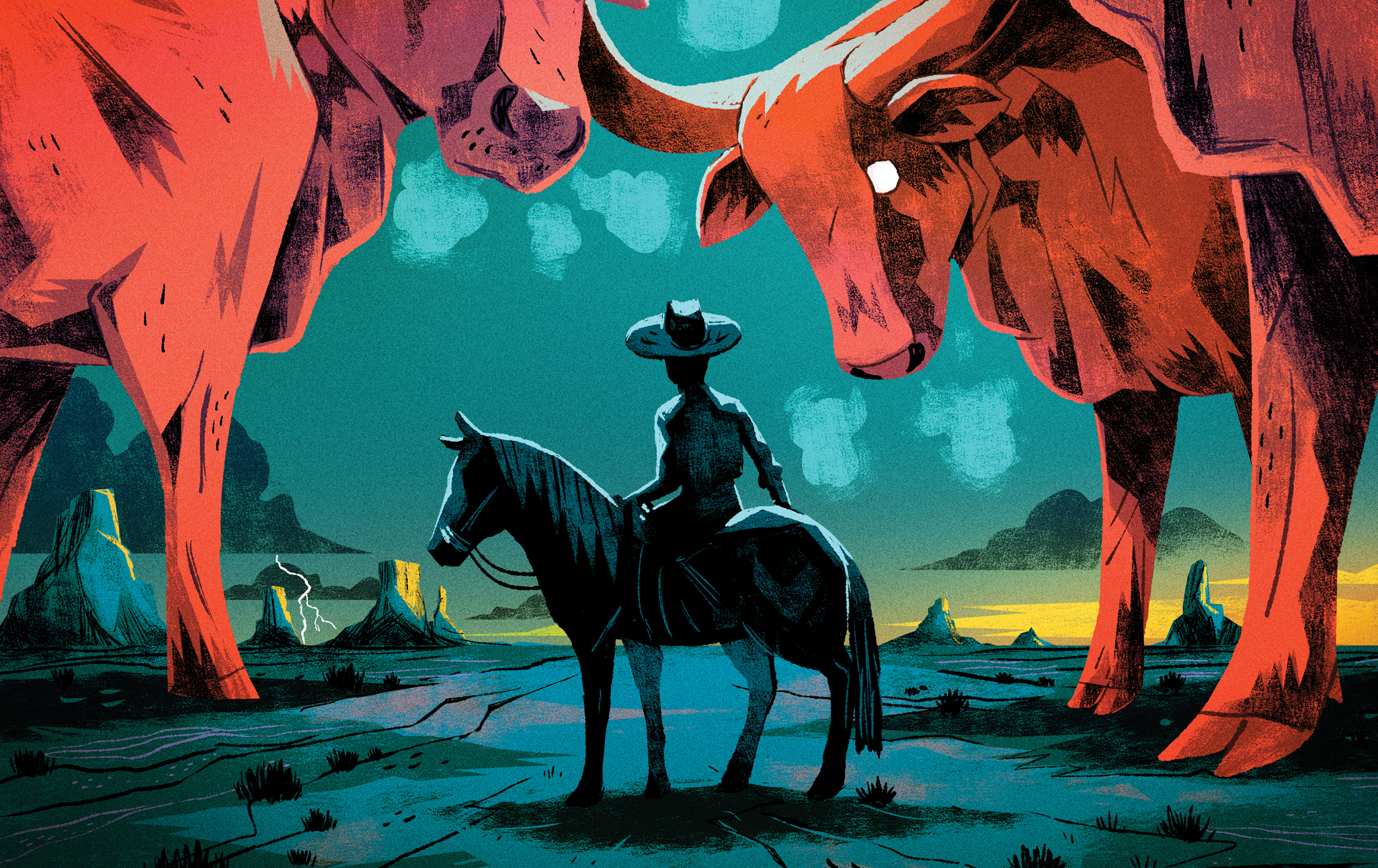
In Texas, our heritage is a sacred cow. We close our eyes and we can see the huge sky, the mesquite trees in the hill country, the spindly pines in the east, where I am from, and the green waters of Galveston. We watch Westerns—my father loves them—and we see ourselves in the outlaws, the cowboys who rode across the open range with their cattle, bandanas pulled over their noses to keep out the dust. Though I am from the suburbs, a creature of air conditioning far removed from any kind of cowboy living, I spent nearly every weekend for a decade in a more rural corner of Harris County, riding horses behind a limestone house. There was perhaps nothing I heard more during my lessons than, “Get tough!” And as I did, a small child alone atop a horse kicking him along with all of my might, I had a latent sense that I was participating in some grand tradition. Under that sticky, humid, unrelenting Texas sun, you whip the horse, you do the work, and for the love of all things good, you do not talk back (which of course, I was liable to do, anyways). This was what we got for being born in Texas: an inheritance of grit, land and rugged individualism that our state has proudly fought for since its inception. Hell, even our zip-loc bags, purchased from beloved local grocery chain H-E-B, read “Texas Tough.”
But what if someone had tinkered with our view of the past, gone through it with an editor’s pen and changed the story of where we come from, and therefore who we are? What if our cowboys were rugged, yes, but not the hyper-individualists we thought they were, and Texas, or at least its government, was not always on their side? Indeed, the original cowboys had a very different relationship to their bootstraps than Texans of today, and if they were still around, they might find themselves as outsiders in a state that still likes to dress up in their jeans. If you’re a Texan reading this, and I’ve just touched a nerve, then David Griscom’s new book, The Myth of Red Texas: Cowboys, Populism, and Class War in the Radical South, will get you up in arms.
“Republicans in Texas have been skillful at crafting a version of Texas history that is favorable to their current goals. And they are not afraid of using their political power to enforce this Narrative,” Griscom, a Texan who hosts the political podcasts Left Reckoning and The Jacobin Show, writes in the introduction to his book. He’s right, and their narrative strategy starts as early as elementary school. Every student takes Texas history, where they learn about life on the open range, frontiersman Davy Crockett, the Alamo he died defending, and the few years Texas operated as an independent republic. As a young student in the 2000s, I got the impression that early Texans were freedom-loving rebels in the style of the cowboys, and the state today, with its limited, conservative government, is an inevitable outgrowth of their moral belief in autonomy. Texas’s modern wealth, success and enviability come from that love of freedom, an inherently capitalist value that teaches us how to build great things on our own, take care of ourselves by ourselves, and do whatever we damn well please. Looking back, the education—which is impossible to fully separate from the cultural lessons I got outside of the classroom in a conservative town—now feels less like history than it does software, a process of calibrating young minds to the state’s default setting. This narrative was so pervasive that even my Spanish teacher gave a lesson (in English) on why socialism, with all its big government programs, is bad.
For this story to appear true, Griscom writes, huge swaths of Texas history had to be ruthlessly re-written. The Myth of Red Texas offers a first-of-its-kind, jaw-dropping corrective. For example, those cowboys we iconize? Griscom tells us they were not Texas’s golden boys, but at moments, the enemies of the powerful men who built our state. In fact, cowboys were actually some of the first labor organizers; not lone wolves, but people who worked together to fight for fair wages and public ownership of Texas’s vast land. When the early corporate ranchers put up miles and miles of barbed wire around their newly acquired property lines, these land-owners willfully broke up cattle trails cowboys had used for decades and claimed exclusively as their own water sources necessary for the livestock’s survival. So the cowboys cut the fences. Instead of coming to their senses and sharing the state’s bountiful resources, the ranchers colluded with the government, who sent the Texas Rangers after our cowboys—rangers who took “morbid pleasure” in hunting them down. When those same ranchers tried to underpay them, cowboys banded together and went on strike in 1883. According to the U.S. Commissioner of Labor, the cowboys won, though many history books will errantly say they lost. In an epic debunking, Griscom writes:
The simple fact is that when Thomas Harris turned down his boss’s offer to break the strike and preserve his $100-a-month position, it was not because of a ‘value system of the rugged individual.’ Call it neighborliness, bravery, or simply looking out for the men riding next to you on that day in Old Tascosa. In any case, being a cowboy in those days—not just working on the range, but more broadly, living by Texan values—meant solidarity.
Without the support of Texas leadership, who vastly preferred to align with rich people, the cowboy’s cooperative mindset matured into worker’s unions and a formal political force that abhorred financialization and corporatization. This coalition had its own left-leaning magazines and ran its own independent political candidates who likely would have won statewide seats had the much more conservative Democrats not rigged the elections. One such candidate, Thomas L. Nugent, advocated for a “gospel-infused socialism,” and beat out the Republican candidate in 1894, winning 36 percent of the vote despite the fact that the Democrats, who controlled the state, intimidated voters and just so happened to run out of Populist Party ballots on election day. Nugent had the support of the United States’ most famous socialist, Eugene V. Debs, an affinity that might have seemed obvious at the time. He aligned himself with the populist Farmer's Alliance, whose 1886 Cleburne Demands—published as the group became more politically active—was among the first formal documents to detail many of American socialism's priorities, from the end of convict labor to taxes on speculation. As The Myth of Red Texas explains:
Gone was the traditional language of rural revolt, of conflict between town and country. Here, instead, were bold and explicit condemnations of arrogant capitalists and powerful corporations. […] [T]he farmers now saw themselves not just as allies of the union movement but as members of the same class—the working class. The demands should be considered the founding documents of the progressive and the American socialist movement.
True though it may be, Griscom’s Texas is not one that Texans will easily recognize. The reality is that American populism started in Texas. It gave way not to a proto-MAGA belief system, but to one of the largest, most radical band of socialists in the country, cultivated right here in the Lone Star State. This is a major, multi-generational political movement that, with some conniving strokes of an eraser on the whiteboard, has gone poof into thin air. “The fact that maintaining a particular politicized view of Texas history requires very active enforcement from conservative politicians shows that it’s not some natural outgrowth of simple facts. It’s a concerted effort for Texas to be seen in a certain light,” Griscom writes.
To help readers integrate all this new, opposing information as smoothly as possible, Griscom uses archival details to reconstruct left-leaning historical characters and stories that Texans can see themselves in, nicknames and all. There’s the blunt, punny name given to Thomas “Red Tom” Hickey, the Irish-born leader of the Texas Socialist Party, who was arrested without a warrant by a one-armed Texas Ranger, apprehended at the post office as he was picking up 60 sheets of a publication he had contributed to. There’s Thomas Harris, that angry cowboy striker, who started his own cattle business in New Mexico called “The Get Even Cattle Company.” We meet “Stump” Ashby, a leader of the populist Farmer’s Alliance, who worked as a circus clown before entering politics. His colleague, J.H. “Cyclone” Davis, earned his nickname after he so thoroughly demolished a Kentucky Democrat in a debate that a local paper declared him “The Cyclone from Texas.” (Texans know how to put on a show.) There are enthralling tales of encampments, multi-night outdoor socialist retreats where thousands gathered to hear “fiery populist speakers [talk] about the evils of capitalism,” dance, and debate. By the time I finished reading about the revelry, I was yearning to attend an encampment myself. I suspect this was Griscom’s intended effect. “While abstract principles are important, alongside calls for solidarity with the people and the working-class, it is even better when you know the names of those you are standing with,” he writes.
And from the mouths of these oh-so-Texan characters, we hear the same ideals and quandaries that we might in a Democratic Socialist meeting today. Should they accept the Democrats’ watered down reforms, or demand more? Why is that, as one traveling lecturer put it, those “who work most get least, and those who work least get most?” In one newspaper article, an eloquent farmer poses: “When you are laboring side by side with your wife and daughter and see your children developing into manhood and womanhood with minds uncultured and bodies deformed from labor, ask yourself if you live in a free country.”
Lefty Texans like me will happily work our way through the book, but the question remains, will moderate and conservative Texans buy it? Probably not in large numbers, not yet. If there is anything we have learned, it’s that facts are not enough to change someone’s mind. Persuasion must be narrative and gripping. Though there are moments of convincing drama and thrill, there are others in which the text is bogged down by the intricacies of interparty politics from 125 years ago. Names pile up, the story feels rushed, and the plot becomes hard to follow. What’s more, Griscom, an accomplished political writer, uses the language of the left without much explanation, which could intimidate someone who has never been exposed to political discourse beyond the morass that bubbles and burps on X. For example, jargon like “cooperative commonwealth” never gets a proper definition. When I was child, for no reason except for the energy in the air, I thought that unions were somehow mafia-adjacent. The simple term “working-class political movement” could make someone close the book. That’s not Griscom’s fault, but it is his challenge, and one this book at times fails to meet. I desperately hope that The Myth of Red Texas is adapted for film, where the characters unearthed by Griscom can tell these stories themselves, with much less politico speak and all the due drama.
Griscom’s book does, however, put modern, urban leftists in an unfamiliar position: he asks them to learn not from the historic failings of the South, but its successes. The Texas Griscom writes about is so similar to the United States we live in today. Both have a political reality dominated by powerful company owners determined to depress wages and exploit workers within an inch of their life. Both then and now, those in power have tried to pit minority groups against each other as a way to stifle solidarity and keep workers in line. Although, today’s company bosses are probably less likely to draw a gun on their striking workers. In this context, and without a single meme or bit of polling data, populists and socialists in Texas once spread an awareness among workers of their class position and turned it into a grassroots, class-rooted movement of economic populism. They did it person by person, through encampments, magazines and traveling lectures, creating a dedicated, celebratory culture of gathering, full of in-person debate, disagreement, and dancing. Griscom’s telling of Texas history makes their lessons clear.
There’s a tendency in the West and the North to call the South backwards, to scoff that its residents deserve the disastrous outcomes of conservative governance—be it infrastructure failure during a freeze or poor disaster recovery after a storm—simply because of their birthplace and how they may or may not vote. If this sounds heartless, know that I’ve heard such things numerous times, said to me by peers who have forgotten where I come from. These are the very people who need to pay attention to Griscom’s Texans. Their buried lessons of community and solidarity are all the more urgent right now as we encounter another moment of narrative seizure, a renewed, fierce attempt to tell Texans—and Americans—who they are.
In December 2025, Texas Governor Greg Abbott debuted a plan to put a chapter of Turning Point USA, the conservative youth political group founded by the late Charlie Kirk, in every high school. Texas A&M, a major university in the state, has severely limited what its professors are allowed to teach, only allowing discussion of race, history and gender if it flatters conservatives. Even the Alamo, a place we are famously supposed to remember, is not off limits. When the historic site’s nonprofit leader tried to share its “full story,” including the land’s indigenous history and the reason white Texas settlers waged battle here—to stop Mexico from abolishing slavery in the area, a reality I did not learn in school—Texas Republican leaders forced her to resign. Likewise, at national parks and monuments across the nation, the footprints of American identity, President Donald Trump has attempted to erase any mention of racism, in a country where Black people were enslaved for hundreds of years. What readers of Griscom will know is that their story, and their United States, is a myth.
Griscom’s book is an opening salvo. It issues an invitation to other Texans to finally wise up to the fact that we have been lied to, that our heritage has been manipulated. And if there is anything Texans hate, this Texan included, it is being taken for fools. The real cowboys should be pissed, and leftists across the country discount them at their own risk.