
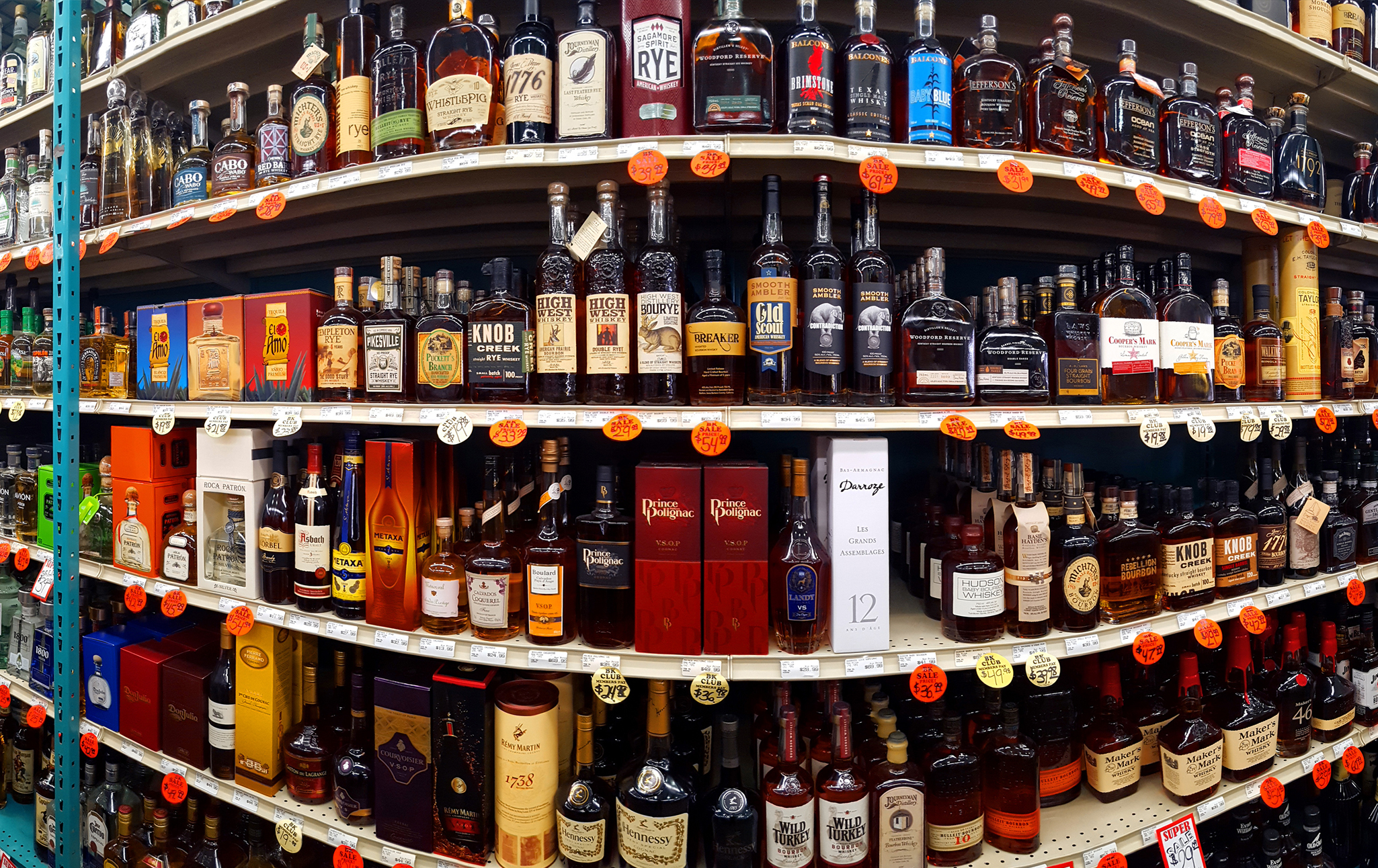
The rules say check IDs, refuse the drunk, protect the vulnerable. The incentives say do the opposite. Somebody has to live in that gap.
This story was co-published and supported by the journalism non-profit the Economic Hardship Reporting Project.

The moment you decide to work at a liquor store, you become a gatekeeper in America’s complicated relationship with alcohol. You’re the final checkpoint between proper procedure and its casual dismissal, between addiction and sobriety, celebration and excess, illegal indulgence and lawful libation. Nobody tells you this during your interview. They just ask if you can work weekends and lift heavy boxes.
I made no bones about all this at the outset of my employment. I have no particular qualms with being a purveyor of alcohol, or of any other addictive substance. If people want to drink, or smoke, or whatever else, they will. I’m just a cog in a causal chain far outside my control. Or at least that’s what I told myself to start. Many such cases on that score, I’m sure.
My actual problems came when I realized how much the rules and regulations were ultimately at odds with customer expectations and my manager’s methods. The first week at the local liquor store, I denied a sale to an elderly man who’d apparently forgotten his license. We’ll leave aside the matter of him having stumbled into the store from a car he somehow drove. “He’s a top customer,” my boss hissed. “Regulars don’t need ID, as long as someone vouches for them.”
Ah. I must have missed the “vouching” clause in the municipal code or the store handbook. In fact, the owner must have too. She specifically sits down with every employee and drills them on the importance of following procedure, since it’s literally the law and she could lose her liquor license if she violates it. As a lovely additional bonus, individuals who sell to people in violation of the law can, of course, be arrested and charged. But hey, good customer service is more important than all that, right?
Every day for the past six months, I’ve stood behind the counter, selling people substances that both enliven their parties (albeit often parties of one) and destroy their livers. I’ve watched weekend revelers become weekday regulars. I’ve seen people’s hands begin to shake, their complexions change, their personalities warp. All this while I continued to silently scan their bottles and take their money. Did I mention we also sell tobacco products?

The employee handbook is a masterpiece of contradictory instructions. We’re told to provide “exceptional customer service” while strictly enforcing alcohol laws. We should “build relationships with regulars” but never sell to anyone intoxicated. We should “maximize sales” but exercise “responsible vending practices.”
These conflicting directives create impossible situations. When I card the 40-something woman buying wine for her book club, she rolls her eyes dramatically. “Seriously? I’m flattered, but come on.” Her friends laugh performatively. I smile apologetically while holding firm. Later, my manager mentions our “customer feedback” objectives, needling me to thread the needle of enabler and enforcer more precisely.
When I refuse to sell to someone visibly drunk, they often become belligerent. One man called me every slur imaginable before knocking over a display of craft bourbon. My coworker Marco rarely denies these sales. “Not worth the hassle,” he says with a shrug. His customer satisfaction scores are stellar.
The worst moments come when I recognize the symptoms of abuse. The customer whose hands tremble until they take their first sip in the parking lot. The woman who comes in at 10:01 a.m., precisely one minute after the store opens. The young professional who rotates between liquor stores to hide how much he purchases.
I once attended a training about “responsible alcohol service” where we were told to never, under any circumstances, sell to anyone without personally verifying their age via government ID. Yet this routinely happens at our store, and we’re actually seen as the strict ones in the area simply because we bother to card people at all.
The regulars have nicknames for me: “ID Police,” “Buzzkill,” “The Narc.” My coworkers aren’t much kinder. I’m the one who follows the rules, which makes me the one who makes everyone’s day harder. I’m the one who insists on checking IDs even when the customer is “obviously old enough.” I’m the one who sometimes refuses sales when someone is visibly intoxicated.
“You’re costing us tips,” Marco told me once. (The very idea of getting tips here—as a retail clerk, rather than a waiter or barista—never quite made sense to me, but I didn’t bother quibbling about such quirks of a small business.) “Nobody wants to feel judged when they’re buying booze.” I suppose he has a point. I wasn’t trying to be harsh.
But what about when they should be judged? What about the woman who I know has multiple DUIs, a suspended license, and still drives to our store? What about the straw buyers who repeat bottle orders we just got an hour ago for people (often minors or problem drinkers) whose sale we already rejected? What about the man who comes in three times daily, hands trembling, eyes unfocused?
In fairness to management, a lot of the extreme cases are ones they refuse sale on. They don’t take chances, nor do my fellow clerks, when youthful-looking groups try to buy without ID. They’ve held the line, though inconsistently, when belligerent drunks (or even hostile non-drunks) hurl abuse at us during peak hours. The staff solidarity is especially strong near closing time. We all want to go home, and working together makes that happen faster. Plus, denying a sale 15 to 30 minutes before the doors lock is just easier.
Yet somehow I still seem to get the brunt of the blame for any denials, both in the eyes of our patrons and in the whispers of my coworkers. Perhaps this is the store’s ritual. I was told when I came on that the last guy didn’t last long. Maybe the store needs a token disciplinarian to play foil in the broader pantomime of liquor sales and supposed law abidance. When I inevitably leave, will it be someone else’s turn to get left standing in this game of musical chairs?
Our store’s owner visits monthly, always making the same speech about compliance. “One sale to a minor could cost us our license,” she warns. “One mistake could end all our jobs.” She emphasizes checking IDs for ALL customers, refusing sales to intoxicated or abusive customers, following every regulation to the letter.
What nobody names out-loud is that the contradictions aren’t accidental. The liability for getting it wrong falls on the clerk. Not on the owner, not on the manager, not on the handbook. The responsibility is on me, the person behind the counter, making twelve bucks an hour. The rules exist, are recited verbatim, and then quietly ignored or set aside whenever they become too awkward or expensive. I’m also, fun fact, the one who’d get arrested if a cop saw me fail to follow the law.
Naturally, two hours after the owner leaves, she calls my manager: “Why are sales down 15 percent from last quarter?”
The answer, which no one says aloud: Because some of us actually follow the rules she gave us.
The double standard becomes clearest during our quarterly reviews. Mine always contains some version of: “Quinn needs to build better customer rapport” or “Quinn should focus on creating a welcoming environment.” These are corporate euphemisms for “Stop carding people who look over 21” and “Don’t refuse sales to drunk customers who spend a lot.”
Meanwhile, Marco’s review: “Excellent customer service. Builds strong relationships with regulars.” Translation: Marco never causes problems by doing inconvenient things like following the law.
I’ve found my own survival strategies, however. I’ve learned to card someone while complimenting their outfit so they feel flattered rather than insulted. I’ve mastered the art of delaying service to intoxicated customers until they give up and leave. I’ve developed a sixth sense for when undercover officers are conducting compliance checks.
The most surreal moments happen when the worlds collide. When a local pastor comes in for communion wine but also grabs vodka “for cooking.” When a regular’s teenage daughter comes in with a fake ID, and I have to decide between embarrassing my regular customer and breaking the law.
I think the fundamental problem at play is that a strict clerk like me may seem more judgmental than is intended. Can I tell a problem drinker from a simple aficionado or social sipper? Of course. Do I have an issue selling to both? Not really. What’s odd is that even after months here, I still think the only judgments of consequence are legal ones.
Yet it’s hard to build the rapport my manager says I need when I have to balance being non-judgmental of people’s life choices with being watchful of possible illegalities. I disassociate, and then get called out for not being fully present. Meanwhile some clerks just straight up do shots with customers at the counter.
The liquor store reveals human nature stripped bare. We all want to be seen as normal, functional, in control—especially when we’re buying something that can take that control away. We want to be welcomed in by friendly faces, but maybe not so effusively that we’re reminded it’s our third or fourth visit in less than 24 hours.
There are so many potential controversies and incongruities. The tightrope act and the circular logic wear on me. For some, the idea of being an enabler might keep them awake at night. For me, it’s the prospect being an enabler and somehow an “unfriendly” or “unpleasant” one at that. Customer approval still matters, even at the bottom of the barrel.
Last month, Rick—another regular my manager overrode me to sell to—didn’t come in for his daily purchase. The next day, his daughter visited the store. She was clearing out his apartment and found our receipt in his wallet. She wanted us to know he had died of liver failure. “He always said you people were his friends,” she told us, her voice conflicted, perhaps bitter.
Were we his friends? Or were we his dealers? Were we providing customer service or facilitating his slow suicide? The line feels impossible to draw when “just doing my job” has so many messy implications baked in.
My manager was quiet the rest of that day. He started checking IDs more stringently, and declining sales more often. It lasted about a week.
Sometimes someone comes in for champagne to celebrate their promotion, or wine for their anniversary dinner, or craft beer to enjoy with friends while watching the game. I remember then that alcohol itself isn’t the villain. What matters is the relationship we have with it. And my job puts me at the crossroads of those relationships.
The training manuals never tell you how to handle this contradiction. They don’t tell you how to reconcile “customer satisfaction” with moral responsibility. They don’t explain when rules matter and when profit matters more. They don’t prepare you for becoming the villain in someone’s story simply because you follow the law.
This industry treats these inconsistencies as part of its charm, not problems to solve. The rules exist to be selectively enforced, creating a hierarchy of who matters and who doesn’t. We card the college students religiously but let the middle-aged businessmen slide. We refuse service to the homeless man who smells of alcohol but serve the well-dressed woman who’s clearly had too many at brunch. We pride ourselves on being gatekeepers while leaving the gate wide open for the right people.
I’ve witnessed colleagues face verbal abuse for enforcing rules, only to be reprimanded by management for “customer complaints.” I’ve seen fellow cashiers praised for record sales numbers achieved by ignoring every ethical guideline we supposedly uphold. I’ve watched my own principles erode in tiny increments as I learn which battles to fight and which to surrender.
“So where’d you go to college?” customers sometimes ask me, assuming this job must be temporary for someone who appears educated. They’re looking for reassurance that I’m merely passing through, that someday I’ll land a “real job” where legal or ethical compromises aren’t built into the daily routine.
I answer vaguely, not because I’m ashamed of my background, but because I’m tired of the patronizing responses. “Oh, you’re too smart for this,” some exclaim, as if intelligence exempts you from ethical dilemmas or pays your rent in an economy where education guarantees nothing.
The truth is that like many service workers, I’m trapped in concentric circles of hypocrisy. The law demands we deny sales to the cardless and the compulsive, while our managers demand we keep regular customers happy. Society expects us to prevent the worst excesses while relying on excessive purchases to keep our businesses profitable. Customers want us to be friendly but not familiar, professional but not judgmental, efficient but not rushed.
My manager appreciates me most when I manage to ingratiate myself to someone who purchases their third handle of vodka in a week. Just as he compliments Marco for recommending bigger bottles to partygoers, or tells someone else to be nicer when turning people away for lack of ID. We’re all participating in systems that reward the wrong behaviors on the sly, even whilst officially denouncing them as a matter of policy.
Other days, I can’t seem to catch a break. Last week, my manager brought me into his office. “Low sales, poor feedback. Last warning, Quinn. Team players should have better metrics.”
I stood there, wondering what “team” I was supposedly on. The team that profits from addiction? The team that selectively enforces rules? The team that values short-term sales over long-term ethics?
Or maybe there is no team, just a collection of individuals making their own compromises, drawing their own lines in constantly shifting sand. Maybe there are no answers. Perhaps the answer changes day to day.

I don’t have illusions about changing the system. The liquor industry, like most service industries, runs on contradictions. We sell liberation while creating dependence, we promote celebration while facilitating sorrow, we offer community while fueling isolation.
So I keep carding people who look under 40. I keep hesitating when hands tremble reaching for bottles. I keep being the least popular employee and the one with the lowest customer satisfaction scores. I keep doing what I’m officially told to do while being unofficially punished for it. It’s a job defined by puzzles and paradoxes, ones I muscle through just so I can pay my rent.
In this strange moral landscape, perhaps the most ethical thing I can do is simply stay vigilant. Be aware of the hypocrisy, aware of the compromises, aware of the human cost behind not only the failure to follow stated policy in favor of unstated norms, but of the specific compromises this job demands. My pauses and vigilance need not be harsh judges of the customers as people, but of the positions we all find ourselves in. That pause could serve as a suggestion, a vehicle to make someone consider their choices, even briefly. Why come to a liquor store without ID? Why drive there in a car without your license? Why come at 10 in the morning, then 3 in the afternoon, and once more right before close? Why be upset with me for noticing?
Sometimes a small act of consciousness, of attention to details, is the only power any of us have. I know it shouldn’t be. But until people setting the tone are incentivized to truly value the standards they claim to, to prioritize the rules they tell me to enforce but resent me for actually following, this is what there is. I hope we all make better choices tomorrow.


.png?width=352&name=Screenshot%202026-09-04%20at%204.00.52%20PM%20(1).png)
%20(1).jpg?width=352&name=miasma-1%20(1)%20(1).jpg)