For decades, American companies dumped cheap, low-quality chicken products on Nigeria, devastating the country’s agriculture. But Nigerian farmers are fighting back.
In 2003, Nigeria banned the importing of frozen poultry to mitigate its negative effects on the economy. The decision was not made due to disease or sudden health risk, but to stop Nigeria being a destination for American surplus chicken parts, a practice that was devastating local farmers. For decades, U.S. producers had exported millions of tons of dark meat, cuts often unwanted in the American market, at prices that made it impossible for local, free-range farmers to compete. Even after the 2003 ban, this surplus was still smuggled into Nigeria. So the prohibition was reinforced in 2015 by “Operation Hawk Descend,” a crackdown on smuggling via Benin. The ban remains in full force today, recently reaffirmed by Minister of Livestock Development Idi Mukhtar Maiha.
This quiet, anti-imperialist food war, which is likely unknown to most Americans, is an important case study in how global power and finance operate today. If studied closely, it will reveal a system that devalues both animals and humans in the Global South as disposable. The United States’ agribusiness and their trade representatives create a perception of “cheap protein” to support their exporting practices, yet fail to take into account the cages in which those chickens have lived, the workers who slaughtered them, and the generations of local farmers whose lives’ work is deemed “inefficient.” In this system, only the bottom lines of international mega-corporations count.
But here’s the hopeful part: Nigerians are standing up to this. The struggles of these farmers have now become the collective struggle for all Nigerians. Nigerians are now fighting against the predatory global economic dogma which sees the worth of humanity, the dignity of rural people, the well-being of ecosystems, as secondary to the pursuit of wealth and profiteering from predatory trade, and they are winning.

The Dumping Machine and Its Human Cost
To understand how Nigeria became a dumping ground for U.S. chickens, one must look back into the late 1970s and early 1980s, when the World Bank and International Monetary Fund (IMF) advised Nigeria to open its market as part of Structural Adjustment Programs (SAPs) designed to promote economic development. The reason was that if protective measures for domestic businesses were removed, markets opened to foreign competition, and goods allowed to freely enter Nigeria, the economy would thrive—or so the IMF argued.
In some ways, it did thrive. Nigeria’s GDP grew by 7.33 percent in 1988 and 11.78 percent in 1990. But, a key aspect of the plan was ignored: local producers were left defenseless. At the time, the country’s poultry farms were largely family-owned small farms and were unable to compete with the overwhelming volume of low-cost chicken being shipped into the country, primarily originating from the U.S. and EU. As of the early 2000s, Nigerian domestic producers supplied less than 50 percent of national demand for chicken. Annually, Nigeria produced approximately 300,000 metric tons of poultry products each year, leaving a wide gap of more than 1.5 million metric tons. After the 2003 ban on poultry imports,, smuggled chicken accounted for 1.2 million metric tons, which led to the collapse of the domestic poultry industry.
The U.S. government actively facilitated this process. The huge subsidies American poultry growers receive allow them to profitably export excess lower-value (dark) meat, unwanted in the U.S. market, to other parts of the world at prices well below what they cost domestically. As former President of the USA Poultry & Egg Export Council James Sumner stated in 2018, “Our primary markets are in undeveloped and developing countries because our chicken leg quarters are the lowest-priced meat protein available.” This is a very structured operation. A 2010 study showed that in 2002 alone Benin, which had limited poultry production to support local consumption, sent 52,000 metric tons of frozen poultry to Nigeria, representing 60 percent of all poultry imports to Nigeria that same year.
In the opinion of the Nigerian government, this is merely dumping under the guise of trade. The World Trade Organization (WTO) defines “dumping” as introducing a product into the commerce of another country and selling it at an amount lower than its normal value. In the WTO definition, “normal value” can be defined as selling below cost of production or selling below the price that is charged in the exporter's country of origin. So, by this definition, U.S. chicken processors are dumping surplus poultry in Nigeria, and calling this action commerce.
The result has been the collapse of local markets. At their peak, imports accounted for nearly half of all poultry consumed in Nigeria. Nigerian farmers, who raised the birds on free-range and nutritious grain, watched helplessly as their businesses were driven under by frozen chicken legs sold for a price with which they could not possibly compete. Small-scale farmers (especially women) disappeared from the economic scene. Many were forced to sell their produce on the street, while others migrated to urban centers in search of jobs that never materialized. Rural communities, which had previously been sustained by local food production, became dependent on imported products and urban food distributors.
Meanwhile, the dream of providing “cheap protein” turned out to be an illusion. The nutritional argument against imported chicken is strengthened by several factors. Many imported chickens are injected with saline to add weight, thus diluting its protein content and increasing the sodium content. This is an extremely serious matter because the Nutrition Society of Nigeria (NSN) states that the average sodium consumption by Nigerians is greater than the recommended amounts established by the World Health Organization (WHO). This has contributed to what has become a nationwide crisis: hypertension that affects approximately 30 percent of all adults in Nigeria.
Some consignments have also been found to contain rotting products or labels that misrepresent the contents, raising further questions as to the safety and quality of imported chicken. For example, in 2015, Nigerian customs confiscated cartons of rotten poultry at the Port of Lagos. In another case, officers of the Nigeria Customs Service seized 24,273 cartons of imported frozen poultry products with duty paid value of N256 million. Afterward, Comptroller Haruna Mamudu stated that, “these poultry products are preserved with chemicals used to preserve dead bodies also.”
The failure of the local poultry industry was not simply a result of unfortunate circumstances; it was instead a predictable consequence of government policy. When it adopted the IMF’s Structural Adjustment Programs, the Nigerian government’s elimination of protective tariffs resulted in a free flow of cheap poultry into Nigeria. Combined with a continued smuggled poultry surplus fueled by U.S. agricultural subsidies, this fateful decision ultimately caused the collapse of the local poultry industry. In this way, global agricultural trade creates an advantage for large-scale North American and European-based food manufacturers, but does not adequately address the needs or concerns of Nigerian families, workers, or animal welfare, which become nothing more than collateral damage.
This economic conflict continues even today. In 2025, the United States imposed a tariff of 14 percent on Nigerian exports, retaliating against what President Donald Trump called Nigeria’s “unfair trade practices”—among them, the banning of importation of frozen poultry and other agricultural products. Once again Nigeria, rather than retaliate against American imports, chose to work through the World Trade Organization. The Nigerian agricultural industry began using the phrase “Chicken Colonialism,” to describe the dominance of foreign poultry over local markets.
The Myth of “Cheap Protein” and the Paternalism of Foreign Aid
This system is justified by a powerful, paternalistic myth. For decades, major U.S. agribusiness companies and their trade representative organizations have portrayed the dumping of chicken in the Global South as providing a much needed service to the developing and undeveloped countries. James Sumner summed up the argument well: American chicken is the cheapest source of protein for them. However, this “cheapness” is an illusion, rooted in a fundamental divergence in animal welfare.
In the U.S. industrial system, chickens are genetically selected for rapid growth, often leading to skeletal disorders and organ failure. The chickens live in large, enclosed environments with no windows. Antibiotics are commonly given to chickens in these systems to help them make it through the poor living conditions.
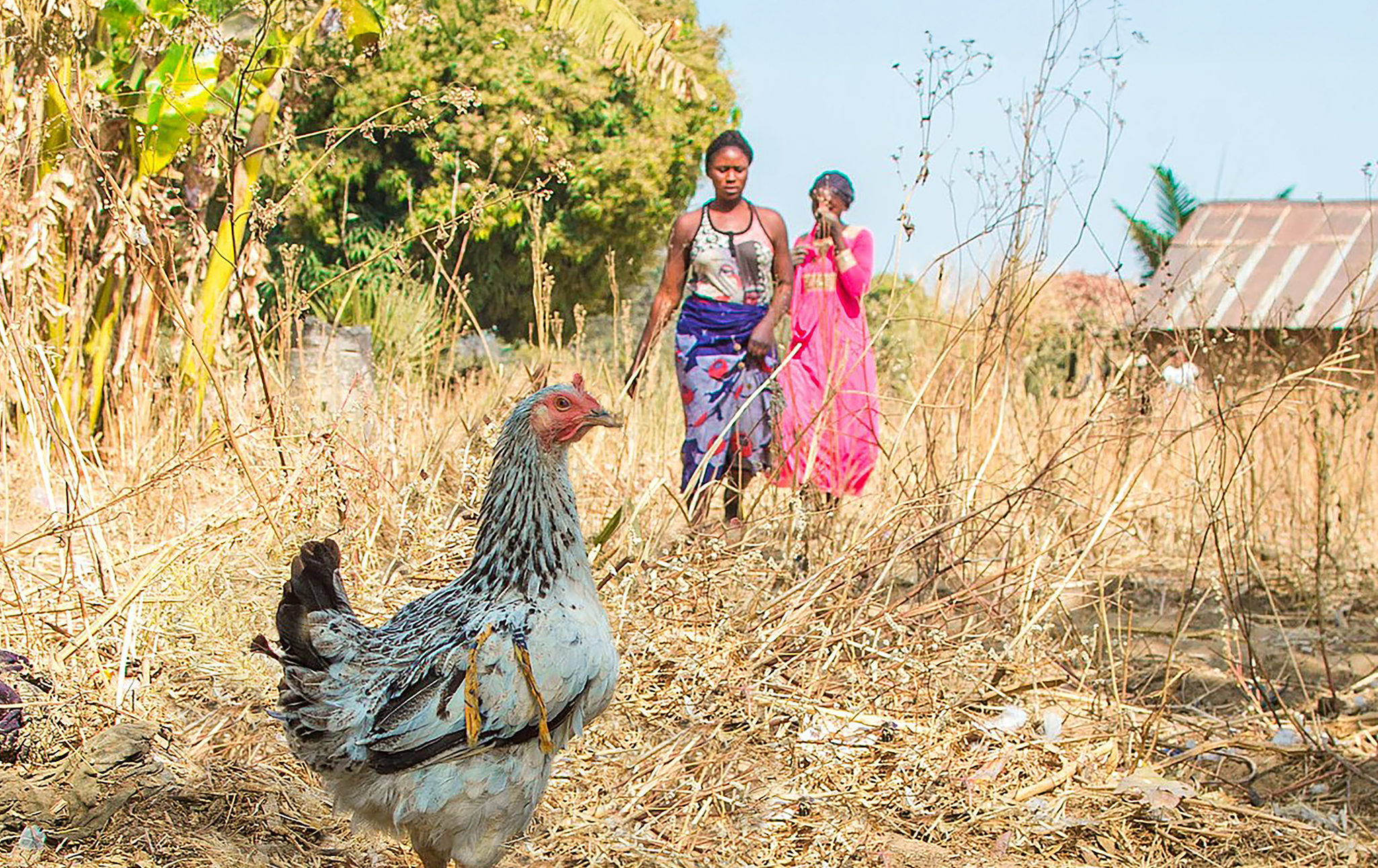
In contrast, Nigerian farmers, who increasingly raise Noiler chickens, provide the birds with the opportunity to behave naturally. The Noiler is a strong, indigenous chicken that will grow at a much slower, but healthy pace than commercial breeds. Typically, Noiler chickens are allowed to be outside (free-range), where they can move around, eat from the ground, and follow their natural behaviors; thus increasing their immunity against diseases, and greatly reducing the amount of antibiotics needed to keep the birds alive. These chickens are not inexpensive; they are valued because they represent land, labor, and community.
The “cheap protein” narrative also assumes that individuals in the Global South lack agency; that Nigerians in particular are mere recipients of Western excess, rather than independent producers with their own systems of knowledge and practices. By contrast, a Noiler chicken represents independence, not dependence.

The Ban and the Backlash
Prior to the 2003 ban, which was reinforced in 2015 during the administration of former president Muhammadu Buhari, U.S. trade officials repeatedly complained about restrictions placed by the government of Nigeria which have made it difficult to access Nigerian markets for many years.
However, the trade officials representing the U.S. government were outraged when the Federal Government of Nigeria reinforced a complete ban on all poultry imports into the country. In a statement posted on its social media platform in April 2025, the Office of the U.S. Trade Representative (USTR) said the restriction, which affects agricultural products, pharmaceuticals, beverages and consumer goods, creates “significant trade barriers” and leads to “lost revenue for U.S. businesses.”
In Nigeria, by contrast, the reaction to the sudden ban on foreign poultry imports was massively positive. Farmers were delighted because the ban instantly led to increased demand for their domestically produced chickens.
Enforcement was difficult. Smugglers were still bringing in frozen chicken by land through the borders of Benin and Cameroon. Some traders labeled their imported poultry as “local.” But the symbolic importance of the policy was tremendous. Nigeria was saying that it would not be the dumping ground for anyone.
More importantly, it opened the opportunity for new growth beyond mere trade protection. It created the financial safety net that made possible the growth of a local food sovereignty system. The food systems were protected from international dumping suppliers long enough for farmers to pool resources, revive some native chicken breeds that had nearly disappeared (like the Noiler), and create functional solutions that were ecologically relevant to their area and consumer demands. This “new growth” produced an independent, self-determined system based on the needs of Nigerian communities, their health and economic well-being, instead of the interests of global corporate entities.
The Tools of Food Sovereignty
While politicians were busy debating over trade policy in Nigeria, farmers in Kaduna and Oyo States that were deeply affected by years of dumping began building their own alternatives. To implement these ideas, these local producers organized the Poultry Farmers Association of Nigeria (PFAN).
PFAN is not a high-powered NGO with foreign funds; it is a grassroots movement structured around mutual aid, and economic self-reliance of small-scale men and women raising chickens on small farms abandoned due to years of cheap imports. These farmers decided to take action and organize, rather than to just give up.
This new system is simple, practical, and localized. It cuts through the complexities of the global economy by ensuring local food production meets local demand, utilizing native breeds which are suitable for local feeding systems, and maintaining all aspects of the food production chain within the local community. PFAN does not depend on changes in international trade agreements to implement its plan. Instead, it builds what it can with locally available resources. Its tools are basic, yet effective.
Firstly, Nigerian farmers revived the original local breeds, and replaced the majority of imported hybrid broilers that are fast‑growing lines (Cobb, Ross, Arbor Acres) that were originally developed in the U.S. and Europe and introduced to Nigeria through major agribusiness operations. Instead, the Noiler chicken, developed by the Amo Farm Sieberer Hatchery Limited in Nigeria, is the mainstay of PFAN’s recovery strategy. The chickens are brought to market weight structurally in 12 to 14 weeks slower than the common broiler chickens, but without a single use of antibiotics. In addition the hens give eggs, as an extra source of income to the farmers.
Secondly, they established Community Hatcheries. Rather than purchasing day-old chicks from large corporate suppliers (often at a high price), PFAN members were producing their own using low-cost solar incubators. The basic solar incubator is just a foam-insulated wooden box that contains a 50-watt solar panel and also has an old refrigerator thermostat and a digital thermometer. It can operate on solar power, electricity, or LPG cooking gas. These units cost only about $300 each and hold 500 eggs, and operate entirely off the grid, making them perfect for rural areas. “Any village could build one,” says Engr. Abubakar Sani, a graduate of Agric Engineering. All the components needed to build one exist locally; no foreign technology required.
The organization has also set up feed cooperatives, where members are advised to avoid purchasing expensive commercial feed. Instead, they create their own feed by mixing locally available items; such as maize, soybean meal, and groundnut hulls. PFAN usually creates the recipes and buys the ingredients in bulk to reduce the cost.
Lastly, PFAN members developed Direct-Sale Networks. To compete against imported frozen chicken in open markets, their members start selling directly to schools, churches, and neighborhood cooperatives. They were using WhatsApp groups to receive orders, and motorcycles for deliveries, which are attached with a very simple branding, such as stamped paper bags with the farm’s name. No middlemen, no importers. Instead, fresh chickens are delivered directly from the farm to the consumer.
The PFAN farmers have also developed strategic relationships with policymakers. They regularly attend local government hearings and use those opportunities to make specific requests (for example, subsidies for feed and vaccines) that would provide them with the needed support for sustainable poultry production. By providing data supporting the number of jobs created, along with tax revenue generated at the local level, they demonstrate an exceptional understanding of economic development principles that resonate well with policymakers.
Additionally, they recognized that federal government policies tend to move very slowly. Therefore, PFAN directed its focus toward bringing about policy changes at the state level. In Oyo State, they convinced the government officials to distribute, make low-cost feed and vaccines available to PFAN members. In Kaduna, they were successful in convincing local schools to purchase 70 percent of their poultry from PFAN members. These small successes have collectively contributed to the overall success of the organization, thereby expanding its network.
The PFAN's average annual net income for 104 small-scale farmers in Oyo State is nearly ₦788,000; their counterparts in the Federal Capital of Nigeria (Abuja) earn a little over ₦397,768, making poultry farming an effective method of pulling families out of poverty. By providing them with access to low-cost chicks, steady feed, and simple low-technology equipment (e.g., feeding troughs) farmers can raise their income, increase their ability to withstand unexpected shocks to their business, and rely less on cheap, imported leg quarters. Building local capacity is not a charitable act; building local capacity is a form of economic self-defense.
The individuals building this infrastructure are those who are most impacted by it. Within a span of just three years, PFAN has assisted a lot of farmers in returning to poultry production, around 75 percent of them women. The average household income of PFAN members has increased by 30 percent, and perhaps most important, PFAN is beginning to help younger generations view farming as a viable means of making a living.
A Global Blueprint and a New Solidarity
The PFAN philosophy is being replicated internationally. Since 2021, the Solidaridad Network and partners, managed by the Poultry Farmers Association of Ghana, has trained more than 450 women and youth in heritage breed poultry farming. In addition, cooperatives called “Mkulima Jovial” are operating in Kisumu, Kenya. Groups such as the Black Farmers & Agriculturalists Association (BFAA) are working in the U.S. to restore heritage poultry and reclaim food sovereignty in rural Black communities.
Taking concrete action to help those in need is the greatest form of solidarity. For example, U.S. readers can act on their solidarity by taking political action against U.S. poultry dumping. The U.S. Meat Export Federation, based in Denver, Colorado, spends millions each year lobbying for the export of dumped chicken products into developing countries. Readers can call their elected representatives and ask why American taxpayers’ funds are used to sponsor a practice that destroys livelihoods in developing countries.
When you eat chicken, ask these critical questions: Where did this chicken come from? Who raised it? Who suffered so we could have cheap meat? Next time, don’t act out of pity or a bothered conscience; act out of intentionality. Because the people on the farms in Kaduna are not waiting around for salvation. They are creating an entirely new way to make food a source of justice instead of charity. They are inviting everyone else to join them—not because of their money, but because of partnership.
What if unionized farm workers in the U.S. partnered with PFAN to expose the full chain of exploitation, from the meatpacking plants in Arkansas all the way to the markets in Lagos? Likewise, European animal rights groups should help support Africans in their efforts against Europe's dumping of cheap meat products into Africa. This approach will allow Africans to resolve their own issues of welfare and sovereignty without trying to impose a solution on them—like veganism—that fails to address the issue of economic justice.

Chickens as Resistance
This is not simply a story about chickens. This is a story about who gets to make the decision on what we eat, and how it is produced, and who benefits financially from that production.
For decades, major corporate interests and regulatory agencies in developed countries (collectively known as the “Global North”) have made those decisions for us. But in small Nigerian villages today, a new future is beginning to emerge with each chicken raised at a time.
While the U.S. has treated its surplus chicken like garbage, Nigerians refuse to treat theirs that way. Nigerians took a long hard look at the remains of their own poultry industry and said: we will rebuild it ourselves. Not with imported chickens or charity. But with our own effort, sweat and tears, our own chickens, and our own ideas of what food should be.
Local poultry production is an act of economic and political resistance because it actively reclaims food sovereignty from corporate dumping, demonstrating a successful rejection of dependency. Nigerian farmers are not requesting for aid or rescue. Instead, they are offering a proven roadmap for food sovereignty that prioritizes community strategy and self-reliance over dependence.
True solidarity will recognize that the struggles for animal welfare, worker justice, and food sovereignty are intertwined. Solutions will not come from above, but from those who are suffering through these crises, taking control into their own hands.