
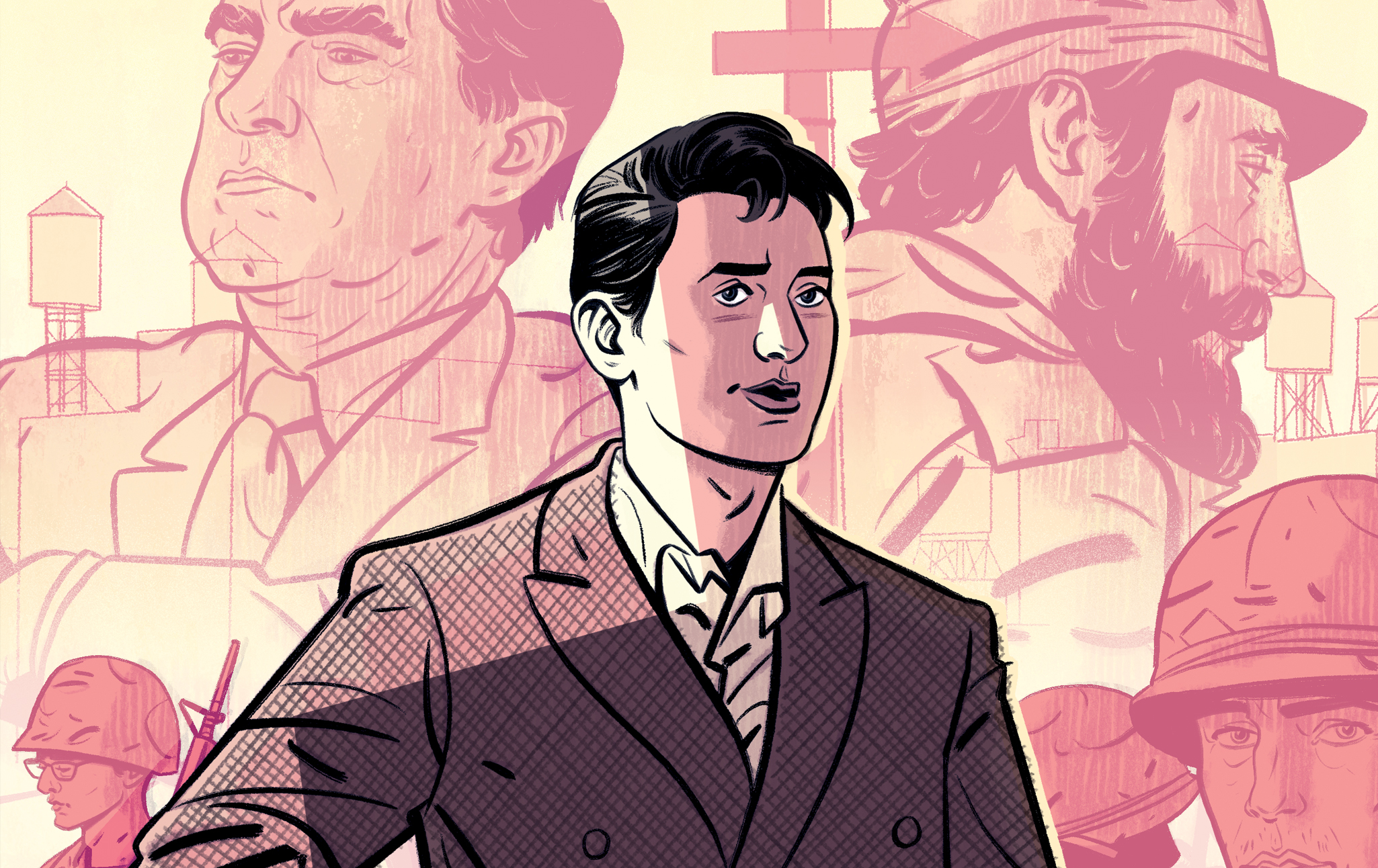
Fifty years after his death, the protest singer’s music is more relevant than ever.
In 1966 a young man from El Paso, Texas sat down with his guitar and imagined a world without him in it: Won’t be asked to do my share when I’m gone [...] / Can’t sing louder than the guns when I’m gone [...] / Can’t add my name into the fight while I’m gone / So I guess I’ll have to do it while I’m here. For Phil Ochs—the great American folksinger, songwriter, and political activist—the most daunting part of no longer walking the earth was that he could no longer fight to improve it. He would die ten years later, at the age of 35.
2026 marks half a century since Ochs’ death, yet his lyrics are more relevant now than perhaps even he could have imagined. Ochs’ career achievements, by any reasonable measure, were substantial—he wrote hundreds of songs, recorded seven albums for two major record labels, consistently sold out Carnegie Hall and other medium-sized concert venues, successfully organized several large-scale rallies, and always provoked an enthusiastic response from crowds at the countless political events at which he performed.
And yet several factors conspired to limit his ability to reach a wider audience, to communicate his ideas to more people, to exert a greater influence on his nation’s political and musical culture, and to receive greater recognition for and appreciation of his contributions.
Perhaps the biggest of these factors is simply that he was a leftist, a fiery (and early) opponent of the Vietnam War, and an equally fierce supporter of the American Civil Rights Movement. Accordingly, many of his songs were “protest songs” on these and other political issues of his time. But leftist radicalism, along with protest art of any kind, tends to be disfavored by the ruling classes, and, more specifically, stands in conflict with the interests of the corporations that control the broadcast media of radio and television. So Ochs’ music was rarely played on the radio (upon the release of his song “I Ain’t Marching Anymore,” which would go on to become an anti-war anthem, Ochs remarked, “The fact that you won’t be hearing it over the radio is more than enough justification for the writing of it”), and he performed on network television only one time, very late in his life.
With these obstacles now largely removed (we no longer need radio and television in order to sample unfamiliar music), and with the current oppressive political climate in the U.S., the time would appear to be ripe for the rediscovery and reappraisal of Ochs’ work. Were such rediscovery to occur, it might help to inspire the creation of new music devoted to current issues, featuring some of the characteristics that made Ochs’ topical work of the 1960s and ’70s so distinctive.
This is not to say, however, that Ochs’ songs—often written in response to very specific events from his time—are now dated, for the broader issues that they address (racism, poverty, class warfare, etc.) are eternally relevant. These works also inspire us by providing an example of past bravery, and showing us that we too can fight back.
As a case in point, consider “The Ballad of William Worthy,” one of Ochs’ earliest songs, appearing on his first album in 1964. Worthy was a reporter who traveled to Cuba and was arrested upon re-entering the United States, as it was illegal at that time for U.S. citizens to travel to the communist island. The chorus contains these lines:
Somehow it is strange to hear the State Department say:
“You are living in the free world / In the free world you must stay.”
Notice that even if one leaves aside the specific issue of the Cuba travel ban, lines like these give insight into the hypocrisy of typical patriotic rhetoric, and invite critical reflection about (and further investigation of) a number of other issues related to U.S. foreign policy, freedom of the press, and freedom of travel.
One of the song’s verses also makes a point about how the United States treats its radical critics:
So, come all you good travelers and fellow travelers, too.
Yes, and travel all around the world, see every country through.
I'd surely like to come along and see what may be new,
But my passport's disappearing as I sing these words to you.
And indeed, Ochs’ activities, including travel, were so closely monitored, and in some cases restricted, by the U.S. government that he called himself a “folk singer for the FBI.” (The FBI’s file on him has now been published. It runs to over 400 pages.)
Returning to the song’s primary issue, the name “William Worthy” is the only one of its elements that is confined to a particular historical era. Travel from the U.S. to Cuba continues to be tightly controlled, and travel for the purpose of tourism remains illegal. In fact, on June 30, 2025, President Trump issued a National Security Presidential Memorandum strengthening restrictions on travel to the island.
This pattern—specific details from his time conjoined with deeper issues that are still with us in ours—applies to almost all of Ochs’ topical songs. So most of them readily lend themselves to being updated. No more is needed in making them current than to change names, dates, and a few other minor details. A good example is “Love Me, I’m a Liberal,” a song from 1966 in which Ochs humorously (despite the seriousness of his criticism) mocks the “safe logic” of those “liberals” who take positions that are “ten degrees to the left of center in good times,” but “ten degrees to the right of center if it affects them personally.” Here’s a sample verse:
I read New Republic and Nation.
I've learned to take every view.
You know, I’ve memorized Lerner and Golden.
I feel like I'm almost a Jew.
But when it comes to times like Korea
There’s no one more red, white and blue.
So love me, love me, love me, I’m a liberal.
Well, that’s pretty dated. Most people won’t recognize the names “Lerner” (Max) and “Golden” (Harry), and many won’t know much about the Korean War. But at a 1971 concert in Houston, Ochs updated that verse as follows:
I read underground papers and Newsweek.
I’ve learned to take every view.
Ah, the War in Vietnam is atrocious.
I wish to God that the fighting was through.
But when it comes to the arming of Israel
There’s no one more red, white and blue.
So love me, love me, love me, I’m a liberal.
(Note: A search for “Love Me, I’m a Liberal, updated” on YouTube turns up many versions by current artists addressing contemporary events.)
Perhaps the most common criticism of topical songs is that, because of their highly specific subject matter, they quickly become dated, and thus cannot hope to attain lasting value as works of art. The folksinger Dave Van Ronk is one of many who have offered this criticism, writing in his posthumous 2005 memoir The Mayor of MacDougal Street:
There is a built-in flaw to topical songs, which is that if you live by the newspaper, you die by the newspaper. You may expend your greatest efforts and do some of your best writing about an incident that will be forgotten in six weeks. I mean, Phil Ochs was one of my best friends and I love a good many of his songs, but it always struck me as a tragedy that so much of Phil’s material became dated so quickly. I remember when I heard him sing his song about William Worthy, I thought, “…two years down the line he won’t be able to sing it anymore.” And sure enough, he couldn’t, because nobody remembered who William Worthy was.
But there is value in knowing history, and a good song can inform the listener about interesting and important events of the past in an entertaining way—especially when written by a witness to the event, who is reacting to it in real time. Further, artists often focus on events that somehow fail to appear in many history books. The Worthy case is exactly the kind of story that people won’t hear about in the 21st century unless they listen to a Phil Ochs song.
Ochs’ song about Worthy is clever and amusing, and thus fully capable of arousing listeners’ interest, perhaps even inspiring them to do further research so as to learn more about Worthy’s case. A successful song—one with a catchy tune and witty, rhyming lyrics—can help people remember what they might otherwise forget. Some of the world’s most powerful works of art (for example, Goya’s The Third of May 1808 and Picasso’s Guernica) are based on specific moments in history that may otherwise have slipped from popular memory.
Aside from the charge that they are dated, the other common criticism of political songs is that they are useless since, allegedly, they fail to persuade. Bob Dylan is one who issued this complaint in 1965: “The protest thing is old. And how valid is it anyway? Is it going to stop anything? Is anybody going to listen? People think this helps […] But songs aren’t going to save the world.” Van Ronk was another: “My feeling was that nobody has ever been convinced that they were wrong about anything by listening to a song, so when you are writing a political song, you are preaching to the choir.”
But even if we suppose that Van Ronk’s premise, the one about nobody being convinced by a song, is true, there are still other ways in which political music might influence people’s thinking. Some may have never heard about a particular issue before becoming informed about it through lyrics. The historian Howard Zinn, who earned a PhD in history from Columbia University, reports that he learned about the Ludlow massacre of striking coal miners from a Woody Guthrie song—it never having been mentioned in the texts he had been assigned, or in the many writings of professional historians that he had read. And while some may indeed have heard of an issue, they may never have been moved to think about it before being stimulated to do so by a compelling work of art.
Another possibility is that Van Ronk’s premise is simply wrong. Some persons may have formed an opinion on an issue rather passively and casually—perhaps by uncritically accepting the position of their parents, or peers, or mainstream society—without caring enough to have formed a deep commitment to this opinion. Exposure to a song arguing against that position might lead some such persons to take a more serious look at the issue, and to change their mind about it. (Note that Van Ronk provided no evidence in support of the claim that none of these things ever happen.)
In any case, even when a political song fails to change minds, it may still have value for other reasons. To his credit, Van Ronk mentions one of these. Responding to his own “preaching to the choir” charge, he then concedes:
Of course, the choir needs songs, and when a group sings together, that builds solidarity. When the cops were coming down on them with the dogs, the clubs, and the cattle prods, the civil rights workers would be standing there singing “We are not afraid”—and you better believe they were afraid, but the singing helped. It had a real function, and in that situation it was very important.
Many criticisms made of Ochs are based on a failure to notice two ways in which his protest songs, in particular, differ from those of other songwriters working in that genre. One critique is that his songs allegedly make obvious points—that war and racism are bad, that people should be free, that presidents often lie, and so forth. But Ochs was a voracious reader and energetic student of politics. His songs are unique, or at least unusual, precisely in their attention to detail and inclusion of specific information that is not widely known or understood.
His many anti-war songs illustrate this point. Many other Vietnam-era anti-war songs either focused on costs to Americans (the war is bad because American soldiers are dying—no mention of the suffering of the Vietnamese, America’s victims), or else made the general point that war is terrible (with no discussion of the specifics pertaining to this war in particular). These limitations minimize the persuasive effect of their art, since many people who agree that war is awful nonetheless think that some wars are justified—perhaps because they are waged against some even more horrendous evil, to be replaced by some great good, such as democracy.
By contrast, notice the specific details in Ochs’ “Talkin’ Vietnam Blues”:
Well I walked through the jungle and around the bend,
Who should I meet but the ghost of President Diem.
He said, “You're fighting to keep Vietnam free
For good old de-em-moc-ra-cy.” [Diem-ocracy]
That means rule by one family
And 15,000 American troops….
These lyrics suggest that the American war effort in Vietnam was aimed at defending not democracy, but rather the government of an autocratic puppet who served himself, his family, and his American masters, at the expense of the interests of those he was governing. The song also implies that South Vietnamese President Ngô Đình Diệm enjoyed no popular support, and offers reasons why. For example:
He said, “I was a fine old Christian man
Ruling this backward Buddhist land.”
Listeners following up these leads would quickly learn details about the corrupt and authoritarian nature of Diem’s government, and would also encounter the famous photograph of a Buddhist Monk, Thích Quảng Đức, publicly immolating himself in Saigon on June 11, 1963 in protest of the persecution of Buddhists under the rule of Diệm, a staunch Catholic.

Reading the Pentagon Papers, a classified history of the Vietnam War written by the Pentagon’s own historians for secret internal use, they would discover the following sentence: “South Viet Nam was essentially the creation of the United States.” They would also learn that the United States had agreed at a 1954 conference in Geneva to call for free elections in Vietnam in order to unify the governments of the South (created and supported by the U.S.) and the North (headed by Hồ Chí Minh and opposed by the U.S), but then reneged on this commitment once they learned that their side would lose. An April 1955 Department of Defense report concluded that if a free and fair election were to be held in Vietnam under international supervision, “there is no reason to doubt” that Hồ Chí Minh “would win easily.” Dwight Eisenhower, in his memoirs, estimated that Hồ would have received about 80 percent of the vote, and adds that he knows of no person knowledgeable about the issue who would disagree with that assessment.
As the reader might guess from Ochs’ discussion of Diệm, and his reference to (only) “15,000 American troops,” this is an early song, released on a 1964 album, pre-dating the Gulf of Tonkin incident and subsequent massive escalation of the war. (His first Vietnam War song was published in 1962.) Ochs did not have access to the Pentagon Papers, nor other documents that emerged later, and yet he clearly read the available evidence correctly and understood the situation accurately—more so than many other anti-war songwriters who addressed the subject later, and with much less specificity.
But it is not enough to point out that Ochs’ songs are studded with highly specific information. Perhaps more important is the fact that this information is typically not widely known—it alerts his audience to important matters, of which many of them had previously been unaware.
In “Here’s to the State of Richard Nixon,” a song from the early 1970s, Ochs sings: “The wars are fought in secret, Pearl Harbor every day.” Here he is talking about two relentless, covert, illegal, large-scale U.S. bombing campaigns, one in Laos (Operation Barrel Roll), the other in Cambodia (Operation Menu). According to journalist Joshua Kurlantzick, the attack on Laos, in particular, became, for U.S. presidents and the CIA, “a template for a new type of large, secret war for decades to come.” The reference to Pearl Harbor in Ochs’ song is also noteworthy in that it frames the issue of secret bombing in a way that would never be found in mainstream media sources.
Some of Ochs’ critics make the mistaken assumption that his art is simply that of a singing journalist—a chronicler of, and commentator on, the major political events of his time—whose works are therefore to be evaluated by journalistic standards. (Bob Dylan, in a moment of anger toward his friend, famously sneered, “You’re not a folksinger, you’re a journalist!”) But such an approach overlooks the other major distinctive feature of Ochs’ music: its astonishing intensity of emotional expression. Ochs cared passionately about politics, empathized with the victims of injustice, was enraged by the actions of the victimizers, and found humor in the absurdity of the justifications they offered in defense of their cruelly selfish policies. Thus, his songs, including even those that are most explicitly addressed to specific political events or issues, also stand as eloquent artistic expressions of basic human emotions—especially anger, humor, and sadness.
Consider, for example, the critical reaction to Ochs’ “Here’s to the State of Mississippi.” The flavor of the song can be gleaned from a sample verse and the chorus:
Here’s to the judges of Mississippi
Who wear the robe of honor as they crawl into the court
And they’re guarding all the bastions of their phony legal fort
Oh, justice is a stranger when the prisoners report
When the Black man stands accused the trial is always short
Oh, here’s to the land you’ve torn out the heart of
Mississippi, find yourself another country to be part of.
Ochs called this one of his “most criticized” songs. Three objections were frequently issued: that it was unfair to condemn an entire state, since Mississippi also contained courageous civil rights activists and other fine citizens; that it was unfair to single out Mississippi, since other states, including northern ones, also were plagued by racism, stupidity, and injustice; and, most of all, that Ochs’ criticism of the state was “over the top,” extreme, disproportionate.
The songwriter responded to these objections at least twice. In his liner notes to I Ain’t Marching Anymore, the album on which “Here’s to the State of Mississippi” appears, he notes, “I was down there last summer [1964] and must admit that I met some nice people and that the state isn’t as bad as my song implies, unless you are a Negro who has forgotten his place, or unless your last name was Chaney, Goodman, or Schwerner.”
Some context: Ochs had travelled to Mississippi as part of the Mississippi Caravan of Music, which worked in conjunction with Freedom Summer, a campaign aimed to register Black voters. Three Civil Rights activists working with the campaign (James Chaney, Andrew Goodman and Michael Schwerner) were kidnapped and murdered by corrupt police working with the Klu Klux Klan. When Ochs sings of Mississippi, “If you drag her muddy rivers, nameless bodies you will find,” he’s referring to the fact that while searching for their bodies in the river, FBI agents found the bodies of two more men who had been kidnapped by the KKK, and additional bodies of Black people who were never identified.
Ochs’ longer and more detailed defense of his song is in his article for Sing Out magazine, “Topical Songs and Folksinging, 1965”:
On the surface [the song] goes against the basic policies of all the civil rights groups and the established rational voices of the Left […] Now, normally you might say that the important thing is to encourage moderate business elements of the power structure of the state, bring about the vote, and get Mississippi back into the Union. I agree with that on a rational political level.
But artistically and emotionally, I wrote that song the day 19 suspects [in the 1964 murder of the three civil rights workers] were allowed to go free. It’s a song of passion, a song of raw emotional honesty, a song that records a sense of outrage. Even though reason later softens that rage, it is essential that rage is recorded, for how else can future generations understand the revulsion that swept the country?
I think it is clear that Ochs’ self-analysis is accurate: his song sounds nothing like an attempt at calm, cool, balanced objectivity. Rather, one hears it as a full-throated scream of outrage, a work belonging to the expressionist tradition in the arts, as exemplified by such painters as Vincent Van Gogh and Edvard Munch. To criticize Ochs for some distortion in his depiction of Mississippi (but only some distortion—he’s clearly responding to something real) misses the point in the same way that criticizing Van Gogh’s The Starry Night for distorting the moon, stars, and sky, or Munch’s The Scream for distorting the human figure, would.
At other times Ochs (temporarily) brackets his outrage at injustice to focus instead on its idiotic absurdity. When performing at the Newport folk festival in 1963 he introduced his “Talking Birmingham Jam” with the observation that “whenever there is a deep tragedy, there’s also present something of the ridiculous.” A sample verse from the song:
Well, I’ve seen travel in many ways.
I’ve traveled in cars and old subways.
But in Birmingham some people chose
To fly down the street from a fire hose,
Doin’ some hard travelin’
From hydrants of plenty.
Now, Ochs’ listeners knew just as well as he did that no one in Birmingham “chose” to be attacked with high-pressure hoses. But they understood his satirical purpose, and laughed heartily. And the folk music aficionados in the audience also appreciated the nod to Woody Guthrie, as two of his most famous songs are “Hard Travelin’” and “Pastures of Plenty.”
Toward the late 1960s the laughs in Ochs’ songs became less frequent, and the anger in them began to be replaced by sadness. There seem to be two, perhaps related, reasons for this. One is that his personality combined two strong characteristics that are rarely found together: naïve, wide-eyed optimism on the one hand, and on the other, what George Orwell called “the power of facing unpleasant facts.” This unfortunate combination led to repeated soul-crushing disappointments. Ochs seems to have had a natural, instinctive patriotism, which led him to expect his country to do the right thing. But then, time and time again, it didn’t, and he knew it. He lacked the great ability that many “patriots” have to rationalize their country’s misdeeds, or, better yet, to remain completely unaware of them.
The other factor leading to his increasing sadness was medical. Ochs suffered from what was then called manic depression (now called bipolar disorder). His symptoms worsened in the 1970s, and reached the status of a full-blown psychosis in the summer of 1975 (he began to call himself “John Butler Train,” to engage in bizarre, erratic conduct, and to claim, repeatedly, that he had “murdered” Phil Ochs). After a few months this “manic” phase of his illness subsided and gave way to a depressive phase, during which he regained his sanity, but at the cost of sinking into a deeper, more unrelenting depression than he had ever previously experienced. In April 1976, in the depths of this depression, he committed suicide.
While it is unclear as to exactly when Ochs began to experience bipolar symptoms, one suspects that they were present (in milder form) from the beginning of his career. The manic aspect might partially explain his ability to have accomplished so much work in so little time (he was a tireless political activist and organizer in addition to being a prolific songwriter, concert performer, and recording artist; Bob Dylan once remarked, in connection with Ochs’ songwriting, “I just can’t keep up with Phil.”) The depressive aspect might explain the unusual intensity of his emotional reaction to political events.

Think of it this way. Because of politics, every passing day brings more examples of people being unjustly maimed, starved, tortured, and/or killed. So wide and deep is this horror that to take it in fully, from an emotional standpoint, would make most persons unable to function, so debilitating would be the sorrow and despair. So even the most caring and committed persons tend to learn that, in order to cope, they must think of politics somewhat abstractly, and to focus positively on what can be done to make things better, as opposed to taking the full emotional measure of the world’s horrors. I conjecture that Ochs, for the reasons mentioned, became over time less and less able to shield himself in this way.
For a time he was able to transform his disappointments, and his sadness, into sublime art. An example is his darkly beautiful album of 1969, Rehearsals for Retirement, written and recorded largely to express his feelings after protesting the Vietnam War in the streets and parks of Chicago as the Democrats were holding their 1968 presidential convention in that city. (In 1998, The Wire, a British music magazine, pronounced this album “the single most eloquent collection of protest songs in the English language.”) Ochs had campaigned for the anti-war candidates, Eugene McCarthy and Robert F. Kennedy. But then he was dealt four devastating blows: the assassination of RFK; the violent attacks on peace protestors by the Chicago police; the Democrats’ selection, at their national convention, of the pro-war candidate, Hubert Humphrey, in spite of the fact that the anti-war candidates had won far more votes during the primaries, and the subsequent election of the loathsome Richard Nixon in the general election.
The sorrowful tone of the album that Ochs made in response to all of this is well illustrated by “The Scorpion Departs But Never Returns,” the minor-key melody of which is both hauntingly beautiful and highly emotive. While the song is ostensibly about sailors aboard the USS Scorpion, which imploded and sank on May 22, 1968, in the context of the album one hears it as being about America, and also about Ochs himself. The final two verses:
The radio is begging them to come back to the shore.
All will be forgiven, it’ll be just like before
All you’ve ever wanted will be waiting by your door.
We will forgive you, we will forgive you.
Tell me we will forgive you.
But no one gives an answer, not even one goodbye.
Oh, the silence of their sinking is all that they reply.
Some have chosen to decay and others chose to die
But I’m not dying, no I'm not dying.
Tell me I’m not dying.
One can still find inspiration from Phil Ochs. His recordings are widely available, serving as both a time capsule into the past and a mirror to the many still-relevant problems of today. But there is also a great need for new songs about new events and new issues—songs that are detailed, well-informed and informative, melodic, witty, poetic, and passionately expressive. Phil Ochs can still inspire those as well.


.png?width=352&name=Screenshot%202026-09-04%20at%204.00.52%20PM%20(1).png)
%20(1).jpg?width=352&name=miasma-1%20(1)%20(1).jpg)