The genre is often used as a punchline, but sneering at ska discounts its long and uplifting history as “the people’s music.”
In a 2016 episode of the popular cop-themed comedy Brooklyn Nine-Nine, lead character Jake (played by Andy Samberg) has a flashback to 1998, when he was featured on a local news broadcast decked out in checkered sunglasses, a black bowler hat, white shirt, and suspenders. “Ska defines who I am as a person and I will never turn my back on ska,” he declares. When the scene flashes forward to present, Jake denies having any regrets, before admitting to his fellow detective that yes, actually, he should.
The gag lands because fandom of ska music has become shorthand for a kind of youthful overenthusiasm—the same earnestness typically associated with theater kids and band dweebs. The punchline is that enthusiasm for ska isn’t just regrettable but humiliating: the butt of a joke that ska fans aren’t in on. Often reduced to glib descriptions like “fast reggae” or “punk with horns,” the U.S. brand of ska music that exploded in popularity in the 1990s has become synonymous with goofy fashion, silly lyrical content, repetitive instrumentation and nerdy aesthetics. In some musical circles, appreciation for the genre is met with ridicule and must be shared with caution, the way one might disclose a passion for fanfiction or mukbang food videos on Instagram. As one formerly-closeted fan posed on Reddit: “Has anyone been afraid to tell people that they like ska?”
Throughout countless television shows, memes and online threads, the genre is treated as a source of embarrassment. But far from a brief and lamentable fad, ska is a decades-long movement whose existence far preceded its breakthrough into ’90s pop culture. It has traveled from the slums of Kingston, Jamaica to the industrial hamlets of the United Kingdom, to stages across America and the globe, spreading a message of working-class solidarity against power-hungry elites—and of unity in the face of racial oppression.
The musical style’s relentless optimism and signature horn-driven melodies were born out of anticolonial struggle and exultant proclamations of freedom. As the genre has spread over the second half of the 20th century and into the 21st, it has moved in many different directions, but continues to offer an uplifting expression of resistance to political and economic despair, extending community as an alternative to division. As author Heather Augustyn writes in her 2013 book Ska: The Rhythm of Liberation, “Whether it is received on the street corner, in a concert arena, or through earphones, ska is still the people’s music, in whatever form it takes.”
Ska might always be fodder for memes and mockery. But today, with a new wave of bands carrying on the genre’s evolution in the United States, it’s time to look past the tired shitposts and see ska for what it really is: a diverse style of dance music that has instilled joy and passion in generations of followers while provoking its haters because it refuses to go away.
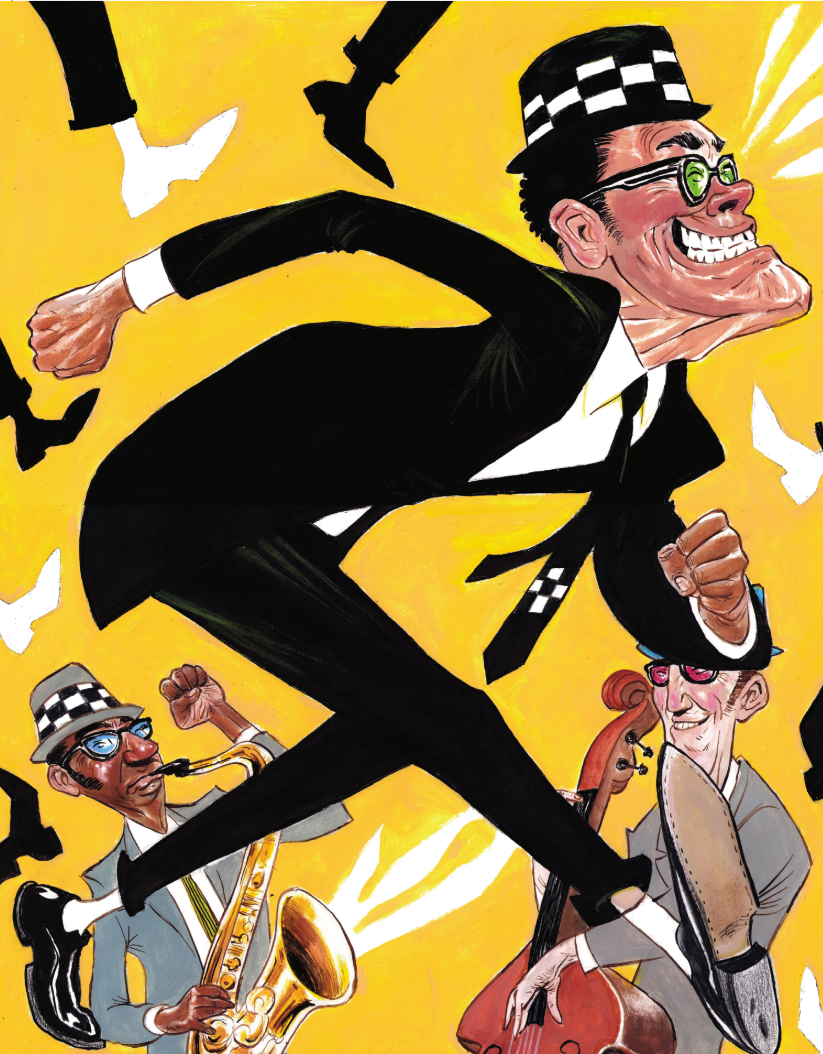
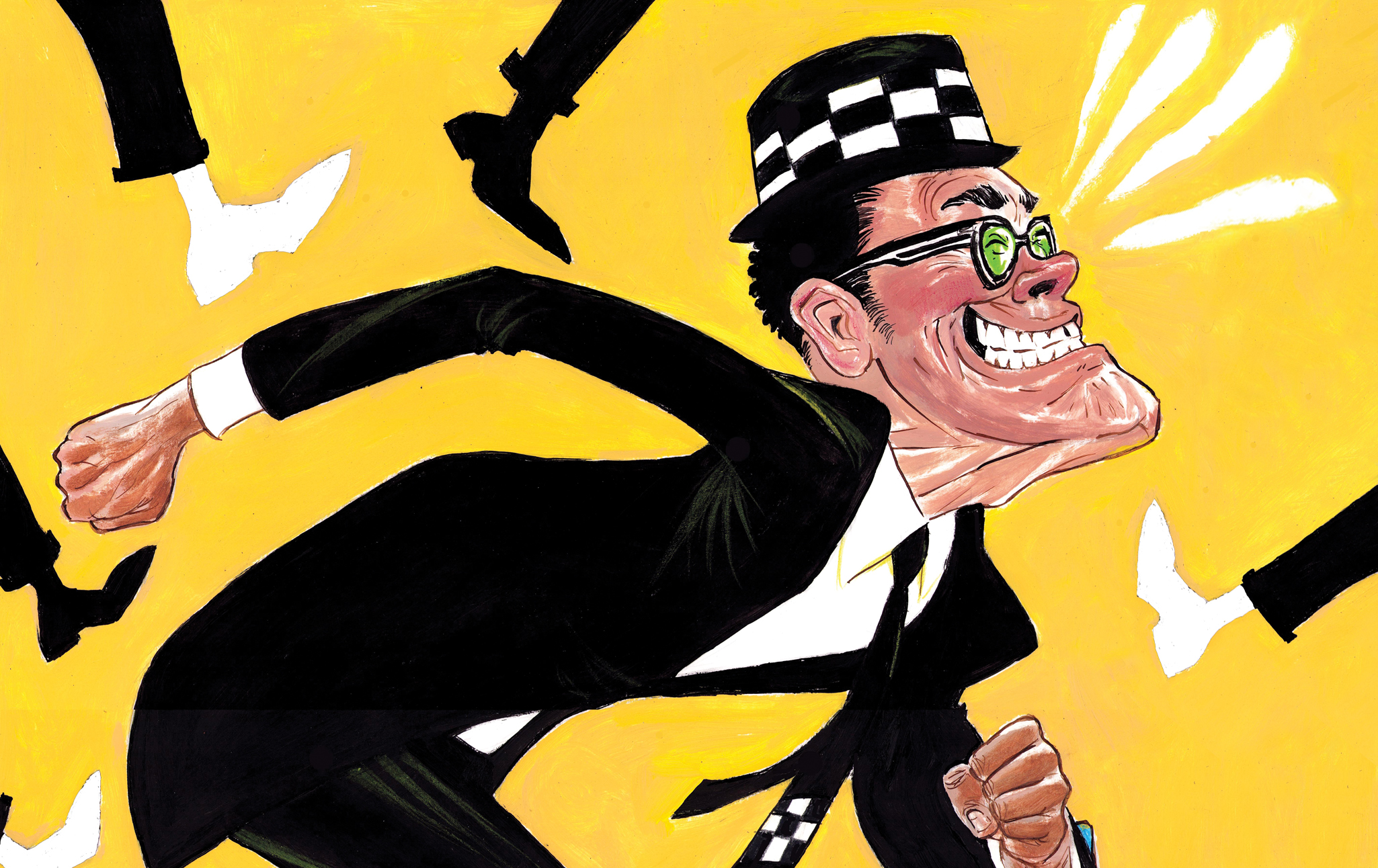
Art by Greg Houston for Current Affairs Magazine, Issue 58, March-April 2026
Sound Systems in Shantytowns
Long before it reached the Warped Tour, ska was the sound of working-class Kingston building something of its own. The genre took shape in the late 1950s across the shantytowns of West Kingston, Jamaica, where local musicians combined elements of traditional mento and calypso (African-inspired forms of Caribbean folk music) with American jazz and rhythm and blues, which had recently begun to reach the island.
During and after World War II, many American soldiers stationed in Jamaica brought their favorite swing and R&B records with them, sometimes trading the vinyls for rum, marijuana, and the services of local sex workers. Meanwhile, island radios began picking up stations broadcasting from cities like Miami and New Orleans, which played popular U.S. artists like Fats Domino and Jack Dupree. After travelling hundreds of miles over the airwaves to reach Jamaica, the music came through choppy and delayed, which some people theorize may have influenced the genre’s staccato sound.
Ska’s defining feature is its energetic tempo, created by accentuating the second and fourth backbeat in a 4/4 measure, rather than the traditional first and third, along with jazzy walking bass lines and bouncy melodic horns. Lyrics reflected subjects like national independence and freedom from daily strife, exemplified in songs like “Forward March” by Derrick Morgan:
Gather together, be brothers and sisters
We’re independent
Join hands to hands, children started to dance
We’re independent
The dance style of “skanking” evolved out of a running motion paired with two-step punching and kicking arm and leg movements synching up with the offbeat rhythms of the songs.
The backdrop to this musical eruption was a Jamaican population under colonial rule. Jamaicans had for centuries endured enslavement and subjugation by Great Britain (and before that, Spain), beginning in the early 16th century. Through the Atlantic slave trade, the island’s indigenous dwellers were joined by hundreds of thousands of Africans brought in to work the sugar plantations. While slavery was technically outlawed in the mid-1800s, a stark class system of wealthy landowners and poor servants continued to permeate the whole of society well into the 20th century. It was under this strictly divided class system that ska music began to blossom.
As historian Joseph Heathcott writes in his article “Urban Spaces and Working-Class Expression Across the Black Atlantic: Tracing the Routes of Ska”, the genre grew out of “the intensely local world of urban (particularly Kingston) working-class Jamaican youth”:
At the same time, ska developed within the global context of rural dislocation, labor migration, and rapid urbanization, processes that turned peasant families into an urban and rural proletariat, and that unfolded within the development of U.S. and British economic colonialism in the Caribbean throughout the twentieth century.
Shantytowns would throw parties in outdoor “dancehalls” using massive sound systems made up of powerful speakers on which DJs (or “selectors,” as they were called) played records of the time for crowds of downtown residents, including “rudeboys”—wayward young people donning black suits, skinny ties and pork pie hats. The practice of “toasting” gained popularity at this time as selectors would scat over recorded tracks, adding repetitive phrases like “chick-chick” and “get up-get up” to help animate the crowd. As Augustyn writes, “sound system dances were hugely popular with the masses who longed to escape poverty and oppression that were rife in Kingston in the 1950s.”
The musical style exploded in popularity in the ensuing years, giving rise to artists like Prince Buster, Desmond Dekker, and The Skatalites, who were instrumental in turning ska into a genre of its own. In 1962, following decades of struggle for freedom, Jamaica officially cast off British rule and became an independent country. Ska musicians celebrated this newfound independence and the music soon became an export to the rest of the world, along with the ensuing genres it helped give rise to: rocksteady and reggae.
Many songs of the later 1960s and 1970s exemplified the spirit of resistance and fighting injustice that were hallmarks of the genre, such as the iconic “Pressure Drop” by Toots and the Maytals. The song, which was later covered by artists ranging from Robert Palmer to The Clash, references lead singer Toots Hibbert’s jail stint for marijuana possession: “When I got out of jail, I had a sense of injustice and a desire to make up for lost time. Ideas just started flowing,” he later told the Guardian. In “54-46 That’s My Number,” Hibberts proclaims his innocence, while pointing to the dehumanization of the prison system, in which inmates’ identities become interchangeable: “So I was innocent of what they done to me[...] 54-46 was my number / Right now, someone else has that number.”
Other breakthrough songs of the time, like “(Everybody Jump On) Socialism Train” by The Ethiopians, envisioned a post-capitalist world of equality and civilizational advancement:
Forget your worries
Your trials and crosses
Everybody equal
Get social as a title
Everybody jump on socialism train
Ska music is known for its optimism, but that quintessential joy is rooted in struggle.
The Rise of 2-Tone
Across the Atlantic Ocean, ska would soon find a new hotbed in the industrial neighborhoods of London. In the years following the ravages of World War II, the United Kingdom began recruiting scores of workers from Jamaica, Trinidad and other parts of the West Indies to take jobs in sectors British residents had avoided, such as transit and construction.
Once there, these Black workers were largely confined to poverty-stricken urban areas while outright racism was a daily fact of life, including physical attacks from white reactionaries. Music, however, provided an escape. Many of the DJs who made the journey brought with them their ska records, which they would play at underground parties in neighborhoods like Brixton in South London, attracting the interest of local crowds drawn to the music. As Augustyn writes, “Just like their Jamaican counterparts[…] struggling British youths found sanctuary in the optimistic sounds of ska.”
By the later 1970s, the British economy was in a tailspin and unemployment was steadily rising. White nationalist movements like the National Front blamed the influx of people of color for the nation’s problems, while Prime Minister Margaret Thatcher similarly placed the onus on immigration for economic hardship. In one televised interview, Thatcher called for “a clear end to immigration,” saying that “people are really rather afraid that this country might be rather swamped by people with a different culture.” In the face of this right-wing bigoted rhetoric, ska music offered an alternative of racial coalition against the forces of hate, as bands like The Specials, The Selecter, The Beat, and Madness cropped up, incorporating both the style and sounds of their Jamaican forebearers.
The result was a sensation. As Heathcott writes, “White and Black working-class youth in decaying urban centers in Britain (and to a lesser extent in the United States) adopted the Rude Boy idiom as a tool of protest amid a climate of disintegration and decline in the fortunes of working-class families.”
While Thatcher pushed through a neoliberal agenda of austerity and stoked racial strife, ska bands made up of multiracial lineups promoted a message of camaraderie among the disenfranchised, with lyrics reflecting commonality and collective history. By the 1980s, the “2-Tone” style associated with Jerry Dammers of The Specials incorporated components of punk and pop with ska, making for a faster, rawer form of the music. The checkerboard pattern was featured in ska fashion, symbolizing racial unity. Popular songs of the time like The Specials’ “Doesn’t Make It Alright” (“Just because you're a Black boy / Just because you're a white / It doesn't mean you've got to hate him / It doesn't mean you've got to fight”) and The Beat’s “Stand Down Margaret" (“I said I see no joy I see only sorrow / I see no chance of your bright new tomorrow / So stand down Margaret”) cast explicitly left-wing political messages to audiences, protesting racist policies and demanding Thatcher’s resignation.
And it wasn’t just a musical revolt; demonstrators across the country also took to the streets calling for justice. Alongside ska’s rise in the UK, Augustyn writes, “through the revolution and rioting, [West Indian immigrants] were standing up and demanding to be recognized as equal.”
Coming to America
In the 1980s, a handful of 2-Tone bands from England toured the United States—mostly gracing mid-sized clubs and university venues—while a range of record stores carried their albums, likely tucked away in the reggae section. But ska didn’t really begin to take off stateside until the music took on a more distinctly American form.
That process kicked into gear in New York City, where Rob “Bucket” Hingley had immigrated from the UK to manage a Manhattan comic shop called Forbidden Planet. After arriving in the U.S., he sought to recreate the ska sounds and live show environment he’d left behind. Hingley founded the band The Toasters in the early 80s, and formed Moon Ska Records shortly after, having failed to convince any existing record labels about the viability of ska. In a 2025 interview with Almost Famous Magazine, Hingley recalls getting “laughed out of the room” by music executives, who said he’d “never get anywhere with that circus music.” Moon Ska Records, would go on to put out albums featuring ska artists ranging from No Doubt to the Dance Hall Crashers. Songs like “Don’t Let the Bastards Grind You Down” by The Toasters decried workplace drudgery and low wages, beckoning listeners to fight back in defiance of an intolerable system:
Each day I wake up in this gray old town
Each day the system tries to bring me down
With a minimum wage in the factory
I'm slaving in the Twentieth Century
Other East Coast bands soon formed, including The New York Citizens and The Second Step, merging ska sounds with hardcore punk, New Wave and other genres that already had built-in audiences. Handmade zines helped spread the word about American ska bands and shows, including those compiled by labels like Jump Up! Records (Everything Off-Beat) and Stubborn Records (Black and White), as well as popular fanzines like Ska’d For Life and Kill Every Racist Bastard. Compilation records served as an introduction for listeners unfamiliar with the upbeat, horn-driven music.
On the other side of the country, British expat Howard Paar in 1980 opened the ON Klub in the Silver Lake neighborhood of Los Angeles, which soon became a hub for the area’s budding ska bands like The Untouchables, which mixed Jamaican ska with Motown and soul, and Fishbone, an all-Black band from South Central, Los Angeles whose music was equal parts funk, punk and ska.
In California’s East Bay, emerging ska bands put on energetic live performances for diverse crowds, helping to break down politically-drawn lines of race and class. These bands trained their lyrical ire at conservatism, Cold War-era militarism, and the economically-destructive policies of the Ronald Reagan administration; a prime example is Operation Ivy’s 1988 song “Freeze Up,” which feels as if it could have been written in 2026:
Empty factories to the east and all our waste
The shape of things that came show on the broken worker's face
To the west you'll find a silicon promised land
Where machines replace our minds for systematic profit plans
Course of human progress staggers like a drunk
Its steps are quick and heavy, and its mind is slow and blunt
I look for optimism, but I just don't know
Its seeds are planted in a poison place where nothing grows
Enter the Third Wave
It wasn’t until the mid-1990s that ska finally broke into the mainstream with the advent of what became known as the “Third Wave.” It was this era that flooded American pop culture with checkerboard prints, horn sections, and skank-dancing youth, imagery that still clings to the genre today.
The release of No Doubt’s seminal album Tragic Kingdom in 1995 helped spread “skacore” across the radio and airwaves as MTV played their videos constantly (even if the record strayed from the band’s previous traditional ska sound). That year also saw the release of Rancid’s …And Out Come the Wolves, and a few months later came Sublime’s hit self-titled record, both of which acquainted throngs of young American listeners to ska music.
As the genre gained notoriety over the next few years, U.S. ska bands were featured across television and mass-market movies, including The Mighty Mighty Bosstones in Clueless (1995), Reel Big Fish in BASEketball (1998) and Save Ferris in 10 Things I Hate About You (1999). Bands like Less Than Jake and the Voodoo Glow Skulls, meanwhile, were showcased on the nationwide Vans Warped Tour.
The sudden acclaim led advertisers to pounce, putting ska music (and its fashion) in ads for everything from AOL to Kit-Kat bars. This quick commodification of the genre—and its oversaturation in what was then still a largely mass culture environment—turned off many fans, while critics skewered the zany optics of bands playing bouncy, humor-filled music at a time when grunge and alternative rock were considered more serious with their embellishment of angst and malaise.
As more and more ska bands got signed by major labels, they began getting tarred as “selling out,” as spoofed in Reel Big Fish’s 1996 song “Sell Out” (“Sell out with me tonight / The record company's gonna give me lots of money / And everything's gonna be alright”), while the genre’s optimistic and even joyful vibe was maligned as overly naive, despite the fact that it was originally borne out of real political activism and a refusal to give in to powerful regimes of authority.
Having been in a ska band quickly became a musical liability, as “ska-vestigators” began looking into any past affiliation with the genre in order to shame bands that were gaining popularity. Spin magazine published an article titled “Ska-letons in the Closet” revealing the rock bands who had members with unfortunate ska pasts. And in 2007, Stereogum attempted to expose indie-electronic artist Dan Deacon as a former member of the late-’90s ska band Channel 59, publishing photos of him skanking on stage. Rather than run from his past association with the genre, Deacon stood by it. “Ska was a way for me to escape into this happy, weird, ‘everything’s fun but nothing’s important’ place,” Deacon told author Aaron Carnes in the 2021 book In Defense of Ska, adding, “listening to ska transports me immediately back to this mindset that music is fun. And people get together to have fun.”
There was also a racial and political component to some of ska’s criticism: a musical style created by people of color was being popularized and profited off of by a largely white cohort of musicians who were more interested in partying than rebellion—a critique that’s far more valid than what most of ska’s detractors have made their focus. Where Black musicians once stood decrying oppression, all-white bands were now cashing in.
Despite all the derision, many ’90s ska punk bands continued to issue pointedly political content. In 1998, Detroit’s The Suicide Machines released Battle Hymns containing songs pillorying warmakers and mocking the ultra-rich ruling class, and Florida’s Against All Authority put out Destroy What Destroys You, featuring tracks titled “Lifestyle of Rebellion,” “Corporate Takeover” and “No Government Can Give You Freedom.”
That same year, Asian Man Records—a label started by Korean-American musician Mike Park—hosted the Ska Against Racism tour in cities across the U.S. As Park told the Chicago Reader’s J.R. Jones at the time, the goal was to “educate about the history of ska, but also hit an age group that’s really impressionable. I know a lot of these kids are just here to see the music, but if we can get a small percentage to really get involved, become proactive, and volunteer their time with youth centers and demonstrate against Klans in their area—whatever. Just to become more educated.”
While that tour faced some criticism (including from Jones) for not doing more to center the work of anti-racist organizations, it did donate the proceeds to local groups. It also uplifted the cause at a time during the Bill Clinton administration when political apathy was a hallmark of American youth culture.
The late 1990s marked the zenith point for ska in the United States, and by the early 2000s boy bands and nu-metal were ascendant. Yet ska didn’t simply disappear—once again it mutated.

21st Century Ska
Many of the bands that took off during ska’s Third Wave craze continued putting out records and touring, even as their audiences waned and their reach narrowed. In 2004, Michigan ska group Mustard Plug inaugurated a tour called Ska’s Not Dead, nodding to the genre’s fall from favor, alongside bands like Catch 22 and MU330. (This was around the same time my own high school ska-punk band Blue Aftertaste put out our sole album, which included a cover of Mustard Plug’s “Beer Song.”)
In the 2019 documentary Pick it Up: Ska in the ’90s, Aimee Allen, frontwoman of current ska band The Interrupters, put it this way: "Ska never went away, it just dips in and out of the mainstream."
South of the border—in Mexico, Central and South America—ska captivated large fanbases into the 2000s and still does today, with major festivals like SkaTex and Non Stop Ska Fest continuing to attract hundreds of thousands of people. And the bands and culture of Latin American ska have carried on the music’s political messages of fellowship and liberation. As Daniel Hernandez wrote in a 2012 article for the Los Angeles Times, “Ska came to represent a movement of musical protest, just as it had during the second wave across England and the U.S., with bands aligning themselves with social justice causes.”
In other countries across the globe, from Japan to Eastern Europe, ska remains a vibrant musical movement. And in the United States, bands like Bad Operation, Kill Lincoln, and We Are the Union are now drawing in kinetic crowds of younger fans, and projecting an explicitly more diverse and queer face of the genre, grounded in inclusivity and anti-authoritarianism.
As Kenneth Partridge writes in his book Hell of a Hat: The Rise of ’90s Ska and Swing, “Two decades into the twenty-first century, ska is still reaching pockets of young Americans. These amateur skankers are too young to remember just how uncool ska became around the turn of the millennium, when casual fans abandoned the genre and industry tastemakers began pushing other sounds, like nu-metal, garage rock, and emo.”
In 2020, Mike Park revived Ska Against Racism as a compilation album highlighting contemporary ska bands to raise funds for organizing groups including the Movement for Black Lives, and, amid the COVID pandemic, copies of the record sold out in days.
In New Noise Magazine, Bad Operation’s Jeremy “Jer” Hunter recently hailed being able “to see new bands come up with fresh new spins on classic sounds, and to see a big connection back to the roots of the genre. To see this new generation of bands take a stance against racism, sexism, transphobia, homophobia, and whatever else excludes marginalized groups. To many, ska is a joke and a fad from the ‘90s. What we are doing is not a nostalgia-driven gimmick […] We are creating a message and a space where everyone can feel safe and welcome, because we couldn’t find one for ourselves.”
The irrepressible buoyancy at the heart of ska music has always been part of its appeal to those facing down subjugation and exclusion. So why has the genre generated so much animus amongst the influencer set? As longtime punk musician Jeff Rosenstock wrote in the introduction to In Defense of Ska: “A grand musical environment anchored in acceptance, DIY-ethics, and uncontrollable chaos was never really going to get a gold star from label execs or pretentious pundits.”
The truth is that, love it or hate it, ska still remains—as The Skatalites once put it—the “freedom sound.”
Miles Kampf-Lassin is the Senior Editor at In These Times magazine. Right now, In These Times is offering Current Affairs readers a special deal: 10 print issues for $15 when you visit inthesetimes.com/ska! It’s a great opportunity to try out a fine left-wing publication.