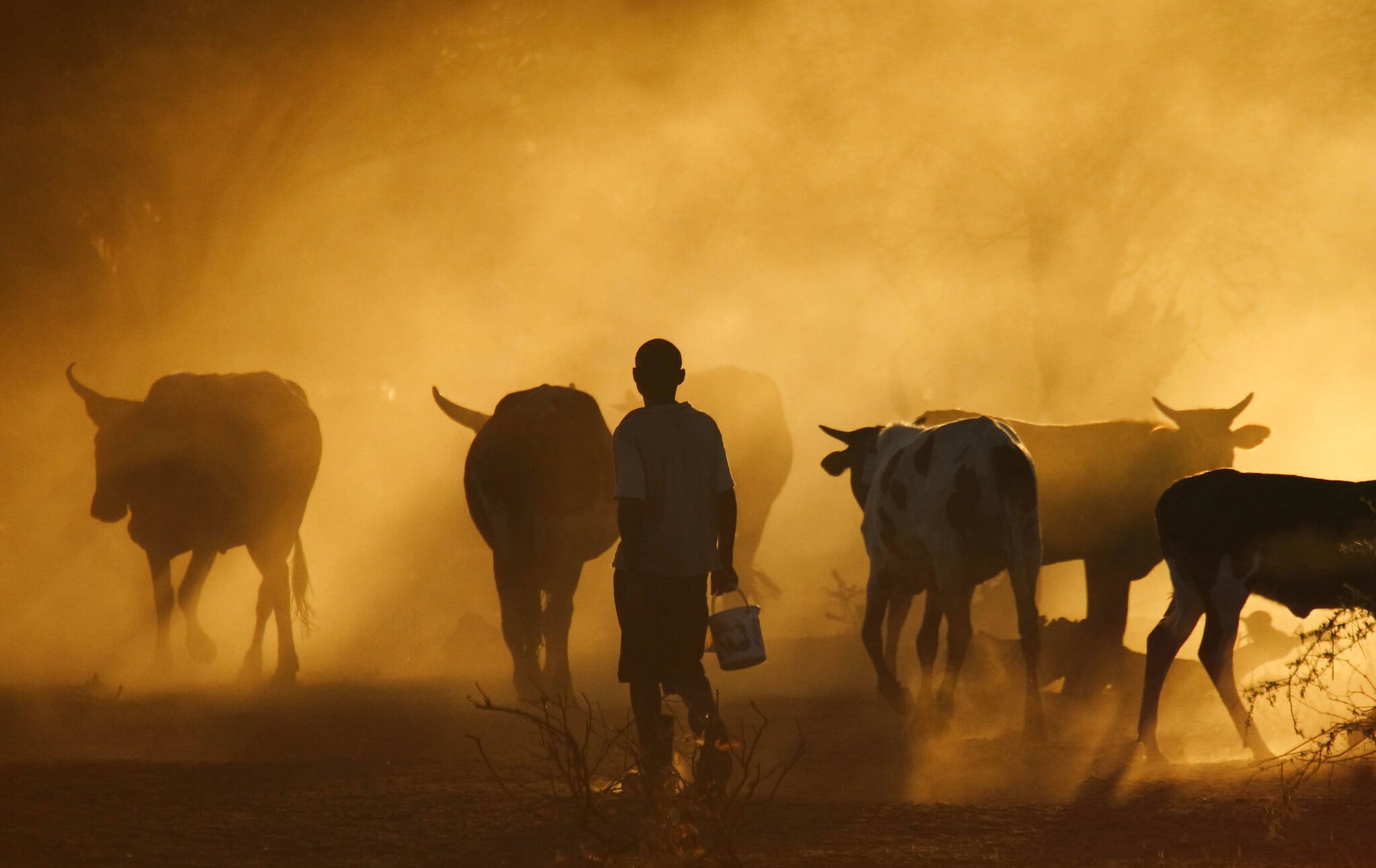
In Zimbabwe, I see firsthand how rising temperatures have killed crops and animals, spread disease, and destroyed the lives of entire communities. We need action on climate change now.
At the height of the 2024–2025 El Niño-induced drought, I watched in revulsion as hundreds of emaciated cattle desperately crowded for a drink around a small muddy dam in Mutare district in eastern Zimbabwe.
Besides being murky, the water in this pool was covered in algae. But in this part of Zimbabwe, it was one of the few remaining sources of water after nearby rivers had dried up completely. A few months down the line, some of these cattle died of starvation as grazing pastures were decimated by the relentless heat and drought.
In Zimbabwe, where cattle are highly prized for both economic and cultural reasons, such losses were devastating to farmers. Many farmers also lost their crops, worsening an already dire humanitarian crisis. And at the peak of the drought, more than 7 million Zimbabweans were left without enough food, with some going for days on end without proper meals. The death of cattle locked the farmers in a vicious cycle of poverty as they depend on the animals for draft power. Even with better rains during the 2025-2026 farming season, the farmers did not have enough animals to till their land. Many of the small farms now lie abandoned; some have already been overtaken by thorny shrubs.
For generations, farmers in Zimbabwe—just like many others across Africa—could predict the seasons with remarkable accuracy. Summer rains in Zimbabwe usually came around mid-October to early November, signaling the start of the planting season for the staple maize, sorghum, millet, and other crops. Agriculture, particularly rain-fed crop farming, has long been the backbone of Zimbabwe’s economy, with up to 70 percent of the population deriving their livelihoods from farming and other economic activities related to rural areas.
But today, these once-vibrant rural economic activities have since collapsed. Droughts are increasingly disrupting the once predictable weather patterns and farming routines. The droughts are becoming more frequent and severe; rains are arriving late (and at times never arrive at all) or ending too soon. Prolonged heat waves are destroying crops, livestock, and livelihoods across rural areas, not only in Zimbabwe but across many countries in Africa.

“According to the Zimbabwe Meteorological Service, daily minimum temperatures have risen by approximately 2.6°C over the last century while daily maximum temperatures have risen by 2°C during the same period. This has seen the country experience extremes of weather over the past two decades, including dealing with 10 droughts, decreased freshwater and destroyed biodiversity,” Boaventura Monjane wrote in a recent study, published by the international farmers’ group Via Campesina.
When I started closely following the impacts of climate change on rural communities in Africa about two decades ago, I noticed that after every drought, many farmers still held onto hope that the next farming season would be better. But over the years, the hopes of better farming have faded into despair and frustration. In Zimbabwe, droughts that once occurred roughly once every decade are now happening almost every three to four years, according to climate researchers and government assessments. At first, some of the more superstitious farmers in Zimbabwe thought the droughts were a punishment from their ancestors for whatever transgressions. Some have even tried to brew traditional beer to appease their rain gods to no avail. I remember vividly one farmer telling me: “We are absolutely cursed.”
A similar story is playing out across much of southern Africa, as extreme heat and prolonged droughts are becoming more frequent and more severe, disrupting rural livelihoods and deepening food insecurity in communities already struggling with poverty. Climate change, experts have warned, is accelerating these extremes, exposing millions of people in the region who depend entirely on rain-fed agriculture to growing risks.
Along with Zimbabwe, several other countries in Africa, including Zambia, Malawi, Mozambique, and Namibia were ravaged by the devastating El Niño-induced drought during the 2024–2025 farming season, one of the worst in more than four decades. Crops were wiped out across large areas, rivers dried up, and millions of livestock died of starvation as grazing land disappeared. And reports say another super-El Niño event will likely hit the region in 2026–2027, raising fears that populations still smarting from recent losses could face another devastating cycle of heat and drought.
On July 10 of this year, I returned to the same small dam in Mutare district to see how it was faring ahead of the anticipated 2026–2027 drought. Encouragingly, water levels had improved following the good rains earlier this year. A local villager could be seen filling a few barrels with water from the dam. Yet it was clear that the dam would not hold enough water to withstand another prolonged drought.
That realization was both sobering and depressing. As a journalist, all I can do is document what I see and warn people about the risks that lie ahead. Beyond that, there is little I can do except hope (and pray) that forecasts of a severe El Niño do not materialize. But hope alone, I know, is not a climate adaptation strategy. Preparing for what science tells us gives us a better chance of surviving the next drought.
“El Niño is a complex phenomenon, and it is becoming even harder to predict its impacts with the added turbulence of climate change,” said John Long, a United Nations climate expert who chairs an inter-agency research group focusing on El Niño Southern Oscillation (ENSO). The oscillation still isn’t fully predictable, but in simple terms it means that changes in ocean temperatures cause corresponding changes in the atmosphere, rainfall, and storm patterns around the world—so when the oceans heat up, the whole complex system is disrupted. In some parts of the world the result can be devastating floods; in others, equally lethal droughts.
Cattle, which are central to rural economies and cultural life in many African communities, are especially vulnerable to heat stress and lack of grazing. In Zimbabwe, Botswana, Namibia, Malawi, Mozambique and Zambia, prolonged dry spells have left many farmers watching helplessly as their animals die from hunger and dehydration. In these countries, this crisis extends far beyond livestock. Extreme heat is also damaging soils, reducing water availability, and increasing the spread of pests and diseases.
With higher temperatures, new crop pests like fall armyworm are emerging, devastating the staple maize. In Zimbabwe, tsetse flies which spread sleeping sickness and mosquitos which spread malaria are expanding to new areas, which are becoming warmer and conducive to their survival. In Zimbabwe’s city of Mutare where I live, cases of malaria were very rare in the past because the city had cold winters. But now malaria is common; temperatures are rising and winters are becoming warmer. At the same time, some parts of the country are experiencing critical shortages of clean water, forcing residents to depend on unsafe sources. This has resulted in sporadic outbreaks of waterborne diseases like cholera and typhoid.
Crops such as maize, a staple food for millions across Africa, are also highly sensitive to heat stress during key growth stages. Researchers say even short periods of extreme temperatures can sharply reduce yields.
“In Sub-Saharan Africa, a 1 percent rise in mean temperature is linked to a 1.51 percent decline in overall crop production, posing a serious threat to food security,” wrote Daniel O.Omokpariola and his team in one of their researches, published in the academic journal Discover Sustainability.
There is an obvious injustice to the whole situation, as the United Nations’ Intergovernmental Panel on Climate Change (IPCC) has repeatedly warned that Africa is among the regions which are most vulnerable to climate change despite contributing the least to global greenhouse gas emissions. Rising temperatures are projected to intensify droughts, reduce agricultural productivity and worsen hunger across many parts of the continent.

For rural families, the impacts are already visible. In many communities I visited in Zimbabwe, women and children are now walking longer distances to fetch water as boreholes and rivers are drying up earlier than before. Some hard-up families had to reduce meal sizes or skip meals altogether during prolonged dry spells. In one rural area, I observed long lines of women and children queuing for water at a hand pumped borehole. Young people, mostly men, are increasingly migrating to towns and cities in search of work as farming becomes less reliable. Sadly, some are even indulging in illicit drugs and substances to cope with the stress associated with droughts and lack of livelihoods. The most prevalent illicit drugs include crystal meth (known locally as mutoriro), cannabis, and prescription cough syrups. Other abused substances include sedatives like diazepam, cocaine, illicit alcohol drinks, and inhalants like glue.
“There is also a danger of attempting to treat climate related mental health as a disease rather than climate conditions, off-shoots and aftermaths. Climate induced consequences need to be visualized using environmental and sustainability lenses so that the placement of drug and substance abuse can be sufficiently diagnosed and interrogated,” Peter Makwanya, a Zimbabwe climate change expert opined.
Beyond the psychological, extreme heat also poses direct risks to human health, particularly for elderly people, children, and outdoor workers. Heat-related illnesses, dehydration and malnutrition often rise during prolonged hot periods, especially in remote areas with limited healthcare services.
In rural Africa, each drought now arrives before many families have recovered from the last; families lose crops and livestock, weakening their ability to recover before the next climate shock arrives. Repeated losses also reduce households’ savings, income, and resilience, trapping many in perpetual poverty.
Despite these challenges, some rural communities are trying to adapt, albeit slowly. In some parts of Zimbabwe, farmers are shifting from maize to more drought-resistant traditional grains such as sorghum, finger and pearl millets. Others are adopting conservation agriculture techniques designed to preserve soil moisture and reduce water loss. In Mozambique, conservation agriculture is led by Allan Schwarz, a climate change expert and founder of the Mezimbite Forest Center, who told me that “Agroforestry practices can reduce net greenhouse gas budgets by sequestering carbon in soil and biomass, decreasing fossil fuel usage by reduced equipment runs in fields, enhancing energy conservation around farm buildings, and enhancing efficiency of nitrogen fertilizer use.” The center also works extensively to restore forests that have been cut down, and has become the single largest planter of trees in Mozambique.
At the same time, some communities are also investing in small-scale irrigation and water harvesting systems, while others are venturing into beekeeping. “Crop farming in our area is no longer sustainable due to severe droughts,” one small-scale farmer in Mutare district in Zimbabwe Nicholas Kwadzanai Mukundidza told me a few years ago. “Beekeeping is now the only way to go.”
From my conversations with this farmer-turned-beekeeper, I came to appreciate that the benefits of beekeeping extend far beyond honey production. It has also become a powerful incentive for conservation, with beekeepers actively protecting the forests where they place their hives because their livelihoods depend on healthy ecosystems. Mukundidza led me to his apiary, nestled below a hill just beyond his homestead. The vegetation was lush and dense, while birds chirped excitedly from the undergrowth. His beehives had become an unlikely shield for the surrounding forest: no firewood poacher dared venture into the area for fear of provoking the bees. In this way, the bees were not only producing honey but also helping to protect the woodland from human encroachment.
Climate experts say such adaptation measures are increasingly essential, but many rural communities lack the financial resources and infrastructure needed to fully prepare for worsening climate extremes.
Humanitarian organizations and governments across Southern Africa have repeatedly appealed for increased climate financing to help vulnerable communities adapt. However, funding gaps remain significant, and many rural areas continue to rely heavily on emergency food aid during severe droughts. And by themselves, these measures are not enough, since they only address the symptoms of climate change, not the root causes. Experts say without stronger global action to reduce greenhouse gas emissions, extreme heat events across Africa are likely to become even more intense and frequent in coming decades, and no amount of swapping out crops or rationing water will save the farms and villages in the danger zone.
For many rural families in Africa, climate change is no longer a distant threat discussed in scientific reports full of bland academic phrases like “anthropogenic causes” or “carbon sequestration.” Instead, it's becoming an ever-present part of daily life. True to American astrophysicist Neil deGrasse Tyson’s assertion that “the good thing about science is that it’s true whether or not you believe in it,” climate change does not care whether some politicians call it a hoax. And as temperatures continue to rise, millions of people in rural Africa face an uncertain future shaped increasingly by extreme heat, water shortages, and recurring droughts; a crisis threatening not only livelihoods, but the survival of entire farming communities.
While these challenges are significant, they also underscore the urgent need for stronger climate policies. In Zimbabwe, for example, thousands of farmers are leaving the country's drought-prone lowlands and migrating to the country’s eastern highlands, where rainfall remains more reliable and soils and grazing land are more productive. Yet the government has no comprehensive policy to manage this growing wave of climate-induced internal migration. Instead, many of these displaced families are labelled “illegal settlers” or “squatters” and face eviction; in most cases these evictions are violent.
At the same time, Zimbabwe possesses numerous large dams whose water remains underutilised, even though it could be harnessed to expand irrigation and reduce dependence on increasingly erratic rainfall. Such investments could help communities adapt to worsening droughts and lessen the pressure driving climate migration.

From my experience, adaptation measures are far more likely to succeed when they are designed with, rather than for, the people they are intended to benefit. Too often, governments, development partners, and the private sector invest in climate-smart infrastructure, strengthen early warning systems or implement resilience programmes without adequately consulting affected communities. The result is that well-intentioned interventions can fail because they overlook local knowledge, beliefs, and priorities.
I witnessed this firsthand when the Zimbabwean government, working with development agencies, delivered truckloads of pearl millet to a drought-affected village called Mambwere. The community rejected the food aid (even though they were hungry) because eating pearl millet, or food prepared from it, is considered taboo according to longstanding cultural beliefs. Had the community been consulted beforehand, officials would have understood these sensitivities and selected a more appropriate form of assistance. Instead, a costly intervention failed because local voices were excluded from the planning process.
As climate impacts intensify across Africa, governments must move beyond reactive responses and adopt inclusive, evidence-based climate policies that address both adaptation and climate-induced migration. Equally, they need to recognize that a “one-size-fits-all approach” is unlikely to work. Such policies will only succeed if affected communities are meaningfully involved in shaping them. Listening to local people is not simply good governance, but it is essential to ensure that climate solutions are both effective and sustainable.
Andrew Mambondiyani is a journalist based in Zimbabwe with a special interest in climate change, agriculture, sustainable development, human rights and the environment in general.
Top photo: Cattle coming in from the fields in the evening in Lhate Village, Chokwe, Mozambique. Photo by Stevie Mann for the International Livestock Research Institute, used under Creative Commons license.