How do we actually get people to pay attention to the crises unfolding around us? As corporate media fails, we need to build a mainstream consensus against fascism and climate collapse.
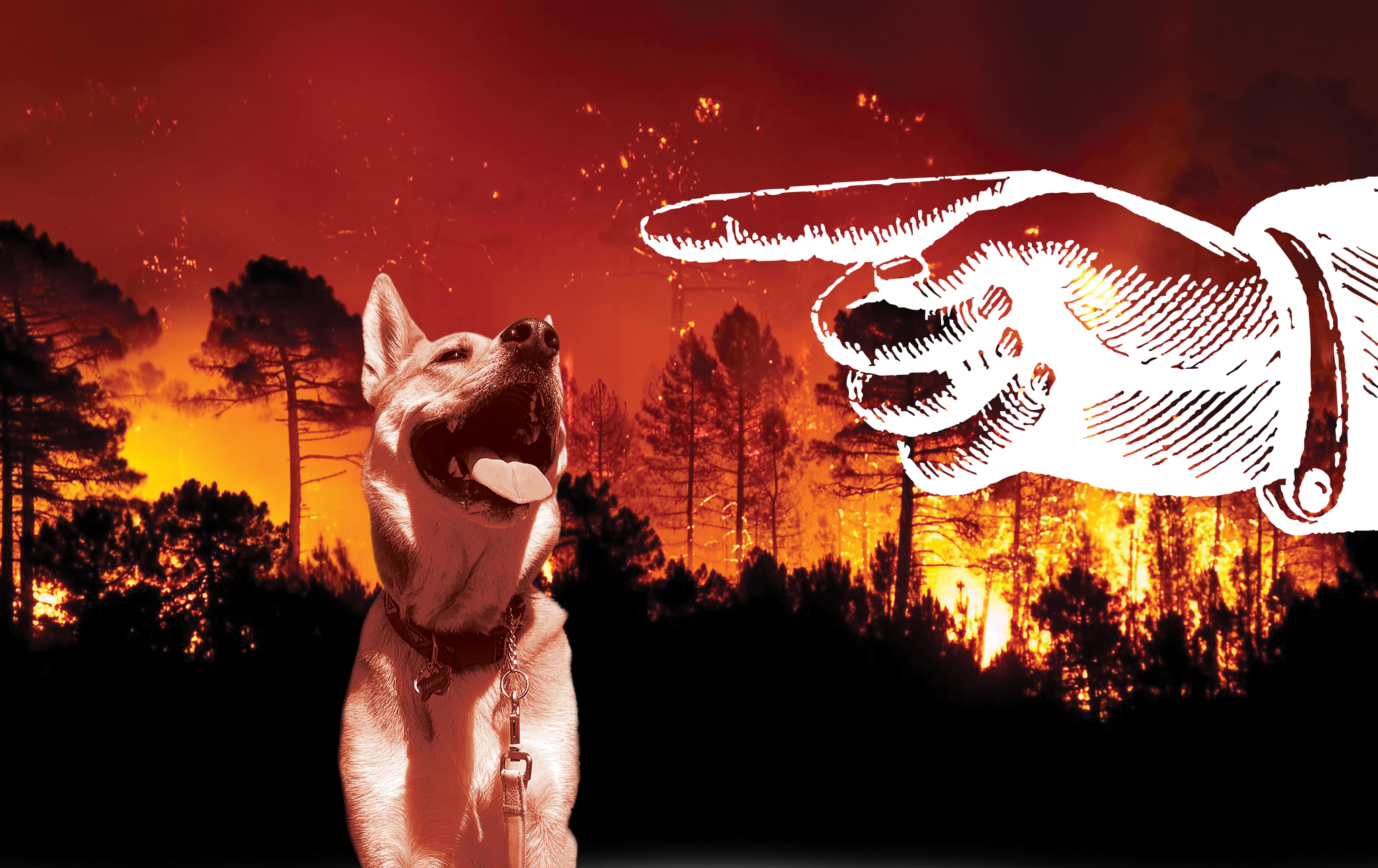
When I point to where I just threw a ball or dropped a treat for our seven-year-old Shepherd/Chow mix, Timothy, he simply stares at my hand. Not to where I’m pointing.
The more desperately I move my arm around, the more Tim focuses on it, my hand now looking like a pecking woodpecker or a fleshier, tastier version of the treat I’m trying to point him toward.
But who’s really the confused party here—me, or black-nosed, curl-tailed Timothy? How could he know what pointing means? He doesn’t have fingers. His sense of direction is based on a highly developed sense of smell, not the arrows and signs that my pointing tries to simulate.
So why do I keep pointing, when it’s not working, and will never work?
As Timothy stares at my hand, while I impotently repeat a cryptic gesture known only to my species, I’m reminded of the way our society has been politically frozen during the last decade, with none of the biggest problems getting solved. Why is it so difficult to direct popular attention and action towards what matters?
Part of the answer is that mainstream news, social media, and the dozens of other ways we communicate with each other have become hyper-profitized, algorithmically manipulative, and twisted into weapons of division by the forces of big capital that are currently having their way with the world. Yet over and over again we return to the same legacy news outlets, pundits, talking points, and pieces of conventional wisdom that once seemed to work, but are now plainly making things worse.
And here we sit, staring at a pointing finger while preventable disaster after disaster pummels us.
The crises could not be more urgent. Mass detention centers are currently being set up across the U.S., with billions being spent on a terrifying “nationwide ‘ghost network’ of concentration camps.” Cartoonish levels of corruption are exploding, with the U.S. falling to its worst-ever rank in a global corruption index and the White House brazenly embracing a “pay to play” philosophy of politics. Fossil fuel companies are escalating their destruction of the planet, obliterating our species’ hopes for a livable future, with scientists warning that global warming is accelerating faster than predicted and feedback loops may well trigger “a new and hellish ‘hothouse Earth’ climate.” And since 2023, we have watched the livestreamed, nonstop slaughter of tens of thousands of people in Gaza, the majority of them women and children, with the full support of the U.S. government under both Democratic and Republican presidents.
In the face of these overwhelming catastrophes, legacy news, talking heads, and elected officials repeat the same kinds of tired, spurious talking points designed to waylay consensus and divert us from taking meaningful action.
It’s complicated.
You have to choose between the lesser of two evils.
Any change must be driven by market incentives.
Or we hear that activists are the problem, not the companies wrecking the planet. On the New York Times op-ed page we read that “attempts to punish the fossil fuel industry by limiting leases or permits for export facilities or blocking projects often backfire” so “advocates should support stable oil and gas production.” Matt Yglesias pleads with us to “support America’s oil and gas industry” as they drive planetary warming off the charts.
Anyway, don’t be so worried. The Wall Street Journal op-ed page says there’s no need to “freak out” about the climate crisis, repeating fossil fuel industry falsehoods to paint a rosy picture of the future. When they do acknowledge the crisis, they tell us that we can’t do anything anyway. Global warming is simply “the future we’re heading toward,” because “humanity has shown that it’s unwilling to impose the limits on economic activity that would be necessary to keep global warming below 1.5 degrees Celsius,” and therefore all we can do is resign ourselves.
But the most powerful weapon of all is silence: simply not mentioning that any of this is happening. Or burying it in the back of the newspaper, as the New York Times infamously did with the Holocaust and now does with climate news. Or reporting it, but doing so only once it’s too late and the window for action has closed.
Helplessness, confusion, and anger have become the one common reality we all share precisely because we’ve been robbed of any unifying mass media depiction of anything remotely resembling reality. Americans are bombarded with dozens of micro-targeted narratives every day, tailored to their comfortable consumer profile but not their need to know in order to act. And nobody can be expected to navigate this moment without having even one functioning, widely-available, news outlet, a trusted source of information to replace the dozens of “legacy” outlets that have collapsed like a 100-foot-tall ice sculpture of Edward R. Murrow on a 92-degree January day.
The oligarchs aren’t even pretending they want to keep us informed anymore. They view functioning news as a threat—which it is, because if people understood how their futures are being wrecked to keep the rich rich, they’d be furious. The pitchforks might come out.
It’s getting worse every day. CBS News, the legendary home of Murrow and Cronkite, is now run by Bari Weiss, a pro-Israel zealot who has already started yanking stories that don’t show “balance,” i.e., that are insufficiently deferential to the powerful. Jeff Bezos ordered his Washington Post to print only opinions that are favorable to free-market capitalism—in other words, to celebrate the very system that is erasing the possibility of maintaining a livable planet. A billionaire dictated that one of our nation’s leading papers, instead of trying to halt our civilizational suicide, will actively cheerlead for it. Soon after, he fired more than 300 journalists, about one-third of the staff, including eliminating the entire books section. (Who needs books?)
The New York Times has shamefully downplayed the Gaza genocide, and blacked out the role of billions and billions of dollars in soft and dark money in steering the direction of U.S. government. They have also buried the climate crisis for decades. Despite having many excellent climate journalists on their payroll, the Times has treated it as a mere “environmental issue,” and the paper has even accepted (and produced) sponsored content for the fossil fuel industry.
Amidst this bog of omissions, half truths and straight up misinformation—even when a preeminent climate scientist like James Hansen posts that with a high probability of an El Niño weather system coming by the end of the year, we will likely see even faster, incredibly dangerous global warming—a person almost can’t be blamed for asking, “Who do I believe? This guy I’ve barely heard of telling me this sci-fi movie information or a 100-year-old news outlet like the BBC or the Times?”
For most people, the exchange becomes “trusted news brand versus one voice,” i.e., the pointing finger versus what the finger is attempting to convey.
And then, Dr. Hansen or one of dozens of other scientists reminds us that in 2023, when we last had an El Niño, temperatures surpassed the Paris Accord’s “do not cross line” of 1.5 degrees Celsius—and did not go back down even after the El Niño ended. (That’s an average global temperature increase of 2.7 degrees Fahrenheit compared to pre-industrial levels.) By now, I don’t know about you, but I can’t take my eyes off this weird scientist’s pointing hand. Why is he so excited and animated? And what’s with the hat?
And then, finally, when Hansen informs us we could easily hit 1.7 degrees Celsius warming in 2027, and there is no guarantee civilization can withstand the violent weather and climatic changes that kind of blindingly fast warming will unleash, the medium has fully and completely become the message. And that message is: “Who is this crank CNN won’t even talk to and why won’t he stop jabbing his pointing finger in the air?”
After all, there is zero chance as flawed as our mainstream news ecosystem is, it would fail to report a story as seismic and life threatening as approaching two degrees Celsius warming in just a few fucking years, right?
Right?

This is exactly the murky place in which a lot of us are stuck. A grey area between the truth and where we grew up believing the truth would come from. Individuals and data versus the warm comfort of an established brand.
And we’ve been getting hammered because of it.
There is some good news though. All of the high-end graphics, high-priced talent, reach, and brand loyalty in the world can't change one thing: stone cold reality. The facts are real, whether they’re reported, distorted, or ignored.
You see, all of the advertising, troll farms, focus-grouped talking points, and bots that are deployed every day by big capital have one end goal in their sights: something the marketing world calls “unaided awareness.” Unaided awareness is when a person brings up a product, movie, candidate, event, issue, etc. without being prompted. Slang for this threshold is “living rent free in your head.” It means a consumer has internalized the marketing and thus big capital’s world view.
But here’s the thing. Actual reality and the way we experience it is by its very nature unaided awareness.
And best of all, it’s free.
For instance, Drop Site News didn’t have a large marketing budget when a couple of veteran journalists shunned corporate funding and set up independently in 2024. They have been breaking story after story about the Gaza genocide, the most horrific atrocity in recent history. The story of how Big Oil fully knew they were destroying the livable climate way back in the 1970s and chose to lie about it? That was reported by Inside Climate News—you won’t see it on 60 Minutes, or hear the reporters interviewed by Jake Tapper. Reporter Julie K. Brown of the Miami Herald was “a single mother with two kids to put through college […] permanently in debt and struggling week-by-week to keep her head above the gathering waters of financial overstretch.” But she started poking around on a story about a sweetheart plea deal that federal prosecutors had given to a Florida billionaire named Jeffrey Epstein. In 2018, Brown eventually exposed how a powerful elite network shielded one of the most prolific sexual predators of our time.
The Lever, 404 Media, Inside Climate News, Sludge, journalist Ken Klippenstein, The Handbasket, The Real News Network, In These Times, Status Coup News, Current Affairs, Democracy Now!, The Nation, Capital and Main and dozens and dozens of other independent news outlets have experienced hockey stick-level subscriber growth over the past five years, as hyper-financialization and the oligarchs devour what’s left of the old information system. And when a new social media site called UpScrolled launched a few months ago, one that is not owned by a creepy, amoral billionaire, account sign-ups shattered all expectations.
There is a hunger for something different and better. People know there’s something wrong. There’s an active change happening in the production of news—the way we relate to it, how we get it, and the way we question, challenge, and support it.
And yes, after idiotically pointing dozens and dozens of times I finally stopped and tried another way to help Timothy find the ball. I just pretended to do another throw in the same direction, and his eyes instantly went in the right direction.
Tim doesn’t screw around. He only understands action.
But he wouldn’t give me that ball back and I couldn’t catch him. Still working on that part.
Adam McKay is the Academy Award-winning filmmaker behind Anchorman, The Big Short, Vice and Don’t Look Up. He founded the nonprofit Yellow Dot Studios in order to harness the power of entertainment to combat Big Oil disinformation and mobilize action on the fossil fuel pollution crisis.

%20(1).jpg?width=352&name=Butch-Ware-2018%20(1)%20(1).jpg)