
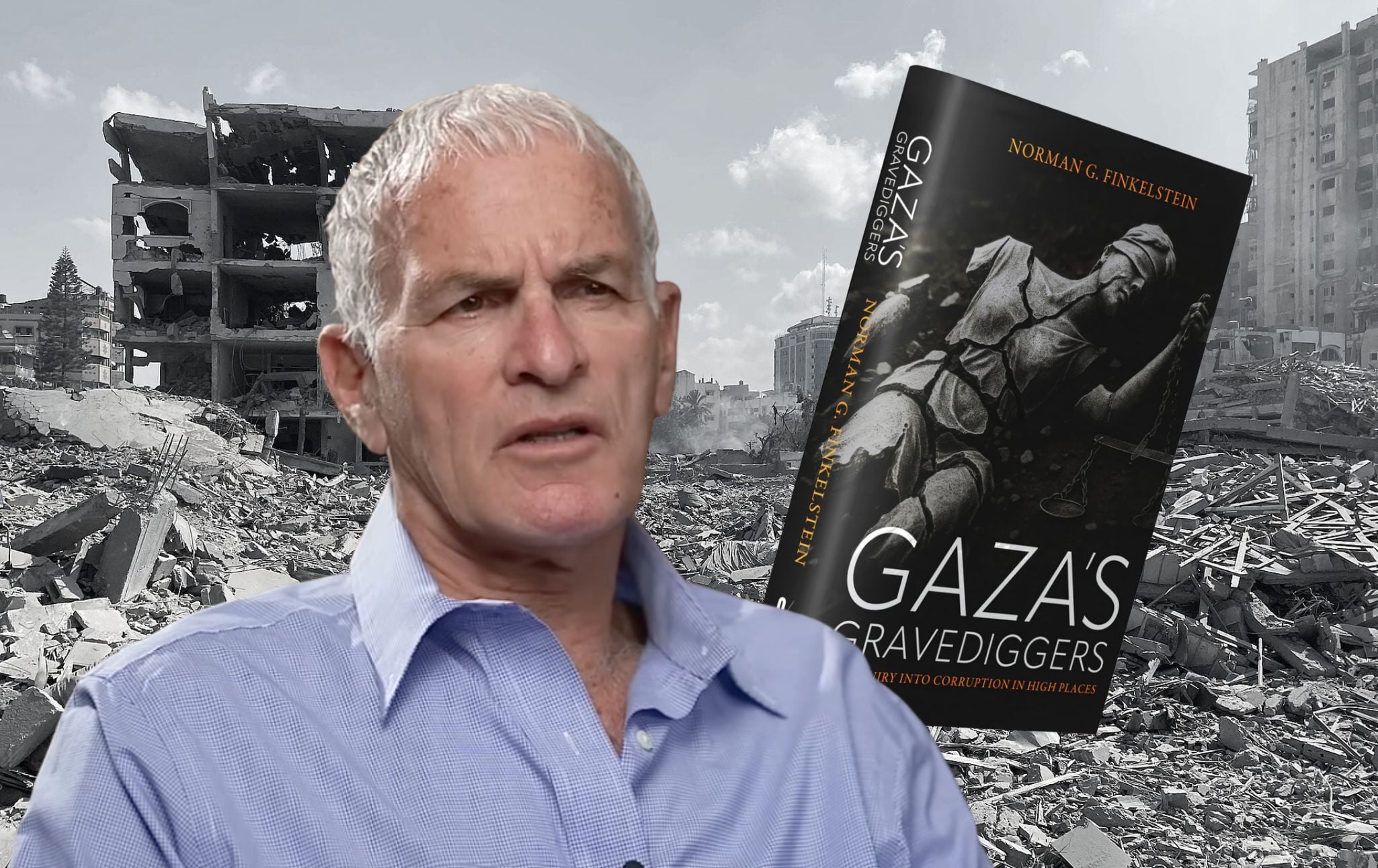
In part two of his exclusive interview, the scholar discusses censorship, October 7, and the moral questions raised by life in what he calls a "concentration camp."
In the second half of his interview with Current Affairs, Dr. Norman Finkelstein discusses the changing political landscape surrounding Palestine, the growing critiques of Israel among right-wing commentators, and why he remains unconvinced by both the one-state and two-state solutions. The political scientist also explains why his latest book, Gaza's Gravediggers: An Inquiry Into Corruption in High Places, focuses less on Israeli propaganda and more than on the failures of prominent human rights organizations to stop a genocide. Because these intuitions are meant to possess a certain "moral authority," Finkelstein says, "it's those betrayals that anger me 10,000 times more."
Read the first part of the conversation here.
ROBINSON
This gets me to a question I've wanted to ask you for a while because I wondered if you changed your mind on something. Several years ago, you made some criticisms of the BDS movement that got some attention, and one of the criticisms that you made was that the ultimate goal of the BDS movement—which you saw them as being a little fuzzy about, or sort of concealing for some reason—was that they wanted to implement the full right of return; it would effectively result in the end of Israel as a Jewish state. You said that's not politically viable, not where public opinion is at, and you should be honest. And you, like Professor Chomsky, believe that the ultimate current political goal should be the implementation of international law, a two-state settlement roughly on the 1967 lines, et cetera.
One of the things that some Palestinians and advocates of a single state, or people who say that a single state in Israel-Palestine is now the only realistic solution, because of the settlements and the degree to which Israel has colonized Palestine, is they say, "Well, you, Norman Finkelstein, have advocated a solution that would essentially preserve what cannot ultimately and should not ultimately be preserved, which is Israel as a Jewish state. The very idea that you can have a state that is for one people over another ultimately has to disappear. That's ultimately what we have to fight against. Ultimately, if there is to be a future for these two peoples in this one place, we need a single democratic state that recognizes the equality of both people."
Do you believe that there can be, should be, long-term a Jewish state? Do you believe the state of Israel should persist long-term, or do you believe it is something that we should ultimately push for, turning into something that genuinely recognizes the equality of both people in this land?
FINKELSTEIN
First of all, let's start from the base. I don't believe in two states. I don't believe in one state.
ROBINSON
Okay.
FINKELSTEIN
No, I don't. I'm at the end of my life. I'm not going to suddenly change my convictions. I'm a person of the left. I've always been, and I expect it will be so when I am interred in my grave. I don't believe in states. The last line of the Communist International is "the International shall be the human race." I'm not committed to any states. So the question is not my commitment to a state. The question is, how do you get to that goal?
And sometimes to achieve a goal, it goes through all sorts of byways and indirection; it's not, as they say, linear. It's a complicated process how you get there. In terms of the current situation, it's true that public opinion has changed radically on the subject since October 7, or let's say a lot of the pent-up anger and resentment, which people have to repress after October 7, bubbled forth, and it became, so to speak, no holds barred. I was saying yesterday to my comrade, friend, disciple, Jamie Stern-Weiner, "In the current moment, you'll forgive me for saying this, it's too easy to attack Israelis and Jews right now." It is. It's become very easy. I had a conversation this morning with a friend of mine, and he was singing the praises of various right-wing figures like Tucker Carlson, Candice Owens, and Nick Fuentes, and saying how much courage they had. And I said to him, "Look, in my opinion, 70 percent of what Tucker Carlson is saying now is true." I have no problem saying that. Seventy percent of it is true. But I don't think it takes much courage now.
There is a lot of pent-up anger because Jews wielded the Holocaust weapon, and then after October 7, they wielded the blackmail weapon, not to mention all along the AIPAC black money weapon. So it takes no courage now to speak out against what Israel is doing. Basically, what Tucker Carlson is doing is, I would say, picking at very low-hanging fruit. Everything he says, of course, is obvious! Anybody who's read human rights reports over the past 20 years knows the things Israel has done have been horrible. But it's not just what they've done. It's the way American Jews have carried on. The arrogance, the brazenness, the flagrance. You're a scholar in your other life, or in your previous life as a student. There is a reign of terror on college campuses now. A complete reign of terror. Everybody's terrified of saying anything about Gaza or genocide. Can't say it. Faculty, adjuncts, students, and administration—you can't say anything, and that all began not under Trump, but under Biden. It began with the Bill Ackmans, who started using the blackmail weapon. "If you don't crush the encampments, we're withdrawing our alumni contributions," and that was a large amount of money.
At Harvard, one person gave $200 million to Harvard, another person gave $300 million to Harvard, and Ackman gave $50 million, and they all collected together. There was a joint statement by Jewish alumni of Harvard about half a year into the genocide, in which they said, "We're not going to contribute." That's a lot of money. So a huge amount of resentment, not just at universities. I have a friend, a physician. Everybody in the hospitals is terrified because anything they post on social media, they lose their job. They do. People have been fired in hospitals. So there's a huge amount of resentment. And now people like Tucker Carlson, Candace Owens, and others are capitalizing on it, and it's very easy to attack Israel. So, I recognize there's been a huge shift in public opinion. Of course, I'm glad about that. And when Tucker Carlson says things that are true, I'm glad he's saying them. I think a lot of what they're saying is crazy. I don't think that Israel killed Kennedy. I don't think Israel killed Lincoln. And I don't think Israel is responsible for the fall of the Roman Empire. I don't believe those things, okay? I think they're nuts.
However, it also remains the case that, take a figure like Jeremy Corbyn, or take the South African delegation, which brought the genocide case before the ICJ. They still say two states. They still say two states. So I'm taking the extreme end of the mainstream public opinion, not at the popular level. I'm taking it at the political level, where people are exercising powers of representation, and they still say two states. So, I would say at this particular moment, we are in an unsettled situation. We have a huge amount of popular opinion, which is now saying "a Jewish state is illegitimate"—effectively saying that—but it's not yet been translated into the political level. The second point I have to make is that when you take the case of South Africa, the ANC (African National Congress) from the beginning, from its Freedom Charter in the early 1950s, was committed to the doctrine "one person, one vote." That, as it were, universalistic doctrine was heavily influenced by the communists, who played a major role in the ANC—not the major role, but a major role. The leadership was very committed to that idea of a non-racialist state.
When Walter Sisulu, who was the second in command of the ANC after Nelson Mandela, was asked the question, "Do you believe that you will live long enough to see a Black president of South Africa?" I never forgot his response. He said, "I don't want to live to see a Black president of South Africa. I want to live to see a democratically elected president of South Africa." A very different proposition, because they had internalized those democratic, universalist norms of "one person, one vote." I don't believe, in either side of the Israel-Palestine conflict, there is a significant political movement that has internalized those norms, and so it makes it, in my mind, very difficult to imagine how they can coexist together. I don't see it. It doesn't exist. I know the leaders of the BDS movement, and I know them personally, because I knew them at Columbia University in the early to mid-1980s. If you read what they actually write, they're not committed to a democratic secular state; they're committed to an Arab state in which Jews would enjoy the rights as a minority in an Arab state. That wasn't the ANC. That was not the ANC.
So I'm skeptical on two levels. Number one, there is still that broad consensus on two states. It hasn't been dented by the change in public opinion as of yet. Yesterday, I spoke at that event I mentioned. Ralph Nader's niece, a wonderful woman, is Nadia Milleron. She's the daughter of Laura Nader, who was a respected anthropology professor at Berkeley. She retired at 92, and she's now 95. Ralph Nader is now 92. Nadia Milleron is running for local office in Springfield. She came to the event, and she gave joint questions and answers. She made brief remarks and said, "There has to be legal rights for all. Everything has to be equal and can't be anything less. One state. Everyone who's there should stay there." And she's running for local office, and she's not afraid to make those statements anymore, because she knows public opinion has shifted, and I recognize that. For me, the question is not what I'm committed to. I'm not committed to one state; I'm committed to no states. I remain an old-fashioned. "The International shall be the human race."
But politics is essentially about one thing: it's assessing what's the maximum you can extract from a given situation with the given balance of forces or where the balance of forces is headed. What direction? Because there's some subterranean movement, which may not or cannot be measured right now, but you could see it coming. That's what politics is. What's the maximum you can extract from a given moment, given the current and foreseeable balance of forces? Given that, I don't see one state as a realistic possibility right now. It could be part of your broad agenda, and of course it is part of my broad agenda, but my broad agenda goes beyond that. I want no states.

ROBINSON
But does it not sort of create self-fulfilling prophecies if you take the arrangement of political forces as a given? There have to be those of us who say you need to have a democratic secular state long-term. Maybe having no states is the thing that's far off in the utopian future, but those of us who want to push towards real justice should have two simple principles, and they are non-racialist states and democratic states, as you said from South Africa, and it's a fairly simple principle to apply. Maybe not to Israel, but....
FINKELSTEIN
Right, but if we're talking about sensible, there was a third plank in the South African platform originally. It was a radical redistribution of wealth. They abandoned that. That was part of their plan. They were supposed to nationalize the big industry. They abandoned it. I don't think my long-term goal is simply "one person, one vote." We have that more or less in our country. We do more or less have it. Yes, I recognize the issues with the Voting Rights Act and so forth, but more or less, you could say we have one person, one vote, and we have an interracial society.
There have not been significant encroachments on the separation of church and state, in my opinion. There have not been significant encroachments on that. But that's not enough for me. That's not enough. It's like right now I'm thinking I'm being attacked—I understand. I don't follow the social media, and when it pops up in my algorithm, I ignore it. I don't want to hear it, because I have work to do, and I'm not going to be distracted by the "podcasters." I have things I have to get done, and I'm not going to get distracted. But people keep reporting back to me that I'm being attacked because of the remarks I made about Mr. Tucker Carlson, Miss Candace Owens, and Nick Fuentes. And I say it happens that on aspects of Gaza our interests intersect. I get that, and I'm glad Tucker Carlson is saying a lot of what he's saying. I am. But Gaza is not my be-all and end-all. It's part of my worldview to fight for justice. I'm not about mass deportations now. I'm not. I'm not about making America great again.
These defectors from Trump—defectors in a positive way—are defecting because they say he betrayed what he originally promised. I never particularly liked what he originally promised. I don't want to put America first. That's not part of my vocabulary or part of my worldview. So, I have to ask a question. I do. The question is very simple: How do mass deportations now cohere with compassion for the people in Gaza? That, to me, is very strange. The right-wing supports self-determination of nations, national liberation struggles, compassion with the poor, the huddled masses? That doesn't sound like their profile. So I have to ask myself the question, "What is going on? What's happening here now?" People say I shouldn't ask that question. Well, I'm a person of the left. Of course I have to ask that question.
ROBINSON
Steve Bannon said, "We need to stop giving all this money to Israel. We need to use it to build the wall and ICE detention facilities." It's like, yes, but what are you doing with it instead?
FINKELSTEIN
Yes. That makes the point. Somehow it's considered an act of betrayal or revealing of my true solidarity with my Jewish people that I pose the question of what's going on here. I find it very strange that suddenly the plight of Gaza has become the cause of the far right. That's very strange. Nobody finds that odd? I do. I've been around long enough to remember that's never been a right-wing cause.
ROBINSON
Certainly, Candace Owens has said some things that are pretty outright antisemitic. She's encouraged people to read The Talmudic Jew and says Israel is founded by a pedophile cult and all that stuff. But a lot of the replies to your criticism and suggesting there's antisemitism are just full of antisemitism directed against you, fairly explicitly, which does suggest that maybe you're onto something that the right might not have solved that problem yet.
FINKELSTEIN
Well, I won't pursue this issue of solving the problem, but it has caused me a little bit of discomfort about which problem might be solved.
ROBINSON
Yes. We don't have too much time. There's a couple of things. First, I just want to go back to the state of Gaza today, and I wondered if you could comment on the Board of Peace, and I want to read to you something that Tony Blair said recently, a couple of weeks ago, in his update on Gaza to the United Nations Security Council.
He said, "The reason President Trump's peace plan succeeded in bringing the war in Gaza to an end is based on a strategically coherent framework. It was clear after October 7, Israel would never tolerate a situation in which the organization responsible for it would continue in power, and the perpetual cycle of conflict would destroy any possibility of a decent future for Gaza's people. Previous conflicts in Gaza ended a series of truces. This time the scale of destruction and the determination of President Trump led us to propose something fundamentally different, harder, and more ambitious, which, if done, will endure, because it deals with the roots and not the manifestation of the issue."
Then he says, "We need to disarm Hamas," impose a sort of technocratic government on Gaza, and he says there's "a vision for peace and rebuilding if the disarmament occurs, the network of restrictions on people and goods entering and leaving in Gaza will be eliminated, and we have established all these transitional bodies, and upon completion," he says, he's "looking forward to a future of peaceful coexistence in accordance with President Trump's plan for Gaza."
I wondered if you could comment on Tony Blair there and the current state of things with this Board of Peace.
FINKELSTEIN
Tony Blair gives sycophants and lickspittles a bad name. It's very hard to listen to this fellow, but let's just take two propositions of his. Number one, he says the scale of horrors on October 7 was such that they disqualify Hamas from holding any power in any future government. Okay, fine. About 1,200 people were killed on October 7, of whom roughly 800 were civilians and 400 were combatants. Altogether, 1,200. And that disqualifies Hamas and any future governance in Gaza. So if you kill probably on the order of 100,000 to maybe 200,000—now, nobody can really get the numbers exactly right—but if you kill 100 times that number in a genocide, the number of combatants who were killed in Gaza is just an accident. Technically they're combatants, but as you probably know, when you declare something a genocide, let's say you take Rwanda, the Nazi extermination, the Roma people, or the Armenian people, does anybody ever even ask the question, how many of those who were killed in the genocide were combatants? Does that question ever come up? No. It's not even a relevant question.
In the case of Gaza, yes, Hamas militants might have been killed. Do you know why they were killed? They were killed in the same indiscriminate extermination that the civilians were killed in. It's just an accident that they happen to be combatants. It's a genocide. You're targeting everybody. The distinction between combatant and civilian is not operative in a genocide. It's operative in a war. In a war, that distinction has merit. It has no merit whatsoever in the course of a genocide. You're targeting the entire population. So if 1,200 casualties, 800 of whom are civilians, are grounds for disqualifying Hamas, then doesn't 100,000 or maybe 200,000 disqualify the state of Israel from being part of any solution? Doesn't that disqualify every and any Israeli official who was in any way implicated in the genocide from being part of any future peace between Israel and Palestine? Why does it only apply to Hamas?
I know the Israelis say so, but Hamas is not credibly accused of genocide. It's accused of what's called "acts of extermination" on October 7. Crimes against humanity, acts of extermination—in my opinion, really silly distinctions only lawyers can invent, but nobody serious. The Israeli government I consider unserious. Israel claims genocide was committed on October 7, but plausibly, and I think it will be confirmed by the ICJ, they committed a genocide in Gaza. Why do Hamas's acts disqualify it, but Israel's acts don't disqualify the Israeli state and everyone who was a participant from being part of a settlement of the conflict?
The second point to be made is problems did not begin when Hamas was elected in January 2006. Everybody is pretending, like Blair, that the problem is Hamas. In 2004, Giora Eilan, the head of the National Security Council in Israel, described Gaza as a huge concentration camp. Now, nobody can claim that he was speaking flippantly. He's an Israeli. He knows the resonance of describing a place as a concentration camp. Surely he knows the resonance, and he's responsible with words. He's the head of Israel's National Security Council. The problem did not begin with Hamas. Even if Hamas were eliminated, the most you could hope for is that it would return to the situation's status quo before the election in 2006. That's the best you can hope for. And what was that situation? A huge concentration camp. That's what Gaza was at that point. So I see, number one, no grounds for disarming Hamas without disarming the state of Israel, and I see no reason to hope that the situation there will be any better than it was before Hamas was elected, which was already a catastrophe for the people of Gaza.
ROBINSON
I want to conclude by asking you about your new book. People might be surprised if they expect you to focus on deconstructing Israeli propaganda. But that is not what you do. Your book is called Gaza's Grave Diggers, and Gaza's grave diggers in the book are not in fact the State of Israel or even the United States government. Instead, you actually single out international bodies that many Israelis accuse of being biased against Israel. You look at the United Nations, the International Court of Justice, and Amnesty International.
Can you tell us why it is that you believe that there needs to be more focus on those who purport to be sympathetic or responsible for the application of international law and holding all sides to account?
FINKELSTEIN
Good question, as always. So, let's start with the beginning. That's what I've always done. If you look at my book, Gaza: An Inquest into Its Martyrdom, I devote a large amount of space to the misrepresentations by Amnesty International and by Human Rights Watch of what was happening there. If you opened up my book, knowing too much, there's a whole part of the book called "Human Rights Revisionism." I see you're looking at Gaza: An Inquest into Its Martyrdom. Look at the chapters, at "Betrayal." I have a page in the book of pictures of all the people who betrayed Gaza at this point. If you turn to page 358, it starts with the pictures. I call the page "Dishonor Roll." Philip Luther, Amnesty International; Kenneth Roth, Human Rights Watch; Louis Moreno Ocampo, International Criminal Court; and Mary McGowan Davis, UN Independent Commission of Inquiry. Because these people enrage me 10,000 times more than the Israelis, because the Israelis are going to lie.
If you ask an Israeli, "What's the weather out?" and they say, "Sunny," I'll say, "Let me just look out my window." There's not a word I would trust from an Israeli. But these are the people who have a certain amount of, if I can use the word, moral authority, and it's those betrayals that anger me 10,000 times more than reading any stupid Israeli apologetic report. And, corny as it may sound, I do believe in the principle of truth. When I analyze, in the spirit of John Stuart Mill, I make the very best case for the other side. I always make the very best case. Mill, when he would argue a point, would always put at a certain point in parentheses, "it may be argued," "it might be claimed." He's always setting up the devil's advocate, the best possible argument against him, and then he goes after it. And I do the same thing. I make the best case for Human Rights Watch and Amnesty International, but it's just a lie. They lied about the alleged sexual violence on October 7. They did. Human Rights Watch lied. Amnesty International lied. As they always do, they tried to find some balance. And it's a lie, and I'm not going to let it go.
Every talk I give—and I'm attacked a lot for that also, by the way—I say, "I don't think honest people can deny that horrible things happen on October 7. I don't think it's plausible to argue that." I know the head of international affairs for Hamas. Very decent guy. He was the former minister of health in Gaza. His name is Basem Naim. Very smart guy. Two PhDs in Germany. Not a small achievement from a fellow from Gaza. Two PhDs from Germany. And after October 7 happened, I had some correspondence with him, and they put out these claims, "It's all lies; it didn't happen." I said, "Look, of course, terrible things happened. The beheaded babies did not happen, the weaponizing of rape didn't happen, but terrible things happened." I said, "In my opinion, the strategy is not to deny what's undeniable, but to explain why what happened happened," which is what I tried to do in the introduction to the new Gaza book, to try to explain why that happened. So I'm not afraid of the facts, but when agencies and institutions that carry significant moral authority lie for political reasons, so as to show balance, it enrages me.
ROBINSON
Amnesty put out a big apartheid report, and they put out a report documenting the genocide. These are good reports.
FINKELSTEIN
They are good.
ROBINSON
Are they so afraid of being accused by Israel of being biased that they feel a need to give excessive credence to Israeli claims?
FINKELSTEIN
I think there are several things going on. This would be the subject of probably another podcast. First of all, these organizations are liberal and secular. That's their profile. They feel very comfortable in Ramallah, the unofficial capital of the West Bank, because East Jerusalem was appropriated by Israel. It's full of NGOs and liberal secular types. They feel at ease in that culture. They don't feel at ease in the culture of Islamic "fundamentalists." That's an alien culture to them, especially on what you might call the liberal secular litmus tests: women's rights, gay rights, and so forth. Obviously, Hamas and Hezbollah fall very short in those categories, and so there's already a kind of alienation from those people by these organizations. Pramila Patten, the Special Representative of the Secretary-General on Sexual Violence in Conflict, feels very alienated from these organizations.
Secondly, there are the pressures—the pressures not so much any longer to lie about what Israel is doing; no, they're like you say. Amnesty's report on the genocide in Gaza was excellent. It was a very high level of professionalism. The legal analysis was unusually good, I thought. Usually the legal analysis is rote, wooden, and slapdash; this time it is very solid, trying to demonstrate why this is a genocide. But they still feel the pressure for balance. They have to show that Hamas is also bad. Israel is terrible, yes, but you have to show Hamas is also bad. And yes, Hamas did things that legally are indefensible on October 7, and my view was, and still is, that you have to acknowledge that crimes of a significant magnitude occurred, but in my opinion, that doesn't bind you to condemning Hamas, which I refuse to do.
And I refuse to do it for a very simple reason. You know what the simple reason is? I spent the past 15 years reading the human rights reports on what was done to those people, and I find it very difficult to, from above, scold them and lecture them about human rights, just as the abolitionists in our country did not condemn Nat Turner, who committed a very bloody revolt. His order number one was "kill all white people," but when you read the abolitionist statements, they say nothing about what Nat Turner did, except to say it was horrible. They said horrible crimes occurred. Blood-curdling crimes occurred. We're not going to deny that. Women were hacked to death; babies were actually beheaded in that case. They turned to white people, and they said, "We warned you, we warned you, we warned you. You treat people this way, then you reap what you have sown."
And it was interesting. I asked the two young women—they were probably around 20 or so—when I met them in Minnesota, "How do people process the situation that happened? Are they very condemning of Hamas, or not?" And one of the women, the same one who said "humble, humbled," said to me, "At the beginning it was very hard to generalize. There were very different opinions; you couldn't make a generalization." She said, "Then at some point, we stopped arguing. We start discussing it. We just had to accept it happened. It happened, and let's stop discussing whether it was a good thing or a bad thing. It happened." And then she said they reached the third stage where they said, "Whether you wanted it to happen or you didn't want it to happen, it was inevitable. It's going to happen! It was going to happen!" You can't do what you did to those people, lock them up in a concentration camp, where they're born into it, languish in it, and are destined to die in it, and not think that something like that's not going to happen.
It was just what the abolitionists said: We warned you, we warned you, we warned you that if you treat people this way, this is what's going to happen. And that's my view. I won't condemn them. I will not condemn. When you read that history, it's very hard to stand on the platform and scold them from above for what was done to those people. I won't do it. I knew it from day one. I struggled and sweated. I've said it many times. Because my usual recourse—and I'm not proud to say it. I'm just speaking honestly with you. I had the highest regard for him, and I thought Professor Chomsky had exquisite moral judgment, exquisite in the sense of a very fine moral judgment. He had exquisite moral judgment, and so my normal impulse would have been to just ask his opinion. Probably, I would have been persuaded to repeat it. But he wasn't available at that particular moment. I had to think it through for myself, and I struggled because, for the first time as an independent voice, I knew my voice would count, and I really struggled very hard with how I'm going to articulate my opinion. And then it happened for a book I wrote on cancel culture. I had been reading a lot about the abolitionists, Frederick Douglass, and Nat Turner.
So I then said, "Let me go see what the abolitionists have to say about the Nat Turner rebellion," because I respected their judgment. I told you at the very beginning of this interview, Charles Sumner was just a sublime moral figure and also very conscientious, hardworking, and brilliant. The whole thing. And I have to say, I sighed a very deep sigh of relief when I saw how they answered that question, and I thought, okay, now I'm ready to make a public statement.

ROBINSON
Does that mean that as leftists we should refrain from passing moral judgment on atrocities if they're committed by anti-colonial or anti-imperialist movements?
FINKELSTEIN
Well, the famous C.L.R. James in Black Jacobins had to deal with the slave revolts in the Caribbean, and we're talking about tens of thousands of whites killed, and he has a very famous footnote. I can't find the book right now, and the conversation has to come to an end, but when the first edition came out, he would refuse to condemn the slave revolts. And then in the second issue, he said, "I came under a lot of attack because I refused to condemn the slave revolts." And he said, "I'm not changing my mind! I'm not going to do it."
So I'm not saying that's the only leftist position. I believe I talked about this with Jamie Stern Weiner. I suspect Professor Chomsky would have been harsher in condemning what happened on October 7 but then would have gone on, like what he did with 9/11. You remember, he said it was the worst single atrocity in recorded history. And then he said, "What about Chile?" The same thing on September 11, several thousand people were killed, and then he started to go through, but he would have been firmer in his condemnation than I was ready to be, but that chases back to two things. Number one, I'm me! He had his judgment, and I was well into adulthood when October 7 happened, and I wouldn't do it. Not because I'm a poser. All sorts of people came on Piers Morgan, and "armed struggle," "revolution until victory," "the right of the oppressed," and "nobody has the right to oppress." The lecturers. Okay, I was like that when I was their age, so I'm not hard on them. I was the same way, the same slogans. But no, I'm an older person now. I've read a lot more; I've had the time to think a lot more. I wasn't prepared to pose for the cameras. Malcolm X; Norman X. I wasn't prepared to pose for the cameras. I'm way past that. I was past that by the time I reached the age of about 29, and I came under Professor Chomsky's influence.
You have to be morally serious. It's about life and death. You have to always say in your mind, "There but for the grace of God go I." I could have been there on October 7, and I could have been in Gaza after October 7. I could have been in Gaza before October 7. "There but for the grace of God go I." I'm in Brooklyn, New York, and I have a reasonable apartment, a roof over my head, food on my table, and clothes on my back. So, you have to be morally serious about it. I wasn't going to be cavalier, I wasn't going to be flippant, and I wasn't going to recite slogans from Che or whoever else. On the other hand, something in me recoiled at the idea of condemning these young men, most of whom were in their early 20s, because they wouldn't have volunteered for the job if they had families. So it would be unmarried men, probably in their early 20s overwhelmingly. Am I going to condemn them after they were born into, languished in, and were fated to die in a concentration camp? Was I going to condemn them? I couldn't do it, even as I recognized atrocities occurred.
ROBINSON
Yes, I think there's also a certain ambiguity about what the word "condemn" entails. Everyone asks you, "Do you condemn?" What does that mean? Does that mean I condemn them absolutely, in the sense that I don't empathize with them at all? I would condemn it in the sense that I reaffirm my conviction that the murder of civilians is universally wrong. I condemn it in that sense, but I'm not going to say that I have no understanding of what gets people to that point or that I see it as analogous to or similar to the violence of oppressors.
One of the things I liked about what Chomsky would always do is he'd say, "Well, yes, of course, that's a horrendous atrocity, but if you think that's bad, you should see the violence carried out by the United States, which carries out terrorism on a scale 100 times larger, and if you think that suicide bombing is wrong and immoral, and I do, and I condemn it, then I have to proportionately spend 1,000 times more of my time condemning the United States."
FINKELSTEIN
Yes, I have no problem with that, and I think whatever differences there are between us are much more semantical than substantive.
ROBINSON
Well, as I say, we have taken much of your time. We appreciate you spending as much time with us here on this Saturday morning. The book, Gaza's Grave Diggers: An Inquiry into Corruption in High Places, forensically dissects a number of documents, opinions, and testimonies from people who were charged with and responsible for enforcing international law, upholding standards of human rights, and you prove pretty definitively in many cases fell far short of that obligation.
People should also pick up your other books, like Beyond Chutzpah, if they want a forensic dissection of Alan Dershowitz, in particular, which is very satisfying; Knowing Too Much: Why the American Jewish Romance With Israel Is Coming to an End, which is a quite prescient book; and a book that might be out of print now, but I still think is your most personally moving book because it's so autobiographical, and The Rise and Fall of Palestine: A Personal Account of the Intifada Years. And on the Current Affairs website, we reprinted a portion of this book about the comparison between rhetoric about the Cherokee and rhetoric about the Palestinians. Dr. Norman Finkelstein, thank you so much for joining us on Current Affairs today.
FINKELSTEIN
Well, thank you for having me.


.png?width=352&name=Screenshot%202026-09-04%20at%204.00.52%20PM%20(1).png)
%20(1).jpg?width=352&name=miasma-1%20(1)%20(1).jpg)