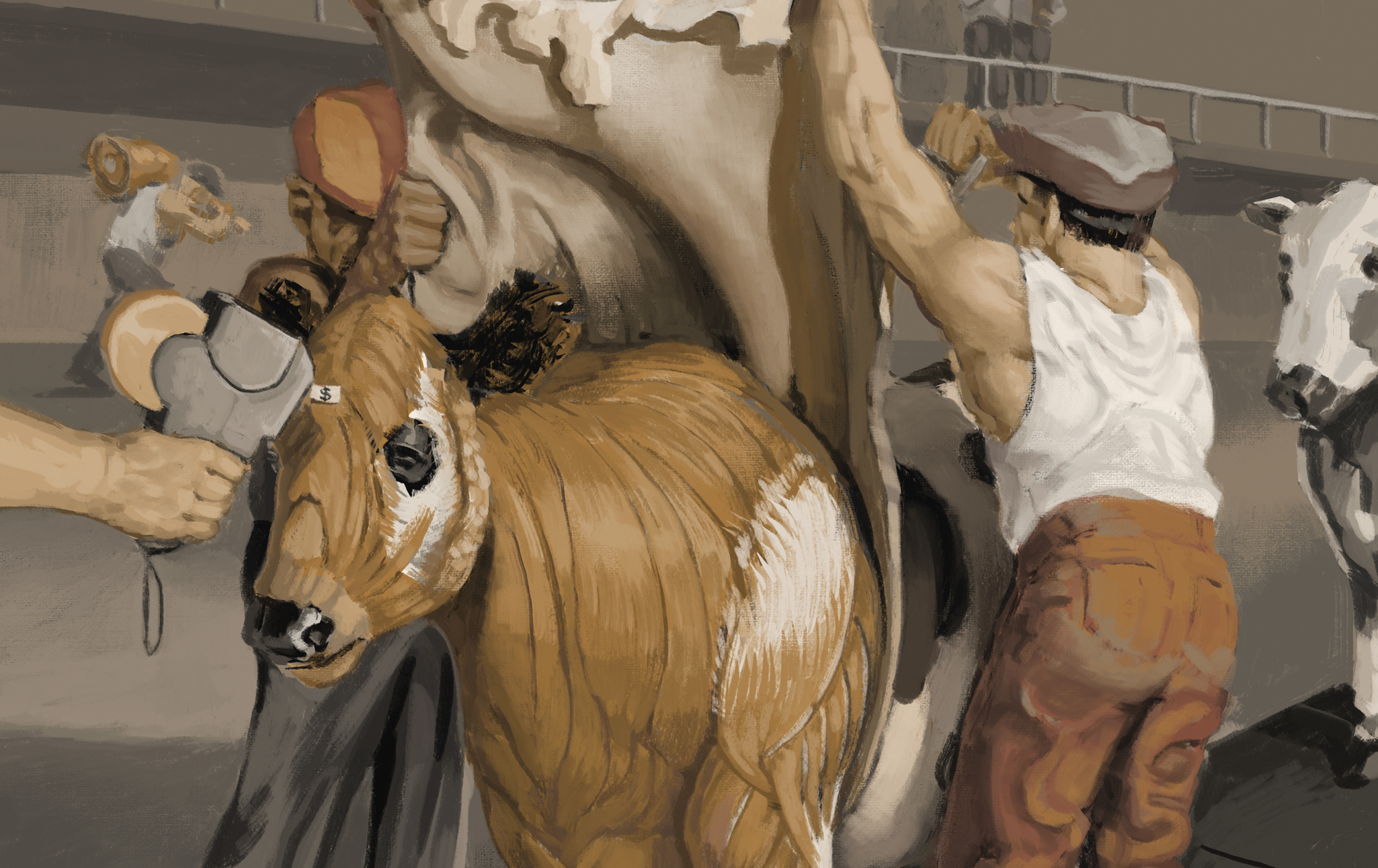
Henry Ford learned mass production from slaughterhouses. A century later, our modern economy still resembles a meatpacking plant.
The entire modern industrial system—from Amazon warehouses where workers have to pee in bottles to Tesla factories where Elon Musk tracks every movement—originated in one place: Chicago slaughterhouses, where capitalists first figured out how to turn living beings into perfectly controlled objects.
This is not a metaphor. Henry Ford literally studied the “disassembly lines” where workers carved up animal carcasses and realized he could apply the same techniques to human workers building cars. As Ford wrote in his autobiography, the Chicago slaughterhouse was “the first moving line ever installed. The idea came in a general way from the overhead trolley that the Chicago packers use in dressing beef.”
Think about that. The assembly line, the foundation of modern capitalism, came from perfecting methods to slice up animals while—and this is the important part—preventing them from resisting. And once capitalists figured out how to turn animals into component parts (just a leg, just a throat, just a head), they realized they could do the same thing to human workers (just a hand, just an arm, just a cutting motion). Ideas of how to prevent human resistance came from first figuring out how to prevent animal resistance.
Antonio Gramsci introduced the term “Fordism” to describe capitalism’s new industrial order. By the 1980s, theorists were already announcing a so-called “post-Fordist” era.
However, we do not live under “post-Fordist” capitalism. This title suggests that Ford invented that which he merely borrowed. We live under slaughterhouse capitalism: a system designed from the ground up to treat all animals, human and nonhuman, as simply raw material for profit. The term “slaughterhouse capitalism” reminds us that the violence we see, all the time, under “post-Fordist capitalism” is not some type of quirk or mistake, some failure or reformable feature, but instead the original and foundational purpose of the entire system—from the moment it was first designed.
The system was always designed to control, to prevent resistance, to produce death as a form of profit. The term “slaughterhouse capitalism” serves to remind us that the capitalist system we live in derives not from the cleanliness of a Ford car factory but instead from the blood-soaked reality of the Chicago stockyards. And the very first lie was this: that the animals being killed could never even speak in the first place.
Animals Aren’t Voiceless—We Just Aren’t Listening
The biggest lie animal agriculture tells isn’t about “happy cows” or “free-range chickens.” It’s that animals are fundamentally voiceless—unable to communicate their own desires and choices. Even some animal advocates perpetuate this nonsense.
This is, of course, obvious bullshit. Animals speak constantly, as researcher Eva Meijer has documented. Dolphins call each other by name. Elephants use different alarm calls for different threats. Ravens use referential gestures to direct other birds' attention, a capacity once thought uniquely human. Squid communicate through skin patterns that function as structured language.
One wonders if the people who make this argument have even met an animal. Abbey is the dog who lives with me, and I can understand when she is scared of thunder, when she is sad, when her legs hurt her because she is getting older and it’s getting cold, her favorite foods, and if she wants me to touch her or to leave her alone. If she were really “voiceless,” how would I understand all of these things? Because, of course, animals can communicate. Not being able to fully understand other animals does not mean that they cannot communicate, any more than me not knowing Chinese somehow means over a billion Chinese people do not know how to speak; it only means I have yet to learn how to listen.
The most basic acts of communication by animals—wanting to stay with their children, not wanting to die, wanting to be free—anyone can understand. No one can watch a documentary about what animals go through in the slaughterhouse, like Earthlings, and somehow not understand that the animals are suffering, resisting, and wanting to be free. Just because we can’t talk about Marx together does not mean we can’t communicate; it does not mean that we cannot be in political solidarity.
And here’s the main takeaway: it’s not animal rights activists who falsely “anthropomorphize” animals. It’s farmers. After studying farm memoirs for 15 years, I’ve seen that farmers constantly interpret animal behavior. The twist: They just always interpret it as consent.
Take Catherine Friend’s memoir about running a “humane” farm, titled Hit by a Farm: How I Learned to Stop Worrying and Love the Barn. She describes forcibly holding down Ambrosia, a female goat, and forcing her to mate with a male goat she clearly didn’t want to have sex with. Friend documents Ambrosia’s repeated refusal in agonizing detail. She understands the refusal perfectly. Then she ignores it because it was the only way to run her farm at a profit. Afterward, Friend makes this “joke”: “Can I still call myself a feminist?”
This happens on every single farm, from the largest factory operations to the most "ethical" pasture-raised operations. They all require forced breeding. They all ignore animal consent. The only difference I have ever been able to discover, as a scholar who has been studying this topic for over a decade, is that "humane" farmers then write memoirs about feeling bad while they do it.
It is not that farmers can’t understand that animals are communicating. Friend would never have made the “joke” if she couldn’t understand what was happening. It’s just that they choose to ignore it. But that is not animals’ failure to communicate; that is humans’ failure to listen.
“Effeminate Rice Eaters”: The Colonial Logic of Meat Eating
Here’s something else you probably didn’t know: the modern obsession with eating massive amounts of meat isn’t “natural” or “traditional.” It comes from colonial propaganda designed to justify white supremacy.
In 1884, a respected medical researcher named J. Leonard Corning wrote that colonized populations lacked “intellectual vigor,” not because of race, but because they were “effeminate rice eaters” instead of meat-eaters like the “flesh-eating nations” who were “ever more aggressive.” He literally argued that “the unbroken triumph of the Anglo-Saxon race” came from being “carnivorous men” who could dominate the “effeminate rice eaters of India and China.”
Far from some fringe racist screed, this was considered mainstream scientific opinion. The appeal was that diet, unlike race, could supposedly be changed. So colonial ideologists could claim they weren’t being racist while arguing that colonized people just needed to eat more Western meat to become civilized. Food writers bragged that “forty thousand of the beef-fed British govern and control ninety millions of the rice-eating natives of India.” Doctors declared rice-eaters to be “a wretched, impotent, and effeminate race.” White bread and beef became the “power diet” that supposedly explained why Europeans could conquer the world.
But here’s the crucial part: this colonial ideology didn’t stay overseas. It also came home to shape American labor politics. If meat consumption was what made men strong, virile, and powerful—what prevented “brain exhaustion” and maintained masculine vigor—then white workers needed meat to prove they weren’t weak like those “effeminate rice eaters.” When Chinese immigrants arrived in America, white workers used this exact same logic, positioning themselves as the “beef-fed” men who deserved higher wages, as opposed to Chinese workers who could supposedly survive on rice alone.
A Chicken in Every Pot
This is where the colonial meat ideology directly created modern factory farming. When white working-class men demanded higher wages, they articulated their demands as a necessary means to buy meat for their families. As historian E. Melanie DuPuis discovered, they used “nativist anti-Chinese arguments” to demand “a living wage that would support their meat-eating,” treating meat consumption as “a privilege of white citizenship.”
The logic was clear: real American men ate meat, unlike those “effeminate rice eaters” from China. Union organizers shaped their demands around this racialized need to afford the masculine diet that would keep them strong and prevent them from becoming weak like the immigrants. You can still hear echoes of this colonial meat ideology today: from Joe Rogan's obsession with hunting and “carnivore diets” to the way masculinity is still tied to meat consumption in popular culture, to the “alt-right’s” obsession with eating meat and drinking large amounts of milk.

But here’s the capitalist “genius”: instead of raising wages, the state and market collaborated to make meat artificially cheap. Rather than pay workers more, they figured out how to bring the cost of meat down by inventing the factory farm system. The surplus value of the industrialized workers—whose wages were not raised, and who were steadily more exploited—was compensated by the surplus value of the animal. The steady ratcheting up of the exploitation of the animal body was tied to the steady ratcheting up of the exploitation of the human animal body. Under slaughterhouse capitalism, animals are always exploited more so human workers can be exploited more.
This is not ancient history. Did you ever stop to wonder why, during the height of COVID, when even schools were shut down, Pres. Donald Trump declared slaughterhouses “essential to national security?” Even as these plants became disease superspreader sites—with management literally taking out bets on how many workers would get sick or die—the government understood the unspoken “deal” operating between the exploitation of workers and the exploitation of animals. Remember: making death for profit is the original goal of the system itself.
Consider the 2020 COVID outbreak at Tyson’s Waterloo, Iowa plant. As more than 1,000 workers became infected and at least five died, managers allegedly organized a cash betting pool on how many employees would test positive. According to court records, supervisors were told to ignore symptoms and return to work—one manager reportedly told a sick employee, “We all have symptoms. You have a job to do.” This wasn't just callousness; it was the exact logic of slaughterhouse capitalism: death as profit and workers reduced to replaceable bodies. In his 1922 autobiography, Ford wrote that without “the most rigid discipline” there would be chaos; a century later, discipline meant forcing workers back onto the kill floor in the middle of a pandemic. During the COVID epidemic, “the kill floor” took on a double meaning. In reality, it always has.
Capitalism’s Hidden Stench
Every time you see workers treated “like animals,” you’re seeing the legacy of the Chicago stockyards. The techniques developed to control animal bodies and prevent their resistance became the template for controlling human bodies. The overhead drag lines, conveyor belts, and automated systems that disciplined animals into profitable submission became the model for disciplining workers into profitable submission.
A management manual from a Chicago packing plant explained the philosophy: “There is no room for individuality or artistry in beef butchering. The worker does not decide where or how to make his cut. All cuts are by the book, the instructions are very exact.” Sound like your job?
The hidden truth in the term “factory farm” is that it was, in reality, the farm—i.e., the slaughterhouse—which gave rise to the factory, and not the other way around. And now all of us live in factory farms of ever greater control and regimentation. And so when we see an Amazon warehouse in which workers’ lives have become so regimented, so machine-like, that they are not even allowed pee breaks, what we are witnessing is the ongoing effects of slaughterhouse capitalism, of workers as mere animals, mere bodies, less than the machines they operate, even if no one can still smell the stench of the stockyards from which it arose.
Animal liberation is not charity; it is solidarity. It’s recognizing that the same system exploiting animals is exploiting humans, and that we cannot defeat either of them in isolation. This is the deepest meaning of “slaughterhouse capitalism”: no fight against the slaughterhouses will ever be successful if we do not also confront capitalism. Likewise, no fight against capitalism will fully succeed unless we also fight against slaughterhouses. To use the language of a scholar for one second: they are “co-constitutive phenomena”—in other words, they make each other. That is the deepest point of this entire article. As a scholar who studies and critiques both forms of politics—fighting against speciesism and fighting against capitalism—I get pushback from both groups, all the time.

I have heard Peter Singer, the purported father of animal rights, speak on several occasions, and he often receives the identical question: What about capitalism? Every time, he has given the same answer: “I think we have enough on our plate dealing with animals without confronting capitalism.” He repeated the sentiment recently on his Facebook page, writing, “Some people talk about overthrowing capitalism; it’s more realistic to encourage capitalists to do better.” However, from Henry Ford studying the disassembly plants of Chicago slaughterhouses to invent the new assembly line of mechanized production, to the colonial legacy of “effeminate rice eaters,” which forced colonized populations to consume ever greater amounts of meat and dairy, to the forgotten history of the support of cheap meat as a way to buy off the working class—capitalism and speciesism have always constituted a single and reinforcing system. We cannot challenge speciesism without confronting capitalism; we cannot confront capitalism without confronting speciesism.
At the same time, in anti-capitalist spaces, I am told, all the time, some version of “there is no ethical consumption under capitalism.” And, of course, they are correct, but what they fail to understand is that animal liberation is not about ethical consumption. It is effective resistance and liberation in solidarity with some of the most oppressed beings on the planet.
As my colleague Sarat Colling spent her life documenting, animals constantly resist. They escape from slaughterhouses, attack their captors, and choose death over captivity. A cow and calf once fled a farm by swimming across a pond and jumping fences to reach an animal sanctuary. Four baboons escaped a research facility by rolling a barrel into position and jumping over walls. A chicken traveled three miles over two months to reunite with her best friend after being sold for slaughter.
These aren’t cute animal stories—these are acts of rebellion. Rebellion against captivity, against control, against oppression and violence, and fundamentally rebellion against having their life turned into an object for profit. In other words, all the same goals and reasons we oppose capitalism in the first place.
What we need, what we have always needed, is solidarity. Solidarity not only among humans but across species, to fight together until every cage is empty—the one that holds the prisoner, the animals, and the human workers—in a shared system of struggle towards actual liberation. And what is needed is solidarity between different groups of humans, between those of us who are fighting against speciesism and those of us who are fighting against capitalism, because both of us are, in reality, dying under the same system of slaughterhouse capitalism. Building that solidarity, building each other up, supporting our shared struggles against oppression, seeing the intersecting connections between the oppression of capitalism and animal oppression, opposing slaughterhouse capitalism in all its different forms—that is how we win. And we are going to win.


.png?width=352&name=Screenshot%202026-09-04%20at%204.00.52%20PM%20(1).png)
%20(1).jpg?width=352&name=miasma-1%20(1)%20(1).jpg)