
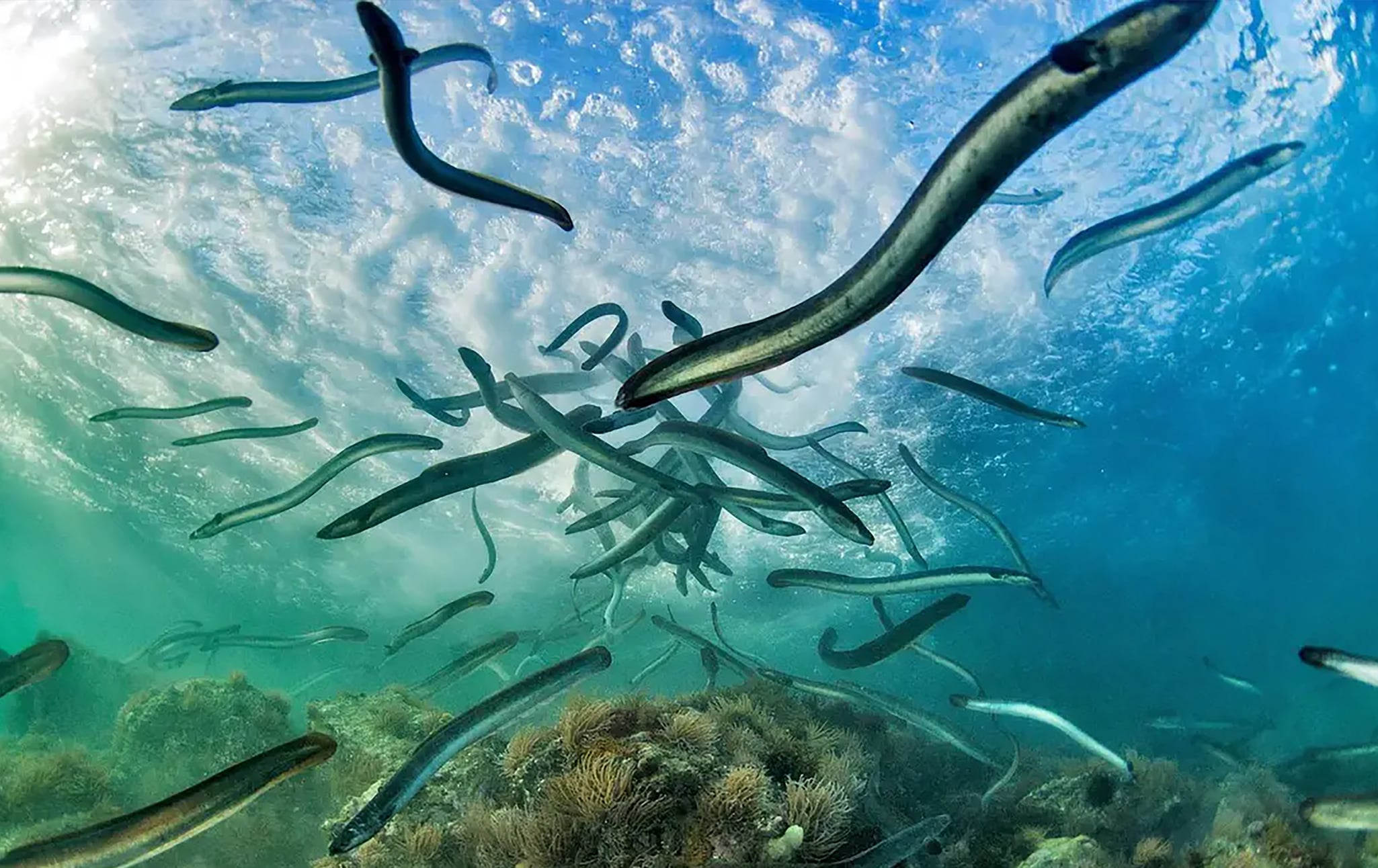
Worth more than cocaine, eels are trafficked by the million around the world. These mysterious, wonderful creatures need to be protected.
Despite being the world's most trafficked animal, the European eel receives surprisingly little sympathy. It lacks the mammalian charisma of the creatures whose plights dominate conservation campaigns; among them the shy, helpless pangolin and the stoically intelligent elephant. By contrast, the eel is viewed by many as a source of revulsion: a slimy, writhing reason to stay out of the water. Yet behind inscrutable eyes, it harbors many secrets. This is the story of how an elusive and often misunderstood fish found itself at the center of an international smuggling network.
In what has been described as “the greatest wildlife crime on the planet,” organized crime groups move staggering numbers of eels each year. Poached from rivers across Europe, these fish are funneled onto Asian markets, where their rarity combined with a rising demand for their meat has pushed prices to a level approaching those of cocaine. According to Europol Intelligence, 100 metric tons of live juvenile eels are smuggled every year as part of an illicit trade estimated to be worth up to 3 billion Euros.
The consequences of the eel trade, whether legal or illegal, have been devastating. Across Europe, rivers that once ran dark and shimmering with eels are now eerily empty. Since the 1980s, the population has plummeted by 95 percent and the species (Anguilla Anguilla) is now classified as critically endangered on the International Union for Conservation of Nature’s Red List. To allow numbers to recover, in 2010, the European Union introduced a blanket ban on the export of eels beyond their natural range, but this has only driven trade underground.

Asian countries import large quantities of eels, as their native species are also in decline, largely due to overfishing. Eel is highly sought after in China and Japan, where it is the key ingredient in several traditional dishes, such as kabayaki, and is believed to be a source of stamina. A legal market exists for some species, with limited trade restrictions applying to the American eel and Indian shortfin eel. However, it is difficult to differentiate between species once they have been processed, and trafficked European eels can be easily passed off as legitimate catches. The only reliable method of identification is DNA testing, and a study of this kind conducted by the University of Hong Kong in 2020 revealed that 45 percent of eel sold in Hong Kong sushi restaurants had been imported from Europe, despite the ban.
Eels are more robust than most fish. They can tolerate poor water quality and survive for periods in low levels of moisture, trapping water in their gills to wind their way across damp fields on migration routes. But it is this physical resilience that also makes them easier to smuggle than might be expected.
They are poached from rivers as glass eels (transparent juveniles no longer than a finger) and transported live in plastic bags, not unlike goldfish on the journey home from a pet shop. These are either packed into nondescript luggage and transported by “mules” via commercial air travel, or moved in even larger quantities through legitimate supply chains, hidden among shipments of meat or seafood. Upon reaching their destinations, the tiny eels can command extraordinary prices, reportedly fetching up to $27,600 per kilogram on the black market. They are then reared to adulthood on purpose-built fattening farms before ending up on plates thousands of miles away from their natural habitats. While the financial rewards of smuggling eels can rival those seen in the drug trade, the penalties are significantly lighter, making it a more appealing, lower-risk enterprise.
For years, trafficking routes ran directly to Asia from countries such as France, Spain, and Portugal, with EU nationals sourcing the fish and Asian intermediaries handling movement across borders. However, international law enforcement has tightened its net in recent years, reshaping the geography of the trade.
Since Operation LAKE was launched in 2015, Europol have intercepted 109 metric tons of glass eels (amounting to roughly 327 million individual fish) and made over 850 arrests. In response, trafficking networks have changed their tactics, increasingly transporting their cargo through countries in the northwest of Africa, such as Morocco, Mauritania, and Senegal. There, they are laundered with falsified catch records, disguising the eels as legal exports and enabling them to slip onto the Asian market undetected.
As stocks of European eel dwindle and EU authorities bear down on smugglers, attention has begun to shift toward the American eel. Maine and South Carolina are the only two U.S. states where it is legal to catch and export these endangered fish, which are facing similar threats to their cousins across the Atlantic. Eel fishing is heavily regulated in these areas and licences are limited, though the U.S. remains one of the biggest exporters, selling more than 900 metric tons of live eels in 2024 alone.
In addition to a booming legal trade, over the past decade, the United States has seen a growing number of high-profile illegal trafficking cases. Operation Broken Glass ran from 2011 to 2018, exposing an extensive smuggling network moving eels through Maine and Puerto Rico, and ultimately leading to 21 people pleading guilty to smuggling a total of $5 million worth of eels.
Not only have eels become the target of a vast criminal network, but in the past four years, they have found themselves unwitting players in one of the 21st century’s most lethal international conflicts: the Russian invasion of Ukraine.
The trade in eels between the U.K. and other European countries ground to a halt after Brexit, but a loophole permitted exports to non-EU destinations on the continent. Until March 2025, the U.K. Government issued one license to an English company, U.K. Glass Eels, enabling its owner and managing director Peter Wood to export eels caught in the Severn estuary to Kaliningrad in Russia.
Officially, the project supported repopulation programs in the Vistula and Curonian lagoons, shared with Poland and Lithuania respectively. However, critics of the arrangement questioned claims that these eels were used solely for conservation purposes. Andrew Kerr of the Sustainable Eel Group also argues that the trade has undermined vital conservation efforts in the River Severn, an ecological artery that has undergone a £25 million project to improve fish migration.
In 2025, pressure from environmental groups and mounting evidence showing that eels were being consumed rather than conserved resulted in U.K. Glass Eels being refused an export licence. The Department for Environment, Food and Rural Affairs (DEFRA) cited “significant risks of illegal trading compounded by the current situation in Russia” as the reason for the decision.
Reading between the lines of this bureaucratic rhetoric, the implications are clear: the sale of eels could have helped to fund Russia’s continued onslaught of Ukraine. Marketing videos produced by the Russian company Goodfish show smiling men slashing open bulging bags, sending countless baby eels tumbling into a shimmering lagoon, suggesting a bright future for conservation. However, these may be no more than works of propaganda, a thin veil covering illegal farming and exports.
Suspicions deepened after the involvement of Russia’s Minister of Industry and Trade and former governor of Kaliningrad, Anton Alikhanov, came to light. Video evidence shows Alikhanov—who faces international sanctions for supporting state policies against Ukrainian sovereignty—helping to release eels with Goodfish and openly discussing plans to expand commercial farming. Concerns over the legitimacy of the program are exacerbated by the fact that Goodfish’s majority owner holds commercial interests in the fishing industry, with stakes in companies including Baltic Eel, which specializes in cultivating captive eels, and Kaliningrad Eel, which sells a variety of edible eel products.
Peter Wood’s France-based company, Civelle Durable, operates legally within the EU. However, evidence has emerged showing that eels in this supply chain may have also been smuggled into Russia. In his research, the investigative journalist Paweł Zastrzeżyński uncovered payments to U.K. Glass Eels from Goodfish that coincided with the delivery of eels to Poland, backing up anonymous reports of eels being transported into Kaliningrad through unofficial channels. Though the director of Civelle Durable, Benoit Chambon, was investigated on suspicion of trafficking eels to Asia, he was ultimately cleared of wrongdoing.
In a recent BBC documentary, Wood comes across as mercenary in his approach to trading one of Earth’s most vulnerable species, declaring, “A new generation of people have been trained to think that making a profit out of the environment is wrong. Everybody has to make a profit to survive.” However, he asserts that his companies have complied with regulations and that all deliveries to Poland were paid for by Polish customers, denying all allegations that he has facilitated illegal trade.
For a species considered critically endangered by numerous conservation bodies, the EU regulations around catching and selling eels within Europe are bafflingly lax. Individual countries are free to devise their own management plans, and though they are required to report the number of mature eels leaving their rivers, these figures can be misleading as they are digitally modeled rather than monitored.
So far, only four European countries (Ireland, Malta, Slovenia, and Norway) have chosen to introduce a total ban on commercial and recreational eel fishing. In many areas, it remains legal to catch and sell eels, and there is a pervasive resistance against better protections. Eels are a lucrative catch for anglers, who argue that their livelihoods are dependent on continued harvesting, though scientists are calling for governments to introduce stricter legislation. Dr. Reinhold Hanel, who has led many research expeditions to the Sargasso Sea, finds it irrational to differentiate between legal and illegal fisheries, from a conservation perspective, stating: “From a scientific point of view, there is no such thing as sustainable eel fisheries.” As governments debate and re-debate quotas and exemptions, eels continue to quietly disappear from our waters.

One issue with the enduring appetite for eel-based dishes is that European eels are currently impossible to breed in captivity; every eel appearing in restaurants and markets across the globe has been taken from the wild. Despite extensive research and centuries of curiosity, we still do not fully understand how they reproduce. Spawning has never been witnessed by human eyes and no eggs have ever been found in the wild. However, research has shown that all European and American eels originate from the Sargasso Sea in the Atlantic Ocean, which is the only sea on Earth with no land boundaries. Instead, it is surrounded by four major currents that play a crucial role in the lifecycle of eels.
They begin their lives as ghostly, leaf-shaped larvae, which are carried on the Gulf Stream to coastlines on the western edges of Europe and Africa. During the journey, they metamorphose into glass eels filamented with little black spines, and are able to swim upstream by the time they reach land. In the wild, the average lifespan of an eel is between 15 and 20 years, though they can live for over 80 years in captivity. The most famous example of this is Åle the eel, who is said to have died at the age of 155, after spending the majority of his life in a backyard well in Sweden. In the wild, mature eels (also known as “silver eels”) make the strenuous return journey to the Sargasso Sea, travelling up to 10,000 kilometers to spawn, and the physical toll this takes on their bodies is the reason they die after reproducing.
Under artificial conditions, scientists have brought eels to maturity and produced larvae from harvested eggs, but none have survived beyond 200 days. They believe that the breakthrough needed to bring on metamorphosis is being held back by yet another mystery, as we still do not fully understand the natural feeding habits of eels at this phase in the lifecycle. If eels could be successfully bred in captivity, farms could play a crucial role in supporting conservation efforts and ultimately put an end to the exploitative black market trade.
People have been eating eels for centuries, and in many countries, they have become embedded in cultural history as well as cuisine. In medieval England, they were used as currency for paying rent, a practice that began in the 11th century and continued for over 500 years. Elsewhere on the continent, 26 people were killed during the Amsterdam eel riot (Palingoproer) of 1886, which erupted after police broke up an illegal game of “eel pulling.” During these games, a live eel would be strung on a rope stretched over the canal, and the objective was to pull its head off without falling into the water. The Dutch government had banned this practice, ostensibly for its cruelty, though sociologists now view the ensuing riot to be the culmination of a widening class divide and the criminalization of working-class entertainment.
Across the western world, many of us are clinging to romanticized visions of the past, unwilling to give up traditions that experts have shown are harmful not only to social structures, but also to the world we inhabit and the other species with which we share it. Traditional delicacies such as jellied eels in London and smoked eels in the Netherlands have taken on an almost mythical standing in our regional and national identities, and efforts to restrict hunting and fishing in favor of conservation are often met with accusations of cultural erasure.
For decades, these have acted as a shield for the Grind—the brutal slaughter of pilot whales on the Faroe Islands—and over the past year, similar rhetoric has been used in response to efforts to halt the Guga Hunt in Scotland. This tradition of culling protected northern gannets for meat on the remote island of Sula Sgeir is the target of a divisive campaign that has produced one of the most signed petitions in Scottish history. (The founder of the animal rights organization Protect the Wild stood as a candidate in the recent Scottish election, dressed as one of the protected birds.) The U.K. politician Torcuil Crichton called the campaign “a kind of neo-colonialism,” stating that activists assume they have “some kind of moral superiority and better knowledge of the world than the people who actually live in that world.” However, his argument is predicated on the notion that hunters intuitively know what is best for their prey, rather than the scientific research that shows a gannet colony at risk of further decline. As more conservation groups demand better protections for eels and existing regulations come up for debate, it is likely that similar frictions will arise.
In previous centuries, eating eels was more sustainable as human populations were lower, there were fewer developments blocking migration paths, and fishing was not carried out on an industrial scale. Now that eels are far less abundant and face an increasing number of human-caused environmental pressures, the global demand cannot be met without threatening the continued survival of the species.
Illegal trafficking is not the only threat to the continued survival of eels, and though they are in many ways physically robust, they are not immune to environmental pressures. They face habitat loss as a result of construction on riverbeds and banks, and manmade obstructions to their migration routes, including hydroelectric dams, prevent them from completing their journeys.
European eels can be found in a variety of climates, from the cool waters north of Norway and Russia to the more balmy temperatures of Morocco. Though this adaptability could mean that they are more resilient to the effects of climate change, scientists warn that temperature variation and changes to oceanic currents threatens their abilities to spawn and migrate in ways that we cannot anticipate.
Though the image of rivers as writhing masses of eels may turn some stomachs, their disappearance would unbalance ecosystems, causing greater biodiversity loss overall. As both predator and prey, they help to keep populations of smaller species in check and act as an important food source for herons and ospreys, which have often been seen flying off with a thrashing eel in their talons. Notoriously undiscerning in their eating habits, eels have also been known to keep waterways clean by scavenging on decaying matter. Despite their ecological significance, there has been relatively little research on the wider consequences of their decline.

It is no secret that many of our rivers are slowly dying as a consequence of decades of abuse by heavy industry and intensive agriculture. While other species of fish can shed pollutants when they spawn, as eels only reproduce once, these accumulate throughout their lifespans and can also be passed down to offspring. The majority of eels contain traces of chemicals such as PCBs, which persist in the environment despite having been banned for decades. But this is not simply an issue of the past. A global shift toward governments that prioritize profit above all else, seeking to gut environmental policies and deregulate industry, leaves the future of ecosystems in a precarious position.
To protect eels, governments need to think about them in the first place—something few political leaders currently do. It is essential to treat their population collapse as an ecological emergency rather than a niche fisheries issue. Redesigning dams and other barriers that block migration routes would allow larger numbers of eels to complete their journeys to spawning grounds and ensure that more young eels return. However, habitat restoration alone is not enough. Existing protections are insubstantial, and without an overhaul of regulations around commercial fishing, and both domestic and international trade, eels remain vulnerable to exploitation.
When we come to think of other species solely as a food source, it is easy to forget that they have internal lives that we will never be able to fully comprehend. In fighting over eels as a commodity, either to be exploited to the point of extinction or preserved for future generations to eat, we have lost sight of what makes them a unique part of the natural world. They are far more than mucous-covered coils of muscle, and with their puzzling lifecycles, bizarre anatomy, and curious behaviors, they leave many secrets yet to be uncovered. If we continue to plunder the environment for profit, we will surely lose all that is mysterious and wondrous in the world around us.