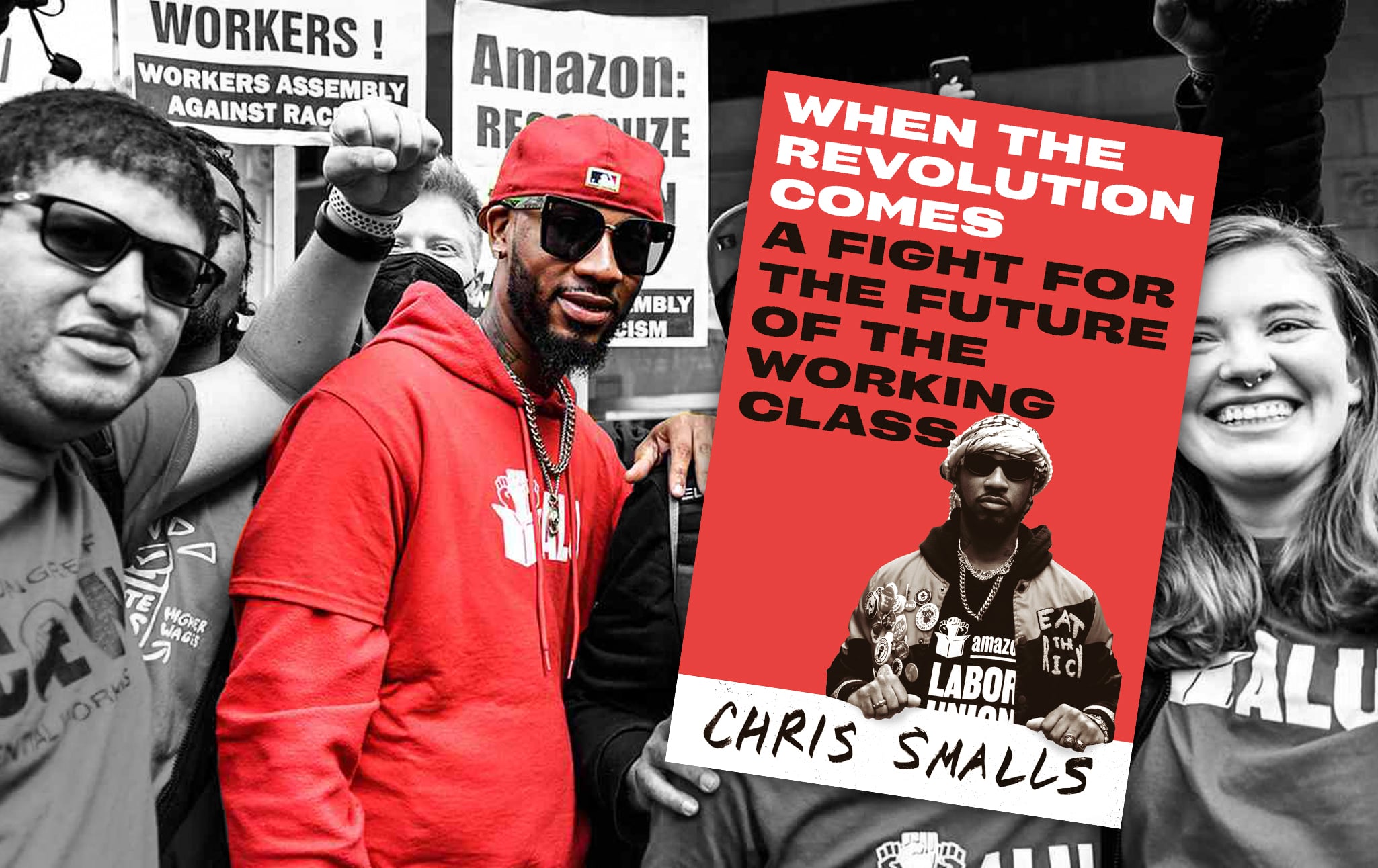
The Amazon Labor Union co-founder on Cuba, Palestine, and his new book on the future of working-class rebellion.
Chris smalls is one of the most impactful, and occasionally controversial, activists working today. Since he stepped down as president of the Amazon Labor Union in 2023, Smalls has joined the Freedom Flotilla to Gaza, been imprisoned and beaten by the Israeli military, and got back on the next aid flotilla to challenge Israel’s blockade all over again. He also joined the Nuestra América humanitarian mission to Cuba this March, and got arrested for protesting Jeff Bezos at the Met Gala in May. In Havana, Smalls sat down with Current Affairs associate editor Alex Skopic to discuss his international activism, how people everywhere can unionize their jobs, and his new memoir When the Revolution Comes: A Fight for the Future of the Working Class, out now from Pantheon Books.
This interview was recorded in late March.
Alex Skopic
We’re going to get to the book and to the union, but I want to start with this aid mission that we’re on now to Cuba. People probably know, since the end of January, the Trump administration has had Cuba under total oil blockade—no fuel coming in, blackouts happening all the time. So how did you get in touch with this Nuestra América mission, and what brought you to Cuba?
Chris Smalls
Yes, I was honored to be a delegate as far as the Progressive International and CODEPINK, representing over 130 different organizations from around the world, bringing about almost half a million dollars worth of donations, whether it be via plane or via flotilla. And yes, this is definitely something that is near to my heart, as is being on the flotilla mission to Gaza this past summer. But also previously, I visited Havana, Cuba, three years ago and did a similar mission with a smaller delegation, bringing a labor delegation. Actually, I brought about ten members from my union down here to work with the community. And also at that time, we were dealing with similar issues: blockade on oil and inhumane conditions for the people of Cuba. So as a labor leader, as an organizer, and as a civilian, with the freedoms and liberties that we have in America, I want to see the people of Cuba be able to have the same type of freedom.
Skopic
Yes, same. And that’s why we came here with Current Affairs, Nathan Robinson and I. So we’ve been here now about two and a half days. I got here on Friday. What have you been seeing as you walk around Havana, and how has the city changed since the last time you were here?
Smalls
Definitely the people are still the same. They’re still resilient, they’re still beautiful people, and they’re probably some of the most resilient people you’ll meet on the planet. And they’re still very optimistic. There’s a lot of hope. As far as the conditions, there’s been some garbage around town that I didn’t see the last time, and of course, as you mentioned, the blackouts. But despite all of that, it’s still been beautiful to see how the people figure out a way to get by. And they are also really, really happy that we’re here doing this mission. Everywhere I go, every time I walk outside, people are coming up to me and saying, “Thank you. We love you Americans for coming here and trying to help the people of Cuba out.” So it’s been, what do they say, like a beautiful nightmare. And I hate to use the term “nightmare,” but that’s what we’re living in under this Trump administration, unfortunately. Whenever our government fails us, we have to rise to the occasion. And this is just another opportunity to do that.
Skopic
Yes, and the thing we want people to know from this trip is that anyone can do this. It’s perfectly legal to come to Cuba, and perfectly legal to bring aid. There’s no reason a flight like this can’t happen every month.
Smalls
Absolutely.
Skopic
And you had a little bit of a moment yesterday. There was a concert in the big—I forget the name of it—public concert center. And you got up on stage with Kneecap, the Irish rappers. You became the fourth Kneecap member. What’s the story there? How did that happen?
Smalls
Yes, a few years ago, when I went to Ireland with one of the largest trade unions out there, SIPTU, their manager was a part of it, and we got acquainted. They gave me a tour of the whole Dublin stadium. And, yes, that’s that connection right there. He’s the manager of really the number one hip-hop rap group in Ireland. And the year our film came out, both of our documentary films came out the same year. We actually met at Sundance in America before they got banned, so that was the connection to that. But this was actually the first time we met in person. So when we saw each other, we really hugged and embraced each other because we stand in solidarity with one another, and I definitely support the music and what they stand for. By the way, they are very, very vocal. As you know, they’ve been battling lawsuits and being banned from several countries and always using their platform to talk about Palestine. I really love everything that they’re about. And I asked them yesterday, “Can I get on stage with you guys?” They didn’t even hesitate. They said, “Absolutely.” And we made it happen. It was historical, for sure.
Skopic
And this connects to some of the things that are here in your new book. Because I feel like people maybe don’t know this about you, but you were pretty seriously in the rap game for a while. You opened for Meek Mill at one point. You were in contact with A$AP Rocky before he got big. And you talk in the book about the importance of hip-hop and how the culture influences how you feel about labor organizing. You talk about what you call “union drip.” So how do those two things come together for you?
Smalls
Well, as you mention this, it’s more of a natural thing for me. As a kid, I aspired to be a rapper, and I had a moment when I was a teenager, 18 or 19 years old, doing a bunch of shows around New York City. As you mentioned, I had an opportunity to host this amazing—actually, I take credit for bringing Meek Mill to New Jersey, but I actually hosted him as a part of an event that I did in 2012. And A$AP Rocky was a mutual friend of my best friend’s cousin, and that’s just how I got indoctrinated into the music industry. But I was still an independent artist. I still had to use the skill sets that I use today. Before social media was what it was back then, in that era, you had to talk to people face-to-face, you had to go to college campuses, and you had to really promote yourself on the ground before you could actually use your platform. And those are some of the same skill sets that I used during the organizing of the Amazon Labor Union. Incorporating music, incorporating the fashion, the union drip. It’s the same way I went to work every day. I come as I am, and I try to be as authentic as possible. And I think it just resonated with a lot of people in the labor movement.
Skopic
And clearly it worked, because Amazon has been around since, what, 1995, something like that?
Smalls
Thirty years now.
Skopic
And it was only in the last couple of years, 2022, that the first warehouse unionized.
Smalls
Yes, to this day it’s still the only unionized warehouse in America. We wear that with a badge of honor, for sure. But also, on the flip side, all the warehouses should be unionized. And unfortunately, we’re dealing with a broken National Labor Relations Board right now under this Trump administration. But even going back to the Biden administration, the National Labor Relations Board was very understaffed and very underfunded, and it takes years to get a due process, and that’s something that we have to change.
Skopic
I’ve got to say, Joe Biden does not come across well in your book. You’ve got this wonderful and terrible story toward the end where you went in to meet him. What were you hoping? To get an executive order for the PRO (Protecting the Right to Organize) Act?
Smalls
Well, that and also accountability. Billionaires, people like Jeff Bezos, are exploiting the working class and monopolizing the entire market. One person shouldn’t be able to have 70-something different companies making all this money when people are out here starving and homeless. Even working for Amazon, we’re dealing with workers that are on government food stamps, living in shelters, and living in their cars, and that shouldn’t be, especially when you were working for the richest man in the world at the time. And I tried to get Joe Biden to see where I was coming from, not just for a photo opportunity. And what I was met with was a pamphlet of their policies that we never even got to see because he’s no longer there.

Smalls and President Biden meet in 2022. they've had some disagreements since. (Photo: White House)
Skopic
And the same day he did that photo op, didn’t his government announce a huge contract with Amazon for web services?
Smalls
I believe so, yes. He gave Jeff Bezos $10 billion of our tax-paying dollars, and this money is being used for him to launch his space program, I believe. And that’s just something that is ridiculous. The same day that you shake my hand, and I leave the White House, and then I’m looking at headlines saying that they just gave this money to Amazon. And we’re talking about a company that pays $0 in taxes. So it’s a slap in the face. And the other claim he made was that he’s the most pro-union president in history, and that’s something that is obviously untrue.
Skopic
Because he broke the railroad strike in 2022.
Smalls
He did, using the act from 1945. Just everything that he said didn’t measure up to his actions, and because of that, now, to this present day, the board is really dismantled. Trump wasted no time within his first two weeks. He fired all the progressives as well. But even under the Biden administration, for four years, they had the opportunity to really change and codify some laws—laws that haven’t been touched since probably the ’60s or even before that, and they really didn’t do that.
Skopic
What do you think about the other people in the labor movement, like the labor leaders? Another big one is Sean O’Brien of the Teamsters, who reckons they can still work with the Trump administration and try to get some type of concession from them. Does that seem possible to you? Or what are the prospects for trying to organize under a Trump government?
Smalls
There is none. I honestly don’t agree with trying to cozy up to any billionaire. And Trump is no different, whether he’s president or not, and he’s never been labor-friendly in his whole entire tenure, and even before that when he was a bad businessman and also a bad landlord. There have always been stories and controversy surrounding Trump and what he’s done to working-class people. So I didn’t see the reason why they needed to lobby on both sides. I didn’t agree with donating to their administration as well. That’s using union dues to go towards the Trump administration to try to cozy up and convince people that their labor secretary, whom they also endorse, was going to be labor-friendly. And I think that came back to haunt him, because I believe that she’s no longer there. Trump has done nothing to keep up his promises, as you know. All the promises he ran on, he’s going against already, even when it comes to starting these endless wars and genocide. So I just don’t agree with it. Sean O’Brien got a lot of heat for speaking at the RNC, but I do agree that we need to get to different spaces as labor, and we need to figure out a way to bring people into the labor movement whether they’re right or left. It’s not about whether you’re right or left. It’s about billionaires making too much money, and that’s what was able to make us successful at Amazon, because we didn’t go over there with, “Oh, we’re on the left, so you guys need to get on board.” We went over there with the common goal, the common enemy being Amazon and the employer, Jeff Bezos.
Skopic
And you had a sort of unprecedented success over there. Here at Current Affairs, we actually just unionized also; we just got on board with the Chicago News Guild.
Smalls
Congrats.
Skopic
And I think there are a lot of people out there who maybe want to unionize, maybe have heard that union workers get better pay, but know nothing about the process of how to go about it. So for anyone out there who is thinking about trying to unionize, what would you say to them?
Smalls
Yes, I tell people all the time, you have to unionize your workplace. Don’t quit. People say this thing, “If you don’t like your job, quit.” You’re just going to be jumping from one fight into the next. And instead of quitting your job, go out with a bang; cause your job to organize, and you’re putting out a fire that somebody else may avoid one day. And that’s something that I took to heart when Amazon fired me. I said that what happened to me, I don’t want to see happen to anybody else. So even after I was fired, I went back and I organized that same warehouse, and that’s what I encourage everybody to do. Whether you work there or don’t, you want to educate people on workers’ rights in general, because it’s not going to be taught to us in our curriculum, especially at a young age. So being proactive instead of retroactive is always the key. And I encourage everybody who’s listening to organize, no matter what industry you work in or what sector you work in. We all need to be protected.
Skopic
And so if somebody’s in a non-union shop and they’re getting bad pay, or have bad bosses, what is the first step?
Smalls
Well, once again, if you want to create a union like we did, which is an extra layer of difficulty, what you have to do is you have to get 30 percent of the shop to sign cards, and you drop those off at your NLRB office. They will verify. After that process, they send a letter to the company, and the company will respond whether they accept this or whether they’re going to combat you. But the next process is the election process, where you’re going to have to get 50 percent plus one—not 50 percent, but that plus one, because if it’s 50 percent, you lost the election. So you need 50 percent plus one, and if you’re successful, you have your bargaining union, and the next process is you’re supposed to get a bargaining order, something that we don’t have to this day—a bargaining order to negotiate a contract with the company, which can take anywhere between one and three years, and with this Trump administration, that may take longer, unfortunately. But that is the process if you’re trying to create a union instead of joining one.
Skopic
And if you’re trying to join an established one, it’s just a question of finding out who your local rep is?
Smalls
Yes, you can find a union that’s willing to take on the challenge. Hopefully the union has some resources that they’re able to really help. You still have to go through the same process, but you’ll have the support that you need instead of doing it the grassroots way, the way we did. We had to start off with a GoFundMe. But hopefully, if your local is strong enough, they’ll send volunteers, they’ll send organizers, and they’ll picket with you. They’ll call rallies, call secondary actions for you guys, and support you through and through.
Skopic
And that’s the experience we had because we hopped on with Chicago News Guild, and they sent a guy, Esteban. So shout-out to Esteban.
And you mentioned that it’s still just the one warehouse in Staten Island. There’s been some work being done in Bessemer, Alabama, where they almost managed it. There’s been talk about Albany. But the progress since that first one has really been pretty slow, and I know partly that’s the Biden and Trump administrations and them failing to really do much of anything to support you guys. But also, there’s been controversy in the union itself, and you write about this in the book.
If I’ve understood it right, the controversy is basically over strategy? There was a certain group of organizers who were warehouse workers. They didn’t go to college. They were doing manual labor most of their lives, different jobs. And then there was a different faction of organizers who you call more like “professional activists” or “white leftists,” and they were maybe more privileged, maybe just joined the job to salt for the union. And it seems like the strategy you had was centered around publicity. You wanted to spread the word as much as possible about the union, do as much public speaking as possible, and encourage everybody to get on board. And the other group’s strategy was more to be really aggressive about strikes and about organizing places that they didn’t even necessarily work. Like you mentioned, there was the one warehouse in Staten Island, and there was another one that was right nearby [that they also wanted to unionize]. So not to dwell on the controversies and the falling out, but what can we learn from all that? And how can we go forward in a better way to get people who are from different backgrounds to work together and make this thing work?
Smalls
Once again, as you mentioned, people are going to have their own, I guess, input on how we should organize, but nobody had the real answer, including me. We’ve done something that was unprecedented, and mistakes will be made. You’re playing chess with a trillion-dollar company, so you still have to figure out things when you get put in checkmate. And the best thing that I tried to do was to keep everybody focused on Amazon, and specifically Amazon at our warehouse. But yes, there were some folks that wanted to spread before we had the resources. There were some folks that don’t understand what it is to be in a union. Most of the organizers that I had at the time were in their 20s. For some of them, it was their first time working at Amazon, as you mentioned, and for veterans like myself who’ve been at Amazon, it would be 10 years if I didn’t get fired—going on 11 years. Also my brother Derrick Palmer, who still works there—who has been there 10-plus years. So we had experience level differences, number one.
And number two, some people came from different communities. We come from a low, impoverished community. A lot of people who salted for us didn’t come from those same circumstances, so they don’t understand how Black and brown organizing is really going to intertwine with the type of ideology that they have. And I had to try to be the glue to figure all of it out. But when you have so many moving parts, and especially when we gain so much attention at such a rapid pace, it is really hard to keep everybody on the same accord. So unfortunately, yes, we had infighting. But that happens within every union. There’s no perfect union. Actually, there are no perfect organizations, if you ask my opinion. There’s always going to be differences, but I think that’s what a democracy is. You’re going to have disagreements, but you have to figure out a way to get everybody back on track. And that was the reason why I thought the best thing for the union going forward, after I left my post, was to make sure that affiliating with the Teamsters would give them the resources to alleviate some of the stress that I had to go through as the president trying to raise money for the organizing.
It’s very difficult when you’re taking on a trillion-dollar company. And I think there are growing pains. But my union in particular was very unique because we were being compared to unions that have been established for over 100 years, and we don’t pay dues, we don’t have a contract, and we don’t have the same resources that other unions have. So a lot of people didn’t understand that we were not the same as these other unions, and even the folks that were within the union don’t understand that we can’t move the way other unions do. We can’t just jump from warehouse to warehouse. We have to allow the workers at those specific warehouses to take the lead, and we can only provide what we can. So we tried the building across the street that was led by those workers there, and that was unsuccessful. And the folks in Albany reached out to us early on. We tried there. We have folks in Kentucky that reached out to us, folks in California. And once again, we can only do so much when we’re in the thick of our own contracts, which we still don’t have to this day. So it was just really difficult to navigate that in the very beginning. But fast forward to now, I think there’s more of a clear path, and the only option that we have right now is to go on strike so that we can force the company to come to the table.
Skopic
Looking back on all that, are there regrets you have, or things you would have done differently with hindsight?
Smalls
I don’t have regrets. Of course, I’d have made different decisions, but ultimately, I’m satisfied with the overall leadership that I had. Once again, we did something that was historical, that’s never been done before, and the fact that it resonated with millions of people around the world. I didn’t know that until I left the country for the first time. And to see every country I go to, everywhere I meet workers, and every Amazon facility that I visit, to this day, we inspire so many people. It really outweighs the negative things that happened, the falling out that we had. It’s bigger than us, and that’s what I always try to express to the workers, that it’s not about us. It’s about everybody. When I got fired from Amazon, Amazon tried to make the story about Chris Smalls. That’s why they released that smear. They wanted to make it about just the individual. And I countered that by saying it’s never going to be Amazon versus Chris Smalls. It’s always going to be Amazon versus the people. And unfortunately, once again, when you’re dealing with folks who’ve never been a part of a union, especially on an executive level, which is a whole other layer of responsibilities to give young adults that have never been in that position before, there’s going to be some growing pains and, once again, disagreements, and you have to figure it out. And I think we did the best we could. I really believe that for the last three or four years under my leadership, just wearing the ALU shirt was a badge of honor for those folks, and it still is to this day. You can’t walk outside anywhere in the country, anywhere in the world, if you’re wearing an Amazon Labor Union shirt, without some type of recognition.
Skopic
I’ve seen a few of those around in Cuba here.
Smalls
Yes, they’re here. There are some folks here that were with me, and, once again, it’s a badge of honor, but also it’s a powerful statement, saying that you were a part of history, and that’s something that is going to last forever.

Skopic
Well, I want to ask briefly about Gaza. We’re here on this mission to Cuba. Last year you were on a much more dangerous mission on the Sumud Flotilla.
Smalls
No, no. The Freedom Flotilla.
Skopic
The Freedom Flotilla, that’s right.
Smalls
Yes. We’re still together, though. Shout out to them. But yes, the Freedom Flotilla to Gaza. I was on the Handala. It’s something that’s been happening for 17 years. I was honored to be on this voyage, going to Gaza to deliver humanitarian aid to try to end that blockade that’s been happening for over two decades. And, unfortunately, I was the only Black man out of the 21 volunteers on the Handala, and I was treated differently, of course, compared to my white counterparts that were on the mission with me.
Skopic
Yes, they singled you out for some violence in a pretty obviously racist way, correct?
Smalls
Yes. I got a glimpse of what Palestinians have to go through. I was in prison for five days, the longest out of everybody else. And along with my Arab brother, Hatem, who’s from Tunisia, we were the last two to get out. Everything from the very beginning to the very end was confirmation that it was a racist apartheid state that we were dealing with.
Skopic
Yes, and people say this word “apartheid” a lot, especially more recently, but to see what it really means in practice like that is something else.
Smalls
Yes, absolutely.
Skopic
So what’s next for you? What are you getting involved in?
Smalls
The Global Sumud Flotilla is leaving in a few weeks, so I’m going to be out there with them. It’s to be determined what I’m going to participate in. But yes, I’m going to continue doing the work, what I’m doing for Palestine, and trying to connect all of these struggles. I’ve been with the dockworkers in Italy, trying to get them to strike again, and I’m raising money for them. Definitely trying to spread awareness about the Amazon Labor Union and also about what we’re doing here in Cuba, connecting the dots with working-class struggles around the world. The book is coming out. I’m happy to be doing this book tour in the U.S. and also in the U.K. as well. So look out for that. And, man, there are so many things going on right now in the world. I’m just trying to do what I can as a labor leader, as an activist, as a father, and as an American citizen.
Skopic
All right. Well, where can people keep up with you?
Smalls
Yeah, follow me on social media: @chris.smalls_ on Instagram, @Shut_downAmazon on Twitter/X, and also follow @disarmgenocide_ on Instagram. That’s where you’ll see the initiatives that I’m doing with the dockworkers in Italy, who just shut down 21 ports in the Mediterranean Sea, stopping weapons from going to Israel. So we’re going to try to do that again. And follow the Global Sumud Flotilla, Freedom Flotilla, and Thousand Madleens to Gaza. We’re going to be trying to deliver humanitarian aid. And absolutely follow Progressive International and CODEPINK. As you can see, we’re doing this amazing work, and this is just the beginning. We’re going to continue doing this.
Transcript edited by Patrick Farnsworth.