Why America is Obsessed with Protein (And War)
The wave of high-protein everything shows a country trying to eat its way out of weakness.
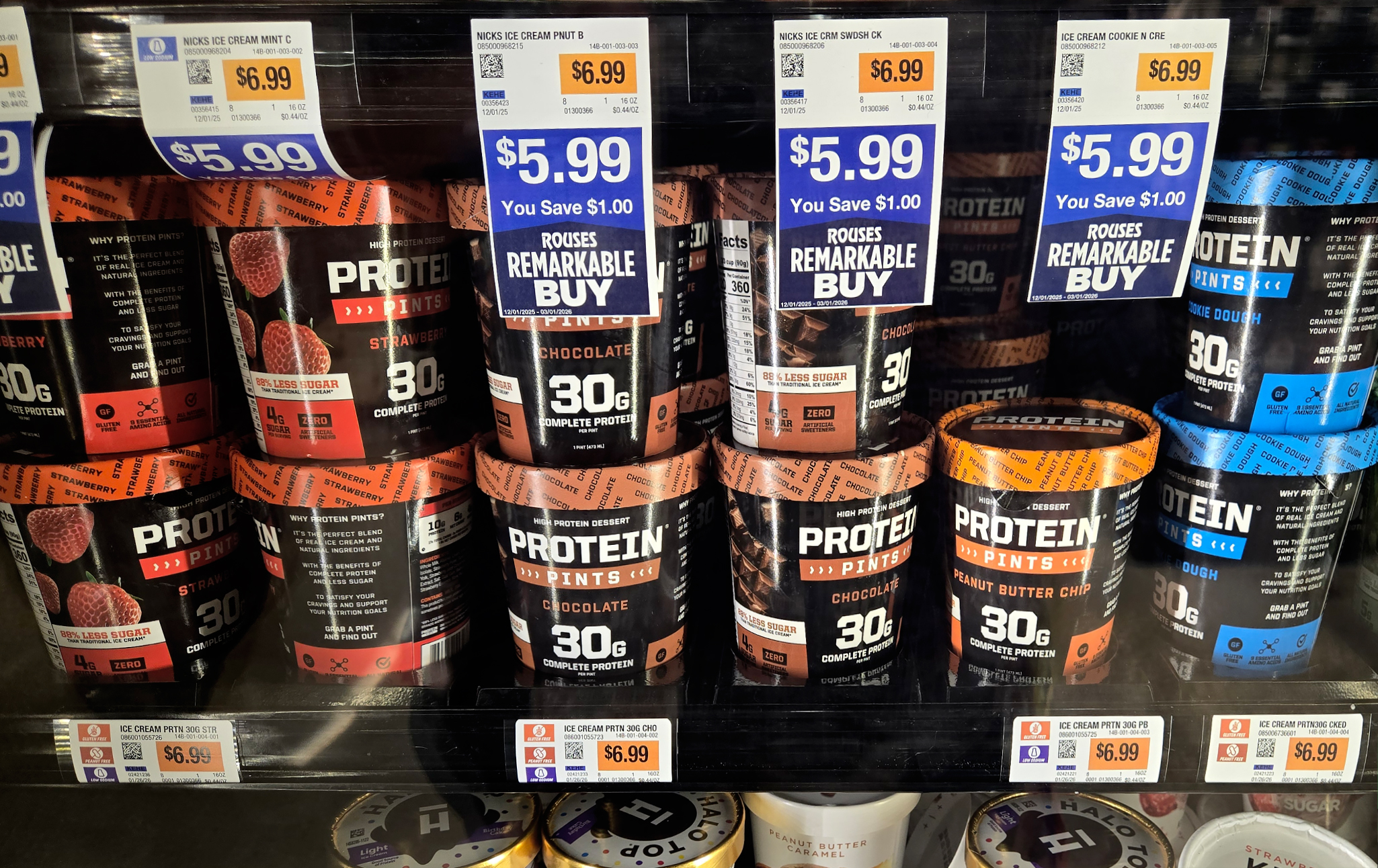
I’m not sure exactly when it happened, but at some point in the last year, my local supermarket appears to have transformed into a GNC supplement store. It’s not that the patrons started looking suspiciously jacked one day; nor did the music suddenly switch from soft rock to the Joe Rogan Experience It’s that now, nearly every single food item seems to be injected with protein.
It’s not only the energy bars. I’ve never even walked down that aisle. It’s everything: protein beer, protein cookies, protein cereal, protein potato chips, protein pancake mix, and a thousand different combinations of protein, espresso, and milk packaged in individual bottles (for people who’ve always wished their morning coffee tasted a little sandier). Even Blue Bell ice cream—the Texas brand known for gluttonous flavors like Gooey Butter Cake and Dr. Pepper Float—has pivoted with the release of Blue Bell PRO: a “high protein frozen dairy dessert” that packs at least 33 grams of the stuff per serving.
This onslaught is backed up by statistics: according to a 2025 report from Cargill, 34 percent of shoppers now say "high in protein" is a very important factor when selecting snacks, a nine percent increase since 2020. Meat consumption as a whole is on the rise, with U.S. restaurant menus now featuring 12 percent more meat items than they did a year ago, while “protein interest” has grown “three times faster in the meat category than in plant-based alternatives,” writes Food & Wine.
The overnight adoption of diet fads in the marketplace is hardly new. Grocery stores of the 2000s saw the rise of low-fat everything, then no-sugar everything, then a pendulum swing back to real-sugar once we decided that high-fructose corn syrup was even worse. (Anyone else remember those Nickelodeon ads that taught us to identify sugar as any ingredient rhyming with “gross”?)
What’s baffling about this latest trend, though, is that protein deficiency is almost unheard of in developed countries. Most people get more than they need just by eating normally. According to the Center for Nutrition Studies, eating exclusively oatmeal would push you past the body’s daily requirement. But those requirements have changed—at least on paper, in line with a government that is pushing masculinity and the illusion of strength.
In January, the Trump administration released new dietary guidelines that recommend a daily protein intake of 1.2 to 1.6 grams per kilogram of body weight: nearly twice the previous recommendation, with a significant focus on dairy and meat. For someone weighing 150 pounds, that's 104 daily grams: equivalent to 17 eggs or four servings of steak (or three cartons of salted caramel Blue Bell PRO!). The Department of Health and Human Services shared these guidelines under the title “Evangelizing Real Food,” with “prioritizing protein” as the first bullet point.
There are a few reasons why the administration seems to suddenly care about Americans’ diets. Of course, there’s the fact that they want to blame individuals for our country's exorbitant health care system and high rates of disease. As the DHHS’s new fact sheet lays out, under the title "Reducing Healthcare Costs," Americans spend 2.5 times more on health care than other developed nations, while “the United States faces the highest obesity and Type 2 Diabetes rates (OECD) in the developed world.” (Don’t bother clicking those links; they’re dead ends. After citing the website in its own report, the Trump Administration wiped the CIA Factbook from the internet with no explanation.)
Simply eating more protein isn’t shown to make people healthier, though. It's still a vital nutrient; on a cellular level, our bodies need protein because it provides amino acids that repair and build muscle fibers, and it also supports digestion and forming new tissues. If you're trying to bulk up, you should certainly watch your intake. But the overwhelming problem with Americans’ health is that we are largely sedentary: half the U.S. population reports sitting down more than 9.5 hours of the day. Eating more meat might help grow your muscles if you’re lifting weights at the gym, but it won’t lower your blood pressure. According to studies cited by the Physicians Committee for Responsible Medicine, when it comes to meat and dairy, “those who consumed more meat and protein from animal-based sources in place of plant-based sources increased their risk of death from chronic disease by 23%”, while “participants who ate the most animal protein had a fivefold increased risk of death related to diabetes.”
So why does Health Secretary RFK Jr. want you to scarf down rib-eyes and raw eggs if his main goal is to avoid paying for your insulin? (Ignoring the fact that he’s stupid, and doesn’t know how diabetes works.) Actually, it’s still because he’s stupid. The U.S. government has absorbed the myth that protein equals strength—an important quality in Uncle Sam’s quest for world domination. The new guidelines lament that “77% of military-aged youth aren’t eligible to join the military,” apparently due to diseases tied to food. You heard Pete Hegseth: how are we supposed to intimidate other countries with our “fat generals” and legions of chubby young men, too weak to lift a rifle?!
In order to dominate, we’ve got to start at the dinner table. Luckily for us, just a few weeks before Trump launched the war with Iran, Kennedy Jr. assured Americans that, at the very least, “the war on protein is over.” (Like the war on Christmas, who exactly was waging this combat remained unclear.)
Moments of heightened geopolitical anxiety often have a way of turning diet into a matter of national security. During WW2, agencies like the United States Food Administration also promoted diets rich in animal protein, selling nutrition as a patriotic duty. The USDA’s 1941 “Make America Strong” campaign featured posters of shirtless men lifting heavy equipment, but also families gathered around the dinner table eating “protective foods”—listed as milk, eggs, fish and organ meats.
Later, during the Cold War, President John F. Kennedy launched a national fitness campaign warning about the “soft American,” premised on the idea that flabby citizens made for a vulnerable nation. In a 1960 cover issue of Sports Illustrated, then-president-elect JFK wrote:
The first indication of a decline in the physical strength and ability of young Americans became apparent among United States soldiers in the early stages of the Korean War.
The second came when figures were released showing that almost one out of every two young Americans was being rejected by Selective Service as mentally, morally or physically unfit.
(Only one out of two was ineligible? The poor guy would have a conniption if he saw what his nephew is up against.) Kennedy continued:
Thus, in a very real and immediate sense, our growing softness, our increasing lack of physical fitness, is a menace to our security.
However, we do not, like the ancient Spartans, wish to train the bodies of our youth to make them more effective warriors. It is our profound hope and expectation that Americans will never again have to expend their strength in armed conflict.
Despite JFK’s placations, it’s clear he worried that a forthcoming draft might produce an army of weaklings, should the Cold War suddenly turn hot. Still, apparently realizing he sounded a little too much like those Commies he was so nervous about, Kennedy focused his appeal on the idea of personal freedom: “We do not live in a regimented society where men are forced to live their lives in the interest of the state,” he wrote, “However, if we are to retain this freedom… then physical toughness is paramount.”
The government wasn’t going to force you to lift weights or eat better. But if you were a real patriot, and you valued your autonomy, you’d want to.
In this way, the relationship between propaganda and culture starts to feel like a chicken-or-egg problem. Are today’s roided-up podcasters promoting protein because Trump is, or is the administration simply echoing a cultural obsession that was already well underway? The answer is complicated. Political messaging and cultural trends don’t move in a straight line from top to bottom. They circulate and reinforce each other, hardening into something that from the outside, appears more like common sense. Usually, the government doesn’t need to tell you outright to promote its ideology—especially when it's framed for the benefit of your own health.
Just take a look at what happened to American fitness culture in the years following September 11. Workout regimens across the country began to directly mirror military training, as programs like CrossFit simulated scenes of combat, natural disaster, or some unspecified catastrophe lurking around the corner. Trainers led “Hero Workouts of the Day” named after fallen soldiers, like the “Murph”—a workout involving several hundred push-ups and squats—named after Lt. Michael Murphy, who was killed in combat in Afghanistan. Meanwhile, obstacle races like Tough Mudder and Spartan Race invited participants to crawl through mud, scale walls, and test their “warrior” instincts, all without ever leaving the suburbs.
No one can deny that exercise and balanced eating are important. But these programs promised more than health. As CrossFit founder Greg Glassman put it, the goal was to “prepare not only for the known but the unknowable”—a soothing promise during the all-consuming anxiety of the War on Terror.
Most Americans will never see a battlefield. Despite whining about the lack of eligible soldiers, it’s doubtful that the Trump Administration will need to employ the Selective Service to fulfill its depraved missions across the globe. We have enough active military members to sufficiently flatten Venezuela and reduce Iran to rubble with airstrikes alone. The devastating sanctions Kennedy first imposed on Cuba are twice as effective today. What the MAGA movement wants is to project strength, dominance, and manhood. Our men eat slabs of meat and gurgle raw milk because they fantasize about war—not because they’re actually going to get on the plane.
In reality, the battle they are preparing for is far less literal, and far more banal. In place of walkable cities and affordable doctors visits, perhaps doubling your protein intake will prevent disease. If you feel weakened, debilitated, emasculated by your low salary and inability to buy a home, then maybe a carnivore diet and a Spiked Protein Swoleberry Beer might make you feel more like a man. In a country that cannot guarantee healthcare, stability, or peace, the least you can control is your macros.



.jpg?width=352&name=Bald_Eagle(2).jpg)
.jpg?width=352&name=Untitled%20design%20(2).jpg)