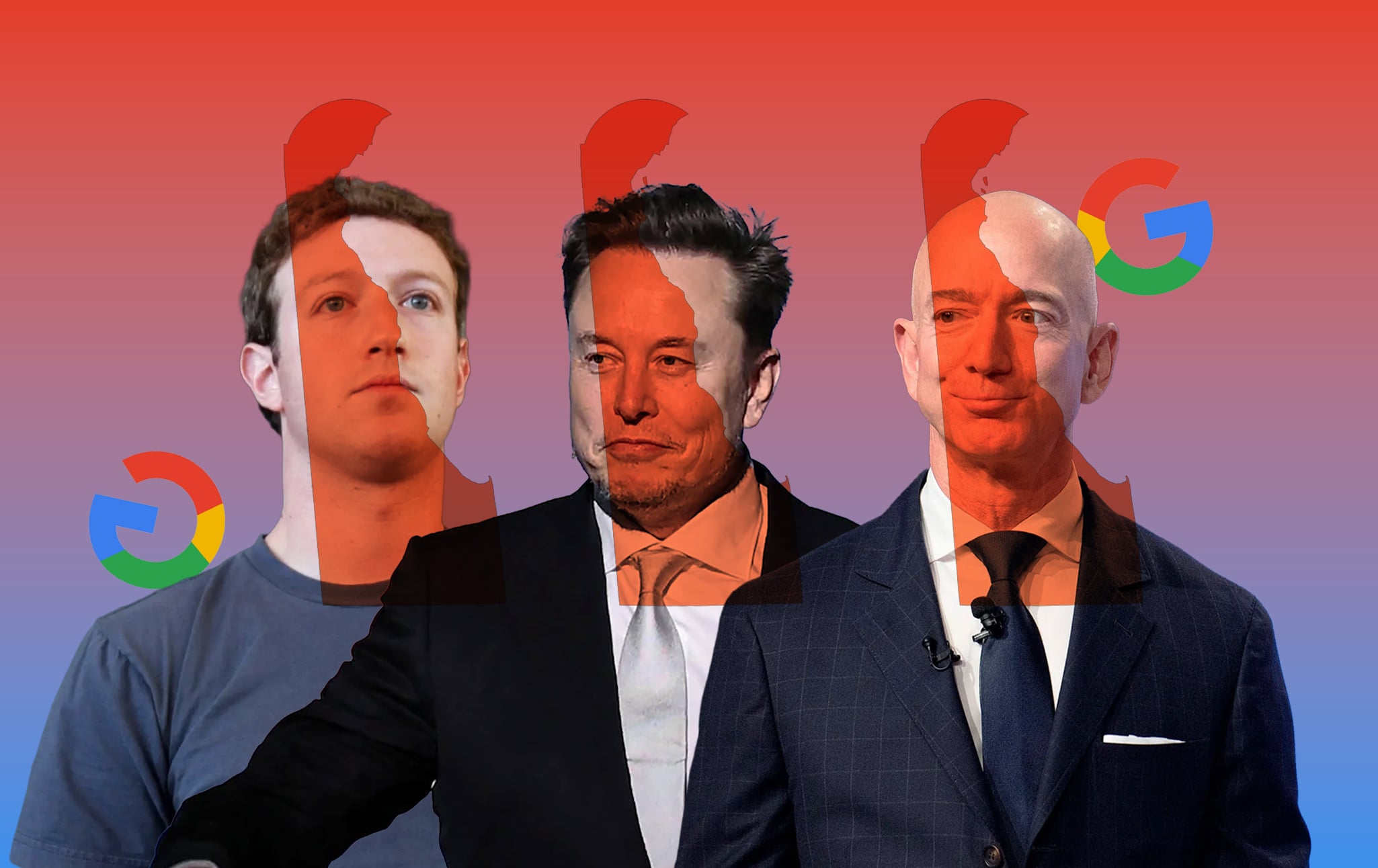
More than two-thirds of the Fortune 500 list are incorporated in the tiny state, and the rest of us have been living with the consequences.
Nationally speaking, the humble state of Delaware doesn’t get much attention. As the second-smallest state in America, it measures roughly 96 miles long and at its widest point, only a svelte 35 miles across. Should you be so inclined, it would take you about an hour and a half to drive all the way from the bottom to the top—presumably, to get somewhere more exciting. The most famous commodity to emerge from Delaware is Joe Biden, along with, apparently, something called “scrapple”: a regional mid-Atlantic breakfast food enticingly described as a “congealed loaf of pork scraps and cornmeal.” What the state lacks in cultural impact, however, it makes up for in far more insidious arenas.
Last week, Delaware made national headlines after a state judge ruled that businesses in the quaint beach town of Fenwick Island may continue to vote in elections, as if they were human beings. Quite literally, each business there receives a ballot, which is then filled out by a “representative”—because concrete structures don’t have opposable thumbs—and is counted alongside the votes of the town’s roughly 400 full-time residents. The story drew widespread outrage, but the good news is that the law only applies to this specific town, and corporations can only vote in municipal county elections, not statewide or federal ones. (Of course, that’s little consolation to those 400 residents, who must live with the fact that their opinion on issues like noise ordinances and zoning decisions counts no more than the short-term rental company next door. And once something is legal in one place, it opens the avenue to others.)
Still, what’s happening in Fenwick Island is small potatoes compared with the rest of the state. Most people think of Wall Street as the headquarters of American capitalism, but thanks to a unique set of “business-friendly” laws, Delaware has earned the title “Corporate Capital” of the U.S. A whopping 50 percent of America’s publicly traded companies are incorporated there, including over 66 percent of the Fortune 500. With a total population of less than 1.1 million people—fewer than live in Dallas, Texas—Delaware holds nearly twice as many legal entities as human beings.
It’s not that all of these companies are doing something nefarious. But the same laws that attract entrepreneurs to the state have also enabled some of the most egregious financial crimes in history. Worse still, they have allowed companies to engage in behavior that should absolutely be illegal, but is permitted for the sake of attracting even more capital to the state. If we want to confront corporate power in America, it turns out that Delaware is the place to start.
As a red-blooded American, you are allowed to incorporate your business in any state you please, no matter where you live. Incorporating just means legally separating an enterprise from yourself as an individual; it allows a business to open bank accounts, enter contracts, and own property, while protecting your personal assets—like your home or car—from lawsuits incurred by the company.
Delaware makes this process remarkably easy. If you’re looking to form an LLC, you can register online in minutes, receiving confirmation in as little as an hour. Hell, Current Affairs magazine used to be incorporated in Delaware before we became a nonprofit. You’ve got to do it somewhere, so why not choose the place that makes it the cheapest and the easiest? In fact, if you’ve worked a corporate job before, go ahead and pull up an old W-2. There’s a decent chance the address in the corner says “DE.” What’s especially unique about Delaware, though, is that it allows you to start a business anonymously.
If that interests you, the first step is hiring a Delaware-based representative who will receive legal mail on your behalf. These agents allow you to write their office address on any documents, meaning your actual location is kept secret, and your real name isn’t revealed. Because Delaware does not require the identities of LLC owners or managers to appear on the public Certificate of Formation, only one person in the world needs to know you’ve set up shop there: the guy you hired to put his name on all the paperwork. This service can cost as little as $49 a year.
If you want to register in the dead of night, you’re in luck, since for some reason, the Division of Corporations office stays open until midnight. Once you’ve formed your entity, you’re largely free to do as you please. Unlike most states, Delaware doesn’t require LLCs to file annual reports. So go ahead and get started with whatever perfectly normal business you’ve launched, which for some reason you don’t want to be publicly associated with!

Now, most of the well-known companies incorporated in Delaware—Google, Amazon, Meta, etc.—are corporations, not LLCs, so this anonymity provision doesn’t apply to them. (They receive their own benefits for registering there, which we’ll get into later.) Limited Liability Companies don’t have shareholders and can’t sell stock, so they’re often associated with small businesses: boutique stores, wedding photographers, local restaurant chains. That doesn’t mean an LLC can’t handle enormous sums of money, though. And the most enthusiastic exploiters of the anonymous-incorporation-loophole are far from mom-and-pop establishments.
In 2009, Malaysian Prime Minister Najib Razak established 1Malaysia Development Berhad (1MDB), a sovereign wealth fund intended for making investments abroad in order to ease poverty at home. Instead, Razak and several associates laundered billions of dollars using a web of offshore bank accounts and shell companies—including eight anonymous LLCs incorporated in Delaware. The money was spent on luxury properties in Beverly Hills, New York, and London, diamonds, a 300-foot superyacht, fine art by Monet and Van Gogh, and, ironically, the financing of Hollywood films like The Wolf of Wall Street.
The criminal case is still highly active, with multiple ongoing trials, and only last week the Justice Department announced that it had recovered an additional $6 million in laundered funds. Some key players have been sentenced, including Razak, but because the entities were anonymously registered, it has been exceptionally difficult for investigators to trace all of the culprits. Government officials have called it the world’s "largest kleptocracy case to date.” Yet almost none of the major reporting on the scheme acknowledges Delaware’s role.
Hal Weitzman, author of What’s the Matter with Delaware?: How the First State Has Favored the Rich, Powerful, and Criminal―and How It Costs Us All, explains that while the 1MDB case was historic in terms of money embezzled, Delaware’s “pro-business” practices have also had a devastating human toll.
One of the most disturbing examples involves Backpage.com: a now-defunct classified ad website, similar to Craigslist, that was best known for selling sex. Over 90 percent of Backpage’s revenue was generated by its adult-services section, which basically operated as a prostitution platform. The site was also discovered to be facilitating the trafficking of minors. Backpage was incorporated in Delaware—and despite lawsuits alleging child abuse beginning in 2011, the company remained in good standing with the state for seven more years, until federal authorities finally seized the forum.
In a University of Chicago podcast, Weitzman explained:
“At its height, Backpage was involved in three-quarters of the child trafficking reports received by the National Center For Missing And Exploited Children. This was a Delaware registered company, that even months after it was shut down by federal law enforcement in 2018, was still considered to be in good standing by the Delaware Secretary of State’s office, because they’d paid their annual fees.
So there’s a case of human trafficking. There are cases of money laundering, of arms trafficking, of drugs trafficking, all not going through Delaware, but all using Delaware businesses. And as I say, with the protection of the United States law.
It’s a way to dress up bad behavior. It puts a business suit and tie on activities like money laundering and drug trafficking by saying, “Well, we have a Delaware LLC. How more legitimate could you be?”
Other beneficiaries of Delaware’s lenient laws include international arms dealer Viktor Bout, nicknamed the "Merchant of Death.” (You might remember him as the Russian prisoner who was exchanged for WNBA player Brittney Griner in 2022. He was also the inspiration for Nicholas Cage’s character in Lords of War.) Bout used at least a dozen shell companies in Delaware to finance his activities, resulting in a 2008 federal indictment for “conspiracy to kill American citizens, acquire and use antiaircraft missiles and supply material to terrorists,” writes the New York Times.
In the wake of Bout’s arrest, Senator Carl Levin of Michigan tried repeatedly to pass the Incorporation Transparency and Law Enforcement Assistance Act, which would have required Delaware to collect information on the people behind companies, and provide that information to law enforcement upon request. The bill failed repeatedly, as Delaware and other incorporation-friendly states argued it would burden businesses. It wasn’t until 2021, over a decade later, that Congress finally passed the Corporate Transparency Act, which mandated that companies report their owners to the federal Financial Crimes Enforcement Network, instead of to state offices.
Wouldn’t you know it, though, the Trump Administration recently announced that it will simply be ignoring that bill. (Only in the case of American citizens.) In March 2025, a Treasury Department press release announced:
The Treasury Department is announcing today that, with respect to the Corporate Transparency Act, not only will it not enforce any penalties or fines … under the existing regulatory deadlines, but it will further not enforce any penalties or fines against U.S. citizens or domestic reporting companies or their beneficial owners after the forthcoming rule changes take effect either. The Treasury Department will further be issuing a proposed rulemaking that will narrow the scope of the rule to foreign reporting companies only.
“This is a victory for common sense,” said U.S. Secretary of the Treasury Scott Bessent. “Today’s action is part of President Trump’s bold agenda to unleash American prosperity by reining in burdensome regulations, in particular for small businesses that are the backbone of the American economy.”
Yay for small American businesses! Like Backpage.com and Paul Manafort, Trump’s former campaign chairman who conducted his tax evasion scheme using nine Delaware companies! (Of course, Manafort was pardoned by Trump in 2020 anyway.)
Again, not all companies incorporated in Delaware are laundering money and trafficking weapons (or children). Most of the state's corporate residents are household names, like Google, Amazon, Meta, Walmart, Coca-Cola, and thousands of others. Some of them might be linked to labor abuse in different ways, but the biggest draw for these corporations isn’t anonymity. It’s Delaware's Court of Chancery: a specialized business court that hears corporate cases without juries.
Supporters argue that the system creates predictability and expertise, by using highly specialized judges who only deal with corporate disputes. Personally, I am icked out by the idea of corporate lawyers and judges developing a body of law that is completely insulated from ordinary citizens, but that’s just me. And the impacts of these cases don’t remain sequestered in Delaware: decisions made by a handful of state judges routinely shape the behavior of some of the largest companies on Earth. In one famous case, Disney shareholders sued the company after former president Michael Ovitz was paid a severance package worth roughly $140 million, despite having worked there for barely a year. The dispute was decided not by a jury of regular people, but by the Court of Chancery, who ruled in Disney's favor—setting a precedent for boardrooms across the country.
Admittedly, though, it’s not always sunshine and roses for CEOs. Some executives have been left distraught by the decisions of the Delaware court, like Elon Musk, who in 2022 attempted to walk away from his $44 billion acquisition of Twitter, mid-deal (possibly realizing that he’d miscounted the zeroes while high on ketamine?). Twitter sued in the state, and after Chancellor Kathaleen McCormick blocked Musk's attempts to derail the proceedings, he was forced to fold before trial. Two years later, the same judge struck down Musk's $56 billion Tesla compensation package, the largest executive pay deal in corporate history, after concluding that the company's board had been too cozy with its celebrity CEO. The blow didn't last for long: Delaware's Supreme Court eventually reinstated the package on appeal, ensuring that humanity would not be deprived of its first trillionaire quite so soon.
While the case was still playing out, however, Musk threw a very revealing tantrum. Delaware had failed to deliver the outcome he expected from a place meant to cater to corporations, so he launched a public campaign urging other companies to flee the state. Soon after, Tesla reincorporated in Texas. Most major corporations have stayed put—but if corporate America starts to agree that Delaware is no longer accommodating enough, the result won't be that businesses suddenly become less powerful. Instead, other states will compete to become even more accommodating.
Lo and behold, after Musk re-incorporated in Texas, the state created its own specialized business court, which lawyers describe as “dethroning Delaware.” The Lone Star state also passed legislation making it harder for shareholders to sue directors, in an explicit ploy to lure companies.

For decades, Delaware’s pro-business practices have resulted in a national race to the bottom. The most egregious example, which likely affects you personally, took place in 1981, when Delaware rewrote its banking laws in order to attract major financial institutions. According to Weitzman, state officials at the time secretly worked alongside major New York bank executives to craft legislation that allowed lenders to charge limitless interest rates.
The reason this mattered has to do with a Supreme Court case called Marquette National Bank v. First Omaha Service Corp. In 1978, the Court ruled that nationally chartered banks could charge the interest rate permitted in their home state, even when lending to customers elsewhere. Suddenly, states that attempted to cap interest rates found themselves competing against lenders in Delaware. Banks migrated there in droves, and today, four of the nation's five largest credit issuers are incorporated in the state: JPMorgan Chase, Capital One, Bank of America, and Citigroup.
Before 1981, nearly all states had strict laws that capped interest rates of credit cards and loans at somewhere between 12 to 18 percent. After Delaware took advantage of the Marquette ruling, even attempts by Congress to set the cap at 36 percent have failed. If you’re struggling to buy a house today, no matter where in the country, you might have Delaware’s 1981 Republican Governor Pierre S. du Pont IV to thank. (Yes, the same du Ponts of the DuPont corporation, a Delaware-based company known for its toxic releases, worker deaths, and production of "forever chemicals.")
This is what makes a single 90-mile-long stretch of land along the East Coast so damn difficult to escape. A state with fewer residents than Dallas has managed to write rules that affect virtually every American. Delaware built an economy out of convincing businesses to exist there on paper, resulting in a place whose largest export is chemicals and whose largest import is corporations: essentially, a tiny America on steroids.
If we are serious about confronting corporate power in America, it’s time we stop letting corporations shop for the legal system they like best. Requiring companies to incorporate where they are actually headquartered would be a good start. At the very least, it would spare the rest of the country from having its corporate laws dictated by a state that takes less time to drive through than the average Joe Rogan podcast.