%20(1).jpg)
Ahmed al-Sharaa is a former al-Qaeda commander responsible for massacring civilians. But according to Donald Trump, that’s just fine.
Unless you followed the Syrian Civil War closely, or possibly have a special interest in Byzantine architecture, Qalb Loze is not a town you will have heard of. Tucked away in the northwest corner of Syria, near the border with Turkey, its population is only around 1,200. Most of the residents are followers of the Druze religion, olive and tobacco farmers whose crops fuel the local cigarette industry. They go to work every day in the shadow of an ancient Christian basilica, constructed around the year 470; not being Christians themselves, they haven’t had much use for it, although somebody tried using it as a sheep stable once. When the Syrian Civil War broke out in 2011, Qalb Loze stayed carefully neutral. But that didn’t save them when Ahmed al-Sharaa’s jihadists came to town.
According to survivors, the massacre came suddenly. In 2015, the Sunni militant group Jabhat al-Nusra—also known as the Syrian branch of al-Qaeda—took control of most of the Idlib region, including Qalb Loze. As jihadists tend to do, they immediately started forcing the Druze to convert to Sunni Islam, destroying their shrines, imposing strict dress codes on women, and segregating public spaces by gender. Then on June 10, they tried to confiscate the home of a man from Qalb Loze, who some accounts say had left the village to fight for the government of Bashar al-Assad. His neighbors objected, shouting and waving sticks at the intruders—so Jabhat al-Nusra militants simply opened fire on them, killing at least 20.
Eleven years later, it might seem a little odd that President Donald Trump, the leader of the so-called free world, is now sharing warm handshakes and compliments with the person primarily responsible for those atrocities. But that’s exactly what has happened. This week, Trump attended the NATO summit in Ankara, Turkey, where he exchanged a mix of pleasantries and threats with everyone from Ukraine’s President Volodymyr Zelensky to Spain’s Prime Minister Pedro Sanchez. But one of his favorite guys, as he might put it, was Ahmed al-Sharaa—who in the space of a few years has gone from the bloodstained leader of Jabhat al-Nusra to the president of Syria, and a trusted ally and partner of the United States. In typical Trump fashion, he’s just openly admitted what American politicians and pundits have spent decades trying to deny: that our country has no issue at all with terrorism, as long as the terrorists are willing to cut Uncle Sam a good deal.

“People said he’s had a rough past; we’ve all had rough pasts,” Trump said last November, when he invited al-Sharaa to hold a press conference with him at the Oval Office. Listening to him, you might think the Syrian leader was a local ne’er-do-well with a few DUIs on his record, rather than a former al-Qaeda commander. In the past year, Trump has heaped praise on al-Sharaa, calling him a “young, attractive guy—tough guy” with a “real shot at pulling it together in Syria.” And the flattery flows both ways, with al-Sharaa saying of Trump that “I see him as a man of peace” and “He is the only man capable of fixing this region, bringing us together, one brick at a time.” At the Ankara summit, their nascent bromance developed further, as Trump promised to remove the United States’ “state sponsor of terrorism” designation from Syria for the first time since 1979—a decision that Secretary of State Marco Rubio has already taken the first steps toward carrying out. They’ve been discussing possible military collaborations, too, with Trump saying he’d like al-Sharaa and the Syrian army to enter Lebanon and “take care of Hezbollah.” Clearly, al-Sharaa’s “rough past” is no big deal to Trump.
It should be a big deal to Americans, though, because Trump has gotten our country into a chummy relationship with someone whose record of war crimes and atrocities is longer than a CVS receipt. Al-Sharaa himself has reportedly been affiliated with al-Qaeda since 2003, when he led a cell in Iraq that reportedly “faced reprimand from al-Qaeda leadership for the sheer amount of bloodshed at its hands.” He was captured by the U.S. in 2005 and spent years in American and Iraqi military prisons, but was released in 2011, after a bizarre lapse in security where Iraqi authorities “reviewed his detention and found no charges against anyone with his assumed name.” Then he immediately got back into Sunni militancy, founding Jabhat al-Nusra that same year.
Al-Sharaa wasn’t personally present at Qalb Loze, and in fact Jabhat al-Nusra put out a face-saving statement after the fact calling the massacre an “unjustifiable mistake”—but the commander responsible, Abu Abd al-Rahman al-Tunisi, was never put on trial for the crime, and remained free and active for several more years until he was finally killed in 2021. And although Qalb Loze is one of the most notorious incidents, it was hardly unique.
Across Syria during the civil war, Jabhat al-Nusra developed a reputation for mass murder: as Human Rights Watch has documented, they were one of the “opposition” groups who killed at least 190 civilians in the rural region of Latakia in 2013, “including 57 women and at least 18 children and 14 elderly men,” along with an Alawite religious leader named Sheikh Bader Ghazzal who the jihadists kidnapped and later executed. That same year, they boasted about killing another 30 Alawite civilians in Homs, calling them “enemies of God,” and the Syrian Observatory for Human Rights reports that they killed dozens more in the industrial city of Adra near Damascus. These are only a few samples of their handiwork, and many more were likely never reported at all.
All of this took place under al-Sharaa’s leadership, although he was going by the name “Mohammad al-Jawlani” at the time. Like any military commander, he bears ultimate responsibility. By any reasonable definition, he’s one of the most prolific terrorists and war criminals alive today, and ironically enough, even the Trump administration has identified him as such. During Trump’s first term, in 2017, the State Department issued a $10 million reward for information on al-Sharaa / al-Jawlani, listing a few of Jabhat al-Nusra’s crimes: his group had “carried out multiple terrorist attacks throughout Syria, often targeting civilians,” had “kidnapped, and later released, approximately 300 Kurdish civilians from a checkpoint” in 2015, and al-Sharaa himself had “pledged allegiance to al-Qaida and its leader Ayman al-Zawahiri after he had a public falling out with ISIS.” (Apparently ISIS are fake friends.) There was even a “wanted” poster with a photo of al-Sharaa in the camouflage uniform of a militant, labeled with the words “Stop This Terrorist.”
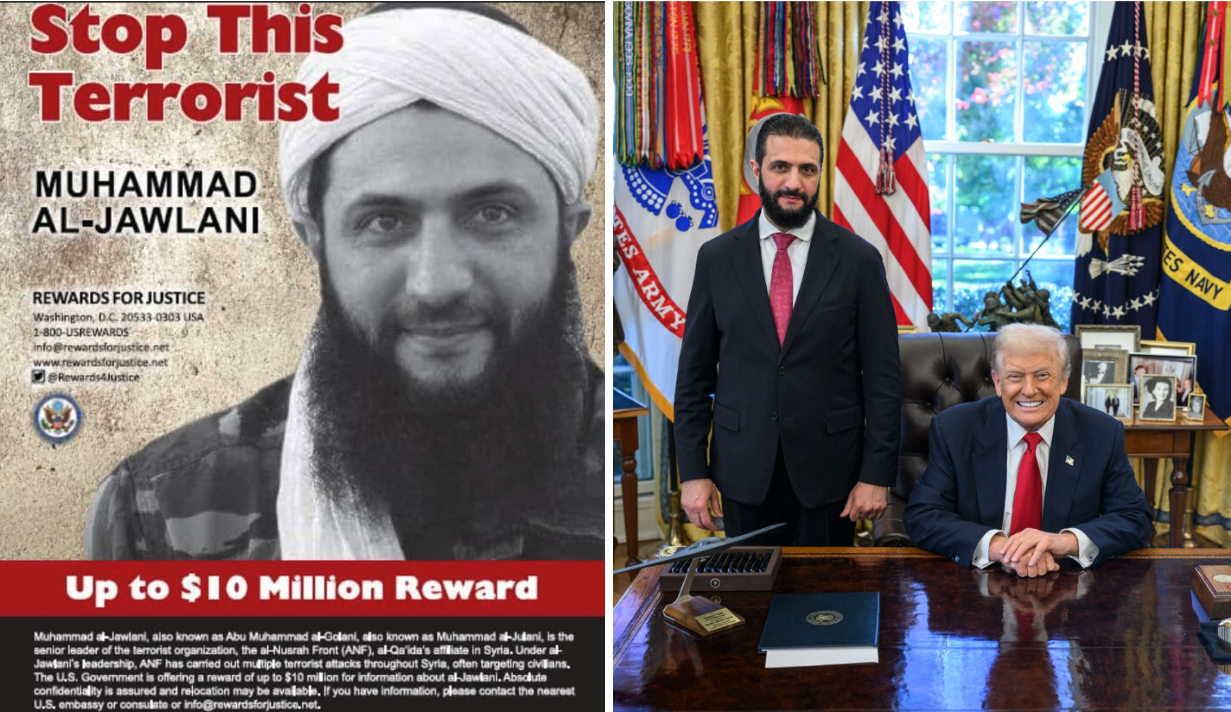
What a difference eight years and a nice suit makes! (Left: 2017, Right: 2025)
But along with his war crimes, al-Sharaa was also indisputably good at leading a terror cell and pursuing power. In 2016 Jabhat al-Nusra rebranded as “Jabhat Fatah al Sham,” cutting its public ties with al-Qaeda to avoid international scrutiny (even though experts assessed that the groups still coordinated behind the scenes). The following year al-Sharaa persuaded several other militant groups to merge with his own, forming “Hay’at Tahrir al-Sham” (HTS) and taking the lead in the anti-Assad war effort. They cultivated relationships with the diplomatic and intelligence services of the U.K. in particular, as investigative reporter Kit Klarenberg has documented in great detail, setting the stage for HTS to be seen as a legitimate government. And in 2024, HTS and its various allies finally succeeded in bringing Assad down, making HTS the de facto government of Syria and al-Sharaa the nation’s leader. So here we are, nearly two years later, with al-Sharaa at the NATO summit in Ankara and Trump shaking his hand.
This whole mess is extremely awkward for anyone who still supports U.S. foreign policy or believes in the country’s much-touted “global leadership.” The usual narrative we’re sold, whether by politicians or their allies in the media, is that U.S. foreign policy is basically moral. As a nation, we care about human rights and democracy, and we oppose dictators and war criminals; so the story goes. “We defeated tyrants, demolished evil, and saved freedom again and again,” as Trump put it in his recent Independence Day speech. And with Syria in particular, we were told for over a decade that Bashar al-Assad represented the “evil” that needed “demolishing.” In the 2016 election, Hillary Clinton even wanted to impose “no fly zones” over Syria, risking a shooting war with Russian aircraft, for that reason. The justification, we were always told, was that Assad was a terrible dictator who killed and tortured his own people. True enough; although details about particular attacks have been disputed by reporters like Seymour Hersh (and there were subsequent disputes about those disputes), the overall picture of Assad as an autocrat who abused human rights is clear. (Winning an election by improbable “Assad numbers” like 95 percent of the vote is a common joke for a reason.)
But how on Earth does it help anyone to depose Assad, if his replacement will just be an al-Qaeda commander who has also massacred Syrian civilians on numerous occasions? At best, that’s a case of “meet the new boss, same as the old boss.” The United States’ willingness to embrace al-Sharaa reveals that its Syria policy was never really about human rights at all. Assad was an opponent, not because he was a murderer, but because he wasn’t amenable to U.S. interests, and preferred to work with Russia; replace him with a similarly lethal murderer who’s more friendly toward Washington, and that person will be welcomed with open arms. Only power matters.
It’s not like al-Sharaa has changed his ways, either. In theory, a former al-Qaeda leader could reform—but that doesn’t mean they should be trusted with state power or geopolitical decisions, especially when their troops are still killing civilians. Last year, a Reuters investigation found that since al-Sharaa took power, sectarian killings of Syria’s Alawite minority have spread and escalated, with at least 1,500 people murdered at “40 distinct sites of revenge killings, rampages and looting against the religious minority.” Those responsible were a mix of militia fighters allied with al-Sharaa’s military and actual members of it, and in many cases Reuters found “a chain of command leading from the attackers directly to men who serve alongside Syria’s new leaders in Damascus.” And in January of this year, al-Sharaa waged a brutal assault against the Kurdish autonomous region of Rojava in northern Syria, where anarcho-communists and feminist fighters were building a genuinely inspiring experiment in self-governance. As Genocide Watch reports:
Now, gender-based violence is being used as a strategy of annihilation. One of the most brutal acts documented in this escalation was the killing of the Kurdish woman fighter Denîz Ciya, who was thrown from a high building in Aleppo after being captured. Her death was not only an execution but a public message threatening to punish Kurdish women who resist and lead[...] A video circulated online shows a Syrian Arab Army (SAA) militiaman displaying a severed braid of a female fighter from the Syrian Democratic Forces (SDF) and framing it as a trophy, using the Kurdish word “hêval” (“comrade”).
In other words, when Donald Trump praises al-Sharaa for “unifying” Syria, it really means forcibly subduing people who wanted their autonomy. After three weeks of this ugliness, the Kurds were forced to accept a highly unfavorable “integration deal” that absorbs their forces into the overall Syrian military and restores control of the northeast from Damascus, effectively ending Rojava in exchange for the recognition of Kurdish as an official language and various other civil rights. And here again, we can see the amorality of the United States, which relied heavily on Kurdish allies to fight ISIS in the 2010s, but was nowhere to be found when they needed help.
The consequence of this amorality is that accusations of “terrorism” from the U.S. no longer mean much of anything. Think about Trump’s proposed military arrangement for Syria to invade Lebanon and go after Hezbollah—which, it has to be said, even al-Sharaa seems skeptical about. Like with Assad, the justification is that Hezbollah is a “terrorist” group. They wage missile attacks against Israel and others, and so they’re on the official list of “bad guys” who need to be “taken out.” (And unfortunately, mental six-year-olds like Secretary of War Pete Hegseth really do use terms like “bad guys” to think about the world.) But again, this moral calculus fails when the attack dog you’re proposing to sic on Hezbollah is also a terrorist who was working with al-Qaeda until ten minutes ago, and continues to brutalize Syria’s minority groups. At that point, you’re just picking and choosing your favorites from among the world’s death squads.
If we look beyond the Middle East, the contrasts get even more ridiculous. With the removal of Syria from the U.S. “state sponsors of terrorism” list, only three countries will remain on it: Iran, North Korea, and Cuba. From that list, Cuba stands out. We are somehow expected to believe that Cuba, a nation which hasn’t waged a war since it defended Angola from white supremacist invasion in the 1980s, is a “terrorist” nation, and yet a Syria under the control of former al-Qaeda and Jabhat al-Nusra jihadists is “not terrorist.” According to the Trump administration, 94-year-old Raúl Castro poses such a grave threat to world security that he needs to be arrested by U.S. forces, but Ahmed al-Sharaa is a perfectly normal leader who we can make friendly deals with. None of it adds up.
But again, the thing that matters isn’t actually terrorist violence, and never was. It’s fealty to U.S. foreign policy goals and U.S. corporate interests, and in that department, al-Sharaa shines. Soon after he crushed Rojava and took control of northern Syria, his government was signing lucrative fossil-fuel deals with the likes of Chevron and ConocoPhillips to extract oil and gas from the freshly-conquered territory. And as University of London professor Gilbert Achcar has written in Al-Quds al-Arabi, there is now a similarly lucrative “Syrian reconstruction market” with an estimated value as high as $340 billion, where al-Sharaa is now soliciting international investors for real estate, construction, and tourism projects. At one point, he even “expressed his desire to see a Trump Tower built in Damascus.” He may be a terrorist, but he’s a profitable terrorist, and so all is forgiven.

Al-Sharaa is only the latest in a long line of the United States’ pet murderers, though. There would have been no al-Qaeda for him to join if the U.S. hadn’t helped to recruit and train Osama bin Laden back in the 1980s, using him and his fellow mujaheddin as a weapon against the Soviet Union in Afghanistan. If al-Qaeda had used the exact same tactics of suicide bombings and airplane hijackings, but deployed them exclusively against the United States’ enemies, he would probably still be considered a great friend and ally. And before him, there was Pinochet, and Suharto, and Carlos Castillo Armas, and the Shah of Iran, and the Contras, and so on down the line, ad infinitum. More than any other country, we have created monsters in our own image.
Or rather, our political elites have. It’s not actually the United States as a whole that takes these actions, but a small handful of State Department executives, policy advisors, intelligence agents, and the leaders of multinational corporations like Chevron. It’s really them Donald Trump represents when he goes to Ankara, not us. By getting the United States into bed with al-Sharaa—to say nothing of Netanyahu, or Mohammed bin Salman—he shames us all by association with his own class’s corrupt, murderous agenda.
But as citizens, we have political agency too. It’s long past time that we discarded the old, cobwebby mythologies about “American leadership” and our alleged defense of freedom and human rights, and look at our nation’s foreign policy for what it really is, in its full horror. In that way, Trump is actually quite useful, because he rarely bothers to put up a pretense. In his crude, blatant arrogance, he shows us exactly where we stand. Now we have to face the atrocities our leaders condone—from Syria, to Gaza, to Cuba, and beyond—and say no more.

.png?width=352&name=Untitled%20design%20(1).png)
.jpg?width=352&name=Bald_Eagle(2).jpg)