There’s barely any pretense that Trump cares about Cuban democracy. This is about privatizing Cuba’s public assets and getting them into the hands of Trump’s cronies.
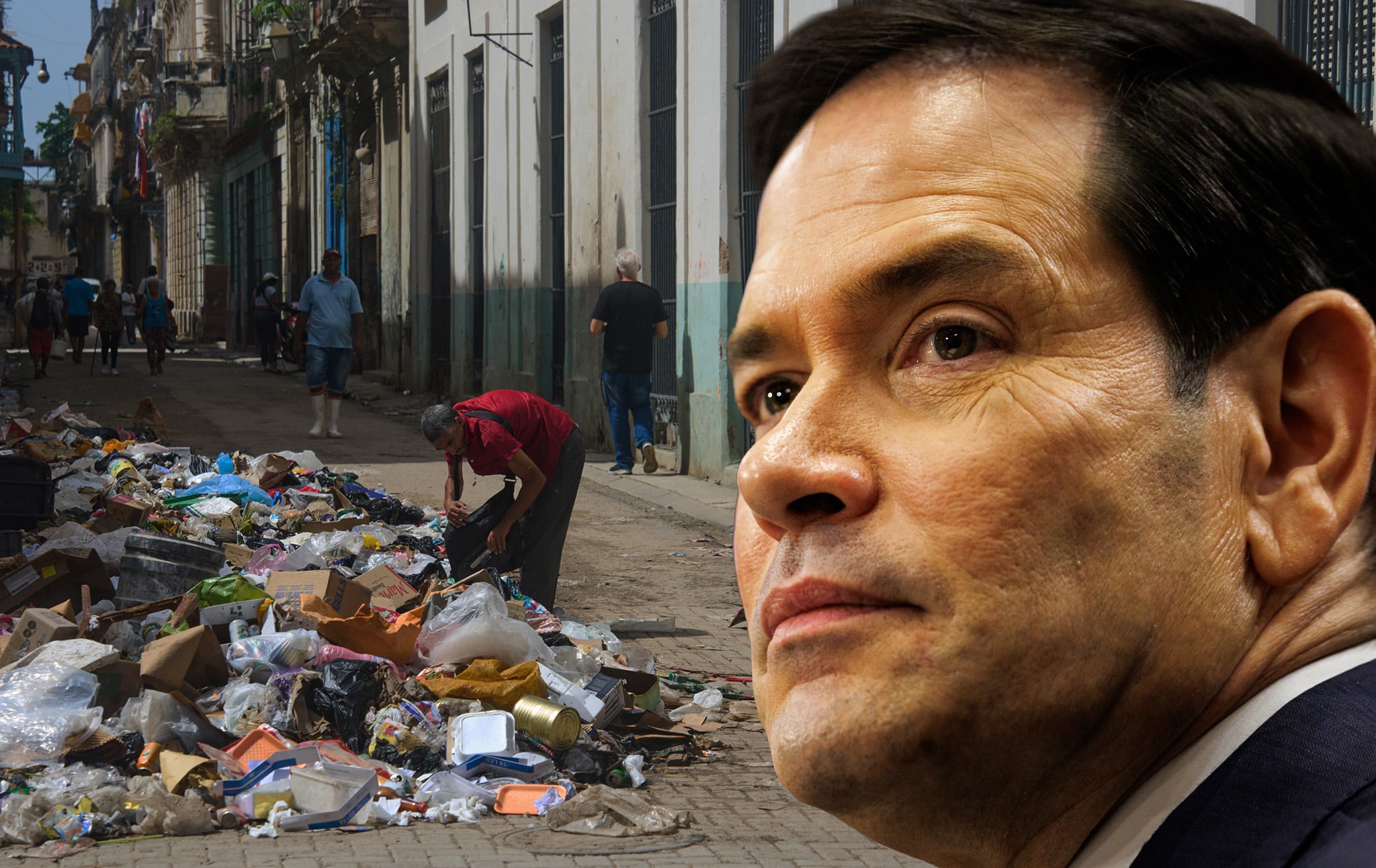
Cuba’s blackouts are getting worse. Many are going days without any light at all and the public electric company is “fighting to provide even a few hours of power a day.” The gas stations are empty. There are “mosquitos everywhere.” People in high-rise apartments are cooking with charcoal, risking carbon monoxide poisoning and deadly fires.
The suffering of Cubans has been inflicted upon them on purpose. It is the intention of U.S. policy to make the Cuban people suffer, and endanger their lives, in order to put pressure on their government. The Trump administration is waging a “pressure campaign aimed at forcing political and economic changes in Cuba.” The Trump administration, earlier this year, took “the almost unprecedented measure of blocking all oil shipments to a country with which it is not at war.” That means that food aid can’t be distributed on the island, because there’s no way to transport it. Once fully-stocked bodega shelves are now empty. (Not because “socialism” is causing shortages, since people had enough to eat before, but as a direct result of the blockade.)
The UN reports that the U.S. policy is killing babies and children: “infant mortality has doubled to 9.9 per 1,000 births; childhood cancer survival rates have fallen from 85 to 65 per cent; and essential medicines are available at only around 30 per cent of normal supply levels.” The UN human rights chief’s verdict on the U.S. is scathing: “Such severe sanctions packages that target entire sectors of an economy and produce broad, indiscriminate and harsh effects on populations are incompatible with basic principles of international human rights law.” But even this condemnation is too mild. The U.S. pressure campaign amounts to nothing but terrorism: making people sick, making them poor, making them suck in carbon monoxide, starving them, denying children their cancer treatments, in order to try to force a change in their government’s policy.
It is hard for me to imagine what life in Cuba must be like right now. My colleague Alex Skopic and I visited a few months back with the Nuestra América aid convoy. Even then, it was agonizing to see what Cubans were enduring. Restaurants were having to suspend service when they were plunged into darkness in the middle of dinner hours. Taxi drivers were sitting idly waiting for tourists that never came. Garbage was piling up in the streets because there was no fuel for the trucks. Things have deteriorated since then.
But the Trump administration decided this was not enough. It has since rolled out “the most significant expansion of U.S. sanctions on Cuba in decades,” punishing foreign firms that do business with the Cuban government. This has resulted in foreign companies fleeing the island to avoid having their assets frozen by the U.S.—Mastercard and Visa have stopped processing transactions there, and major hotel operators have shut down, in a blow to what was left of the tourist economy. A Russian tanker carrying a “lifeline of fuel” recently turned away from the island, despite Russia’s previous promise that “we won’t abandon the Cubans.” Grocers are panicking now that “two shipping companies that carry 60% of the goods entering the island have suspended all new orders.”
Cuba’s government has not been as pliant as the U.S. expected. According to Politico, “Trump and his aides have grown frustrated that the U.S. pressure campaign, which includes starving the island of fuel, has not led Cuba’s leaders to agree to significant economic and political reforms.” A source close to the discussion said that “the Cubans are proving much tougher than originally thought.” So Trump is threatening to invade Cuba, a threat he apparently means very seriously, especially since it is Marco Rubio’s lifelong ambition to successfully carry out the overthrow of the Cuban government.
What does the Trump administration actually want from Cuba, though? Well, we can get an understanding of that by looking at what just happened with the Canadian mining company Sheritt. Sheritt has been operating in Cuba for over 30 years, but the Trump administration’s new threats to sanction any foreign business that operates in Cuba resulted in Sherritt announcing it was pulling out of Cuba entirely. But the company swiftly reversed course, announcing it would remain in Cuba. Sherritt had reached an agreement to sell a 55 percent share of its company at a discounted rate to Gillon Capital LLC, a financial office for the Washburne family, one of whose members, Ray Washburne, was appointed by Trump in his first term to head the Overseas Private Investment Corporation. In other words: companies that do business in Cuba have to shut down, unless they are sold for bargain basement prices to Trump cronies. The goal of handing public assets to private companies is in no way disguised. Politico reports that Cuba has been under pressure to “make serious economic reforms” such as “privatizing many state assets” and “allowing more foreign investment.”
El Pais reports that as foreign hotel operators are pulling out of Cuba, Airbnb and Marriott are ready to expand their operations there when the Trump administration gives them the go-ahead, and “once foreign companies withdraw, their replacement by U.S. firms appears to be the next step.” Ben Roswell, the former Canadian ambassador to Venezuela, concludes that the Sherritt deal shows the “changing character of the US relationship with the region as it’s turning into an extractive predator.” One might argue that the U.S. has long been an “extractive predator,” but it’s true that Trump has been quite open about believing that the U.S. is allowed to use force and violence however it likes, in total disregard for international law, to enrich Trump’s friends in the business world. That was the Venezuela playbook: fossil fuel companies donated heavily to his campaign, and Trump then kidnapped Venezuela’s president so that he could open the country to U.S. oil producers. This is precisely what is happening in Cuba: Trump is starving the country in the hopes that the government will institute “economic reforms” (read: privatization) that allow Trump’s donors to get rich.
One of the sticking points in negotiations with the Cuban government is that the U.S. is demanding Cuba, a poor country, pay billions of dollars to Miami businessmen to compensate them for property nationalized after the 1959 revolution. Like Haiti having to pay back the “debt” to slaveowners from their lost property values after the revolution (much of that property being human beings), Cuba is expected to pay for treating its assets as belonging to the people as a whole rather than belonging to a small moneyed elite.
There is no secret conspiracy here. There’s a conspiracy, yes, but it’s no secret. It’s right there in the pages of the Miami Herald, which recently reported on the plans that Cuban Americans have for how to run the country once the Trump administration puts them in charge of the economy. The New York Times, too, recently reported on a Cuban American expat named Teo A. Babún, Jr., still bitter over the expropriation of his family’s “railroad, sawmill, shipyard, cement factory,” and “grand estate,” who was literally photographed in front of a whiteboard containing his plans for the “Cuba transition.” Whether it’s called “transition,” “reconstruction,” “reform,” or “democratization,” the end result will be the same: Cuba will not actually get more democratic. It will get more business-friendly.
Ostensibly, the pressure on Cuba is about Cuba’s repression of dissidents and absence of democracy. (The administration has also been arguing, ludicrously, that Cuba poses a “national security threat” to the United States.) We can set the stated justification aside immediately, because as we know, the Trump administration happily embraces authoritarian governments around the world, from El Salvador to Saudi Arabia. For the U.S. the problem with Cuba is, as it has been since the 1959 revolution, that the country refuses to allow private capital to do as it pleases. The Trump administration is furious that the Cuban government is not willing to let U.S. corporations rule the island. The corporations themselves do not want to let a single square inch of the Earth exist outside their grasp.
I cannot think of a more morally grotesque act than for a rich man to murder a baby in order to slightly increase his wealth. Yet that is what is going on in Cuba. The Trump administration knows full well that its policy of economic strangulation will kill children. But it has been escalating the policy nonetheless. The depravity of this agenda is impossible to overstate. And we may not have seen the worst yet.