A former New Jersey state trooper reflects on following his father into law enforcement—and why he soon walked away from the badge.
Recently I took in a matinee of Springsteen: Deliver Me From Nowhere at a theater. A dozen of us, all grey-haired, watched the show.
The film is engaging art, and depicts Bruce Springsteen’s unorthodox effort in creating one of his early albums, Nebraska. But there are also deeper messages in the movie. One is Bruce’s struggle with his father who was aloof, suffered from mental illness, and verged on violence at times. The second is Bruce’s wrestling with his own mental illness.
I reacted strongly to the film, partly because Bruce and I had some commonalities growing up, and also because our paths crossed once. Decades ago—before walking away, disillusioned, from the career path I’d seen my father forge—I’d escorted “The Boss” to five of his concerts during my time as a New Jersey State Trooper. My tenure as a cop was brief, but long enough to open my eyes. After joining the force in the early 1980s, I witnessed a world of structural poverty and deeply-embedded racism, the likes of which I’d never realized, in the peak of the crack cocaine epidemic. Little did I know at the time that Bruce Springsteen’s music reflected these realities.
Springsteen’s lyrics spoke of poverty, prejudice, state violence, and the limits of the American Dream. But on a warm night in 1985, as I stood amongst the crowd and listened to his words for the first time, I wondered if the audience could really hear him. Later, as I contemplated the purpose of my badge, I’d wonder if I could too.
Now judge, judge I got debts no honest man could pay
The bank was holdin' my mortgage and takin' my house away
Now I ain't sayin' that make me an innocent man
But it was more 'n all this that put that gun in my hand
—Bruce Springsteen, “Johnny ‘99” (1982)
That summer, when Bruce was at the peak of his fame, he came to what was then Giants Stadium in East Rutherford, New Jersey to give six homecoming concerts in the middle of his international “Born in the USA” tour. Tickets for the string of shows sold out immediately. There was concern that hordes of Springsteen devotees would gather outside the stadium each night trying to buy tickets, or at least be in the vicinity of the music—and indeed, fans flooded the area each night.
It was my fourth summer on the New Jersey State Police force, and my unit was called in to keep crowds from getting out of control during Bruce’s concerts. (The Meadowlands Sports Complex was under the authority of the New Jersey Sports and Exposition Authority, part of the state government. The complex included an office of the State Police.) I was personally assigned to escort Bruce into and out of Giants Stadium to assure he would not be mobbed by fans.
Bruce was driven from his Rumson residence to the stadium in an old cargo van by whom, I assumed, was his bodyguard. The singer remained hidden in back, behind a curtain.
Each concert I waited in my marked troop car for Bruce’s van to arrive on the offramp from the New Jersey Turnpike, and accompanied it into the back entrance of the stadium. This gave an appearance to fans that I was escorting a vehicle with equipment. When the concerts ended, I quickly led Bruce’s getaway car out of the stadium and back to the Turnpike entrance ramp.
During one concert I was allowed to change into civilian clothes and go onto the stadium field, close to the stage where I could watch Bruce and the E Street Band perform for a good part of the show. It was my first rock concert. I was astounded.
All the seats in the stands and almost every foot on the field were taken by 65,000 fans in the stadium. Everyone stood for every song and most danced along with it. The scene felt like a massive human heart pulsating with the thunderous instruments and Bruce’s emotional voice cavorting on stage. Bruce was a gut-deep, soul-stirring phenomenon.
I was hearing many of his songs for the first time. The music was powerful, but I was more taken by the lyrics. This “average Joe” guy in jeans and T-shirt was a poet laureate, not for the millions of his fans around the world, but for the downtrodden, the disadvantaged, and the disenfranchised. Bruce was a veritable prophet. I stood at his feet.
Yet, after some time watching the show, I sensed an underlying disconnect between the crowd and these revelatory songs. I questioned whether the fans were fully getting Bruce’s messages about distressed towns and families, unemployed working-class men and women, a beaten-down underclass, and the murderous warring on Vietnam. I guess it was hard to dance to poverty and loss, if not bordering on perverse, so fans were more engrossed in the tunes and beat, rather than the lyrics.
Standing in this immense and spirited crowd, I felt my own confused disconnect: one that had already been rising during my policing. I initially and enthusiastically wanted to stop crime. But now, those feelings were fading.
To understand that feeling, I have to go back—to where I came from, and to my father.
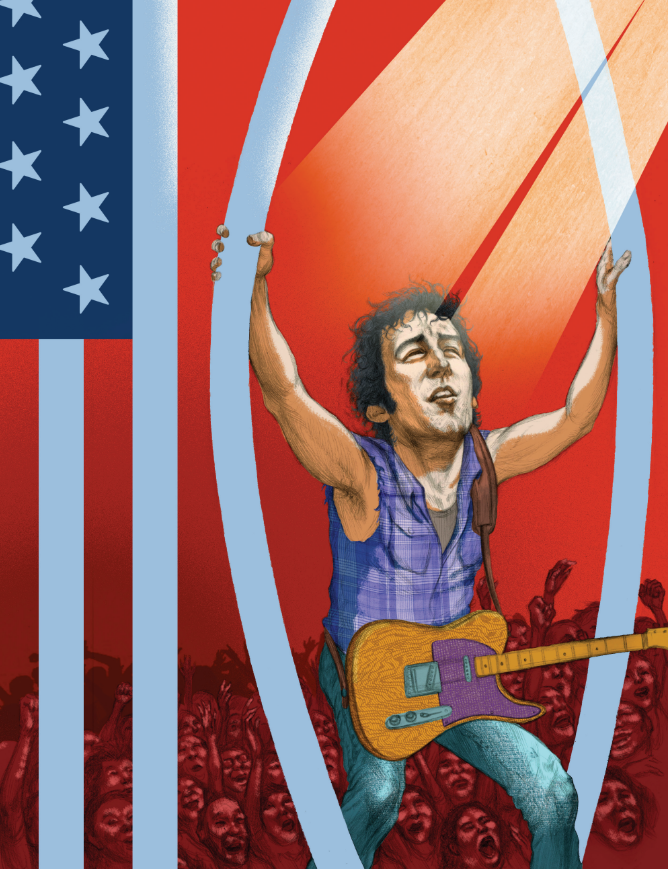
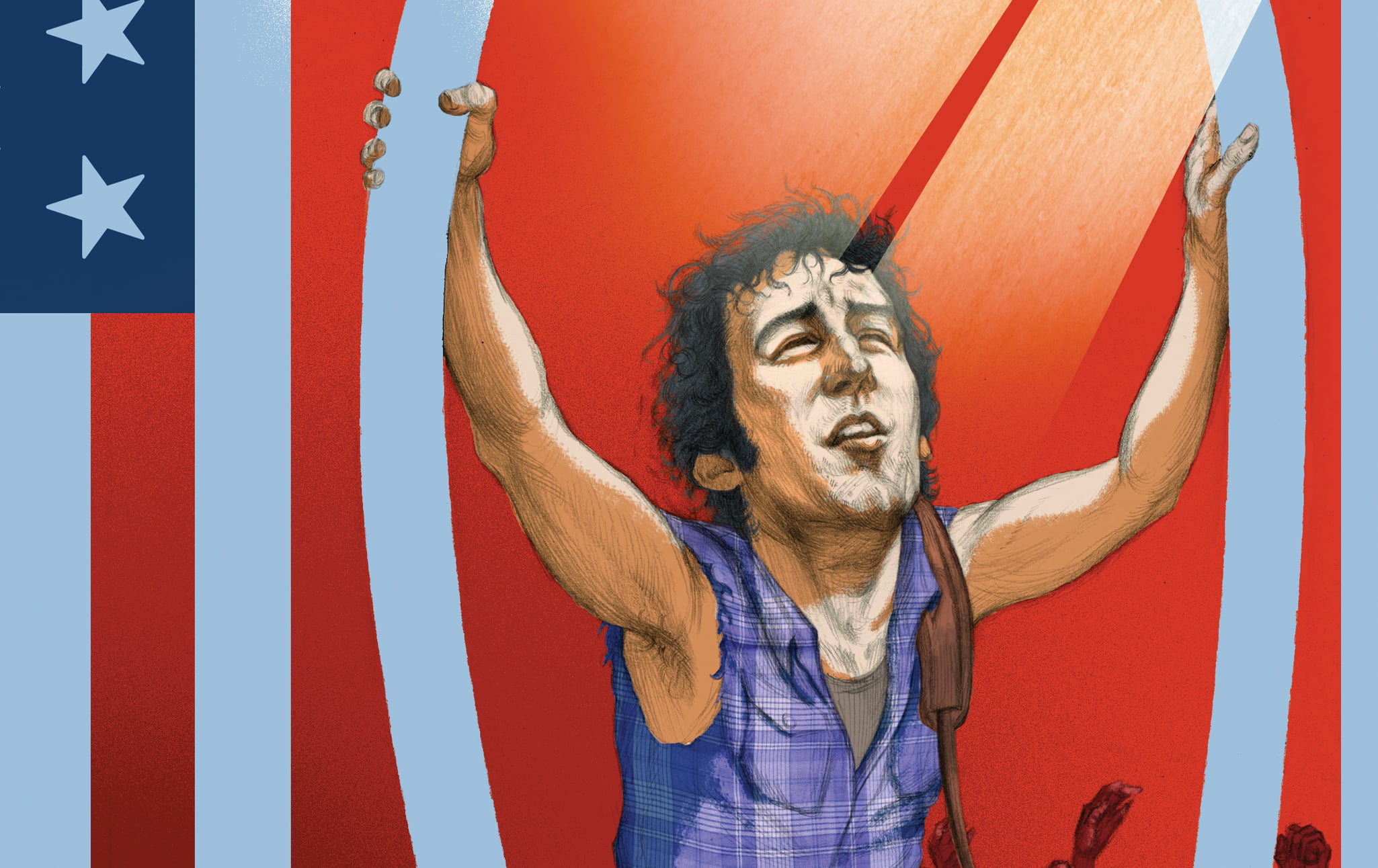
Art by C.M. Duffy from Current Affairs magazine, Issue 59, May-June 2026
I was born in Redbank, New Jersey, seven years after and seven miles from Bruce Springsteen’s birth in Long Branch. We were both raised in blue-collar towns, equally distant from the shores of Asbury Park, where my family made rare outings so that my four siblings and I could enjoy the rides on its amusement boardwalk. Some years later, Bruce began to build his musical career at the Stone Pony, a beachfront bar just a few blocks away.
The Fina and Springsteen families were both of modest means. My father was a New York-New Jersey Port Authority police officer who worked 26 years as a cop, mostly at the George Washington Bridge and Lincoln Tunnel. Bruce’s father had a number of jobs, most of which he had difficulty keeping until he became a bus driver. (This is according to Bruce’s 2016 memoir, Born to Run.)
My father was principled, hardworking, and highly responsible for his family. He was also stoic; I rarely saw him laugh, and never saw him shed a tear, even at his own father’s funeral. My father had a temper, and while sometimes he scared me, he never hurt me or any of my siblings. He showed utmost respect for my mother. According to the Born to Run memoir and depicted in Deliver Me From Nowhere, as Bruce grew up, his father was quick to anger, drank too much, and disrespected his wife.
So our fathers were different, with a few impactful exceptions. I don’t recall my dad saying he loved me, but I knew he did. Bruce similarly couldn’t recall his father using those words, but he knew he felt that way.
Bruce stated in his memoir that his father was both his hero and his greatest foe. My father was also a hero to me, but never a foe. Yet, I didn’t really get to know him. He spent a disproportionate amount of time at work and commuting; he was literally and emotionally distant. My father died suddenly, overnight, from a brain aneurysm when he was 46. He was buried in an old cemetery up the street from our house. I was 17, and rattled.
Bruce’s father died at 73. As an adult he got to know his father, especially what was hurting in him. Later in life he even felt the elder Springsteen’s warmth.
I adopted my father’s stoicism when he died, but ached to know his heart and his hopes. A hundred times or more I stood by his grave, and carried on one-way conversations. In time I set off in search of my father, and how to make him proud of me if he were alive.
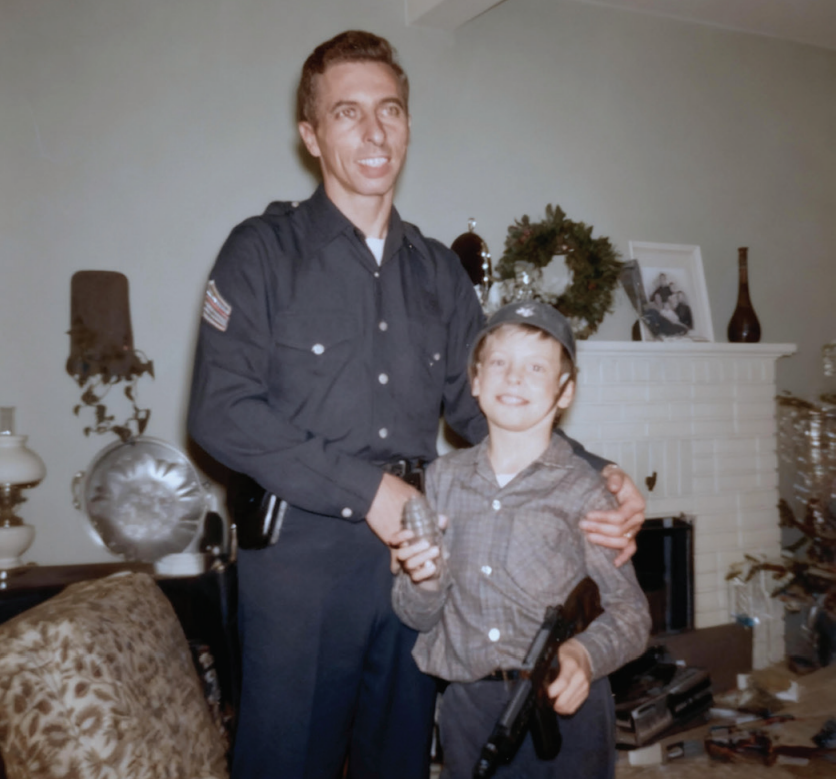
My father and I pose for a photo in our family living room in 1964: him in uniform, and I, age eight, holding a toy gun. I have never touched a firearm since leaving the State Police—and never will again.
And so, I decided to walk in his footsteps; I became a cop and joined the State Police. Within two years I was assigned to the elite TEAMS Unit. Among the unit’s many operations were SWAT and special criminal interventions. As a cop I was exposed to poverty and disproportionate violence in urban neighborhoods. By the time I found myself at the Meadowlands in 1985, I started questioning what had led to these circumstances. I was running into structural inequalities without seeing them, yet sensing something was radically wrong.
The crack cocaine epidemic peaked in the mid-to late 1980s in cities across the United States, and Newark, New Jersey was in the line of fire. Its targets were impoverished, mostly African-American neighborhoods where crime exploded.
Not far from the Meadowlands, Interstate 280 intersects with Highway 21 in the city of Newark. A public high-rise housing project, the Christopher Columbus Homes—which was torn down in the 1990s—loomed over the freeway exits that led to Broad Street. The central business district of Newark was just a few blocks south. I-280 and the ramps to Broad were under the jurisdiction of the State Police; the area was hit by addiction, neglect, and violent crime.
Employees driving on I-280 to Newark’s central business district from middle- and upper-class communities were alluring targets for largely unemployed, desperate, prospectless, young Black male residents of the Christopher Columbus Homes, who easily robbed them. My TEAMS Unit was called in to stop them.
The assignment took me into the public housing complex where I observed radical destitution. One night, my unit entered a high-rise building in search of a young man who was possibly involved in a murder on an off-ramp of I-280. We took the steps up several floors, walking through trash and stench in dingy stairways. The building was barely habitable, yet crowded with families.
Prostitution and drug dealing were common around the premises of the Christopher Columbus Homes. At such places there was little chance for residents to escape poverty, but a huge chance to be incarcerated.
Increasingly, it felt like my job as a cop was to help separate a world of empowered white people from a world of marginalized Black people. Too often, this resulted in arrests by cops and imprisonment of desperate people living in places like public housing projects.
In the years since, I’ve come to understand that what I was witnessing was structural: persistent, socioeconomic inequality wrought by the isolation and concentration of impoverished minorities. I learned about these issues from the writings of William Julius Wilson, a sociologist who published a seminal work in 1987: The Truly Disadvantaged: The Inner City, the Underclass, and Public Policy. The text was required reading in one of my graduate courses, and probably the most compelling during my doctoral studies.
Consider how Wilson, in his book, described the situation of the impoverished urban communities in the 1980s:
Today’s ghetto neighborhoods [sic] are populated almost exclusively by the most disadvantaged segments of the black urban community, that heterogeneous grouping of families and individuals who are outside the mainstream of the American occupational system.
Included in this group are individuals who lack training and skills and either experience long-term unemployment or are not members of the labor force, individuals who are engaged in street crime and other forms of aberrant behavior, and families that experience long-term spells of poverty and/or welfare dependency.
Wilson’s research focused on intergenerational, Black poverty in crime-plagued inner cities. The book included discussion of Chicago’s Robert Taylor and Cabrini-Green public housing projects. He could have easily developed his arguments by studying the Christopher Columbus Homes in Newark, walking beside me, observing underlying realities I was blind to as I carried out my policing.
Wilson (and other social scientists of like thinking) concluded that historical racism, unjust public policy, and inequitable economic processes placed urban African Americans at a radical disadvantage. These factors included: the mass migration of African Americans from the South to northern cities seeking better paid factory jobs during the four decades following WWI; the allowance of restricted deeds and covenants prohibiting sales of homes to racial minorities; redlining by the Federal Housing Authority (refusal to insure mortgages for homes in places where African Americans lived); the federal Urban Renewal program—using the blunt tool of eminent domain—literally plowing over neighborhoods because they were Black and working-class; and the outmigration of industry and white residents from cities to suburbs, especially during the 1950s and ’60s.

Sadly, since my tenure on the force in the 1980s, there has been a substantial change in the overall incarceration rate in the United States—for the worse. According to the Vera Institute, the U.S. currently has four percent of the world’s population, but 16 percent of the world’s imprisoned people. In the spring of 2024, there were 1.8 million incarcerated people in our nation.
Readers will recall that Giants Stadium held 65,000 fans in the 1985 Springsteen concerts. It would take more than 27 such stadiums to hold the number of incarcerated Americans today. Of those, white incarcerated people would fill ten stadiums, while Black incarcerated people would have filled well over eleven—even though the percentage of white people in our nation is four times greater than the number of Black people.
Economic inequality has also grown in the U.S. from the 1980s, with racial disparities further compounding the problem of incarceration. Since 1989, the U.S. Federal Reserve has been reporting on the “Distribution of Household Wealth” in our country. The report provides a telling picture. In the third fiscal quarter of 1989, the wealthiest 0.1 percent of Americans held nearly nine percent of the total household wealth, while the bottom half of Americans held only 3.52 percent.
Thirty-six years later, things have gotten substantially more inequitable. In the third fiscal quarter of 2025, the top 0.1 percent of Americans held over 14 percent of the total household wealth, while the bottom half of Americans held only 2.45 percent.
The glaring inequality revealed by these figures points to a grossly unjust political economy with a large segment of our population struggling to stay financially afloat, especially racial minorities. According to KFF (formerly the Kaiser Family Foundation), roughly 20 percent of Black Americans and 16 percent of Hispanic Americans in 2024 were living in poverty, compared to only 9.1 percent of white Americans.
In late February of 2026, the National Community Reinvestment Coalition (NCRC) published a report titled “Racial Wealth Snapshot Series: Overview of Black America.” The NCRC found that:
The median Black household holds $44,100 in net worth compared to $284,310 for White households. This means Black households have roughly 15 cents for every one dollar in wealth that White households have.
In other words, white households have over six times the net wealth of their Black counterparts. The National Women’s Law Center reported in October 2025 that seven out of 10 Black women, and eight out of 10 Latina women were “worried about affording groceries…”
These striking economic disparities read like a page out of Victor Hugo’s 1862 classic Les Misérables. Looking back to my policing days, I could see myself as Javert chasing down a desperate Jean Valjean for stealing a loaf of bread for his starving family.
As a cop in the 1980s, I didn’t understand the unjust factors and inequities plaguing American society. But I felt them, as I contributed to them.
One experience in particular helped drive me toward my resignation from the State Police.
My unit was called upon to capture a prisoner who escaped from an AIDS ward at Trenton State Prison in late 1986. The inmate was a younger Black man who was imprisoned for armed robbery. He was hiding in a large house in a predominantly African American neighborhood in East Orange, New Jersey. (I note my unit was entirely white.) The house was occupied by his extended family. The inmate was in remission from AIDS, but had little chance to survive the disease; effective medicines were not available at the time.
I vividly recall how we ordered the inmate’s family members to evacuate the house, using a loudspeaker. One by one they came out, weeping and terrified, especially the children. A crowd of neighbors gathered on the sidewalk in front of the house, clearly angry that state troopers had invaded their community.
We then announced, repeatedly, for the inmate to exit the house and surrender. He didn’t respond. I and four other troopers eventually went into the house to search for him.
We determined the man was hiding in the attic, which was accessible only by a panel door in the second-floor ceiling. We stood underneath, with handguns unholstered and ready to fire, assuming he might also be armed. It crossed my mind that the escaped inmate, who had little to lose, might start shooting through the attic floor at us, or that one of my fellow troopers might start shooting through the ceiling first. Either possibility would lead to a barrage of gunfire.
Thankfully, I was able to talk the inmate down from the attic and handcuff him.
This episode was the closest I had come to shooting someone, and nearly did so within earshot of the inmate’s desperate family. I’ve often questioned, what kind of a fiend had I become?
Not long after, I turned in my badge.

Policing in the U.S. is a no-win endeavor. It can lead to great losses. A classmate from the State Police Academy, Trooper Carlos Negron, was killed while patrolling the New Jersey Turnpike during our third year of service. Carlos stopped to give assistance to a van that had broken down on the shoulder of the highway. He was unaware that one of its occupants was armed and wanted by the New York Police Department for the murder of two people in Queens. The suspect shot Carlos four times as he approached the van. Carlos was 29, and left behind a wife and 11-month-old son.
I believe Americans generally resent being policed. That’s no surprise; our Constitution limits police authority, upholding civil liberties. Yet, Americans demand police protection for themselves, their institutions, and their political and economic arrangements. In such a society, cops are simultaneously heroes, villains, and victims.
My career as a trooper ended prematurely, only a few years after I had escorted Bruce at Giants Stadium. Looking back, I can still feel the muggy air of that 1985 night, and the thoughts racing through my head; I had travelled several years down my father’s path, only to realize I must forge another one. I still regret that I contributed to the racial disparity of incarceration in the U.S. as a cop.
New Jersey Turnpike riding on a wet night
'Neath the refinery's glow out where the great black rivers flow
License, registration, I ain't got none
But I got a clear conscience 'bout the things that I done
Mister state trooper, please don't stop me
Please don't stop me, please don't stop me
—Bruce Springsteen, “State Trooper” (1982)
Bruce Springsteen sings about state troopers, but I doubt he could have ever been one. He would make a lousy cop, but he’s one hell of a prophet. His career as a musician still goes on, now in his late 70s.
Decades after having resigned from the State Police, I found myself an old man sitting in a nearly empty theatre, watching Deliver Me From Nowhere, reminded of my father, and for the first time, crying during a movie.