
One of the most powerful people in Congress is a 92-year old Iowan who’s obsessed with Dairy Queen, his vacuum cleaner, and ruining the lives of his constituents. So why haven’t the Democrats beaten him yet?
Did you know that, right now, the person who sits third in line to the U.S. presidency is a deeply strange 92-year-old from Iowa? It’s one of those facts you forget about, until you look at the government website for “presidential succession” and get taken by surprise. But there it is: if anything happens to Donald Trump, JD Vance, and Mike Johnson, Senator Chuck Grassley would be our country’s Commander in Chief. He’s both the President pro tempore of the Senate and the chair of its Judiciary Committee, which makes him one of the most powerful people in Congress. This is alarming news for America, because Grassley is also the oldest member of Congress—he’s been in politics since the Eisenhower administration—and one of its foremost weirdos. On a regular basis, he puts things on the internet that make Trump look normal by comparison. He has a legislative track record a mile long, and most of it is awful. But the problem he represents is much bigger than one man. The fact that someone like Chuck Grassley has represented Iowa in the Senate for 45 years is a sign that American democracy is in a near-terminal state of dysfunction. What’s more, it’s the most damning indictment of the Democratic Party imaginable. If they can’t beat this guy, what are they good for?
When Chuck Grassley was born in 1933, Hitler and Stalin were both still alive, and the chocolate chip cookie had not yet been invented. When he was first elected to the Iowa state legislature in 1958, segregation and Jim Crow were still in full effect, and would be for another six years. When he became a U.S. senator in 1980, it was part of the “Reagan Revolution” that created the Republican Party as we know it today—and Grassley was endorsed by the Ku Klux Klan, who reportedly gave him “an eight out of ten for his voting record.” One of his first big decisions in Washington was to vote against the creation of Martin Luther King Jr. Day in 1983, although he insists he was just concerned about the expense of giving federal workers another day off. Simply put, this guy has been in Congress forever, outlasting six successive presidents. Now, at age 92, he visibly struggles to read statements on the Senate floor—but that hasn’t stopped him from filing the paperwork to run for yet another term in 2028, when he’d be 95. More likely, if the actuarial tables are anything to go by, he’ll follow in the footsteps of Senator Dianne Feinstein and Representative Gerry Connolly, and simply drop dead in office one of these days.
There’s a popular line of thinking, embodied in David Hogg’s “Leaders We Deserve” PAC and Samuel Moyn’s forthcoming book Gerontocracy in America, that says elderly, out-of-touch leaders like Chuck Grassley are behind a lot of the country’s problems. Certainly with people like Dianne Feinstein and Joe Biden, there’s a pattern of politicians staying in office long after it would have been sensible to retire. But you’ve got to be careful here, because the problem with these leaders is not only that they’re old. In general, age is a bad proxy for policy preferences, class allegiance, and even competence. The presumption behind the “gerontocracy” narrative is that younger equals more progressive, more worker-friendly, and that’s statistically likely, but not always true in individual cases. Even basic on-the-job ability varies. Bernie Sanders is old, though eight years Grassley’s junior, and he’s still doing (mostly) solid work. Ritchie Torres and Marie Gluesenkamp Perez are young, and they’re terrible. In Grassley’s case, the real problem is a more insidious combination of things. He hasn’t just been hanging on to power like a barnacle for decades, he’s also been making policy choices that directly harm the people of Iowa, and he’s been exhibiting some truly bizarre behavior along the way.

Congress is, as we know, essentially a group home for cranks, perverts, and the deranged. But even among that crowd, Grassley stands out. Like Donald Trump, he loves to post, and every time he goes online, he gives the world a glimpse into a lifestyle that can only be described as baffling. Take his longstanding devotion to Beth the vacuum cleaner. This is a 1987 Hoover Concept Two upright vacuum, which presumably used to be white-and-red, but thanks to the passage of time is now more beige-and-red. Not only has Senator Grassley named this vacuum cleaner “Beth,” which is weird and vaguely sexist by itself, but he feels the need to tell the world about it on every major holiday, like clockwork. “Once again Beth has performed wonderfully for family reunion If u knew Beth like I know Beth u would know the dependability I know,” he posted this August. Or, in April 2022: “Grassley to Beth: Sunday we hv our Easter family gathering are u ready to roll ?” Or last December: “Beth going to get Grassley farm house ready for 32 guest Christmas Day.” The man is obsessed.
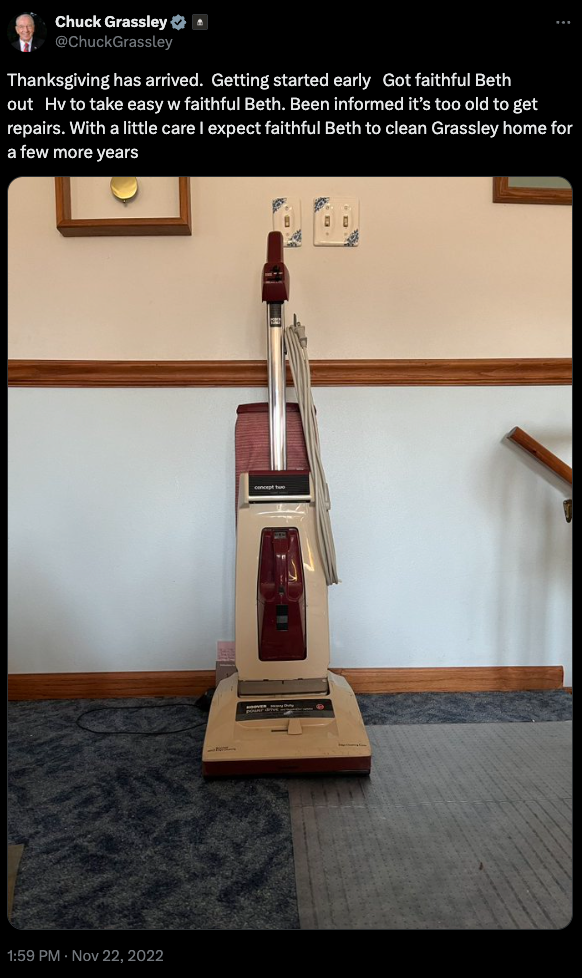
Like a lot of older people, Grassley’s posting style is terse, full of abbreviations and run-on sentences, and somewhat incoherent. In a recent article, the Iowa-based Little Village described it as having “the start-stop, quiet-loud, herky-jerky quality of an E.E. Cummings poem.” The subjects, too, are odd. “Windsor Heights Dairy Queen is good place for u kno what,” the senator tweeted in 2014, causing a collective huh? to spread across the nation. He would repeat the sentiment the following year, writing that “I'm at the Jefferson Iowa DairyQueen doing ‘you know what’ !!!” Apparently, “you know what” just means “eating ice cream”—or at least, that’s the story he’s sticking to.
Other times, Grassley seems to accidentally tweet from his pocket, posting a single “N” or “P” and leaving it up forever. He keeps people updated on his run-ins with deer on the road, showing a morbid fascination with the animals’ lives and deaths:
Grassley also has his own hashtag, #cornwatch, which contains dozens of posts showing him driving around Iowa taking pictures of corn. (“Update on corn maturing. Last week no kernels dented. This week most but not all kernels dented.”) This at least makes some sense, since Iowa is an agricultural state, but the fact a sitting U.S. senator is doing the corn-watching is still puzzling. Isn’t that what we have the USDA for?
And then there’s his lawn-mowing contraption. Not satisfied with using one lawn mower like us mere mortals, Grassley uses three at once. Two of them are walking mowers, with the familiar handlebar to push, and they’re mounted to the back of a riding mower with a metal rod, which seems to be welded or bolted into place. Grassley has included footage of himself tooling around on this thing in his campaign ads, and proudly posts about it too: “Pretty simple invention but very cheap and it works.” You can easily picture him riding across Iowa on it, like the protagonist of David Lynch’s The Straight Story.
Grassley is a fascinating figure, because you never know what you’re going to get next with him. And all of his corn and vacuum-related antics might be charming, if he didn’t have any political power, and was just somebody’s weird grandfather (or, at this point, great-grandfather). There’s an entire category of American political grotesques like this: figures who’ve been defined in the public eye by their personal strangeness and entertainment value, as much as their actual politics. Trump is another, with his constant stream of garbled utterances about the relative merits of death by shark vs. electrocution or how “nothing bad can happen, it can only good happen.” Or there’s RFK Jr. with his brain worms and quack cures, or even New York City’s favorite sons, Eric Adams and Curtis Sliwa. But the problem is, these people do have power. They control things like public health, the police, and the military, and they decide the outcomes of people’s lives. Like Sideshow Bob on The Simpsons, they’re a lot less funny when you realize they’re actually trying to harm you, and Chuck Grassley is no exception.
So what has Chuck Grassley done with his considerable power? When the curtain finally falls on his life and career, how will he be judged? Not well, if you’re an ordinary working-class Iowan. At every turn, Grassley has consistently made decisions that make their lives worse.
If you like having your thumbs attached to your hands, for instance, you might not like Chuck very much. As the Iowa Capital Dispatch reports, he spent 2021 going around Congress collecting signatures for a letter to the Biden administration, urging it to loosen safety rules and let meat companies speed up the lines in slaughterhouses and packing plants. When you do that, as Chance Phillips recently wrote for Current Affairs, more workers get injured, including in grisly ways like amputation and “the loss of an eye.” But when reporters questioned him about his reasons, Grassley was refreshingly honest: “It’s going to affect profitability.”
If you’re an Iowan dealing with diabetes, as approximately 248,315 people (or 10 percent of the state’s population) are, Chuck has also screwed you over. Back in 2022, he spearheaded Republican efforts to get a $35 price cap on insulin taken out of the Inflation Reduction Act, arguing to the Senate “parliamentarian” that it violated an arcane budget rule. Then, as Douglas Burns wrote for the Iowa Capital-Dispatch, he immediately did an online promotion for deep-fried and sugar-laden Iowa State Fair food:
I’m not trying to be The Grinch Who Stole The State Fair Corndog or unsweetened that State Fair lemonade. I get that the fair-food contest is an annual fun-spirited endeavor the Grassley staff schedules. But to run an eating contest tied to two weeks of gluttony days after your boss takes a public-relations beating on failing to back the insulin cap? Well, it’s just not Christian. Or very smart.
The insulin price cap eventually did pass, more or less, but only in spite of Grassley’s best efforts. If he’d had his way, people would still be shelling out hundreds or even thousands of dollars for the stuff—or, if they don’t have that kind of cash, just rationing their shots and dying. (As a senator, of course, Grassley himself gets only the best healthcare money can buy.)
If you live in Iowa and want a good education, you’ll also find yourself at odds with Senator Grassley. It was him, along with a handful of other Republicans, who led the effort to get rid of the Biden administration’s SAVE (Saving on a Valuable Education) plan for student loan borrowers, which would have lowered monthly payments and eliminated some people’s debt after enough time had passed. Like most of what Biden did in office, it was a sad half-measure compared to what was really needed: full debt erasure, on the spot. But even that was too much for Grassley and his ilk, who gathered like bloodhounds around a tree at the smallest suggestion that poor people might get something. And here, the age issue really does come into play: when Grassley graduated from the University of Northern Iowa in 1955, his tuition was just $159 per year, compared to over $8,000 for his young constituents today. Apparently, he thinks they ought to pony up tens of thousands for an opportunity he received practically for free.
Then, too, as head of the Senate Judiciary Committee Grassley had a major role in converting the Supreme Court to the openly right-wing institution it is today. Back in 2016, when he first led the committee, it was Grassley who delayed the vote on Merrick Garland’s confirmation to the Court until after the 2016 election, effectively stealing a seat from the outgoing Obama administration. Afterward, it was Grassley who was among the staunchest defenders of Brett Kavanaugh, even (and especially) after it became clear that Kavanaugh had lied to the American people about the sexual assault accusations brought against him by Christine Blasey Ford. So in a sense, all of the decisions that make up the Court’s post-2016 rightward turn—from the dismantling of women’s reproductive rights to the sweeping criminal immunity granted to Donald Trump—are Grassley’s handiwork.
Good news, though: if you’re a mentally ill person who wants to get a high-powered gun, Chuck Grassley is your best friend! One of his pet projects in 2017 was to repeal Obama-era regulations that prevented people from buying firearms if they had “mental impairments” so significant that they needed a third party to help them claim Social Security benefits. That seems like a rule even the most avid hunters and rifle collectors could agree with—if you can’t fill out a form unaided, you shouldn’t have a gun—but Grassley objected, claiming that the standards were too “vague” and that “if a specific individual is likely to be violent due to the nature of their mental illness, then the government should have to prove it” on a case-by-case basis. Never mind that, by the time the “proof” arrives, a school or a Walmart could be riddled with bullets and bloodstains.
This is who Chuck Grassley is. He makes decisions in Washington that ruin people’s lives, and then he flies back to Iowa to post incoherent gibberish about Dairy Queen online. The wacky grandpa image is a cloak for the deeper depravity. And his constituents know it. In 2021, only 28 percent of Iowans wanted him to run for re-election, with “the age thing” cited as the most common reason. More recently, Grassley’s town hall events have become outpourings of frustration against Republican policy: “I’M PISSED!” one man recently yelled at him, after he made a mumbling defense of the Trump administration shipping people to a gulag in El Salvador without due process. He spoke for millions.
Which leads to another, even grimmer question: why, in Grassley’s 45-year career in the Senate, have the Democrats never been able to unseat him?

The closest they’ve ever come was in his most recent election, in 2022. The Democratic candidate going up against Grassley was retired U.S. Navy Vice Admiral Mike Franken—another in a long parade of Democratic “troop” candidates, like Kentucky’s Amy McGrath or Texas’s MJ Hegar, who’ve run on their military records with tepid results. (Why the Democrats keep thinking this will work is anyone’s guess.) Franken was an utterly unremarkable centrist, so inevitably, the fine minds at the Atlantic called him a “strong candidate,” reasoning that he’d be a “nonthreatening alternative for the independents and Republicans who are reluctant to give Grassley another term.” But local Iowa journalist Randy Evans wasn’t convinced, writing that the Democratic Party didn’t seem interested in actually attacking Grassley on anything substantive:
There is a range of issues the Iowa Democratic Party could have emphasized in its reaction after Grassley’s announcement. It could have been the senator’s tepid support for the safety net for low-income people. Or his votes against the Affordable Care Act. Or his most troubling lack of leadership, his refusal to support an independent commission to investigate the Jan. 6 riot at the U.S. Capitol on the day the 2020 election returns were being certified.
But the Iowa Democratic Party did not emphasize these reasons for why Grassley does not deserve another term. Instead, the party decided to smack him for something else: Grassley has not lived in Iowa full-time since 1981.
Well, duh. Isn’t that a natural result when we vote to send someone to Washington? Is the party really implying that Tom Harkin commuted to Washington every morning during the 30 years he was a U.S. senator?
The Democratic Party risks irrelevancy in Iowa if this is the best it can do when there is a news announcement that surprises few people. And Iowa needs to have two strong political parties.
Alas, Evans wouldn’t get his wish. As Lyz Lenz reported for Politico, national Democrats noticed that Joe Biden polled poorly in Iowa, so they barely tried to win the state’s Senate seat:
[F]unding from the Democratic Party has dried up, along with organizing infrastructure, and all the big names in the Iowa Democratic Party chose to sit this year out. As one Iowa lobbyist, who was granted anonymity because they were concerned about maintaining a positive working relationship with politicians in both parties, told me, “It’s the Iowa Democratic D-listers’ time to shine.”
Calling Franken a “D-lister” does him a favor. He reportedly got crowds of 20-odd people at his campaign events, and his staff made depressing attempts to “organize a secret meme group on Twitter” inspired by John Fetterman. (The memes, according to Lenz, were “often just pictures of Franken listing his accomplishments.”) The fact that Franken had a sexual assault allegation against him, which many Democrats downplayed or ignored, didn’t help either. Grassley always retained a lead of eight points or more, and won easily; at this point, it looks like only the Grim Reaper will get him out of office.
This race, now three years old, is a perfect encapsulation of everything wrong with the Democratic Party today. There’s no reason they couldn’t win Iowa, or plenty of other conservative-leaning states, if they actually cared enough to try. The issues are in their favor. Iowans have to pay rent and buy groceries like everyone else; as Lenz noted in her Politico article, Iowans care quite a lot about reproductive rights. If you offered them a candidate with a strong populist agenda on economics and basic freedoms, you could send a weird nonagenarian ghoul like Chuck Grassley packing. For proof of concept, all you have to do is look at Nebraska, where labor leader Dan Osborn came within an inch of taking down incumbent Senator Deb Fischer. That’s with an independent campaign; if he’d had the kind of money, staffing, and media resources a major party can provide, he’d probably have won. The problem isn’t that places like Iowa are inherently “red,” and Democrats just can’t win them. The problem is that the party keeps running bland centrist nonentities who are only marginally different from the Republicans they run against. And that’s when they run a candidate at all: in 2019, there was no Democrat challenging Senator Tom Cotton in Arkansas. Why would anyone bother to get out of bed on a Tuesday and vote, when that’s the case?
Lately, I’ve been thinking a lot about the kind of leaders a system of government throws up in its dying days. You probably remember them from your high school history books. Romulus Augustulus, the last emperor of Rome, who ruled for only ten months before being deposed by the Barbarians (who found him so non-threatening they let him retire to a monastery). Kings Louis XIV through XVI in France, swanning around Versailles in their fur capes while the revolution was brewing outside. Nicholas II in Russia, letting Rasputin whisper in his ear as more and more of his people got blown to bits in World War I, while Lenin and Trotsky drew up battle plans of their own. Later, President Boris Yeltsin, who had crippling alcoholism even by Russian standards, to the extent he “wandered into the street in his underwear” during a state visit with Bill Clinton—and who played a key role in the downfall of the Soviet Union. In each era, the pattern is the same. The people in power are incompetent, corrupt, and personally contemptible, pale shadows of the leaders the country or system had at its peak—and yet, there seems to be no way to get rid of them.

Contrary to the “great man” (or rather “weak man”) theory of history, it’s not that these leaders cause the downfall of their regimes through their personal failings. Just the opposite. They’re not catalysts of decline, but morbid symptoms. The fact that they ever got near power is proof that the system itself is no longer functional. The mechanisms that are supposed to produce strong, effective leaders, from education to military promotion to party leadership contests, are no longer doing so. The skills and attributes needed to reach the top of the hierarchy no longer have much, if anything, to do with the skills and attributes needed to actually rule. Nepotism, mutual back-slapping, and financial corruption have taken hold, like rust. In the early 1800s, Napoleon was able to sweep across the map of Europe like a holy terror, in part because the ancien régime was still choosing military officers based on their noble bloodlines, while Napoleon only cared about effectiveness and would promote any old commoner who could win battles for him. Monarchy was dying, and the last things it belched up as it expired were tenth-generation, third-rate Hapsburg cousins, ripe for the slaughter. In the USSR, the bureaucracy elevated people based on how well they recited the Party line like a catechism, as much as their actual abilities. Thus, they eventually produced a Yeltsin.
And today in the United States, we have Chuck Grassley.
Looking at his record, there’s no way anyone could say with a straight face that Grassley, out of everyone living in Iowa, is the best-equipped to represent the state on the national stage. The thought of him trying to deal with a crisis is laughable. And yet, he’s what liberal, capitalist democracy has spit up. He’s clearly mastered the skills that actually matter: pleasing party bosses and wealthy donors so they’ll support your campaigns, trading favors with other legislators like yourself, stomping ruthlessly on the interests of anyone who doesn’t have money. And in the Democratic Party, the same patterns have defined his opposition, to the extent that no matter how bad he gets, they’ll always run a Mike Franken against him. They’ve also defined another notable Chuck, Senator Schumer, who thinks a “very strong letter” is a good way to oppose Donald Trump. They’ve defined Hakeem Jeffries, John Fetterman, Marie Gluesenkamp Perez, Mike Johnson, George Santos, Ted Cruz, and virtually all of the other politicians we find ourselves saddled with. There are exceptions, socialist insurgents like Zohran Mamdani who set themselves in opposition to the system as it currently exists—and the fact that someone like Mamdani, or Katie Wilson in Seattle, can now get elected is a testament to how weak and vulnerable the party elites have become. But this is still a state of crisis. We’ve got to burn out all the deadwood, whether they’re aged 92 or 32. Otherwise, the death of American democracy may look like Chuck Grassley, riding into history on three lawn mowers at once.