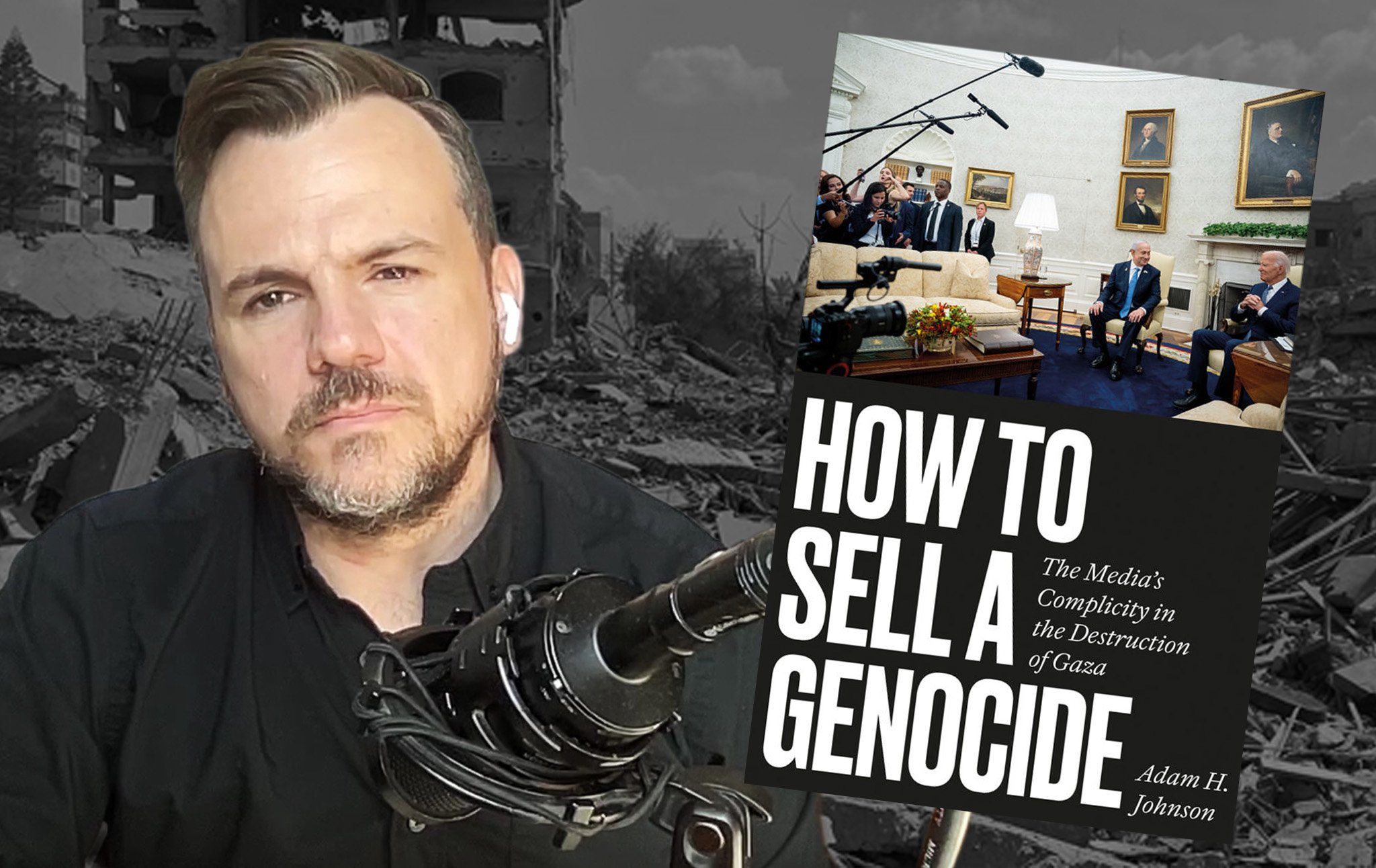
Media critic Adam Johnson on how distortions about Gaza in the New York Times, CNN, and The Atlantic helped the Biden administration get away with murder.
Adam Johnson is one of the left's leading media critics. The co-host of the Citations Needed podcast, his writing has appeared in The Nation, In These Times, The Intercept, Los Angeles Times, and the San Francisco Chronicle. His new book How to Sell a Genocide: The Media's Complicity in the Destruction of Gaza is a data-rich account of how U.S. press portrayed the destruction of Gaza as it unfolded. He uses detailed empirical analysis to expose media double standards in coverage of Palestinian and Israeli victims, and draws on interviews with insider sources at major media organizations to show how mainstream outlets deliberately censored Gaza coverage. Johnson recently joined Current Affairs editor-in-chief Nathan J. Robinson to discuss some of his findings.
Nathan J. Robinson
Your book is an analysis of how reporting about Gaza distorted the facts of what happened, and attempted—albeit partially unsuccessfully, given the state of public opinion on Israel-Palestine now—to create a false narrative about the destruction of Gaza. But before we get into that, let us lay out the actual facts, in brief, of the genocide. You do use the word genocide. You use it unashamedly. In doing so, you are adopting the language of the consensus of human rights groups. So before we get to the distortions, I hope you could give us a little bit of a summary of the real picture that you think people ought to understand of what happened in Gaza starting in October of 2023.
Adam Johnson
Yes, so obviously I'm not a genocide scholar, nor am I a lawyer. However, I rely on what we'd broadly consider to be Western experts, in Amnesty International, Human Rights Watch, and the International Association of Genocide Scholars, 86% of whom voted in favor of a resolution saying it's a genocide. And obviously, Doctors Without Borders, the Lemkin Institute, and various others charged with studying it professionally.
It's universal consensus for a number of reasons. Chief among them are what actually happened, the high level of civilian deaths, and the use of starvation as a weapon. But of course, most acutely and most notably at the time were the genocidal statements made by Israeli officials themselves, up to and including Prime Minister Benjamin Netanyahu, who gave his infamous Amalek speech on the eve of the invasion, where he made biblical reference to killing every man, woman, child, and animal, as it turns out, as well as, of course, Yoav Gallant, who said that they were human animals and "We're going to cut off water and food." And then, of course, there was President Isaac Herzog's "no innocent people in Gaza" speech, I think, on October 12 or 13. So these are the pieces of evidence that have been used by genocide scholars.
Of course, genocidal statements were made by many members of the War Cabinet and administration, including claims of Nakba, openly. So, evidence for genocide is fairly overwhelming. I think it mostly comes from, again, their genocidal statements, both in terms of dehumanizing the whole of the population as well as forecasting what they ended up doing, which is starving and creating tent cities and, of course, mass slaughter under the very thin military auspices of "eliminating Hamas," something that, of course, everybody knows was never possible, nor was it ever sort of a legitimate goal in any meaningful sense, because to them, anyone shooting back that is not on the Israeli or US payroll is considered Hamas.
And so that's the opening premise, and it's not one I really spend a lot of time litigating, because I think it's self-evidently true in key ways. And also, of course, if you don't accept that, or you reject the consensus of the scholarship on this, then I'm probably not going to convince you anyway. I think the book is primarily marketed to and written for what I would call fence-sitting liberals who vaguely sense that the media created the conditions for genocide but don't necessarily have the evidence for it or the argumentation and logic for it. So this book attempts to take those people and convince them of this so they themselves can sort of defend against that in the future and sort of look back at who was responsible and talk about what it means to have accountability, both politically and in terms of the media.
Robinson
Even though it is accepted as a premise in your book, it is important to remind people of what a genuine, principled media would have reported during this time, namely the unfolding of a genocide. There were deliberate attacks on aid workers and journalists and the deliberate destruction of mosques, universities, and hospitals, over and over and over—just an endless series of quite deliberate atrocities with everyone at every level of the Israeli government, from ordinary soldiers to high officials, saying pretty explicitly—often in Hebrew, the English language statements were a little softer—all sorts of horrendous things about why they were doing what they were doing to the Palestinians, and it had very little to do with eliminating Hamas.
But your book looks at U.S. media, and a specific part of U.S. media. You don't spend that much time, for example, on Bari Weiss and The Free Press, or on Fox News, or on various parts of the right-wing press. You look at what we might call the mainstream media: CNN, The Washington Post, The New York Times, The Los Angeles Times, and MSNBC.
Can you explain to us why you have chosen to focus in on their role specifically?
Johnson
That's a good question. I think it's important because, and I say this in the introduction, the right-wing press, I think would largely not even dispute the claim that they were—they wouldn't use the word "genocide," but they were pro the destruction of Gaza in key ways. Whereas the liberal media, in this context—and I'm using small "l" liberal, not in the kind of Rush Limbaugh boogeyman sense of the word, but we'll say publications that editorially, historically support Democrats is a maybe more neutral way of putting it—they're key to selling a genocide.
The title is not meant to be provocative. I mean it literally. They sold a genocide. They packaged it and sold it like you would any other product. And just as The New York Times was essential to selling the war in Iraq to the public, the so-called center-left or liberal media, in this instance, was central—primarily because we had a Democratic president at the time, whose support was essential to maintaining the genocide, and who, of course, propped up many of the axioms of the genocide, and of course sent all the weapons for it.
So the intervention of Democratic-aligned media was essential, just as you needed the New Yorker, The Atlantic, and The New York Times to help launder propaganda for the selling of the Iraq War. Because right-wing media will always only get you 35–40%, but to get it over the finish line to 50–60%, or in this instance, to just get the left or anti-genocide activists off Biden's back, you need liberal buy-in. And really what the liberal buy-in here accomplished, and this is key, was to waste everyone's time. It was to buy time. By December of 2023, there's not really anyone defending the genocide on principle or from first principles or on its own terms. It's truly about hand-waving, buying time, and soft genocide denial.
Then eventually, you move into argument by non sequitur: "Biden's actually helpless"; "Biden can't really do anything." The goal is to sort of get the rising activists and protest movement kind of off their back. And then, of course, you pivot into the "Oh, wow, everyone who's protesting is actually a secret antisemite" kind of distraction. And the goal is to lower the temperature and to kind of keep the status quo churning along. That's really where you see the intervention, because there really wasn't a liberal argument beyond the first few weeks. Initially they could say, "Well, they have every right to defend themselves and go after Hamas," and then after, you have 2,000, 3,000, 5,000, or 7,000 dead children. There's not really a credible liberal universalist argument for any of this. And so then it begins to pivot into the realm of the non sequitur. The genocide is ongoing, and really, all you need to do is just create political space and distance between the White House and the manifest nihilistic violence that they're supporting.
Robinson
Now, I'm sure if I brought a reporter at The New York Times or CNN on the program—you actually spoke to a number of sources at these institutions, people who confirmed what you report in the book. But there are plenty of reporters I'm sure I could talk to who would say what you've just said is outrageous, because you have implied that we believe in the destruction of Gaza and are making some kind of conscious effort to whitewash and sell it. And they would say that they did their best to fairly, neutrally, and accurately report the news as it was unfolding, that they, of course, lamented the destruction of Gaza, wished for it to come to an end, and had deep humanitarian sympathies. One of the points that you put forward in the book is that the way to challenge that is to do an empirical analysis and to show the various ways in which it's quite clear from the reporting that there is in fact a bias, an ideology here, that this pretense of neutrality crumbles under scrutiny. So how do you begin to expose that pretense of neutrality and show that there is, in fact, ideology under it?
Johnson
Well, you empirically show it. In some intuitive sense, it's kind of a truism on the left that the media has a pro-Israel bias. But that's not good enough. Because you don't need to convince people who are leftist of this. You need to convince centrists, liberals, and even maybe some kind of apolitical types. And what we did is we attempted to show that, using what I think are pretty clear apples-to-apples comparisons, both in terms of how deaths of Israelis and deaths of Palestinians are written about, and also Palestinians versus Ukrainians.
Now, of course, comparing war crimes is not anything one wants to do, but in media analysis, it's the only real way you can tease out bias, especially since the invasion of Ukraine only happened roughly 18 months prior to October 7. And so you had an example of how you could humanize a population, how you could center the agency of those doing the vast majority of the killing, and how you could center sympathetic victims like journalists and children. We had an A/B test of all these major media outlets, and we used that to compare. And so one of the first ways we intervened was to build off an article we actually wrote in January of 2024, and now we did a much more robust study. How do you describe the killing of Israelis on October 7 versus the subsequent killing of Palestinians, specifically using what we call emotive words, or words that are very emotionally charged, versus language use for Palestinians, which was always very sterile and in passive voice?
So we studied the use of the words "massacre" and "slaughter" and then what we would argue are the racially charged terms "barbaric" and "savage." And the asymmetry is pretty patent. I can sort of read a few examples if you indulge me. So The New York Times described Palestinians killing Israelis as a "massacre" 124 times. And they described the killing of Palestinians—this is a survey for the first 60 days—as a "massacre" zero times. The Washington Post described the killing of Israelis as a massacre 50 times versus zero for Palestinians. AP news was 80 for Israelis and zero for Palestinians. CNN.com was 53 for Israelis and zero for Palestinians. Politico was 12 for Israelis, zero for Palestinians. And USA Today was 33 for Israelis and zero for Palestinians.
The term "slaughter" was used exclusively for Israelis, 53 versus zero for Palestinians, and so on and so forth. And then this was reflected also in cable news, which used the term "massacre" for Israelis—CNN 225 times versus 16 for Palestinians. And CNN used the word "slaughter" to describe the killing of Israelis 79 times versus two for Palestinians. The word "savage" was used 13 times for Israelis and zero times for Palestinians, and the word "barbaric" was used 56 times for Israelis and zero for Palestinians. MSNBC used the word "massacre" to describe the killing of Israelis 177 times versus eight for Palestinians. They used the word "slaughter" to describe the killing of Israelis 102 times versus four for Palestinians. And "savage" and "barbaric" were 23 and 46, respectively, versus zero and zero, respectively, for Palestinians. Now there is no conceivable way that Israel can murder 20,000 children—that's a conservative estimate; the number is probably twice that. This is the documented number. The Washington Post and The New York Times endorsed this number: 20,000 children—again, 20,000 worlds, 20,000 universes, 20,000 dreams, 20,000 hopes, 20,000 human beings extinguished off the face of the earth under the age of 18. They managed to do that without once committing a "massacre" or a "slaughter." Just editorially speaking, this doesn't pass the sniff test. I think everybody would agree with that.
So why is that? And then when you confront them with that question, why October 7 was repeatedly said to be a slaughter, a massacre, the answer they give you is functionally a kind of racist tautology, which is that, by definition, Israel cannot seek to kill innocent people. They only do so reluctantly and with a heavy heart, and by definition, Hamas only kills innocent people for the sadistic jihadist [pleasure] of doing so. This strikes me as a very convenient and very unlikely series of events, especially given the genocidal statements emanating from Israel, and especially given the fact that we know they target healthcare workers. We know they've targeted children, especially with sniper fire. This has all been documented since, although we knew most of it at the time. And that asymmetry and emotive language, I think, really are very stark evidence of editorial, either formal or informal, decisions about whose deaths mattered and whose deaths were considered basically statistical abstractions.
Robinson
Yes, we had Dr. Feroze Sidhwa on the program, who served in Gaza, and he and other medical workers put together all the evidence that Israel had been deliberately targeting children with sniper fire. But as you say, without once committing a "massacre."
It's important to remember, of course, that those discrepancies that you cite would be bad enough, even if the deaths were equal on both sides. It's fair to call October 7 a massacre. But after the massacre on October 7, the deaths were almost entirely on the Palestinian side.
Johnson
And they surpassed October 7 in about, I think, eight days. And then everything after that was greater than that. Of course, it ended up being 100 times.
Robinson
Now, one of the really important things that people will get from reading your book is the ability to notice things when they read or watch the news that might pass them by. They might not quite be aware of the fact that there is any ideology at work at all. In fact, one example, which I hadn't even really thought about until I saw the documentation in your book, is this casual use of the phrase—I knew about the efforts to discredit the Gaza Ministry of Health by calling it the "Hamas-run Ministry of Health" and all that. But you point out that whenever Palestinian death statistics are cited, there is a phrase appended, which is "the Gaza Ministry of Health, which does not distinguish between civilians and combatants," implying that many of these deaths, even if it's a high number, could be Hamas fighters.
But one of the things that's notable is that reporting on October 7 doesn't distinguish either; it's almost always 1,200 Israelis killed, as if these are all civilians. But in fact, one of the things that I feel like was one of the most underemphasized facts of October 7 is that approximately a third of the deaths were combatants. And one of the reasons that's a fact that I think many people don't want to draw attention to is that, if it's true that one-third of the deaths on October 7 were combatants, it really makes it a lot harder to make the argument that has been made subsequently that the civilian-to-combatant ratio in Gaza is par for the course in war, but the civilian-to-combatant ratio on October 7, which could have been fairly comparable, was genocidal. So perhaps you could discuss this civilian-combatant thing in particular.
Johnson
Well, the killing of children was 10 times higher in Gaza versus October 7. Three percent of people who died on October 7 were children, which is obviously 3% too many, but the numbers for children in Gaza are roughly 30%, and that's according to multiple estimates. So even if you're using that as a metric, it's not even remotely close. And they would say it in the same paragraphs; they would say 70,000 or 60,000 or whatever the number was died. And then they would have this—especially The New York Times does this—kind of snarky disclaimer about how these are the Hamas-controlled figures that don't distinguish between civilians and combatants. They basically handwave it away, and then they say, "in response to the killing of 1,200 people on October 7." Where they don't say that—because you're right, it's 800 civilians and 400 active military duty. And you point that out to them, and they don't have an answer, because there is no credible answer they could give to justify that asymmetry.
And the use of the "Hamas-run" pejorative, which I detail, explodes after the October 17 al-Ahli hospital bombing and the subsequent crybully campaign by the ADL and others. That was truly when the genocide, I think, became a fait accompli in key ways. There was an institutional way in which the obscene numbers coming out of Gaza, we would become numb to and handwave them away. And that was this idea that, "Don't worry, these are just terrorists. It's a Hamas-run number." Despite the fact that everybody knew—everybody knew—who knows anything about Gaza knows that those numbers are very, very credible. Historically, they have been very credible, so much so that the US State Department and Mossad both rely on them, so much so that in 2014, when there was a comparison between the final IDF civilian deaths in Operation Protective Edge in 2014 and the Hamas-run health ministry, there was a difference of only 7%.
If anything, these numbers are very conservative. They don't include people under rubble. They don't include people that can't be identified because various parts of them are blown up in an explosion. They don't include people who die of preventable diseases, people taken off dialysis, or people who can't get their insulin because they're diabetic. So they are already very conservative numbers. So when you throw in this "Hamas-run health ministry" pejorative, it's obviously meant to say just ignore the huge number that's coming after the sentence because it's all a bunch of boogie-boogie terrorists. I don't think you can really quantify how much damage that kind of light genocide denial, did, and it was institutionalized at CNN, MSNBC, NBC News, and The New York Times, and then later was kind of quietly dropped when there was internal pushback and people realized its function.
And then once the goal was already served, why keep doing it? And so a lot of outlets kind of quietly dropped it in mid-2025 or late 2025. But it served its function, which was, again, the function of so-called center-left media all around, which was to lower the temperature, to sort of give space so the genocide could continue, and to make sure there was no real specific outrage people could promote and build around, whether it was the al-Ahli hospital bombing, the death of Hind Rajab, or the assault on al-Shifa Hospital. You just need to kind of do the firehose of bullshit and muddy the water such that the liberal outrage never reaches a certain crescendo.
Robinson
You mentioned there what the effect of invoking the name "Hamas" is. And I wondered if you could talk about another tendency here that you note, which is that Israel's government, no matter how many genocidal statements are made by leading members of it, is treated as serious and credible. They're asked for comment, and if Israeli officials say something, it'll quote what Israeli officials say as if that makes a story credible. Hamas, on the other hand, is treated as an entity that is essentially fanatical, irrational, and genocidal, even though the statements of Hamas, when you examine them, tend towards having a political analysis and a pretty clear set of goals, all of which are ignored. And you call this the ISIS-ification of Hamas.
Johnson
Well, that was essential. So again, remember that on October 7, the Secretary of State, Tony Blinken, tweeted out a call for a ceasefire because that was pro forma. And then within hours, he deleted it. And then on October 13, there was a memo sent out by the State Department, as reported in the Huffington Post, that banned all administration officials from using the "C" word, the word "ceasefire." So there was clearly some decision made in the immediate hours after October 7 to do what they did, to do a genocide. Maybe they don't call it that. They say we're going to do some sort of weeks- or months-long episode of extreme violence as recompense for October 7 or to kind of carry out preexisting genocidal agendas. And that was obvious.
So you have to then think, okay, well, what is the way in which you prevent any pushback? And the way you do that is you say there was a precedent for calling for a ceasefire, again, as evidenced by the fact that the Secretary of State did it. And there's a reason why Human Rights Watch, Amnesty International, and Oxfam all called for a ceasefire immediately, because we knew that this was going to be genocidal. In addition to the statements that were being made, there was a history with 2014, with 2018, and with 2021. There was a playbook. And you know that this is not something that can just be bombed into a solution. This was just going to be mindless, nihilistic violence; even under the cruel logic of liberal Zionism, it was never going to have any military rationale, which everybody knew. And the way he prevented these calls for a ceasefire from being taken credibly and seriously is you have to remove Hamas from the moral plane of acceptable parties.
Someone who was key to this was Bernie Sanders, who went on CNN and CBS and said, "I don't know how you can have a ceasefire with a group like Hamas, who seeks the destruction of Israel." Now never mind the fact that those in charge of Israel want the destruction of Palestinians and a Palestinian state, and Palestinian groups calling for a ceasefire is not an endorsement of Israel. The idea that calling for a ceasefire was somehow an immoral endorsement of Hamas was a totally ad hoc talking point that was just invented, heretofore unknown to any calls for a ceasefire in the past. A ceasefire is just a ceasefire so you can do a political solution for a problem that's fundamentally political. And obviously, a lot of other people did it as well, this immediate kind of "what Hamas did was uniquely evil," whether it was beheading babies or whatever, that they existed outside of history and of politics, and that they're effectively an ISIS-like entity. Never mind that ISIS was largely foreign-backed mercenaries with no organic support, whereas Hamas is comprised of Palestinians who were born and raised in Gaza, and they have some level of support. Polls can show 40 or 50%, depending on which one you're looking at. And we know that anti-colonial struggles with some modicum or meaningful amount of domestic support are not something you can defeat in any meaningful sense, because again, anyone firing back is considered Hamas, and of course, it also included PIJ and PFLP and others. And so you had to sort of separate that from the serious discussion.
Some key progressive groups and some key liberals, like Ro Khanna in Congress and others, accepted this premise. Elizabeth Warren basically was doing the "They have every right to fight back against Hamas" or whatever, "but they can't kill too many," and they would never tell you how many "too many" was. Presumably they had some number of dead Palestinians that were acceptable. But this was never revealed to us. And that fundamental premise that a ceasefire was capital "U" Unserious until, of course, there was a sort of pivot in February and March where the definition of "ceasefire" changed was really essential to buying time and delegitimizing calls for a ceasefire as being somehow not only out of the realm of serious policy but also somehow morally objectionable or somehow pro-Hamas. I really think that this is why they instantly tried to ISIS-ify. This is why you had thelie about beheaded babies, because that triggered a certain kind of visceral psychological reaction in the American public mind, and even, frankly, the American liberal and so-called progressive mind, that these were mindless jihadists with no secular grievances, and any journalist or pundit or cable news personality trying to provide context was immediately disciplined.
Because on the morning of October 7, Ali Velshi and others on MSNBC started to provide context. They explained the siege of Gaza; they explained why people would break out of this open-air prison. And that was the first time, and I think possibly the last time, that Comcast corporate ever directly intervened and said, "You can't do that." And this is well documented in my book, and it's also been reported by The New York Times in kind of other ways, that it was not okay; that context was considered terrorism apologia, and that kind of othering and mystifying and removing Hamas from history became this conventional wisdom, even among so-called congressional progressives and progressive media, to some extent. Then it was over. Because if you can't have a ceasefire, then what do you do? You can't really end the mindless nihilistic violence, and then you're just negotiating some arbitrarily high number of Palestinians that, for some reason, Israel has a right to kill based on some medieval notion of recompense.
Robinson
Well, Hamas can't be a rational actor. And if you discuss some of the historical background, there might be rational explanations for at least some of their behavior. As you point out, this really is the case that in US media, after October 7, the entire history of the Israel-Palestine conflict disappeared. History did sort of reset and was seen to start on October 7. And one of the extraordinary things is that you've talked to a lot of people in the industry about how they put their coverage together, essentially indicating, "Well, we couldn't really give any background on the conflict."
Johnson
Well, Mark Thompson, the head of CNN, wrote a memo on October 26 that explicitly said, "Anytime you mention Palestinian suffering or death or destruction, you have to mention October 7. You have to preface it by mentioning the death count on October 7." The implication of that is fairly obvious: that this is all self-defense, and then history is only allowed to begin on October 7, and anything prior to that, you're not allowed to talk about. And you can see that in the reporting. You can see that in the output both at CNN and The New York Times that every single time there's a story about children without arms, their faces bashed in, missing eyes, multiple amputees, or entire family trees being wiped out, every single one of these articles starts the clock on October 7 and says, "In response, blah, blah, blah"—"Israel bumbled" and committed an infinite amount of war crimes.
And the goal of that is obvious. That is to say, to the extent to which we're criticizing Israel, they had a hotheaded response. It was perhaps an overreaction, but they're fundamentally, morally justified, whereas October 7 exists completely outside of history. Let's not talk about the fact that Hamas leadership is made up entirely of orphans killed in previous Israeli bombings, or their families are made up of people who were kicked off their land in Israel and shoved into this cage. That's not permitted to be discussed, because that's considered justifying terrorism. And this is a dynamic you see almost uniformly in every major publication. So then the far-left flank of acceptable discourse becomes what Adam Curtis calls "Oh dear-ism." You can kind of witness suffering, but it can't really have an author. It certainly can't have a moral antecedent. And to the extent to which Israel is responsible, it has to be framed as a war of self-defense.
Robinson
Yes, you call this "reporting war crimes like earthquakes." And so, The New York Times could point to long pieces it has put out about people in Gaza, but you note that there is a total lack of agency in identifying what is causing the suffering. And as part of your empirical approach here, where you're trying to do comparisons, you even at one point look at the question, compared to Ukraine: at what point in the article is the party responsible for the bombing discussed? Is it buried, or is it at the outset? And so you can look at all these ways in which the same act done to people is discussed differently so that even, yes, you may be profiling innocent Palestinians, but there are all these sorts of choices of language and framing that are often quite subtle but all have a very clear effect and direction.
Johnson
We didn't want to be arbitrary or cherry-pick. We did different versions of this, but one of them was we compared the actual front page of The New York Times to the first month after Russia's attack on Ukraine versus the first month of Israel's invasion of Gaza. We didn't start the clock on October 7 because we wanted to be maximally fair. We started it on October 13 to November 13, and then we did it the first two months. And in the first two months, I think it was something like 32 of the references to Russia centered on Russian agency: "Russia attacks," "Russian bombs," "Moscow bombs." And only two—Israel's invasion of Gaza and bombing of Gaza—mentioned Israeli agency. It's "blast emerges," "hospitals under siege." Israeli agency is quantifiably obscured and not mentioned. This is something you see over and over again in the headlines.
And one of the reasons is that after the al-Ahli hospital bombing and the subsequent Zionist crybully campaign led by the ADL—and this was confirmed at CNN, and we're almost certain it happened at The New York Times, because other reporting alludes to it, and we had others who said that's the case—they instituted a new policy because they got flak for saying, "Hospital bombed by Israel, according to Gaza officials." This was a normal standard they used in every other war zone and still use for every other war zone except for those that Israel is bombing. They had to wait for the IDF to confirm their responsibility before they could put it in the headline, which was a standard that was invented only after October 17. And if you notice, it was used for the US bombing of the Manab school in Iran, where The New York Times took five days to attribute that to the US-Israeli coalition strike. Meanwhile, of course, they don't do that for Iran. They certainly don't do that for any bombs that happened to land in Israel.
And so this strict editorial standard of waiting for IDF confirmation is a way you take pressure off because a week later they say Israel's responsible or they frame it as an allegation by Hamas, which was not a standard that is not used in any other war zone. It's not used in Ukraine. It's not used in Russia. And it wasn't used in Gaza until after the al-Ahli hospital bombing and the subsequent crybully campaign. It was normal editorial practice to say, "Hmm, well, the country dropping 99.9% of the bombs is probably responsible for this explosion or blast." But then after that, you see over and over again "blast" or "explosion" in Gaza because they had to wait until the IDF confirmed. And the IDF would oftentimes take three or four days to do that. If they did at all. Because sometimes they just wouldn't. And this was a way you just numbed people, because once the agency's removed, it looks like a natural disaster. It's reported on like a natural disaster. And Israeli agency and motives are obscured and downplayed repeatedly, quantifiably.
Robinson
We've talked about how much of your book looks at double standards and says, "How do we talk about this in one case versus the other?" There are so many different examples of this, from linguistic choices like you talking about how Israel takes "prisoners" while Hamas takes "hostages." Palestinians kill "children," whereas Israel kills "minors." The term "right to defend itself" is really extraordinary. Everyone will have heard about Israel's "right to defend itself." The concept of the "Palestinian right to defend themselves" is almost unknown in U.S. media. When have you ever heard Palestine—or, first off, you can't even say the word "Palestine," which is, I think, still officially banned by the AP—but the Palestinian right to defend themselves?
Johnson
Yes, you refer to "Palestinian territories."
Robinson
Yes. It's extraordinary. So can you talk about all the many ways in which these double standards apply? Some of them are kind of small.
Johnson
Yes. Well, a good way to look at it is that even the concept of a Palestinian wasn't really a mainstream term until the Second Intifada. They were all just Arabs. Or they were frustrated Jordanians. And it wasn't really until there needed to be some kind of liberal response to the existence of these inconvenient people that liberals and liberalism were forced to sort of internalize the concept of Palestinians, and since then, they've kind of been in time-out as a people. They're permitted to exist, but they can only exist as native informants, cartoon terrorists, or passive victims. They're certainly not entitled to any kind of right of self-defense. They'll make vague reference to the right of "self-determination," which is kind of this meaningless concept. But they're not really permitted to have any of the rights that, certainly, Israelis are permitted to have, and from that flows a linguistic regime of just total double standards.
Everything they do is mindless jihadist violence. They don't have children; they have minors. They're all human shields. The human shield canard is probably the single most important defensive propaganda metric to handwave away the violence. And this is not a construct that's remotely supported by any human rights organization. Not Human Rights Watch, not Amnesty International, not Oxfam, not Doctors Without Borders. This is not what the term means legally. A guerrilla force having proximity to civilians is not what a human shield is. It's not what it means legally. "Human shield" is where you put a gun to someone and say, "Go stand there and protect us from some other enemy fire."
Robinson
Which Israel does.
Johnson
Which Israel does, in fact, en masse. And so even something like human shields, which is used hundreds of times in U.S. media, is not something that's endorsed by any credible third party. It's just a racist vibe. And meanwhile, of course, the Mossad headquarters is in downtown Tel Aviv, and they have bunkers underneath much of the civilian infrastructure, and that's never referred to as "human shields" when Iran manages to fire at them. So the double standards are just infinite. There are too many to count, and we really do try to show as many as we can, and the numbers are so asymmetrical, I think they speak for themselves.
Robinson
I wanted to ask you about media coverage of Joe Biden specifically, because a lot of what you talk about is the way in which the Biden administration was successfully able to get the media to adopt its preferred narrative: that the administration lamented the destruction of Gaza, that it was attempting to stop the destruction of Gaza, but that it was thwarted in its attempt to rein in the violence that it so very lamented. And how Joe Biden was very deeply frustrated and angry. You talk about the trope of the "angry Biden."
Johnson
Well, it became clear that this was not going to stop. Biden, who is an ideologically committed Zionist and almost certainly a racist, was never going to meaningfully pressure Israel into a ceasefire, something that Israeli officials later confirmed. They said he never asked them for a ceasefire. He certainly never asked them on pain of losing their military and arms support.
So once that's removed from the equation, what Biden wants or doesn't want is ultimately just theater. It has no meaningful purchase in reality. The analogy I give is that it's as if it's game seven of the World Series and the LA Dodgers manager, Dave Roberts, sits Shohei Ohtani, Freddie Freeman, Mookie Betts, Teoscar Hernández, and all of his all-stars, and then he gets up in front of the camera and says, "I really want to win game seven." If he did that, we would consider him insane. He would be committed. Clearly, if you're putting a AAA team out in game seven of the World Series, you don't really want to win the World Series. They would assume you're on the take or whatever. Because if you forfeit all your leverage, you don't really want something—voluntarily, by the way, not through any sort of third party forcing him to do it.
So when Biden says, or his flunkies say in sort of vague terms, that he would never, ever, ever, ever genuinely pressure Israel vis-à-vis holding back or the credible threat of holding back arms, then everything that follows from that is vapid. It's meaningless. It's just theater. And so what you get is this emerging narrative of helpless Biden, who is unable to because of some savvy analysis of the limitations of American power. And then you have a corollary, which is sad Biden, or upset Biden, where there are dozens and dozens of articles. Barak Ravid does 24 of these. He's an Axios stenographer who later was given an award by the White House, incidentally. And the sources on these stories are—and I calculated, I went through every single source and calculated—94% either Biden aides, mostly anonymous, or Biden allies in the media, like Aaron David Miller.
His sole job during this whole thing is to come into Foreign Policy magazine or The New York Times and say, "Well, Biden couldn't stop it, even if he wanted to." And then he would always follow it up by saying, "But he doesn't really want to." And it's like, well, okay, so he doesn't want to then. It's an issue of "won't" versus "can't." And then there would be some version of, "Because he has a deep commitment to Israel and blah, blah, blah." And then there was kind of a version where he said, "He wouldn't get any political protection from Republicans" or some other facile, amoral gamesmanship.
But the reality was that he simply didn't want to because he agreed with it. And this was too ugly for people to confront. Biden aides, who were fully aware that what they were doing was both deeply immoral and deeply unpopular, began to sort of pepper these stories about how upset he was or how they were always about to break. They never had any basis. Let me read you some examples here, if you'll indulge me. Barak Ravid had so many of these.
Robinson
He really earned that award.
Johnson
He truly did earn that award. And it was a dubious award indeed. So let's give you some examples of the deeply concerned, fuming Biden. He's always asymptotically about to break with Netanyahu but mysteriously never does. So this isn't from November of 2023, NBC News,
"The gap between the Biden administration and the Netanyahu government over Gaza's future is widening." Ooh, it's widening.
CNN, December of 2023: "Unprecedented tensions between White House and Netanyahu as Biden feels political pressure standing with Israel." "Tensions."
Axios, January 14, 2024: "Biden running out of patience with Bibi as Gaza war hits 100 days."
Washington Post, February of 2024: "Biden moving closer than ever to breach with Netanyahu over war in Gaza."
CNN, March of 2024: "How a brief exchange and a call explains the strained Biden-Netanyahu relationship."
And so on and so forth.
And then Politico, which is my favorite one from March of 2024: "From I Love You to Asshole: How Joe Biden gave up on Bibi. After decades of building a close personal friendship with Netanyahu, Joe Biden has had it with the Israeli prime minister. Now he's hitting him hard, and it may be working."
These serve no function. They're not reporting any actual news. It's just court gossip and theory of mind guesswork. The most cynical was Peter Baker's version of this, when he talked about, on the eve of Israel's Rafah invasion, that Biden's hard line on Netanyahu was working because Israel had postponed for weeks its invasion of Rafah, and then two days later they invaded Rafah, killing thousands, and it's now an empty ghost land. So that raises the question, what was the purpose of that article? Was it accurately reflecting a genuine point of pressure, or was it simply laundering the public relations needs of President Biden? I think the answer in retrospect is quite obvious.
Robinson
First off, the articles there exemplify another tendency that you write about, which is what we might call "Netanyahu exceptionalism." This is often true among liberal Zionists who are embarrassed by Israel. They pin everything on Netanyahu as the villain in Israel.
You mentioned that from the fact that the Biden administration did not act, we can infer that they supported Israel's actions. But we also know that Biden was lying about Palestinian atrocities and laundering the beheaded babies thing, that he was lying and suggesting that Palestinian death statistics weren't accurate, and we know that the Biden administration deliberately buried evidence of Israeli war crimes so as not to have to comply with US law prohibiting arms transfers to states that are in violation of human rights, all of wihch which seems to be even further and more compelling evidence that they wanted this to happen. You might not believe they wanted it to happen. You might not accept that they wanted it to happen, but the available pattern of behavior suggests they worked very hard to make sure that what happened happened.

Johnson
Yes, and they also propped up the fake intelligence surrounding the so-called Hamas command and control center under al-Shifa Hospital that we now know was total bullshit. Again, the Washington Post debunked that in December of 2023. No one, of course, has ever seen this intelligence. No one knows where it is. Supposedly it exists. Again, no evidence was presented once Israel occupied the hospital, which they did several times.
So, they're an active participant. They were an active participant from day one. Tony Blinken went in front of Congress and told lies. Jon Finer and Jake Sullivan—these were all people who actively promoted, advocated, and incited against the Palestinians in pursuit of genocide, both in terms of rhetoric and policy. And so, again, it's just that it was just very unpopular. So then you have a cottage industry that emerges in media to explain that away, because Uncle Joe can't be doing it. Our guy can't be doing it. Therefore, there has to be some secret, 11-dimensional chess bear hug strategy.
And then that's why these articles read like a sketch. The analogy I use is a sketch versus a plot. A plot moves forward. Things happen. A sketch is the same gag four or five times, and you get out in under five minutes. And these articles were fundamentally a sketch. If you read these articles—again, there are dozens of them—there's no news, there's no policy change, there's nothing substantively changing. It's just "he feels bad" or "he's helpless," over and over again. And then this is a sketch that just goes on for 15 months. You would think that after literally the hundredth time this article gets published, some editor would say, "Well, wait a second. Are we sure we're not just getting worked over by Biden's aides, who are trying to distance themselves from a deeply unpopular genocide? Perhaps there's something more to this than just these supposed consternations behind closed doors or him yelling at Bibi Netanyahu on phone calls that everybody knows are recorded." And there was obviously a lot of performance to this.
Now, I don't dispute that within the context of "we must support Israel no matter what" there were disagreements. Because again, I'm sure the AAA teams that David Roberts would run out in game seven in the World Series would work hard. They would try to win that game. But nevertheless, once you've eliminated your core leverage, once you've benched Mookie Betts and Shohei Ohtani, once he refused to use arms as leverage or military support as leverage, then nothing after that really matters. It's just liberal ornamentation.
Robinson
We have focused so far in this conversation on what has been said in the media and the various ways in which it is said: choices of language, choices of framing, and choices of what to cover versus not to cover. But I think we would be remiss if we did not also mention the question of who is saying it, who is heard from, and who is not heard from—Palestinians heard from in the media versus who actually gets on the air. You talk a lot about people like Jake Tapper and Joe Scarborough. Can you talk about the kind of voices that people would have had their understanding of this conflict crafted by if they paid attention to the mainstream liberal press?
Johnson
Well, yes. So the "massacre" versus "slaughter" numbers I read out earlier were from pundits, anchors, and reporters on air. The reason why you had a handful of mentions of Palestinians being massacred was literally just the token Palestinians they would find, typically someone from the PA (Palestinian Authority), and that was pretty much it. We couldn't do an exact ratio of who was brought on because that was just quantitatively too big for us to compute, but you can look at specific programming, which does have a more finite data set that you can look at. One example of agenda-setting television is the Sunday morning news shows, which we looked at for the first year, and actually I subsequently looked at the first two years. And for the first two years—and it may still be the case over two and a half years later; I haven't done an updated analysis—Meet the Press, ABC's This Week with George Stephanopoulos, and State of the Union with Jake Tapper and Dana Bash did not feature a single Palestinian guest whatsoever. And Face the Nation had a single token Palestinian guest, who was the British ambassador from Palestine, once on November 5, 2023, and subsequently, they did not have any Palestinian guests. So you had one Palestinian guest. But after November 2023, they had zero Palestinian guests for over two years on the agenda-setting morning shows.
Meanwhile, you had six different interviews with Benjamin Netanyahu in the first year, two puff interviews with Dana Bash alone on CNN, and you have, obviously, a countless roster of American officials and Israeli officials and Israeli defense ministers and Israeli spokespeople, and, of course, pro-Israel pundits who are kind of too numerous to count, who are not necessarily associated formally with the Israeli government but are pro-Israel. And so when you actually can sit down and use a finite data set like Sunday morning show guests, because that's all very public information, there are basically no Palestinians. And to the extent to which you do see Palestinians emerge here and there, they're either scolded and told to condemn Hamas, like Noura Erakat, who was generous enough to do the foreword to the book, but then they're not invited on afterward once they begin to reject those premises.
Because, again, there are three categories you can be: a mindless terrorist, a native informant, or a passive victim. And if you don't fall into the three categories, they don't want to hear from you. And The Atlantic managed to find a couple native informants who kind of gave the liberal Zionist spiel and talked about how evil Hamas was. But even that's quite difficult; there's not a huge pool of people to pick from who are willing to do that, because it is such a deeply unpopular position within Palestinian society, both there and in the diaspora.
Robinson
There are so many more tropes that we could discuss, and you discuss things like the degree to which people profess to be endorsing the destruction only with a very heavy heart, for instance. You also have an extensive discussion of the role of campus antisemitism panic stories and the discrepancies between discussions of Islamophobia and discussions of antisemitism. I think people should pick up the book and read the full range of your analysis, including your excellent empirical work.
But I wanted to conclude by asking—actually, I have one little question after this—but my final main question is, what happened to journalists who tried to push back against this? Because you talked to a lot of media industry insiders. You have, I believe, someone from CNN who told you about what happened when they tried to put attribution of Israeli responsibility into a story. So can you talk about how these tendencies are maintained and what is used to keep people in line?
Johnson
Well, to be blunt, a lot of it was just using racism as a proxy for sympathy with Palestine. If you were Arab or Muslim, you were pretty much just discriminated against. That's something we heard over and over again. But even if you weren't, there were many ways in which this kind of thing was disciplined. A lot of it was just top-down memos from the president of CNN. Obviously, immediately after October 7, the head of Disney, the head of CNN, and Shari Redstone all put out statements, basically doing the whole "Hamas exists outside of history" routine. So it quickly was put into this September 11 narrative that, for the first few weeks, kind of did the work for them, that it was civilization versus barbarians; it was us versus them.
We could kind of dispute the excesses of the response, but fundamentally, "Hamas had to go" was just an axiom everyone kind of accepted. And if you didn't accept that, or if you tried to provide context, you were immediately disciplined, oftentimes directly by corporate. And again, a lot of it was just a blunt instrument of racial discrimination. It wasn't even that sophisticated.
The second mechanism was just that it was in the air. Everybody knew what the line was, and you had to more or less fall in line. And also, what you have to understand is that really interrogating some of these axioms of anti-Palestinian racism—it's one of the axioms of Manufacturing Consent. It's a lot of work to push back against conservatism. It's a lot of words. It's a lot of language. You have to really challenge things and go into history. So concision is necessarily conservative—I believe that's the term that's used. These isms and these tropes, and this ISIS-ification and this kind of racist shorthand for the War on Terror, are just easier, and they're easier to assert and implement. And anyone who tries to provide context is called a terrorist apologist. Anyone who expresses any kind of sympathy is veering outside into ideology, whereas the ideology of Zionism and U.S. imperialism is simply taken for granted like gravity or the tides. It's sort of an agreed-upon truism.
So a lot of it was just people trying to push back who were told, "That's not your department," or "That's too confusing." We talked to one booker at one of the major networks who said the day after October 7, he had one or two Palestinian academics lined up, and he showed up to work the next day and found it was all Israeli officials. So a lot of it was just top-down.
But anytime you're trying to figure out where these pressures come from—so what we really wanted to do in this book is really ask those questions: what does it actually look like? Not just make a bunch of left-wing assertions about bias, but really talk to people and do reporting from people in the rooms. And frankly, a lot of it was just, again, racism, and a lot of it was just you learned very quickly, like a rat in a maze, what wall you weren't supposed to touch because you got electrocuted. You only need to get electrocuted one or two times before you quickly realize what walls you're not permitted to touch. And it was very clear that you could have vague sympathy towards Palestine, but you could not in any meaningful way dispute the premises of this so-called war on Hamas, not in any meaningful sense, and certainly not in the first few months.
Robinson
Just at the end here, I wondered if you could comment on The Atlantic magazine in particular. Sort of a long-standing nemesis here at Current Affairs. I wrote "The Worst Magazine In America," and I've been annoyed with The Atlantic for a while. So I was very pleased that you had something on them as "the guardians of seriousness in American political discourse." I wonder if you could just say a word or two on the role of The Atlantic in particular.
Johnson
Well, they really are one of the most high-leverage, along with The New York Times, of what I call soft genocide denial for the tote bag set. Their interventions were consistent. They were genocidal. They were racist. They promoted the beheaded babies trope and never retracted it. They published Eliot Cohen's "these people are barbaric" kind of outright racist screeds. They published Hillary Clinton with her "Hamas must go" headline. They didn't have any pro-ceasefire arguments at all. They constantly scolded and demagogued against a ceasefire. They did genocide denial with respect to body counts. Graeme Wood's interventions were really disgusting—his infamous "it's permissible to kill children legally" line. Pretty much every intervention they had was genocidal, and to the extent to which they allowed some hand-wringing, there was no real call to action. No mention of child deaths in any meaningful, rigorous way. No mention of the dozens of journalists who were killed by Israel. No mention of Hind Rajab. Just an obsession with fake college antisemitism. Dozens of articles about Claudine Gay alone, again, without mentioning any other major moral crisis in the context of Gaza.
Just bottom-rung Zionist propaganda by a former IDF prison guard. But it's all done in this kind of highbrow trappings. It has the aesthetic of serious reportage and the aesthetic of intellectual and academic seriousness. But again, if you read a lot of what I call the "move along, nothing to see here" genre, they would have these multiple rebuttals to claims about genocidal statements by Israelis. They're very unrigorous. I'm sure you've come across this because you're obviously very rigorous when you do this. But they'll sort of say, "Israel didn't mean to be genocidal when they said that." And you're like, "Well, why?" And they don't even say; they just kind of move on. Because it has the trappings and the aesthetics of rigor and think tanks and academic kind of credibility, but it's really just third-rate, sloppy, racist, dehumanizing arguments meant for upwardly mobile liberals who could have maybe been swayed towards the anti-genocide camp.
Robinson
Well, that's what I appreciate about what you do here, because, as you say, it's very easy to see it when people like Randy Fine say, We just need to do a Hiroshima in Gaza."But you're talking about this pretense of academic seriousness and of compassion that takes some work to unmask. And fortunately, you do the work in this book. As I say, people might be surprised if they're just expecting a polemic that you do so much. You have so many charts that you go through, and you prove it so aggressively and so rigorously. You have all of these insider sources, which are also great. You contribute new evidence to this discussion. And as I mentioned at the outset, buying the book is for a good cause. It's for the Middle East Children's Alliance.
The legendary Noura Erakat, who has been on this program, says it's vivid and meticulous. "Through painstaking documentation, Johnson shows how anti-Palestinian racism among elite liberals and liberal institutions primed Western audiences for genocide."
Adam Johnson, thank you so much for joining us on Current Affairs today.
Johnson
Thank you so much for having me on.
Transcript edited by Patrick Farnsworth.