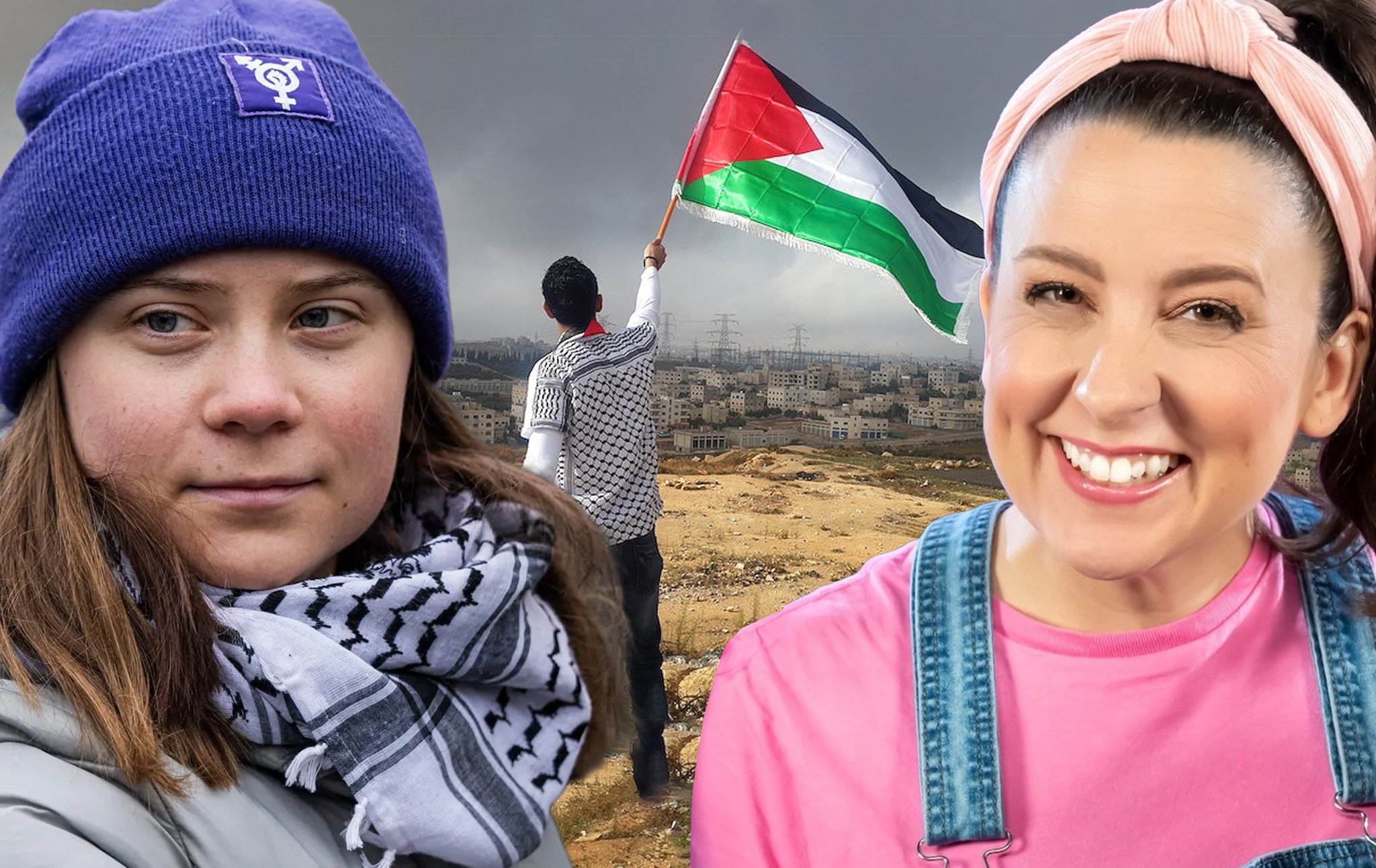
They could have “stayed in their lane.” But they couldn’t stand by and silently watch the destruction of Gaza.
Climate is not an easy issue to be an activist on. You’re taking on some of the world’s most powerful corporations, contending with a culture of widespread indifference, and going up against endless propaganda reassuring people that global warming will simply turn the Earth into a lush tropical paradise. There is plenty of repression, but advocates for Palestinian rights face demonization as terrorists and antisemites, blacklisting, and are even criminalized. So when the world’s most well-known climate activist, Greta Thunberg, expanded her focus to include Palestine, she must have known she would incur a wave of new hostility. But Thunberg has not just spoken up for Gaza, she has put her body on the line, and has been arrested and abused by the Israel Defense Forces after trying to carry humanitarian aid to Gaza aboard the Global Sumud Flotilla.
This past week, Thunberg was arrested in London for holding a placard that said “I support Palestine Action prisoners. I oppose genocide.” Yes, you read that correctly. In Britain, free speech does not exist for Palestine activists. The U.S. may have serious problems with censorship and repression, but Britain has gone truly Orwellian. It has banned the Palestine Action group as a “terrorist” organization, because Palestine Action has used minor vandalism as a tactic and one of its members has been accused of assaulting a police officer who tried to arrest them. None of that amounts to “terrorism,” and one should note that it pales next to the actual terrorism being meted out on the population of Gaza, with the aid of the British government. Being part of or supporting Palestine Action is “a serious criminal offense punishable by up to 14 years in prison.” This was “the first time in modern British history that a protest group that does not call for violence against people had been labeled a terrorist organization,” and thousands of people have now been arrested for holding signs (i.e., exercising the right to free speech) supporting the group.
Note that Thunberg’s own sign specifically said she supported Palestine Action prisoners, many of whom are on hunger strike “for better conditions in prison, rights to a fair trial, and for the UK to change a July policy listing the movement as a ‘terror’ group.” The mere act of showing solidarity with the prisoners was considered a crime, even though Thunberg’s sign says nothing about whether she endorses Palestine Action’s specific methods. That doesn’t matter, because under British law, you can be punished with prison if your actions merely “arouse reasonable suspicion” that you support a “proscribed” organization. The policy is outrageous, an even more blatant government ban on protest than anything seen in the U.S.
In Thunberg’s expansion of her activism to include Palestine, I am reminded of Dr. Martin Luther King Jr.’s decision to speak out against the Vietnam War. Dr. King faced an agonizing dilemma, because he knew that antiwar activism might distract from the fight for racial justice, and that his stance would alienate some Cold War liberals who were supportive of his civil rights agenda. The New York Times was scathing of King’s stance on Vietnam. As King’s biographer David Garrow writes, the “Times called Dr. King’s remarks both ‘facile’ and ‘slander.’ It said the moral issues in Vietnam ‘are less clear-cut than he suggests’ and warned that ‘to divert the energies of the civil rights movement to the Vietnam issue is both wasteful and self-defeating.’” Even many allies in the Civil Rights movement thought that King was making a mistake. But King felt that the moral issue was too important for silence to be an option. Likewise, Thunberg has said that the issue of genocide simply demands action from all of us:
There is a genocide going on in front of our very eyes, a live-streamed genocide[…] No one has the privilege to say we are not aware of what's happening. No one in the future will be able to say we did not know[…] We cannot take our eyes away from Gaza, from all the places of the world that are suffering, living on the forefront of this business-as-usual system: Congo, Sudan, Afghanistan, Gaza and many, many more[…] What we are doing is the bare minimum. I will never comprehend how humans can be so evil. That you would deliberately starve millions of people living trapped under an illegal siege as a continuation of decades of oppression and apartheid.
Sure enough, the choice to take a consistent moral stand in favor of human rights has created backlash. Thunberg has been labeled an antisemite, media outlets that once called her an “icon” have gone silent, and she has been accused of betraying the climate movement (a ridiculous argument, not only because activists can champion two issues at once, but because the carbon footprint of Israel’s relentless bombing dwarfs that of entire countries). One can hear echoes of the criticism of Dr. King’s Vietnam stand when reading Forbes admonish: “her sharing controversial political opinions that only serve to alienate entire demographics, while not advancing an environmental cause, only weakens her ability to advocate and harms the overall climate change movement.” But Thunberg feels that she has a moral obligation to use the profile she has built as a climate activist to speak out against human rights abuses.
The popular children’s educator and YouTube star Ms. Rachel has taken a similar position. She, too, built a public profile in an area entirely unrelated to Palestine. But she has become an outspoken advocate for the children of Gaza, featuring many of them on her show and refusing to work with anyone who has not condemned Israel’s destruction of Gaza. For this, the organization StopAntisemitism called her one of its “Antisemites of the Year” and she has been deluged with hateful comments (notably missing from the list of finalists was actual Nazi Nick Fuentes, who lamented the snub). Earlier this year, StopAntisemitism even urged the Attorney General to investigate Ms. Rachel. Some of the anonymous comments about her online are truly unhinged; I saw her being accused of “stochastic terrorism against Jews.” Her pro-child sentiments are, according to some, a form of “Hamas propaganda.” What kind of propaganda? Well, for instance, writes Glamour, she “posted a video of herself singing toddler favorite ‘Hop Little Bunnies’ with Rahaf, a 3-year-old double amputee who lost her legs in an airstrike.” Ms. Rachel explained that she’s not trying to take an ideological stand, merely trying to show consistent compassion for children who are suffering: ‘My deep care for children doesn’t stop at any border. And I saw these human rights violations, and I had to speak up, because I—it’s who I am. That’s who I am as Ms. Rachel. I love all kids.’”
For some, that’s the problem. Alex Zeldin, a columnist for the Forward, blamed Ms. Rachel for having “narrowly fixated on kids in a war and removed all other context” and said that her fans “hate Jews.” (He later deleted the tweet.) Ms. Rachel, then, didn’t appreciate the context of Israel’s killing of multiple children every day in Gaza. She was just “narrowly fixated” on their well-being, and therefore doing the work of Hamas. This criticism, ludicrous as it is (a renowned children’s educator is fixated on children), highlights something important, which is that if we apply some basic humane principles consistently, we are often taken to politically “radical” conclusions. If you believe that no child deserves to lose their limbs in an airstrike, you will end up a fierce critic of U.S. foreign policy under both Democratic and Republican administrations. Ms. Rachel does not appear to have much of a political identity beyond loving all children, but to sincerely love all children means opposing war, and opposing war means taking on some of the most powerful governments in the world.
Along with Dr. King,I am reminded of Dr. Benjamin Spock, “America’s favorite baby doctor.” A pediatrician and author of bestselling parenting guides, Spock became an antiwar activist in the 1960s, against both nuclear proliferation and U.S. policy in Vietnam, and was ultimately arrested and convicted for encouraging draft resistance. In the opening chapter of Dr. Spock on Vietnam, titled “Babies of Vietnam,” he draws a link between his work as a pediatrician and his antiwar stance:
The death of a child is our worst fear as mothers and fathers. Parents and doctors have worked hard together to reduce the hazards with new vaccines, antibiotic drugs, other health and safety measures. Today the chances of a one-year-old dying before the age of 21 are less than one in 60. Is anyone optimistic enough to think that the risk of nuclear destruction is as small as that? Today the greatest danger by far to the lives of our children is thermonuclear war[…] Some people say that because doctors and parents are not experts on foreign and military policy they should keep out of it. Nonsense. Democracy depends on citizens informing themselves and using their influence.
“People have said, ‘You've turned your back on pediatrics,’” Spock would later comment. “I said, ‘No. It took me until I was in my 60s to realize that politics was a part of pediatrics.’”
It would have been easy for these figures to avoid taking controversial stances, to “stay in their lane” and stick to what they were known for. Dr. Spock had become rich from his hit child-rearing books, and his activism would lead him into multiple arrests. But seeing the suffering of some of the world’s most deprived people at the hands of a devastating military machine (as was true in both Vietnam and Gaza) moved them to act.
I think both Thunberg and Ms. Rachel would be the first to say that they themselves should not be our focus, and do not deserve excessive praise. We should keep our eyes on Gaza, including on the brave Palestinian journalists who report from there, many of whom have been murdered, like Anas al-Sharif. We should focus on those who languish in Israeli (and British) prisons, and celebrate those like Mahmoud Khalil who are actively risking their personal freedom. Ms. Rachel and Greta Thunberg are comparatively privileged and wealthy white women, who are comparatively well-protected. They are nevertheless significant, and worthy of note, because they chose the path of solidarity. They are not Palestinian, and had nothing to gain from joining the Palestinian cause, but were moved to act out of sheer moral conviction. They show us what it looks like to take your principles seriously. And their choice makes it obvious how many celebrities are making the opposite choice, choosing to stay silent, to avoid comment, refusing to risk rocking the boat or jeopardizing their careers by taking “controversial” stands. As Thunberg says, what she is doing is really the “bare minimum.” So why can so few manage even that?

%20(1).png?width=352&name=obrien-trump%20(1)%20(1).png)